The Queen After Ten Thousand Years
10 thousand years after the last pharaoh was entombed, the some of kings and queens of ancient Egypt awaken but exactly as they promised, cloned from ancient DNA a product of generics — the great queen rebuild her lost kingdom into a vast technological super-empire spanning most of the world.
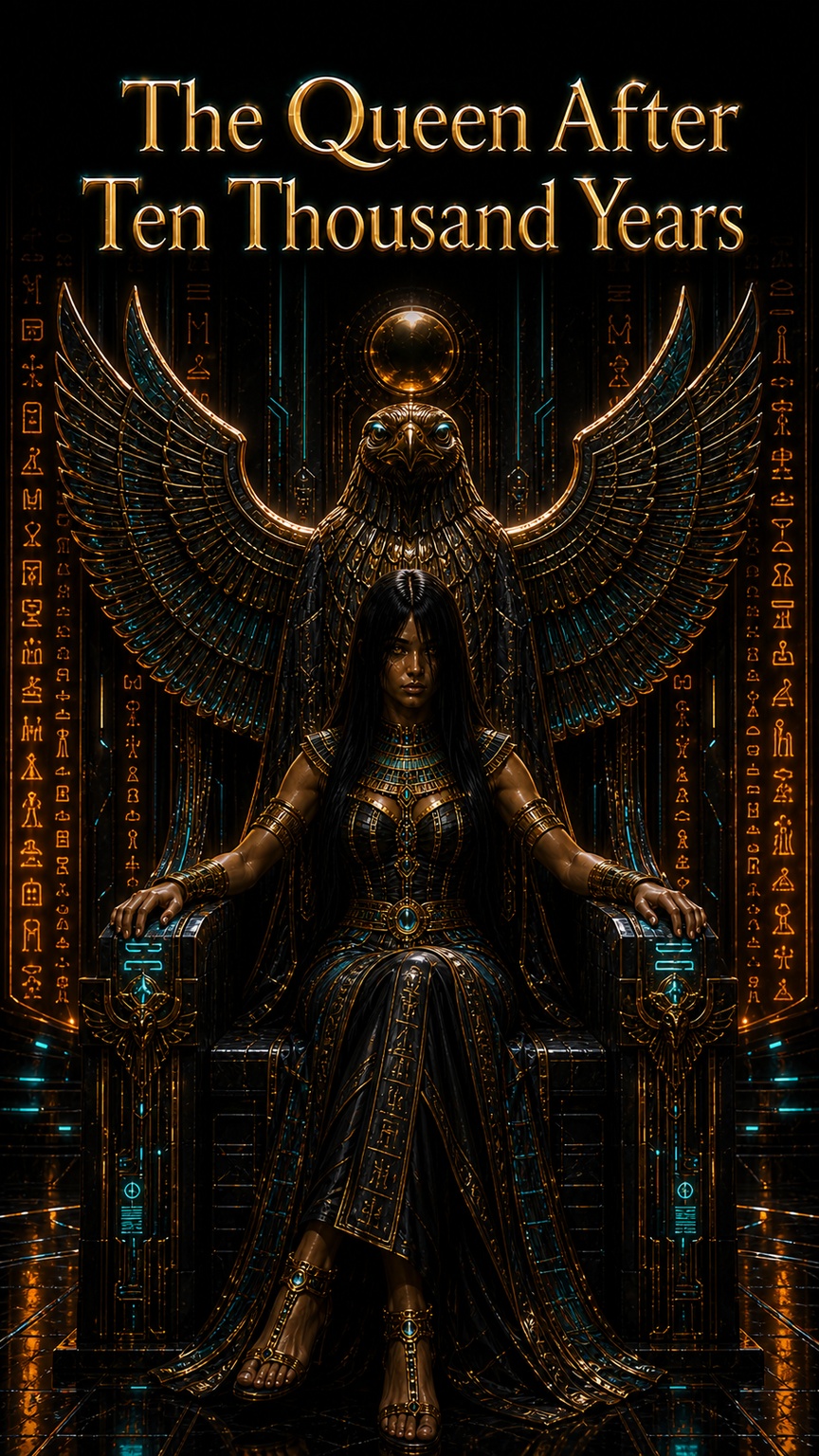
The first thing Merneith knew was that the gold was wiring.
It climbed the black wall in bright, branching channels, entered the spread feathers of a solar falcon, and vanished beneath the stone couch where she lay. Turquoise coolant ticked through glass capillaries under her palms. Everything had been made to resemble a tomb by people who did not believe in tombs.
She sat up too quickly. The room tipped. A woman caught her by the wrist, laughed once, and let go when Merneith stiffened.
“Good,” the woman said. “You dislike being handled. They will be disappointed.”
Merneith knew six languages, three systems of orbital mechanics, the chemistry of the coolant, and the probable century of her own death. She remembered lessons delivered across the accelerated years of her body’s growth: diagrams, rehearsals, arguments with patient tutors. She remembered no husband, no son, no First Dynasty court. The life pieced together from seals, tomb goods, and later scholarship was a house whose foundation plan she had studied from outside.
According to every instrument, she was a clone made from ancient DNA: surviving sequence where the fragments allowed, modeled genes where decay had erased them. No instrument could call her the woman who had died.
The woman beside her wore gray laboratory cloth. Her shaved head made the long planes of her face severe. She looked familiar because Merneith had been taught the surviving statues.
“Hatshepsut,” Merneith said.
“That is what they hope.”
Beyond the glass wall, geneticists and custodians watched without pretending not to. One held a ceremonial collar on a cushion. Another held a museum contract.
Merneith looked down at herself. Adult hands. Fine scars where growth monitors had entered the skin. Black hair, still damp, falling almost to her waist. “How long?”
“Since the last pharaoh was put under stone? Ten thousand years, give or take the arguments. Since they pulled your viable sequences out of a tooth and began filling the gaps? Nineteen.”
“I am nineteen?”
“Your bones disagree. Your opinions will have to catch up.”
Merneith swung her feet to the floor. The technicians had warmed the stone, an unnecessary kindness she resented because it worked.
“Did you wake with memories?” she asked.
Hatshepsut shook her head.
“Did any of them?”
“No.”
Merneith pressed two fingers to her brow, absurdly searching for a seam. Nothing opened. She had expected nothing else. She had been taught the limits until she could recite them under sedation: genes could rebuild a body within tolerances, not retrieve a vanished mind; resemblance was not recollection; the missing portions of a genome were estimates, not revelation. Still, a person might be reasonable and disappointed at once.
On the wall, a translation of an ancient burial promise glowed above the observers: the name enduring, the body renewed, the ruler joining eternity. The laboratory had used it in every funding appeal.
“They call it the Return of the Sovereigns,” Hatshepsut said. “Until one of us complains. Then they call it the Heritage Genome Initiative.”
“Which did you choose?”
“Hatshepsut. For now. It opens doors, and I like the shape of it.” She folded her arms. “They cannot give it to you. That part is yours.”
The glass door opened. A custodian entered with the collar and a smile disciplined by months of rehearsal.
“Your Majesty,” he began, in reconstructed court Egyptian.
His vowels were dreadful. Merneith knew that because her tutors disagreed about them.
She glanced at the contract. Six years of appearances in the Giza Renewal Vault, supervised interviews, approved clothing, no political endorsements. Beyond the custodian, the observation gallery held the silhouettes of donors who had purchased the privilege of seeing history blink.
“Show me the Nile,” she said.
The custodian faltered. “The orientation sequence—”
“A map will orient me.”
The wall abandoned the funeral promise. A river appeared, narrowed by drought works and studded with the lights of quarrelling city republics. There was no Egypt on the political layer. The name survived only on archaeological zones, commodity brands, and the laboratory beneath her feet.
Merneith touched the nearest light. It opened into water prices, ration hours, power losses, a municipal appeal unanswered for eleven months. The figures were new to her and instantly intolerable.
“How long has it been divided?” she asked.
“Which time?” said the custodian.
Hatshepsut snorted. Merneith looked at her, and the other queen tried unsuccessfully to make her face innocent.
“I choose Merneith,” she said. “Let the historians keep their question marks. The name is mine.” She lifted the ceremonial collar from its cushion and placed it around her own neck. It was too heavy and one clasp pinched. “Now show me who owns the pumps.”
Her second throne had wheels.
It rolled along the half-built audience hall in Alexandria on a magnetic track while welders worked above the petitioners. Black composite columns rose around old blocks of limestone too damaged for any museum to want. Gold conductors ran openly along their sides. At the far end, the wings of a solar falcon spread thirty meters across the wall, each feather a heat exchanger feeding the district grid.
Merneith had ordered a fixed throne. Hatshepsut had put it on the track so construction crews could move her out of the way.
“Symbolism should be useful,” Hatshepsut said when challenged.
“It symbolizes that my chief builder is insolent.”
“And mobile.”
Four years after the Vault, the river cities had not so much bowed as discovered that Merneith’s power contracts used the same junctions as her water contracts, and both improved when councils stopped charging one another at every boundary. She had bought failing solar fields, repaired desalination mouths, and linked them to a single Nile spine. Cities joined because the lights stayed on. They stayed because neighboring cities had joined first.
This was not the return she had been promised. It was better. A dead queen could only be admired. A living one could make herself difficult to remove.
She dismissed three tariff petitions and opened the route survey for the southern conductor. A straight gold line crossed the map.
Hatshepsut reached over her shoulder and bent it east with two fingers.
“Put it back,” Merneith said.
“There are houses there.”
“The survey says scrubland.”
“The survey is nine years old. I went.”
“You went?” Merneith disliked how childish the question sounded.
Hatshepsut enlarged the ground image. Courtyards clustered under patchwork shade. A child had drawn blue fish on a cistern. The new line curled around them and cost an additional eleven days.
“Straight lines are excellent for dead kings,” Hatshepsut said. “Nothing moves into them.”
The petitioners heard. One covered a smile with both hands.
Merneith restored the curved route. “Twelve days,” she said, because yielding eleven would look affectionate.
“Cruel woman.”
“You may spend the extra day apologizing to the survey office.”
Hatshepsut leaned against the throne, close enough that their shoulders touched. She had taken to growing her hair and cutting it again whenever sculptors settled on a likeness. She accepted no title longer than her name. Merneith had offered her First Royal Builder, Co-Sovereign of the Two Banks, Beloved of the Renewed Sun. Hatshepsut had asked whether any came with better boots.
Their arguments became part of the court’s machinery. Merneith pushed until Hatshepsut showed her what would break. Hatshepsut repaired what Merneith refused to abandon. Between them, the Nile spine reached the sea.
At night the solar falcon shone over Alexandria, each feather carrying more current than the Giza Vault had consumed in a year. People began stamping Merneith’s profile on batteries without permission. She sued the first manufacturer, licensed the second, and bought the third.
When the last river council signed the union charter, Merneith removed the wheels from her throne.
Hatshepsut kept them in her workshop.
Ramesses woke in the twelfth year of the New Egyptian Empire and spent his first public morning arguing about furniture.
“Equal height,” he told the attendants. “The historical record is unambiguous.”
“It is not,” Hatshepsut said.
“My building program alone—”
“You have not built anything. You have been awake for eight days.”
He turned to Merneith. He had the broad face reconstructed from the mummy and the immense confidence reconstructed from everything else. “Great Queen, I speak of precedence.”
“You speak of six centimeters.”
“Six visible centimeters.”
Merneith let the attendants raise his chair. They had gathered beneath the completed falcon in Alexandria, where warm light moved through its gold veins and turquoise fluid carried heat toward the night farms. Beyond the palace, aircraft lifted silently from the harbor. Above them, the first Egyptian mirrors were opening in orbit.
A petitioner waited inside the throne map, transmitted from a drought-struck coast beyond the western desert. Wind tore at his robe. Behind him, a salt storm had turned noon brown.
“We need nine rainfall towers,” he said. “Your physicians too, if the fever crosses the camps. We are not asking for soldiers, flags, or a queen.”
“He asks for weather,” Hatshepsut murmured as Ramesses drew breath.
“Weather has always been strategic ground,” he said.
The petitioner squinted at the three of them. “Is that one new?”
Ramesses sat straighter on his elevated chair.
Merneith concealed her pleasure. “The towers require orbital mirrors. The mirrors require defended ground stations. I will not place Egyptian crews beyond Egyptian law.”
“Then sell us the machines.”
“You cannot maintain them yet.”
“Teach us.”
That was the dangerous answer. Merneith admired him for finding it.
She offered a twelve-year compact: shared courts for the stations, local command beneath an Egyptian shield, physicians without charge, engineers paid by both governments. At the sixth year, a vote. At the twelfth, another. She made the words sound temporary and the power sound immediate.
“And if we vote you out?” the petitioner asked.
Merneith looked at the brown sky behind him. “Then you will know how to keep what we build.”
Hatshepsut looked at her. Not disbelief. Worse: measurement.
The compact passed. Then three more did. Ramesses took command of the shield fleet after making Merneith repeat before the court that he served as a king in alliance, not as a general in obedience. She repeated it. He heard what he needed and became magnificent in battle.
There were battles. The old states did not vanish because Egypt had better pumps. One bomb opened the western spine and left eight million people counting the hours in their cisterns. Ramesses broke the blockade without burning the cities behind it, though he complained that restraint made poor relief sculpture. Merneith used the victory to bind eleven governments into a water league. Hatshepsut used it to force redundant channels into every later design.
At the compact’s twelfth year, the coast voted to leave.
The throne map put the result in Merneith’s palm. Fifty-two percent. The ground stations now protected three neighboring territories, two of which had joined the empire, and the rainfall towers fed reservoirs across every border. Withdrawal would darken the shield for thirteen minutes and leave the eastern basins dry by the next summer unless Egypt built a separate lattice.
Merneith postponed the vote’s effect until that lattice existed.
“There is always another lattice,” Hatshepsut said in the empty hall.
“There are people beneath it.”
“Yes. That is why it works.”
Ramesses paced between their thrones. “They accepted protection. They used our blood to defend it.”
“It was mostly machines,” Hatshepsut said.
“I am speaking as the Usermaatre Setepenre, Sovereign of—” He stopped, jaw working. Humiliation made him reach for titles as if one might contain the sentence he had lost. “They cannot spit us out when the wells fill.”
“That,” Hatshepsut said, no humor left in her, “is not better.”
Merneith approved the postponement. She also funded the separate lattice at triple speed and forbade Ramesses to occupy the coast. None of them called this consent. None of them found a clean way to keep the shield up without making departure expensive.
The coast left nineteen months late. Its neighboring territories did not.
At twenty years, Merneith’s throne faced east.
At thirty-two, it faced the entire Earth.
The map changed faster than the regalia. Gold entered the northern ice cities by treaty, the eastern island belts after a cyclone season, the inland federations behind Ramesses’ shield ships. Turquoise marked water and medicine. By forty years the colors touched across three oceans, and the New Egyptian Empire governed more human beings than all the states beyond it together.
Merneith crossed it in ceremonial aircraft whose wings echoed the falcon at Alexandria. She opened genomic clinics where children stopped inheriting the poisons of ruined soil. She watched autonomous foundries raise black towers from desert glass. In one mountain city, people threw apricots instead of flowers and stained her gold mantle orange. In another, they turned their backs because an accession governor had taken grain for a launch rail. She removed the governor and kept the rail.
The other sovereigns awakened one by one. A young king accepted his ancient name, served six months, and left to repair fishing craft under the number from his birth room. A queen whose face existed on ten thousand banners refused to look at any of them; Merneith gave her a house where the walls held no screens. Two rulers joined Ramesses. One became a composer. None remembered Egypt.
Merneith made their freedom a law and their faces a pageant. The contradiction bothered Hatshepsut more each year.
“You let them go,” she said once, “and then project their empty chairs behind you.”
“The chairs are historical.”
“The emptiness is current.”
Merneith’s hair remained black long after the first silver appeared, thanks to an indulgence so minor she refused to be ashamed of it. Her hands would not cooperate with the same vanity. Veins rose beneath the skin. The imperial rings had to be widened twice. In audiences, she learned to keep one hand open over the map so its tremor became command.
Fewer people entered the room unfiltered. Petitions arrived cut to ninety seconds, then forty. Governors learned that one weeping child survived compression better than a thousand figures. Merneith knew this and still remembered the children.
Hatshepsut alone walked in without being announced. She brought broken components, unflattering reports, fruit with bruises. Sometimes she sat on the lowest step of the throne and read while Merneith ruled most of the world. Sometimes she disappeared for a year to build something too ordinary for court notice.
Merneith never asked her to stay.
Sixty years after Merneith opened her eyes, the last great accession unfolded above the Giza Renewal Vault.
The equatorial republics had signed at dawn. Their votes gave Egypt an unbroken planetary energy exchange and put nearly four people in five beneath the double crown. Celebrations filled the approaches to the pyramids, but deep underground the Vault remained cool and nearly silent. The old viewing gallery had been removed. In its place stood three thrones beneath the winged falcon: Merneith’s at the center, Hatshepsut’s and Ramesses’ one step lower.
Merneith had ordered the tableau for the noon transmission. One timeless royal house. Ancient promise, modern dominion. The words had tested well in seventeen languages.
Ramesses inspected his chair. Age had thickened him and softened none of his sensitivities. “One step.”
“It is a shallow step,” Merneith said.
“It is photographed from below.”
“Everything is photographed from below when I commission it.”
He almost smiled. Then he saw Hatshepsut had not dressed for the transmission.
She wore gray work cloth like the day of Merneith’s waking. Her hair was cropped close again. On the center throne lay the museum contract Merneith had refused, its old surface crazed with age.
“Where did you find that?” Merneith asked.
“The wheels were in the same cupboard.”
“What do you want?”
“To leave before noon.”
Ramesses looked from one woman to the other. “Leave the room?”
“The court.”
“Today?” His offense was almost tender. “We have just acquired the world.”
“Most of it,” Hatshepsut said. “Do try to leave someone unconquered. It gives the maps texture.”
“Hatshepsut,” Merneith said.
The joke died. Hatshepsut slid the contract toward her.
“They grew us, dressed us, and arranged us in this room so strangers could see the dead agree with them. You walked out. I helped you walk out.”
“You helped me build.”
“I did. I chose it. Then I chose it again. That does not make every next choice yours.”
Ramesses touched the back of his throne as if steadying it. “You carry office. There are oaths.”
“My office expires in nine days. She wants me to renew it on camera.”
Merneith had prepared concessions: a five-year term instead of life, independent budget, veto over new accessions. Each one sounded smaller in the Vault.
“You could have told me before the chairs were installed,” she said.
“I have told you for thirty years. You hear engineering beautifully.”
Merneith turned to the falcon. Its glass channels carried the same turquoise pulse she had seen on waking, though every pump behind them had been replaced. Above its bronze head, a dark mirror reflected the three rulers without flattering any of them.
The transmission director signaled from the doorway: six minutes.
“If you leave now,” Merneith said, “they will make it a repudiation.”
“It is a refusal.”
“They will not preserve the distinction.”
“You own most of the transmitters.”
There it was, the old abrasive confidence that Merneith could fix any material difficulty, and beneath it the request Hatshepsut would not make: do not make me escape you.
Merneith wanted her face on the right of the throne. Not because the republics required it; their signatures were already sealed. Not because the empire would fracture; it had learned to survive worse things than honesty. She wanted one witness from the impossible morning who could look at all this and call it a return. Ramesses believed because belief enlarged him. The crowds believed at a useful distance. Hatshepsut knew exactly what had been absent from Merneith’s first breath.
“Say it once,” Merneith said. Her public voice had entered the room without permission. “Say you recognize what I have restored.”
Hatshepsut’s mouth tightened. “I recognize you.”
It was not enough. It was the only answer Merneith trusted.
The director raised five fingers.
Merneith removed Hatshepsut’s nameplate from the right-hand throne. The magnetic catch resisted, then released with a hard little snap. She handed it across.
“Your transport?” she asked.
“Waiting.”
“Of course it is.”
Hatshepsut put the nameplate into the pocket of her work coat. For the first time that morning, she looked uncertain. She reached toward Merneith’s hand, changed her mind, and touched two fingers to the old contract instead.
Then she left by the same door through which the custodians had once entered with a collar.
Ramesses watched her go. “What shall I tell the court?”
“That Hatshepsut has resigned.”
“They will ask whether she remains Hatshepsut.”
Merneith looked at him until he glanced away.
The noon transmission showed two sovereigns beneath the falcon. Hatshepsut’s empty throne remained outside the frame. Merneith accepted the equatorial republics into the New Egyptian Empire. Orbital mirrors flashed in sequence over most of the Earth; deserts lit under solar wings; water moved through continental arteries whose first crooked segment still bent around a cluster of houses south of the river. In the square above, millions spoke her chosen name.
Afterward she returned alone to the Vault. The floor carried the warmth of machines through her thin soles. Someone had removed Hatshepsut’s throne. Merneith sat in the central chair and let her old hands lie where they pleased.
Ramesses appeared at the door without attendants, crown, or visible grievance. He stood there long enough to lose the sentence he had prepared.
“Great Queen,” he said at last. “May I have a private audience?”
The remaining chair was still one step lower and several meters away. Merneith released its floor catch, took the gilded arm in both hands, and dragged it up the shallow rise until it stood beside hers.