
The daughter has the shears, and her father wants them back.
They stand on opposite sides of a length of scarlet silk lined with black linen. He has embroidered the royal bird across it, each feather edged with gold. She has put her cutting hand beneath the silk, where he cannot safely snatch at it.
“I need them,” she says.
“Then get the little ones.”
“These will be quicker.”
Something in her voice makes me slow my shuttle. I have followed this family through seven generations, and this daughter usually tells her father what she thinks of his plans before he has finished explaining them. Today she keeps her answers short. He has mistaken her quietness for the beginning of surrender. I know that because he starts telling her where the little shears are kept.
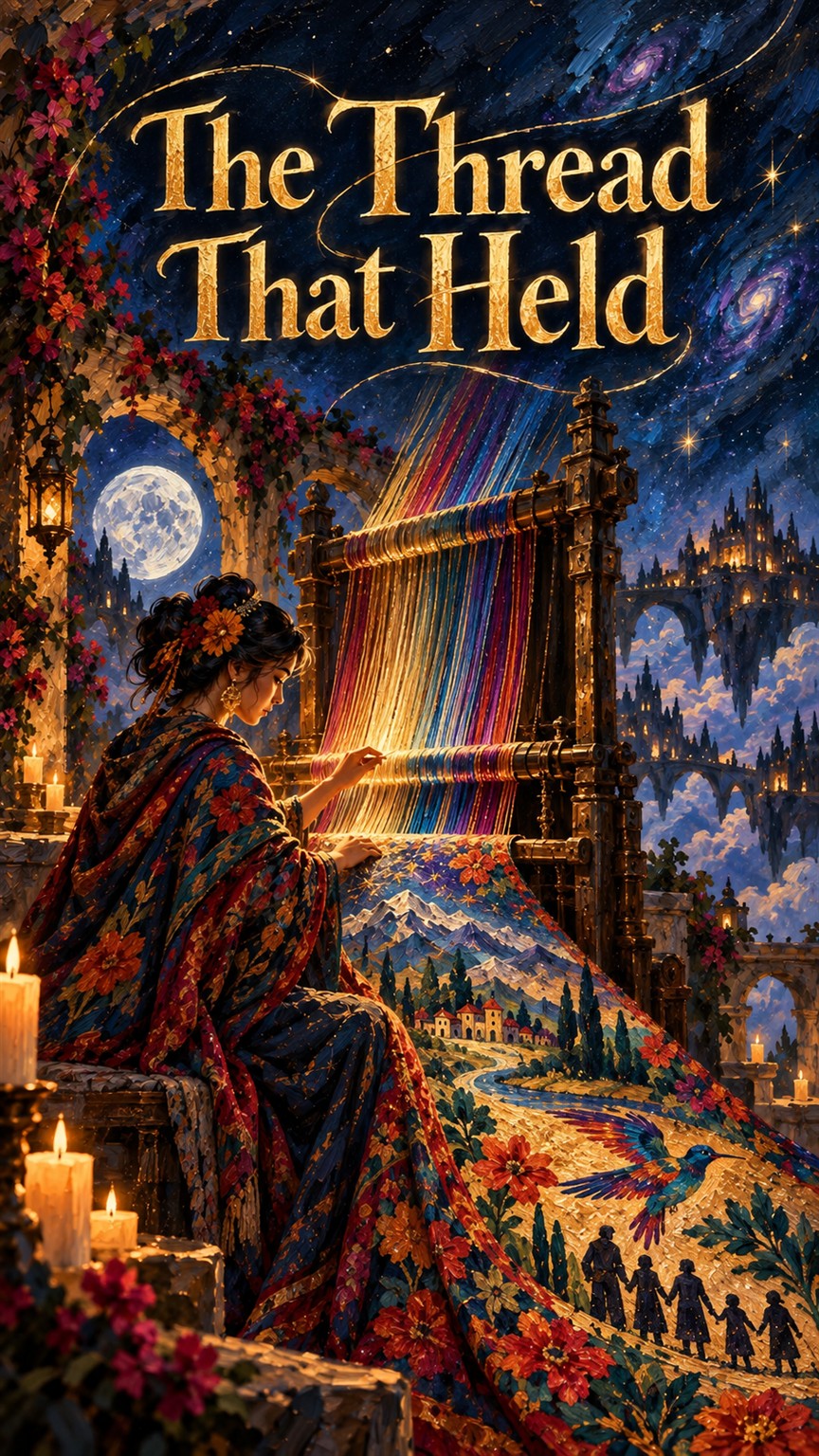
I settle the gold thread across my loom. Beneath it, summer spreads through the city's orchards; a line of houses catches the afternoon light. My hands keep the many influences of the world in relation, making cloth of seasons, settlements, lives. I remember no first morning at this work, no time before the loom. The people in it supply their own difficulties. I cannot make the daughter hand over those shears, any more than I can persuade an apple tree to be a sonnet.
On the brass crosspiece beside my knee, I keep a flower painted by a child who has been dead for nine hundred years. The flower is rather good.
You can see why I get behind.
Yes, you, reading. The gods who are about to arrive will not hear that. Nor can you call into the workshop and suggest a solution. I have tried leaving room for answers. What comes through is the particular silence of someone elsewhere, attending.
Four shadows fall across the cloth. I look up before their owners can complain that I have made them wait.
Orsivet is already drawing his chair closer to the loom. The chair is mine; I put my foot on its lower rung. Vaulenne settles on the bench instead, breathing hard, and asks whether I have anything she can put behind her back. I give her a cushion embroidered with a city that no longer exists. Dembrel remains standing. Irthess, last through the door, closes it against the stars.
“Have you agreed?” I ask.
“Two each,” Irthess says. “You must settle it.”
Orsivet gives the chair a small, unsuccessful tug. “After hearing us.”
I release it. He sits with the dignity of a man who has never had to put away a cushion.
They have come to decide whether to end an Era. In the kingdom under my hands, four great protections have become so tightly interwoven that withdrawing them together would bring down more than the dynasty. The king's armies, the grain caravans, the towns beyond the passes: everything grown dependent upon those protections would begin to fail. Irthess and Dembrel propose withdrawing. Vaulenne and Orsivet refuse. For this undertaking, and this undertaking only, the four have agreed to abide by a fifth voice.
They have chosen me because I remember the last collapse.
Unfortunately for them, I remember other things as well.
Irthess lays a packet on my worktable. When he unties it, a smell of smoke rises from the linen. Inside are folded scraps, some written on both sides, one with a child's arithmetic showing through beneath a petition.
“Thirty-one executions this morning,” he says. “The families left these in my temple. They're still waiting outside.”
“For burial?”
“For the bodies. The king is keeping them until someone names the others.”
Through the cloth I hear the banner maker saying, “We've already been paid.” His daughter shifts her grip beneath the silk.
“I went to the palace,” Irthess continues. “They received me in the little court. No chair, no witnesses. He said I could have the bodies when the inquiry was finished.”
Orsivet begins, “He has a right to—”
“Don't.” Irthess looks directly at him. “I know what his rights are. Your priests read them to me.”
The god of sworn obligations smooths his robe over his knees. A murmur follows the movement: at a hundred altars, people are promising things in his name. His face loosens as the prayers reach him. He catches me watching and takes his hand away.
“If we remove the protections,” I say, “the burial grounds become hunting grounds again. You know what nests under those hills.”
“I do.”
“And the people waiting outside your temple?”
He pushes the packet toward me. “Read what they asked for.”
Several beg for a particular body. One asks for the king's death. Another asks that no king ever sit in that palace again. I unfold the arithmetic. Beneath the petition, someone has worked out the price of six measures of flour and reached the wrong answer.
“They haven't all asked for the same thing,” I say.
“No. But none has asked me to keep doing this for another hundred years.”
He rubs his forehead with the heel of his hand. The skin stays creased a moment after he lowers it.
“There have been three uprisings,” he says. “The soldiers swore to the crown before they knew what they'd be ordered to do. Each time, men who wanted to desert found they couldn't pass the barrack gates. Those are your oaths, Orsivet. The king could never hold so many towns with willing soldiers.”
“Release every oath and the towns lose their protection too,” Orsivet says.
“Yes. They would have to defend themselves. Some of them are ready. They have councils, stores, people who could govern without asking his leave.” Irthess looks at me. “I have been there.”
I look for the towns beyond the passes, small knots of brown and ochre along the upper warp. “And the ones that aren't?”
“I don't have a good answer for them.” He draws the loose linen over the petitions, then pushes it back. “But how many more times do I tell the families at my temple to wait?”
Dembrel sets a shoe beside the petitions. It is broad, badly patched, and worn through at the heel.
“The woman who wore that tried the eastern pass,” she says. “Then the western. Then she tried to hide in a wool cart. Three times they brought her back to the estate.”
“Was she bound by debt?” Orsivet asks.
“Her grandfather was.”
“The debt may still have been valid.”
“She offered to pay it. They changed the sum.”
“Then she should have appealed.”
Dembrel keeps looking at him until he says, more quietly, “To my temple.”
“She did.”
He reaches for the shoe, but she leaves her hand on it.
“I'll inquire,” he says.
“You did. They restored the old debt and added an exit tax. Is that forbidden?”
Orsivet says nothing. Behind him, his murmuring robe goes on receiving promises.
I ask Dembrel where the woman is now.
“At home. Her mother can't walk anymore. She won't leave without her.” Dembrel takes her hand from the shoe. “I've kept the passes open for a hundred and sixty winters. The soldiers travel them too. Every time I make a crossing easier, someone puts another guard at the end.”
“There would be guards without you,” Orsivet says.
“Yes. There would. I'm trying to decide whether I can bear being useful to these ones.”
Vaulenne reaches past the shoe for my little cup of barley. I keep grain near the loom to help me set the spacing of harvests; she knows she may take it. She rolls a few kernels in her palm.
“The last time,” she says, “we lost the red kind.”
“We have red barley,” Irthess tells her.
“Not that kind. The one that would ripen on the high slopes. There was a black mark at the base.” She holds out a kernel, discovers that it cannot illustrate her point, and puts it down. “I don't remember what they called it.”
“We can't keep this king because you miss a grain.”
“I'm not talking about the king.”
He looks toward the petitions. She waits until he looks back.
“It was the third year after the fall. Or the fourth. I could bring a mild spring, and I did. There were women in the fields with baskets tied to them. They were gathering everything green. They had eaten the seed the winter before. You can't make a harvest out of a mild spring and no seed.”
“I remember.”
“Do you remember the next spring?”
Irthess opens his mouth, then lets her continue.
“They sowed a little. Too little. Their daughters were old women before the hills were planted again. There was one who used to come to my shrine with a basket. She'd turn it upside down and sit on it. Never asked me for anything after the first few years. Just came and sat.”
Vaulenne tips the kernels back into my cup. Two fall on the floor. She bends for them, and I touch her shoulder to stop her; the bench is narrow and her knee has begun to shake. I pick them up myself.
The last collapse lies wound on the lower beam. I can spread its record beneath my fingers, but I cannot pull it loose and have the years again. Here is a palace made into lime for cottages. Here, a granddaughter grinding ornaments into pigment because the blue mines have been forgotten. Beside that blue runs an absence I still catch my nail in: a language whose final speaker woke one morning without anyone left to scold.
Across other stretches of the cloth, cities went on prospering. Some never learned that this kingdom had fallen. The world has seldom done us the courtesy of ending all at once.
“The first king brought the roads under oath,” Orsivet says. “A traveler could cross six estates under one protection. Before him, every estate could take what it wished.”
“I was there,” Dembrel says. “Before him they took the traveler's mule and her boots, and sometimes the traveler. I helped you post the first guards, and I was glad to.” She looks at the shoe. “I didn't think they'd still be standing there for her.”
“Every market on those roads runs on my oaths.” Orsivet lays a hand on his robe, where the altars are murmuring. “The carters swear, the tolls hold, a widow can send her wool over the mountains with a boy of twelve and be paid for it. Take the oaths away and the guards won't go home. They'll stay where they are and stop answering to anyone.”
Dembrel doesn't argue. Orsivet turns toward me. “You remember the first royal banner.”
I do. Its bird had a crooked beak because the banner maker's ancestor was better at horses. Afterward she bought a shop with her commission. Her eldest son turned its loft into a bedroom, and his wife put a yellow bowl in the window. I watched that bowl break. I watched it glued together, used for buttons, thrown away. The third generation painted the door blue. In the fifth, a boy left to become an actor and came home only twice, both times wearing shoes beyond his means.
There has always been someone at their table who dislikes the way someone else makes the porridge. When the current daughter's mother died, her father kept making it too thin because that was how his wife had liked it. The daughter ate it without complaint for eleven mornings. On the twelfth she took the pot away from him and made it properly, and he cried.
I wanted to see her teach someone else.
Orsivet has found the edge of the family thread. I move his hand away.
“Those commissions fed them,” he says.
“I know.”
“And many others. We can require changes. I can speak to the king about the inheritance of debts.”
Irthess doesn't lift his eyes from the petitions. “You told me that about his father. He lowered the levy on your temple estates, and the villages beside them paid the difference. I have their petitions too.”
Orsivet pulls his chair back. One leg catches my hem. “And the families living on those estates.”
No one speaks for a while. I free the embroidered edge of my wrap. There is barley dust on my fingertips.
Then the daughter cuts into the royal bird.
Her father catches the silk after the blades have passed. The shears make a heavy, almost comfortable sound. She cuts the banner into broad strips, turning it so the bright embroidery will lie inside.
“Stop,” her father says. “Please. That's enough.”
“We need something that won't show in the dark.”
“Who does?”
“You know who.”
He does. He has washed a stranger's blood from her sleeve, once already this year. I watched him do it and allowed myself to believe what she told him about an accident with a knife.
She folds the strips into a pile. She is twenty-three, with dye in the ridges of her left thumb and a burn on her wrist from the porridge pot. Her father holds the severed bird's head.
“They'll close the shop,” he says.
“I'm going tonight. Tell them I stole it.”
“And will they believe me?”
She doesn't answer. The shears hang open in her hand.
Dembrel leans over my shoulder. “Is keeping her home what you want from this vote?”
“I couldn't do that.”
“I asked what you wanted.”
I keep my eyes on the cloth. The daughter has set the shears down, carefully, with their handles toward her father.
You may have reached me after reading some other life in this same world. A different century, a different catastrophe. Perhaps you came straight here. Either way, beyond this story are others; their people do not stop living when your attention turns from them. I can feel some of those far-off lives pulling where our histories touch. That is not the same as knowing what happens next.
You can close this page while the daughter stands beside her father. I am tempted to do the equivalent: follow another family, another thread. There is a wedding just beyond the orchard. Someone has hidden the groom's good coat. I could spend the afternoon there.
“Tapissier,” Irthess says.
I have been silent too long.
“Give me a moment.”
He takes a breath to object, but Vaulenne puts her hand on his sleeve.
I lower my head. The flowers pinned in my indigo hair brush the cloth. Beneath my wrap, gold wings press close along my back; the broken violet crystals of my halo are hidden among the pins. I have worn this disguise so long that the gods believe it is all there is of me.
You should know who is asking for another moment. I am the Astral Valkyrie. When I leave this loom, I sometimes go where shelter has run out. Under those wings I can keep a living person for a little while. If someone offers me a memory, I can receive it. I cannot summon their dead to complete it, or carry a city because I love the view from its windows.
The gods know tales of the Valkyrie. None knows that she has just picked two barley grains from the floor. I do not tell them. Irthess, particularly, would hear a promise in it that I could not keep.
Already I have begun choosing. If the protections go, I will look first for the daughter. Or perhaps her father, who will stay too long gathering work from the shop. At the thought of choosing between them, my wings tighten painfully beneath the embroidered cloth.
I lift my head. All four gods are watching my face.
“If we continue,” I ask Irthess, “what will you do?”
“Get the bodies back.”
“And afterward?”
“I don't know. Go to the families. Ask what they want now.” He looks at the cut banner. “There are people preparing to fight. I may help them.”
Orsivet makes an impatient sound. Irthess ignores him.
“Will your protection cover them?” I ask Orsivet.
“If they swear lawful oaths.”
“The king decides what's lawful.”
“Not in every matter.”
There it is: how little my vote will settle. The king will remain in his palace. The people outside Irthess's temple will still have to wait for their dead. Dembrel's woman will still have a mother who cannot walk, and the officials will have paper enough to invent another fee.
Under my fingers the city's summer holds, imperfectly. I can feel where the contributions of the four gods must be renewed: their living power meeting mine, the little brass hooks warm where I guide it into the warp. I have no reserve that can take their place. If I vote to withdraw, they will release those strands together. If I refuse, they have pledged to keep them through the coming season. We will still have to live with one another after that.
“I vote against withdrawing,” I say. “Keep the protections.”
Dembrel closes her eyes. Orsivet smiles at me, and I look down at the warp.
Vaulenne places her palm against the loom. Warmth enters the seasonal thread, carrying the smell of crushed barley leaves. Dembrel takes longer. Then she presses two fingers to the strand that crosses the mountains, and distant bells sound at a travelers' shrine. Orsivet breathes his undertaking over the oaths already woven there. I feel their pull strengthen, including the ones I wish had never been sworn.
Irthess picks up the loose cord from his packet and puts the end into my hand. His power passes along it as he murmurs the names of the burial grounds under his care. I work the four contributions into the cloth. Summer advances a little beneath the crosspiece. In a prison near the palace, the yard bell rings for the change of guard. A woman lifts her head at it. “Is that for us?” she asks. No one comes to open her door.
My shuttle slows. Irthess notices.
“Is that still your vote?” he asks.
“Yes.”
He finishes naming the grounds.
When it is done, he gathers the petitions. Dembrel takes the shoe. Vaulenne gets up slowly and gives me back the cushion, though I tell her she may keep it.
At the door I catch Irthess by the sleeve.
“If you help them fight,” I say, “don't send that girl somewhere she can't come back from.”
He looks down at the daughter, who is wrapping the silk around her shoulders to test how it hides the red.
“I won't promise she'll come back,” he says. “If she asks for my help, I'm going to give it.”
I let go of his sleeve. He waits, and for a moment I dislike him for waiting. He has accepted my vote; I want him to accept this also. I want his anger to stop short of the little house with the blue door.
“She won't let you finish explaining,” I say at last. “She never lets her father finish. Tell her the danger first.”
He looks at the girl a moment longer. “I'll start with it.”
He leaves with the others. The latch settles into place. I remain standing beside the loom until the ache under my wrap subsides.
In the shop, the banner maker is finding fault with the knot his daughter has tied. He has always found fault with her knots. She lets him loosen this one and pass the end through again, though she watches the window while he works.
“There,” he says.
She touches his wrist. He pulls it away and goes to the back of the shop. I think he means to let her leave without another word. Instead he returns with the little shears, their blades wrapped in a rag.
She takes them. Neither says anything else.
Outside, people are carrying summer fruit home in the dusk. The daughter turns left, away from the market and the orchard, toward a part of the city I have scarcely attended to. She walks quickly. Once she reaches beneath the folded silk to check that the shears are still there.
I draw my stool along the loom to follow her. For years I have watched this family from the same place; now the brass edge presses into an unfamiliar part of my knee. Behind the daughter, the window of the shop grows smaller. Her father has lit the lamp. I can still see him, standing beside the scarlet pieces, but I have to lean farther and farther to keep them both in view.