The Trouble With Tuesdays
You inherited a watch that can rewind any mistake, and you have used it for everything from fallen toast to failed first dates. Seven Tuesdays after your sister's death, the Goddess of Time arrives with an audit: every rescue you overwrote was still a death your sister remembers, and you have one last chance to choose between a better goodbye and letting time move forward.
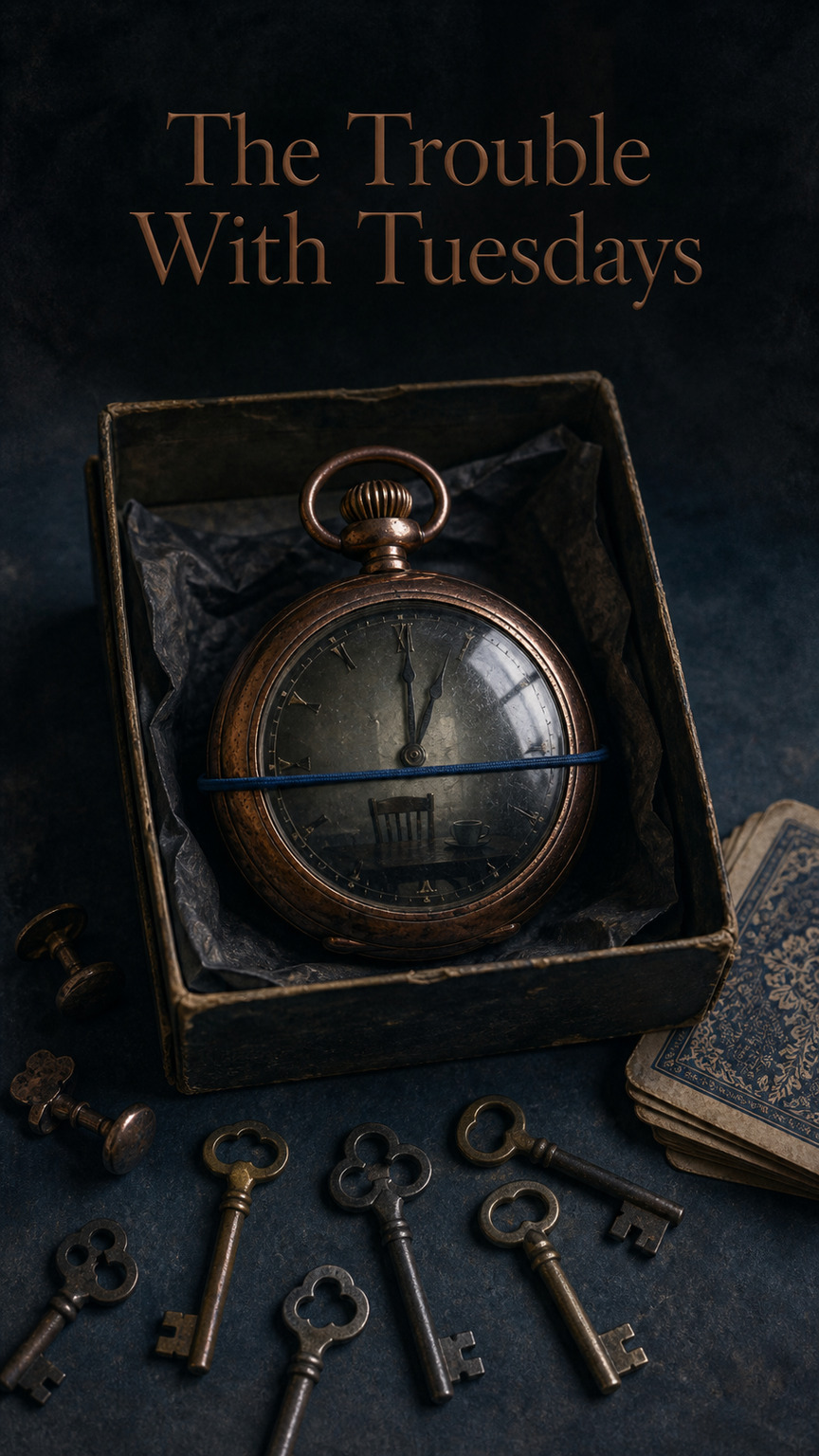
The first time Eli Fenwick used his grandfather’s watch, it was to save a piece of toast.
The watch had come to him on a Tuesday in a shoebox full of effects nobody else wanted: two cuff links, a deck of cards gone soft at the corners, and six keys to locks the family no longer owned. It was copper, scratched across the case, with a stem too large for elegance. Eli had been turning it between his fingers when the toast slipped from his plate.
As it fell, butter-side down, he pressed the stem and thought, No.
The toast rose. Not gracefully. It slapped up from the floor, shed three crumbs into the air, and landed butter-side up on his plate. The crumbs vanished into the bread. The second hand walked backward seven marks and resumed its dutiful ticking.
Eli ate the toast.
The second use gave him nine seconds of a film back after a coughing fit swallowed the punch line. The third rescued Aunt Linda’s novelty mug from the kitchen tiles. Then came dog mess, a pub-quiz answer, and Mara from Hinge.
The date lasted twelve minutes. Eli made it happen five times.
On the first version, Mara asked what he did for fun and he said, “Optimization,” which sounded worse aloud. On the second, he tried “urban exploration,” forgetting she had just complained about trespassers behind her building. On the third, he laughed too early at her joke. The fourth was nearly human. The fifth ended with Mara saying she did not think chemistry could be debugged.
Four presses. Five versions. Twelve minutes each.
He rewound a wrongly sent message and left it unsent. He rescued soup from the rug. He corrected one shut train door, one cuff dipped in coffee, one foolish answer in a meeting, and one coin dropped through a street grate. Fifteen small edits in all, each begun by his living thumb and completed by the faint copper heat that followed.
The world never objected. Sometimes it seemed to hesitate: the taste of coffee lingered after the clean cuff returned, or a laugh felt bruised before the joke had been told. Eli took those sensations for the price of remembering a better draft.
Then April twenty-second happened.
Seven Tuesdays later, someone knocked at eleven by Eli’s phone and ten fifty-five by his kitchen clock.
He had not touched the watch since April. It lay in the bedroom, shut in its shoebox beneath a week of clean laundry he had never put away. He had also not shaved, opened the curtains, or washed the two cups beside the sink. Grief had proved surprisingly administrative.
The woman outside wore a charcoal coat and carried a round biscuit tin.
“Eli Fenwick?”
“Depends who’s asking.”
“The Goddess of Time.” She glanced past him at the clock. “And that is slow.”
He checked his phone. She was right by five minutes.
“You could be a burglar with excellent punctuality.”
“I could. I am not. Put the kettle on.”
She entered without touching him, which was not quite the same thing as being invited. In the kitchen she selected the least offensive chair, set down the tin, and waited while Eli scrubbed one of the cups with his sleeve.
“That one is Aunt Linda’s,” he said when she reached for the mug with the painted flamingo.
The woman inspected it. “Linda has left a formidable material record.”
“You know my aunt?”
“I know the mug. Do try to keep the categories separate.”
She called the biscuits shortbread and laid them in a precise row. Eli brought the watch from the bedroom but did not surrender it. He kept it cupped in his palm on the table.
The Goddess of Time circled one finger above the copper case. She never touched it. Under the motion of her hand, the watch’s three hands moved through a series of tiny reversals, pausing at intervals only she appeared able to read.
“Forty-six activations,” she said.
“That seems high.”
“Toast. Nine seconds at the cinema. The mug. The pavement incident. The quiz. Four corrections to one twelve-minute date.”
“That was research.”
“It was five bad dates wearing one coat.” Her finger continued its circuit. “A message, soup, a train, coffee, a meeting, a coin. Fifteen uses before April twenty-second.”
Eli closed his fingers around the watch. “Nobody was harmed by the toast.”
“The toast has lodged no complaint.”
“Or the film.”
“Nine seconds,” she said. “You keep trying to make duration the same thing as consequence.”
“Nine seconds is practically nothing.”
Her finger stopped. The second hand stopped with it.
“Then we come,” she said, “to the other thirty-one.”
On April twenty-second, Mae had met him outside the central station with a paper bag under one arm and the expression she reserved for her younger brother’s most repairable defects.
“Rose does not need a telescope taller than she is,” she had said.
Rose was Mae’s daughter and Eli’s niece, and therefore someone he considered himself professionally obliged to spoil.
“She said she wanted to see the moons.”
“She also said she wanted a horse in the kitchen.”
They were still arguing at the curb when Eli saw the van.
It had jumped the light. Mae had stepped down without looking because she was turning toward him, smiling despite herself, ready with whatever sentence would have won. The van’s horn began one long, blunt note.
Eli pressed the stem before it reached her.
The city snapped backward. The horn drew itself into silence. A torn receipt leapt from the gutter into a stranger’s pocket. Mae’s last three words returned to her mouth, unheard.
Eli had twenty-two seconds.
The first time, he caught Mae by the shoulders and hauled her away from the curb. The van passed. She twisted free, furious and off balance, and missed the top station step behind her. The sound of the paper bag striking stone stayed with him longer than the sirens.
He held the stem down.
The second time, he planted himself between Mae and the curb. She demanded an explanation. A courier swerved around them, clipped her as she stepped sideways, and sent her into the iron rail. A little bicycle bell rang once after she had gone still.
He pressed again.
The third time, he dragged her back through the station doors. A delivery cart struck a glass panel. Eli remembered the white burst of safety glass, Mae’s hand closing on his sleeve, and rain coming through where the door had been.
Again.
He changed single variables. He told her about the van. He did not tell her about the van. He took the bag. He made her sit. He sent her toward the ticket hall, the side passage, the café, the rank of waiting cars. Every instruction altered the crowded little system around them. Someone braked sooner. Someone else turned. A door opened into a path that had been clear. Mae refused to stay where he put her because Mae had never mistaken his panic for authority.
After ten attempts he stopped using sentences and simply pulled. After twenty, he could no longer remember which warnings she had already heard in a history that no longer surrounded them. Once, she cupped his face and asked what was wrong. He used the precious seconds explaining, and that version ended beneath the station clock while it clicked calmly to the next minute.
Each failure made the moment feel more like a lock. Eli only needed the right sequence: stand here, turn there, wait six seconds, take the northern door. The fact that no sequence worked did not weaken his faith. It made him frantic for a better key.
The first press had come before Mae died. After each of the first thirty deaths, he pressed again and returned to those same twenty-two seconds. His thirty-first press began his thirty-first attempt.
On that last attempt, he did almost nothing. He said her name. He put out a hand. Mae saw his face, stopped at the curb, and stepped back toward him.
The van missed her.
Behind Eli, someone shouted. Mae turned toward the sound. What followed was quick, ordinary, and final enough for the street: a driver looking the wrong way, a hard stop too late, Mae’s paper bag opening across the road.
Eli knelt beside her with the watch stem under his thumb.
He could not make it move.
Not because the watch refused. His hand did.
Thirty-one activations that day. Thirty-one lived deaths. The last was simply the one the city kept.
At the kitchen table seven Tuesdays later, Eli said, “No. There was one death. I remember the others because I was outside the reset.”
The woman lowered her hand. The watch resumed ticking in Eli’s fist.
“The street retained one sequence,” she said. “This watch can overwrite material history. It cannot declare a person’s lived boundary imaginary.”
“Those versions were erased.”
“From the street.”
“Then from Mae.”
“No.”
The word was quiet. It left him nowhere to argue but the truth.
Eli put the watch on the table and pushed it toward her.
“Take it.”
The woman drew both hands into her lap.
“I cannot.”
“You’re the Goddess of Time.”
“That is the title I gave you.”
“Fine. Time. Steal it.”
“I cannot seize it.”
“Ask me to give it to you.”
“I cannot request its transfer.”
“Hint.”
“You have now suggested that I hint, which is not the same as me doing so.”
He shoved back from the table. “Destroy it.”
She looked at the watch as if it were a disagreeable legal document. “Your grandfather won it in a card game from someone he described, unreliably, as a minor saint of bad decisions. He signed a napkin. The transfer was witnessed. Whatever made the arrangement effective bound this object to his living bloodline and barred coercion over its ownership and use.”
“A napkin.”
“Grease stain in the upper corner. Unusually robust work.”
“So the contract outranks you?”
“Here, in this matter, it limits me. I can show you what the watch recorded. I can explain. I cannot make your next choice respectable by making it for you.”
Eli stared at the copper case between them. “Why come at all?”
The woman turned Aunt Linda’s mug so the painted flamingo faced the empty chair.
“Because Mae agreed to three minutes,” she said. “If you can spend them listening.”
The Goddess of Time placed two fingers against the mug’s handle and closed her eyes.
Nothing happened until she breathed out.
Then the kitchen sounds thinned. The refrigerator’s hum seemed to withdraw behind a wall. Steam stopped wandering above the mug and rose in one unbroken thread. The woman’s fingers whitened against the ceramic; whatever opened, she was holding it open herself.
“This is a window,” she said. “Not a copy, not a recording, and not a summons. Mae chose to come to it. She may choose to leave.”
The empty chair gained a shadow.
Mae sat in it.
She wore the blue jumper from the week before April twenty-second, though Eli knew better than to ask what that meant. Her hair tucked itself behind one ear in the old impatient curve. She looked first at the woman, receiving a small nod, and then at Eli.
“You look terrible,” Mae said.
His breath broke on her name. “You’re dead.”
“Still opening strong, then.”
He laughed once, without permission. It hurt so cleanly that he nearly mistook pain for relief.
Mae looked at the row of shortbread. “Did you eat mine?”
“I didn’t know one was yours.”
“There were four, Eli.”
For one second they were themselves again: older sister prosecuting a theft too trivial to matter, younger brother already constructing a defense. Then he noticed how tightly her hands were folded.
“Do you remember?” he asked.
Mae’s smile went away.
“All thirty-one.”
He shook his head. “You couldn’t. You didn’t know between resets.”
“Not while you put me back. Not consciously. After the last one, I had all of them.” She glanced toward the still thread of steam. “I don’t know how much of that is the watch and how much is where I am now. I know they are mine.”
“But the versions—”
“Don’t call me a version.”
The sharpness in her voice stopped him.
Mae opened one hand on the table. “I remember the horn cutting off. I remember the stair rail cold through my sleeve. I remember that ridiculous little bicycle bell. I remember glass in my hair and you saying, ‘Not this one,’ before I understood what you meant.”
Eli’s chair creaked beneath him. “I was trying to save you.”
“I know.”
“I couldn’t just watch.”
“So I had to.”
He looked at her.
“Every time,” Mae said. “I was the one dying. You were the one deciding it did not count because you could try again.”
“I didn’t know.”
“The first time, no. The fifth? The twentieth?” Her fingers tightened. “You knew I was frightened. You knew I was hurting. You decided the result could erase the attempt.”
“I thought if I found the right way—”
“Life isn’t one of grandfather’s locks.”
He glanced at the watch. “I could have found it. Another angle, another minute. If my hand hadn’t—”
Mae flinched.
It was small. A tightening around her eyes, a breath held against what he might do next. Eli had seen her afraid of the van, the stairs, the careening bicycle, the falling glass. He had never seen her afraid of his hope.
He took his hand off the table.
“I’m sorry,” he said.
“I believe you.”
“Can you forgive me?”
Mae looked down at her open palm. “Not in a way that makes this tidy for you.”
The answer landed harder than refusal and kinder than absolution.
“Rose,” Eli said. “What do I tell Rose?”
“You tell her I loved her. You answer when she calls. You let her be angry when she needs to be angry.” Mae’s gaze lifted. “And you do not turn her into another problem you can solve for me.”
The steam above the mug trembled. The woman beside it inhaled through her teeth.
“We have a little less than a minute,” she said.
Panic moved through Eli with the old, familiar logic. A minute could be improved. He could ask where Mae was. Whether she was alone. Whether she had felt him beside her at the end. Whether there was a sentence that would carry the proper amount of love and remorse.
“Mae, wait. I need—”
“No,” she said, and the word belonged wholly to her. “You want one more draft of goodbye.”
He swallowed.
“Stop practicing losing me.”
The refrigerator hummed faintly at the edge of the room. Eli forced himself to stay quiet.
Mae’s mouth bent into its crooked smile. “And if you’re going to serve tea to the dead, buy decent leaves.”
He laughed again, wet-faced now.
Mae turned to the woman. “I’m done.”
The Goddess of Time waited for her nod. Only then did she lift her fingers.
The chair was empty. Steam collapsed across the rim of Aunt Linda’s mug. The refrigerator returned with a shudder, and three minutes had passed.
The woman closed the biscuit tin and stood.
“That’s it?” Eli asked.
“It is what she consented to.”
“And what am I supposed to do now?”
She put on her coat. “My restrictions are tiresome, but occasionally well designed.”
She took the tin with her. The door clicked shut at eleven fifty-three.
At eleven fifty-six, Eli’s phone sounded from the counter.
The reminder on the screen had been set two months earlier: Call Mae about Rose’s birthday.
He sat on the kitchen floor until midnight.
When the date changed, he picked up the watch. The copper warmed against his palm, answering pressure and body heat without whisper, hunger, or will. The stem rested beneath his thumb.
One tap would buy seconds. A firmer hold would buy minutes. He could return to Mae in the chair and begin differently. He could apologize before defending himself. He could leave the shortbread untouched. He could ask better questions. He could say the thing he had failed to invent even now.
The temptation sounded like love because love was inside it. So was the old conviction that care made him custodian of which moments counted.
His thumb settled.
Mae flinched again in his memory.
Eli let the stem rise without pressing it.
Nothing reversed. Midnight continued to become one minute past, then two. The reminder stayed on his phone. The tea cooled. Outside, a late train dragged its iron complaint through the city, going only forward because that was what trains generally did.
Eli found the shoebox. He placed the watch beneath his grandfather’s keys, the two cuff links, a pencil worn down to an inch, and the old deck of cards. He did not smash it. He did not label it. He did not call Rose.
He closed the lid.
The years that followed were not improved versions of anything. They contained missed trains, scorched dinners, graceless apologies, and birthdays on which Rose answered him only after the third call. They also contained school performances, long walks, laughter that arrived at the wrong moment, and grief changing weight without ever becoming unreal.
The box followed Eli through two moves. Sometimes he put it at the back of a wardrobe and sometimes on the highest shelf. He never pressed the watch again. He never told Rose what it could do.
Many years later, on a Sunday, Eli was carrying groceries into his flat when a heart attack narrowed the world without warning. He had time to set down the eggs so they would not break.
He did not have time to think of the box.
Nine days after Eli’s death, on the second Tuesday without him, Rose cleared the top shelf of his wardrobe.
She was grown now. Grief made her feel nine years old.
The shoebox held six useless keys, two cuff links, a pencil stub, old cards, and a scratched copper watch. There was no note. No warning. Only a stem made to fit beneath a thumb.
Rose thought of the eggs lined neatly on his counter. She thought, with the blind force of fresh loss, Take me back to before.
She pressed hard and did not let go.
Her living grip warmed the copper. The hands spun. Nine days tore backward through her, and Rose opened her eyes in Sunday-morning light before the phone had rung.
Elsewhere, the woman who called herself the Goddess of Time paused with a cup halfway to her mouth. She sighed and reached for the biscuit tin.