The Unfinished Sunset
The white-haired ronin returns to the village she abandoned twenty years ago, only to find it trapped beneath the same sunset—and everyone inside still waiting for her to finish the duel she fled.
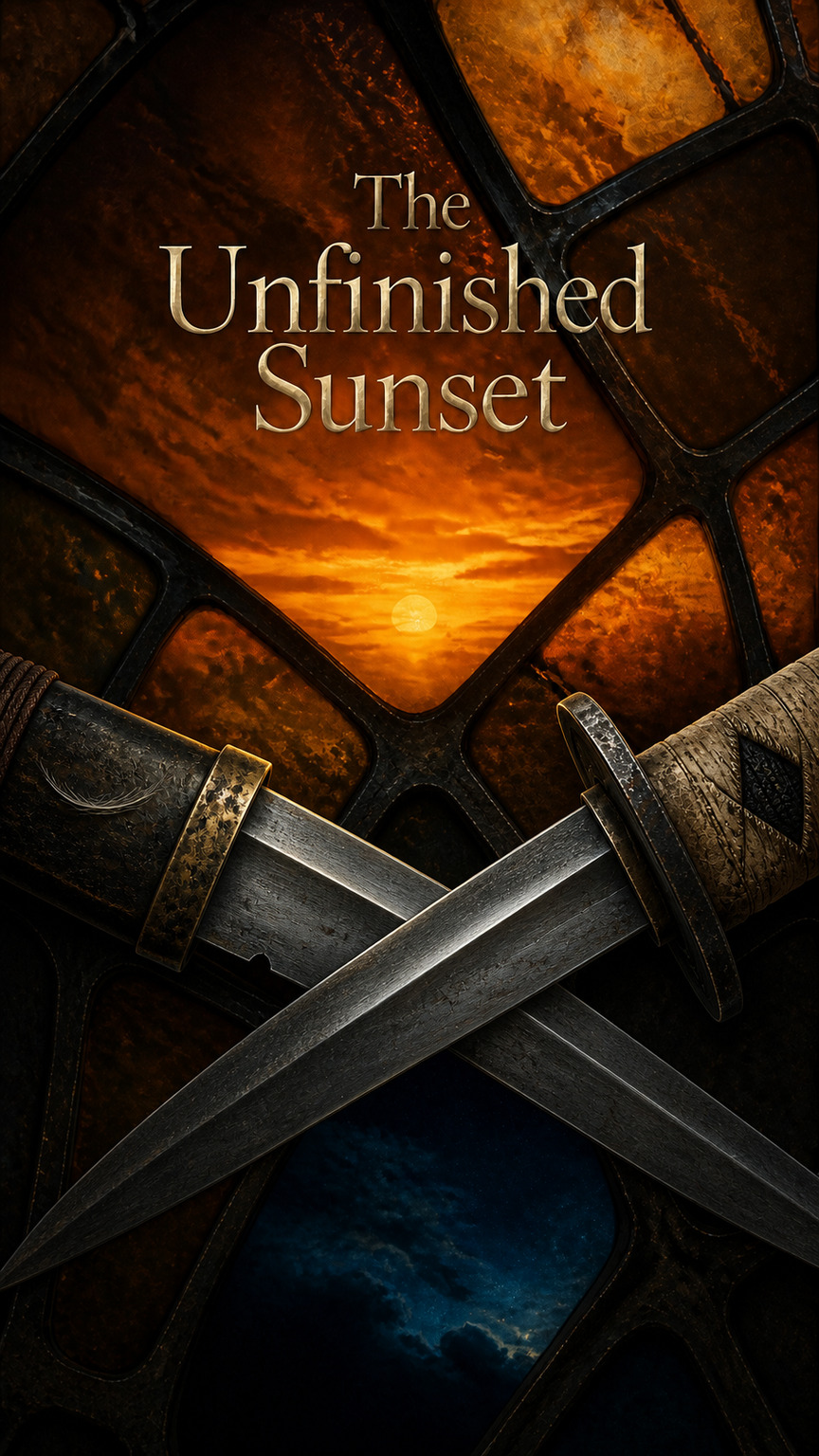
The road let Arveth into Aderi without making her turn around.
That was the first accusation.
Two shepherds had tried to guide her up from the lower valley. Both had come back to the same cairn facing downhill, certain they had followed the north track. Arveth had continued alone. At the last rise, her white hair was full of road dust, her left hip burned, and the old sword knocked against her pack with every other step.
Beyond the boundary ditch, Aderi lay in a light too yellow to be evening and too still to be weather. Barley terraces held one long slant of sun. The mill wheel flashed at the same point in each turn. Above the roofs, rows of mineral panes stood on black wooden vanes, holding the sunset over the village as they had been built to do during harvest.
Forty-three minutes. That was all the keepers had ever charged them to hold.
Arveth stepped across the dry ditch.
The pressure in her ears vanished. Behind her, the track straightened as if it had never wandered. Ahead, a sack split on the mill terrace and poured barley around a woman’s boots.
Nobody cried out. Nobody asked who she was.
The miller looked at the grain, then at Arveth. “You’ve come late in the turn.”
“South pass was washed out.” Arveth gave the fact automatically. “The bridge below the east field is gone.”
“I’ll plan another delivery route.” The miller crouched and began scooping barley back into the torn sack. “When it’s morning.”
At the far end of the terrace, Ilessa leaned against the stone watering trough. Her dark hair was tied high to keep it clear of her shoulders. The scar beside her mouth was the same narrow white line Arveth remembered. So were her hands, her height, the unweathered brown of her face.
Only the way she stood had changed. Twenty years ago, Ilessa’s weight had announced which foot would move. Now even stillness told Arveth nothing.
Ilessa looked at the sword.
Arveth took the strap off her shoulder. “I brought it back.”
Ilessa pushed away from the trough. She carried a plain village blade with a leather-wrapped grip, worn pale in two places. She did not reach for Arveth’s offering.
“Halen,” she called.
An old man was already descending the ladder from the pane walk. His sleeves were rolled above his elbows, and bright mineral dust marked both palms. He looked older than Arveth remembered until she understood that he had already been old. A cut release braid hung from the control frame beside him, its severed end newly picked apart.
“West pin first,” he said. “Then the three lower vanes. Joined pressure before release. In that order.”
“You don’t know whether the pin will hold,” said the miller.
“Which is why it goes first.” Halen reached the terrace and looked Arveth over once, not lingering on her white hair. “How long to the notch?”
A child sitting on the mill wall checked the fixed sun against a split in the western ridge. “Six minutes. Maybe five and three quarters. The smoke is thick today, but it was thick at the start, so that doesn’t help.”
The voice had a quick adult impatience. Arveth recognized the small blunt chin only after the child jumped down.
“Neth?”
Neth’s expression shut. “Yes. Don’t do the calculation where I can see it.”
Arveth had already done it. Nine when she left. A short body in a patched shirt, bare knees, and an adult’s level stare.
From the lane came the knock of a loom, then stopped halfway through its pattern. A farmer stacked three baskets beneath an eave while another sat on an overturned tub and watched. Near the bakehouse, two women were playing a game with stones scratched into the dust. One lifted the pieces before the board was finished and put them into her pocket.
No one gathered around Arveth. They remained at tasks, or at refusals of tasks, chosen across twenty years of the same failing light.
The elder came down from the upper lane with a wool blanket around narrow shoulders. “Take the sword from her.”
“Not like that,” Ilessa said.
The elder’s eyes stayed on Arveth. “Then keep her this side of the ditch.”
Neth gave a sound that was almost a laugh. “We can’t.”
The sun touched the notch.
Light struck the mineral panes all at once. Arveth smelled hot copper and cut grass. The barley at the miller’s feet rose in a soft backward rush. The sack sealed around it. A peg Halen had set beneath the control frame leaped into his hand as a split piece of wood. The game stones returned to the dust. Neth vanished from beside Arveth and reappeared halfway up the lane, running toward a doorway.
The whole village flinched into its old positions.
Then people moved by choice. The miller caught the sack before it fell and lowered it carefully. One player abandoned the restored game board. Halen looked down at the broken peg in his palm and sighed.
In the upper lane, a woman took the blanket that reset beside her former husband’s door and carried it to another house. He watched her go, then returned to his baskets.
Neth took two more running steps, stopped, and kicked the wall.
“Salt shelf,” they said when they returned. “My body starts for the salt shelf every time. I haven’t been sent there in twenty years.”
Arveth’s own feet had not moved. The reset had passed through her like a cold wire, finding no place to put her.
“First boundary condition,” Neth continued, fast now. “Anything inside at closure returns to where it was. You weren’t inside. Second: changes to our bodies return too. New cuts close, but an old injury comes back. So do the hunger and fatigue we had at closure. Third: what we remember stays. So does what we learn. So does being afraid of something that technically hasn’t happened anymore.”
Halen fitted the broken peg on a shaving block. “Neth.”
“She needs the short version.”
“She needs the safe version. West pin, three lower vanes, joined pressure. No experiments while I seat the pin.”
Neth folded their arms. “I stopped experimenting with the vanes fourteen years ago.”
“You proposed one yesterday.”
“I stopped conducting them.”
The miller caught Arveth looking at the unbroken sack. “We can eat. The food comes back. So does the empty feeling. I have ground this load more times than you’ve eaten supper on the road, and it has never once become flour that lasts.” She pulled the sack toward the mill. “I want night. Halen wants every hinge clean first. The elder wants you tied to the trough. Ilessa doesn’t tell me what she wants.”
“A vane breaks under moving charge, the catch may go with it,” Halen said without looking up. “Then there’s no return to recover.”
“I heard you the first thousand times.”
“Keep away from the hinges, then.”
Ilessa had already gone to the sun-catch frame. She tested the west socket with both hands, then knelt to steady the split peg while Halen shaved it. Every reset returned the peg to broken wood, but his fingers retained the shaping.
Arveth followed because the other direction was the ditch.
The mineral panes were clouded amber, each no wider than a handspan. In an ordinary harvest, living keepers stood along the copper rail at sunset and gave the panes a measured charge through their palms. The inert stone held what it was given. The vanes bent the stored light down over the terraces for forty-three minutes, then opened and let evening proceed.
Twenty years ago, with the punitive patrol climbing the south road, Arveth had opened every charging gate and forced her unmeasured living charge into the rails.
Memory came as the bite of copper, not pictures. Halen shouting for her to take her hand off the rail. Ilessa catching her shoulder. Arveth’s sword coming free because a sword was the answer her body had known best. Ilessa’s blade meeting it above the live frame.
Opposed living motion. The panes had taken that too.
“We’ll try the handover before anything else,” Arveth said.
Ilessa slid the new pin home. “Try it.”
On the cleared threshing floor, Arveth unwrapped the old sword. The grip leather had been replaced twice, the scabbard once. The blade itself was original, with a shallow notch near the hilt that no smith had persuaded her to grind away.
She held it out flat.
Ilessa drew her own blade and laid its edge against Arveth’s. A hum moved through the terrace stones. Light stirred in the lowest pane.
Arveth opened her fingers.
The sword struck the floor. The hum stopped. The pane went dull.
Ilessa nudged the fallen weapon back with her boot.
“Joined pressure,” Halen said from the frame. “Not touching. Not possession. Opposed pressure, unbroken until separation. West pin, three vanes, joined pressure.”
“We made a handle and had her pull against it,” Neth said. “We put the blade in a vise. We used another sword. We had Ilessa hold your wrist and take it. We asked the catch nicely, too, in case twenty years had improved its judgment.”
The elder had taken a seat beside the watering trough. “Have her yield properly.”
“Words don’t enter the rail,” Halen said.
Arveth picked up the sword. Her stiff hip complained when she straightened. “Then she can take it while I resist.”
Ilessa moved before the last word. Her blade struck once near Arveth’s hand, slid down the old steel, and turned. Arveth stepped back. A second cut came at her shoulder, controlled but quick enough that she had to catch it.
The panes brightened.
Arveth shifted her grip loose, intending to let the sword be pulled away.
Ilessa broke contact and stepped out.
“No,” she said.
“You need it out of my hand.”
Ilessa tapped the flat of Arveth’s sword with two fingers, then pointed to Arveth’s feet. Her meaning was plain: she would not rehearse another escape disguised as cooperation.
Neth hopped onto the terrace wall. “If you’re pretending, the opposed motion ends before the separation. We measured the pane response.”
“How?” Arveth asked.
“Brightness, sound, heat, the draw on the rail, shadow displacement, and once with moths. Moths were unreliable.”
Halen said, “No moths today.”
“I didn’t bring any.”
The mill started behind them. On its second grinding turn, a few villagers returned to the fields. The elder remained.
Arveth sheathed her sword. “I should see the boundary.”
“You saw it when you crossed,” the elder said.
“I want to know what closes when the blades meet.”
Ilessa walked downhill without waiting for agreement.
At the ditch, Neth tied a blue wool thread around their wrist and gave the other end to the miller. They had clearly done this before; the miller paid out line without looking up from a handful of grain.
“Walking first,” Neth said. “Then running. Angles don’t matter, but I check because conditions can change.”
They stepped into the ditch. Their foot reached the outer lip. The air folded with a small sound like cloth shaken once, and Neth stood inside the boundary again, facing inward. The blue thread never went taut.
“Carried, pulled, unconscious, on a cart, under the culvert, above it with a ladder,” Neth said. “No crossing. Things thrown out arrive back here. You can leave because your movement was never closed.”
Arveth looked along the ditch toward the south track. “Patrol was nine mounted. Six followed me past the shale cut. Three stayed below until smoke covered the terraces.”
No one had asked.
The miller rubbed a grain between finger and thumb. “Did you lose them?”
“Two horses broke legs in scree. The riders continued. I crossed the eastern river before the flood came through.”
“That wasn’t the question,” Neth said.
“They didn’t come back here.”
Ilessa crouched at the boundary and pushed her blade into the dry dirt. The point stopped where the air folded. She watched the steel, not Arveth.
Arveth had been a sword-retainer then. When she refused the order to seize winter grain from the upper farms, her master named her deserter, and the patrol had followed the ronin toward her birthplace. She had meant the overload as a decoy: close Aderi out of ordinary light, draw the patrol after the one visible fugitive, return when the road cleared.
Ilessa had opposed the risk. Arveth had cut the release braid and crossed the ditch anyway, completing the catch around everyone but herself.
“The lower road stayed watched eleven days,” Arveth said. “Then snow took the pass.”
Neth answered at once. “That accounts for eleven days and a winter.”
“In spring I was east of the river.”
“Road fact.”
Arveth looked up toward the lane she had not entered. A loom knocked there again. Three beats, pause, two beats. Her mouth formed the beginning of a word and stopped.
She tried Ilessa’s name next, meaning to make it carry every other name she had not asked after. Nothing came.
Ilessa pulled her blade from the dirt.
“I came within two ridges the next spring,” Arveth said. “I saw no smoke. I thought the catch had failed. Or released.”
The miller’s handful of grain trickled back into the sack. “You could have checked.”
“Yes.”
There was no clean road fact after that. There had been work escorting carts, a fever season, two more washed bridges, hired blades coming after her sword. There had also been mornings when Aderi lay three days away and she chose a road that made it ten.
Ilessa’s gaze settled on Arveth at last. “I saw you cut the braid. I saw you cross.” She pushed the village blade into its sheath. “That’s what I know.”
Then she headed back to the terrace.
The next reset returned Neth to the salt errand and the miller’s grain to the torn sack. Arveth remained beside the ditch with twenty years in her knees.
Halen used most of the new turn to prepare. He shaved the west pin until it entered without forcing. He and two other keepers laid their palms against the copper rail, not to add charge but to feel whether the old load shifted evenly. At the cut release braid he wove a temporary bridge of copper wire and green flax. He tested it, unwove it, and started again.
“West pin,” he said each time someone spoke to him. “Three lower vanes. Joined pressure.”
The miller moved her sacks under the eave. “If we get dark, I want the grain dry. If we don’t, it comes back.”
The elder stationed two field workers near the ditch, watching Arveth rather than the catch. Others chose the stone houses. One farmer stayed on the terrace to hold a vane rope. The game players finished their match in the dust and disagreed over the last move until Halen ordered them away from the frame.
Neth marked the boundary with bits of chalk at six-step intervals. “For after,” they said. “If there is an after.”
Ilessa worked through the terrace footings, stopping twice to scrape barley chaff away from a landing place. Each movement ended with her balanced to move again.
Arveth rolled her left shoulder. Age had not made her slow everywhere, only in places she could no longer predict. Road fighting had taught her to use doorframes, mud, cart wheels, the glare off water. Ilessa had been given the same terrace, the same light, and more practice than either of them could count.
Halen tied off the bridge. “On my call. If a lower vane sticks, stop. If the west pin lifts, stop. If either blade loses pressure before separation, stop. We can reset and try again.”
“We can,” the miller said. “I’d rather not.”
Ilessa stepped onto the threshing floor.
Arveth drew.
Neither repeated the opening they had used twenty years ago. Ilessa entered behind a low cut, turned Arveth’s guard, and drove her toward the mill wall. Steel met and parted. Each contact woke another amber line in the panes. Arveth used the wall to shorten her retreat, slid past a flour bin, and caught Ilessa’s blade close to the hilt.
Ilessa changed hands.
Arveth barely cleared the return cut. She knew how to break a rush because road thieves used them. Ilessa knew how Arveth broke one.
They crossed the terrace. Ilessa gave ground once, then took it back in three quick steps. Arveth’s hip tightened. She let the weakness show for two exchanges, then pivoted the other way and used a scatter of barley to force Ilessa wide.
Ilessa had practiced on spilled grain. Her foot found the clean stone between kernels.
Their blades bound. The panes flared hot gold. Halen put both hands on the release frame.
“West pin holding,” he called. “First vane ready.”
Ilessa pressed. Arveth yielded a step, then another, drawing them down the slope. The dry ditch touched her heel.
The air behind her opened.
She knew it by the sudden smell of pine from beyond Aderi, cool and ordinary, and by the give under her next step. Her sword slid free of Ilessa’s as she crossed. The catch dimmed.
Arveth stood on the outer road.
Inside the ditch, no one could follow. Ilessa held her blade down at her side. Halen kept one hand on the frame, the other raised away from the first vane. The field workers watched. The mill continued grinding because no one had stopped it.
The south road lay clear. Arveth knew its grades, its water, the place a traveler could sleep without being seen. The facts arrived in order. Her feet were already turned correctly.
Beyond the catch, the real sun had lowered a finger’s width.
Arveth stepped back across the ditch.
She did not offer the sword. She settled both hands on its grip and returned to the threshing floor.
Halen examined the west pin. “Again. Same order.”
Neth erased one boundary mark with their heel and drew it fresh.
Ilessa came at Arveth without a word.
This time Arveth contested every inch. She did not reach for Ilessa’s blade or turn her grip false. When the old pattern in her shoulders invited a high attack, she broke it with a short step learned in a wagon yard; Ilessa answered by striking low. Arveth caught the blow. The blades stayed together.
“Joined,” Halen said. “First vane.”
Wood knocked overhead. One pane swung free, pouring its stored light across the opposite ridge.
Ilessa bore down. Arveth turned under the pressure, steel grinding along steel. If she stepped away, contact would break. If she loosened her hand, it would be surrender again. She held, changed angle, forced Ilessa toward the trough.
“Second vane.”
Another knock. The sunset shivered. Shadows moved for the first time.
Ilessa’s young body had not tired across the years, but it had learned. She let Arveth win the angle. Arveth followed, seeing the disarm half a breath too late: not at her blade, but at the stiff left hip that had to carry her weight.
Ilessa stepped across that foot. Her hilt drove under Arveth’s guard. The village blade never left the old sword; it rolled against it, opposed all the way, while Arveth fought to recover her grip.
“Third vane,” Halen said.
Arveth’s fingers opened despite her.
Ilessa tore the original sword free.
Halen pulled the bridged release.
The vanes opened with a sound like a roof taking wind. Amber light streamed out of the panes and thinned above the terraces. The old sword spun once. Ilessa caught it by the grip before it struck stone.
For several breaths nothing else happened.
Then the sun passed through the notch.
Neth’s chalk marks stayed beside the ditch. Halen’s new pin stayed seated. A bruise darkened across Arveth’s knuckles and did not clear. Along the lane, doors opened on a light none of them had seen reach the ground.
Ilessa did not age. Neth’s patched sleeves did not shorten. Their bodies kept no missing years to collect, and their memories did not empty.
Night came at its ordinary speed.
The miller laughed once when she saw flour remain in the bin, then swore because the grain under the eave was damp. Halen ordered everyone away from the cooling panes and repeated the order when nobody listened. The elder sent one field worker to the upper lane and kept the other beside Arveth.
Ilessa sheathed her village blade. She kept Arveth’s sword bare in her hand.
“Catch house,” she said to Arveth. “You’ll sleep there. Two watchers.”
Arveth nodded.
“First, Halen needs the lower ropes secured.”
Arveth took the rope Halen threw her and tied the road knot she trusted most. Halen inspected it, untied it, and showed her the broader hitch the vane posts required.
At the ditch, Neth stood with one foot on either side.
They stepped out. The air did not fold. They walked six paces down the road, crouched to touch a tuft of grass that had never been inside the catch, then rose and looked toward the darkening valley.
No one called them back.
After a while Neth returned across the ditch. They picked up one end of the miller’s smallest sack.
“Not that one,” the miller said. “Bottom’s split.”
Neth chose another. Arveth took the opposite end, and together they carried the grain under cover while Ilessa watched with the sword.