The Unfixed Face
Genetic modification becomes commonly available so anyone can change any of their attributes at any time in their life. Instead of dying their hair plastic surgery etc they can literally modify their genes to look however they want.
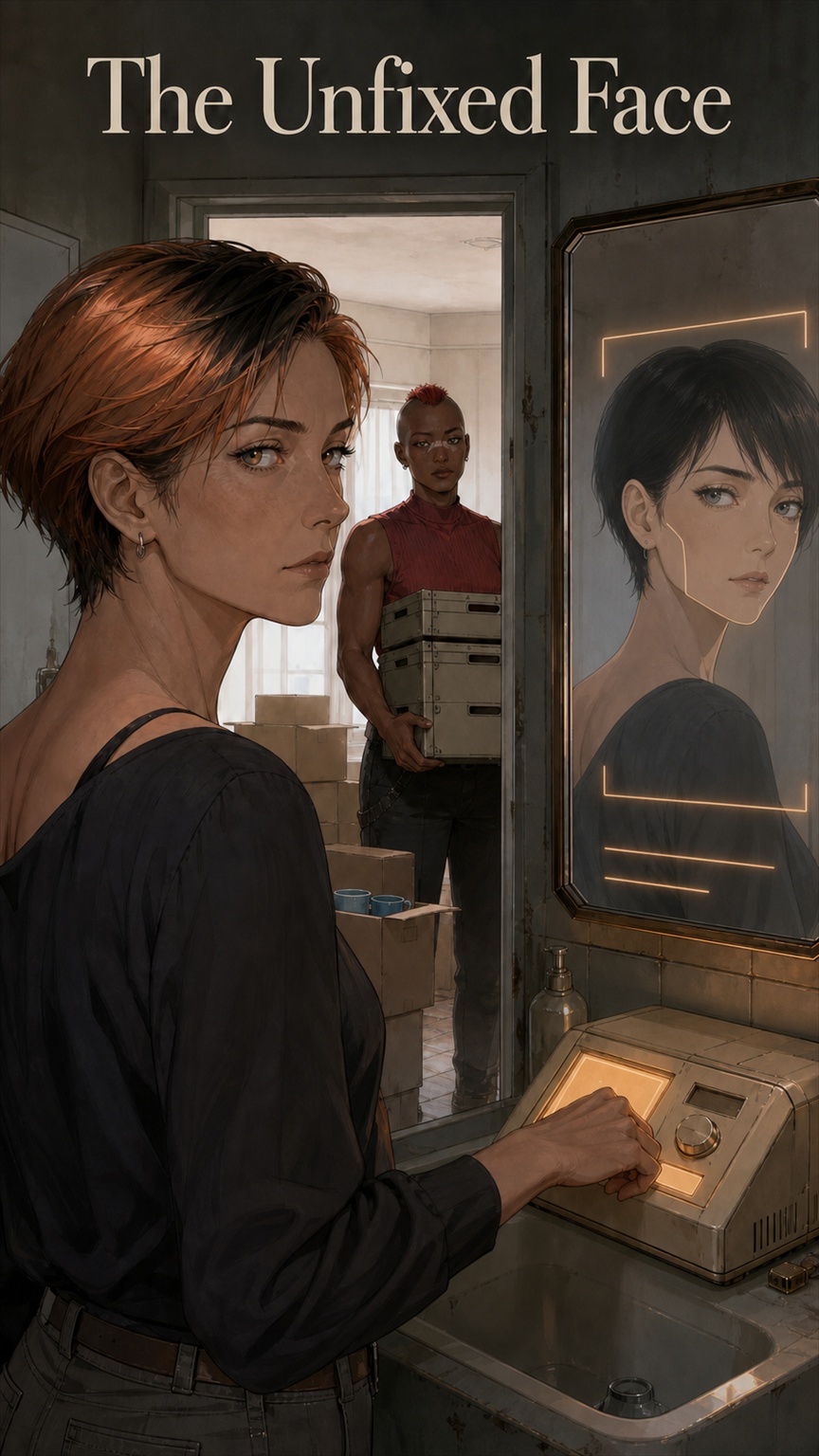
The door knew Erisel’s pulse but not her face.
She held two fingers beneath the lintel while Mirrorglass House searched the capillaries in her hand. A rose-colored beat moved from wrist to knuckle, paused, then repeated faster. The same cadence had opened the studio when she was nine and too short to reach the brass plate. Back then she had stood on Lucian’s boot while he steadied her elbow.
Now the plate was gone. Everyone altered something. A neighbor might sharpen night vision before a winter shift, smooth an old joint on the way home, or borrow a different jaw for a wedding and return it on Monday. Faces made poor keys.
The lock answered with a green seam. Erisel pushed inside and caught the door before it crushed the cardboard carrier against her hip.
“Your food,” she called. “And the settling salts you forgot to order.”
“I didn’t forget. I declined.”
Korrin came through the beaded curtain wearing their father’s last face.
It was not an exact restoration. Lucian had been seventy-three when the lung fever took him, and the mourning preset had been stored years earlier: square cheeks, dense silver brows, the shallow cleft in his chin. Korrin had kept her own height. The shoulders beneath her work apron were hers, as were the quick, planted steps. Then she frowned at the cardboard carrier, and Lucian’s left eyebrow climbed before the right.
Erisel nearly dropped the food.
Korrin took the carrier from her. “You changed again.”
“Temporary face. The northbound carriage seals badly around narrow sinuses.”
“You could have changed your sinuses.”
“They came bundled.”
“Of course they did.”
Lucian’s mouth had always pulled inward on the last word. Korrin’s did it now, without her seeming to notice.
Erisel hung her coat on the peg marked VISITORS, because the peg marked ERI still held a child-sized oilskin. “How much is left?”
“Seven cabinets and the private shelf. The public presets sterilized at noon.”
“You did that without me.”
“They expired without you. I pressed the confirmation. There’s a difference.”
Korrin set the carrier beside three unopened tins and went back through the curtain. Erisel followed into the revision room.
Mirrorglass House had never contained many mirrors. Lucian said clients watched surfaces when they should have watched balance and breath. The long room held a padded bench, a washbasin, and ranks of seedglass cells in cooling shelves. Most were already clear. A few still carried smoky whorls: anonymous body plans waiting for their permissions to lapse. At sunset the house would heat every remaining cell to white, leaving no living pattern that could be used without its owner.
On the central table, Korrin’s tablet showed a column of glyphs beside each cabinet. Green for released. White for sterilized. Amber for disputed.
There were too many amber marks.
“Family presets,” Korrin said before Erisel could ask. “Mine. Yours. His.”
“Mine can go.”
“The one with the winter lungs?”
“I have a copy at home.”
“The copy you said you hadn’t checked since you moved?”
Erisel picked up the tablet. “We’re not retaining client material because my filing is poor.”
“I didn’t say client material.”
“This building is client material.”
Korrin opened her mouth. Lucian’s face prepared an argument with a familiar tightening around the eyes, and Erisel turned away before the words arrived.
A harsh triple pulse ran through the ceiling conduits.
Emergency access.
Korrin was moving before the third pulse ended. She swept the tins from the bench and tapped the door glyph. “Name?”
The answer from the vestibule was a scrape, a breath, and something that might once have been a word.
Erisel reached the door first.
The person leaning against the outer frame had the elongated arms and dark sail membranes of a gliding form. One membrane hung folded cleanly along his left side. The other dragged at the floor, its outer edge thickening into skin where the return had begun and stopped. His pupils had spread across nearly the whole eye. Black heat-patches stood out on his throat and ribs. Under the skin of his temples, capillary light flickered too quickly to parse.
He thrust his wrist toward them. His device drew a single glyph in red: MEKRAN FOYLE.
Korrin caught his elbow. “Mekran. It’s Korrin. Bench is four steps.”
He looked at Lucian’s face, and some of the strain left his grip.
That was worse than Erisel expected.
They guided him inside. His right foot had widened for landing, while the left was already narrowing toward an ordinary arch. Neither matched the balance his hips attempted. He stumbled at the threshold and struck the side of the bench hard enough to rattle the cells.
“Don’t lie flat,” Erisel said. “Your rear membranes will trap heat. Sit forward. Korrin, wet cloth, not cold. Mekran, I’m Erisel Malk. Pattern specialist. Can you hear me?”
His temple lights gave one long band, then shattered into little flashes.
“That isn’t a standard yes,” Korrin said.
“I know.”
Mekran’s device drew an ear, crossed it out, then drew it again with one side dimmer.
“Uneven hearing,” Erisel said. She moved to his left. “This side?”
He pressed thumb to forefinger twice.
Korrin brought the cloth. He jerked from its touch, light flaring bright along his jaw.
“Too cold?” she asked.
He gave no hand sign. The device showed a spiral, then went blank.
Erisel touched the cloth herself. Tepid. “Could be skin pain, not temperature. Ask before contact.”
“I did. He didn’t answer.”
“You touched while you asked.”
Korrin’s borrowed brows drew together. She held up the cloth where Mekran could see it and waited.
His fingers opened once. Korrin laid the cloth over the heat-patch on his ribs, slowly enough for him to stop her. His breath eased.
Erisel checked the wrist device. Its local history held a revision receipt from Mirrorglass House and a promised personal return sequence, but the return file itself was absent. Lucian’s compact seal sat on the receipt. A mark, nothing more. He had taught them to keep records bounded: what had been ordered, what had been consented to, which body carried the cost. Never a person’s habits. Never a simulated voice.
“When did you start the return?” Erisel asked.
Mekran tried to speak. Air grated behind his tongue.
The device wrote: TRAIN. Then: 3 BELLS. Then it added a small wing glyph and crossed it through.
“Three bells ago, on the train,” Korrin said. “You triggered the home preset and the sequence failed.”
Mekran pressed thumb and forefinger twice.
“Can I search the private archive for the return pattern attached to this receipt?” Erisel asked. “Only that pattern. No previews beyond what’s necessary to identify it.”
His temple lights slowed: three brief pulses, a pause, three more. The cadence on his receipt.
Korrin touched the same rhythm against the bench. “Consent registered.”
Mekran’s gaze fixed on her face. He mouthed something without sound.
“Lucian is dead,” Korrin said. “I’m his daughter. I handled your settling appointments.”
He closed his eyes. Not assent. Not refusal. Only no more looking.
Erisel swallowed the correction she had been about to make. “We’ll tell you before each step.”
She drew a thread of active seedglass from the diagnostic spool and set it beneath her lower lids. The change itched for six breaths. The room’s ordinary colors thinned, and living revision patterns surfaced as quiet geometries: the dense green scaffolds of the archive, Korrin’s mourning preset braided gold beneath her skin, Mekran’s failed return stuttering red across muscles and vessels.
“Cabinet order?” Erisel asked.
Korrin pointed. “Recent work on the west side. He came every half-year, but his last visit was during the roof leak. Lucian moved active files away from the wall.”
“To which shelf?”
“If he’d told me, we wouldn’t be searching.”
They began with the west cabinets anyway.
Each anonymous cell answered only a consented cadence that matched its owner. Erisel placed cells one at a time in the shallow reader. Mekran watched the neutral previews cross the tablet: a change in night color, a shoulder joint’s range, a heat-shedding lattice. He rejected the first with a closed fist. The second made him touch two fingers to his sternum, uncertain.
“Not enough,” Erisel said. “Do you recognize it, or does it hurt?”
Mekran shook his head, then stopped, dizzy. His device drew an eye and a question mark.
“Recognize?” Korrin asked.
One finger opened.
“He says yes.”
“He answered the last thing you said, not the choice I gave him.” Erisel removed the cell from the reader. “We separate questions from now on.”
Korrin’s jaw set. She turned her tablet so Mekran could see and placed two glyphs on it: KNOWN and WRONG. He tapped KNOWN. Then he tapped the bench twice and pointed at the next cabinet.
They changed the procedure. One preview. One question. An answer repeated through two available channels whenever possible: device and hand, light and posture, speech and touch. It was slower. Outside, the western windows reddened toward sterilization time.
The cells offered lives no one in the room had lived. Amber irises opened briefly in Korrin’s borrowed face. A breathing lattice feathered across Erisel’s ribs. Mekran watched his own hand acquire delicate climbing pads, then knocked the reader aside before the preview could climb past his wrist.
“Wrong,” Korrin said, and cleared it.
Mekran’s temple lights pulsed approval.
“Current capacity,” Erisel said. “Can you still distinguish those pulses?”
He held up three fingers, folded one, then frowned at his hand as if it had betrayed him. His index finger had begun webbing to the next.
“Light, device, gross pressure,” Erisel said. “Fine gesture is unreliable.”
“And speech is gone,” Korrin added.
Erisel looked at her. “Don’t inventory losses over him.”
“I’m inventorying the channels we have. Mekran, pressure means you squeeze one of our hands. Once is stop. Twice is yes. Hold means wait. Is that usable?”
He reached for Korrin. Twice.
They continued.
At the fifth cabinet, Mekran’s device went dark. He struck its edge with the heel of his hand.
Korrin sat beside him. The silver brows lifted, the mouth softened, and she spoke in the low, measured tone Lucian had used with frightened clients. “Let the body be unfinished for a minute. We don’t have to chase it while it changes.”
Mekran stopped hitting the device.
Erisel remembered those words from her own first revision, when she had tried to take back the height she had asked for before her bones finished settling. She remembered Lucian’s hand, broad and dry, over the control.
Korrin went on. “We know the safe order. Eyes after heat, feet after balance. You did this route here before.”
Mekran opened his eyes. He looked at Lucian’s face as though the last six years had narrowed to a usable door.
Then light moved beneath Korrin’s temples: the old sister-code, three quick beats and one dragging beat, used since childhood for don’t make this worse.
Mekran saw it.
His grip snapped tight around her wrist. Once.
Stop.
Korrin fell silent.
He pushed her hand away and pointed at the borrowed face. The heat-patches on his throat darkened. His device remained dead; his fine gestures were failing. He could not tell them which part had broken trust, only that something had.
“That was Lucian’s script,” Erisel said. Too much explanation already, but Mekran needed the fact. “Korrin remembers it. The preset has his voice shape, not him.”
Mekran squeezed Erisel’s offered hand once.
Stop that too.
So she stopped.
Korrin rose and returned to the cabinets. She did not apologize. She pulled each remaining cell, checked its date against her tablet, and put it back when the mark did not match. Her work grew faster and rougher. Lucian’s face did not vanish; bodies could not be revised like masks peeled away. Its borrowed expressions simply went still.
At the private shelf, Erisel found six family presets and no client file.
“Nothing,” she said. “Receipt says he left with a complete return. If the archive copy isn’t here, it must be linked under a carrier permission. Did Lucian ever split emergency fragments?”
Korrin kept her eyes on the cells. “During the leak. He put two into his own active preset so they wouldn’t sterilize with the wet shelf.”
“Two. Whose?”
“I don’t know. The record stayed anonymous.”
Erisel lifted the cell tagged only with Lucian’s private cadence. Its gold pattern matched the braid beneath Korrin’s skin.
“You’re wearing it.”
Korrin looked toward Mekran. “I know.”
The words were hers. Flat, late, impossible to soften with anyone else’s mouth.
“You knew before I arrived?”
“I knew there were fragments. Not that one was his.”
“And you activated the preset anyway.”
“I activated Dad’s face for the closing. I checked the base anatomy. I didn’t open records that weren’t mine.”
“The carrier index isn’t a client record.”
“It names a presence. That was enough for me not to look.”
Erisel wanted to tell her precisely how many safeguards she had mistaken for sentiment. The explanation assembled itself in clean steps. Then Mekran’s hand knocked once against the bench.
Stop.
They had made him wait through a family quarrel while his breathing changed.
Erisel set the cell in the bounded reader. It showed no anatomy until Mekran pressed his cadence against the bench and Korrin supplied Lucian’s private sequence from memory. The two permissions met. A thin branch lit inside the mourning preset, red threaded through gold.
The record contained four glyphs: Mekran’s return receipt, a consent seal dated before the roof leak, the carrier transfer, and the consequence of release. No message. No explanation in Lucian’s voice.
“It’s yours,” Erisel told Mekran. “Releasing it will remove this preset from Korrin. The return pattern will enter the reader. We can start with heat regulation and breath. Do you consent to release?”
Korrin held out her hand. Mekran squeezed twice.
His temple light gave three pulses, then broke into a white flare.
“Two channels,” Erisel said. “Confirmed.”
Korrin looked at the release glyph. “Do it.”
The seedglass woke with a damp crackle.
Gold drained from Korrin’s pattern into the reader. Her borrowed face loosened by degrees: cheeks narrowing, brows paling, chin smoothing as dormant instructions gave way. At the same time the red branch reached Mekran. Erisel guided the sequence through the diagnostic spool.
“Heat first,” she said. “Mekran, cloth on your ribs?”
Two squeezes.
Korrin applied it. The black patches faded to brown. Mekran’s breaths came deeper, but the right membrane seized along his spine.
“Next is vascular release. It may brighten your signal before it stabilizes. Proceed?”
His temples burst bright.
Erisel touched the next glyph.
Mekran crushed Korrin’s hand once.
Stop.
Erisel froze before the seedglass opened the stage. The flare ran wild beneath his cheeks, steady brightness without cadence. Pain, not permission. She had named the possibility and still mistaken light for assent because it arrived when she wanted an answer.
“Stopped,” she said. Her own voice had gone thin and technical. “No stage entered.”
Mekran kept hold of Korrin’s hand. Not squeezing now. Holding: wait.
Korrin’s face settled unevenly. One brow remained silver; her cheeks no longer belonged to Lucian, but the throat still carried his deepened resonance. She pressed fingers to it, coughed, and changed the voice setting down until the next words emerged rough and light.
“I won’t use his voice again,” she said. “Not for this.”
Mekran looked at her. His grip eased, but he did not release her.
“We need a signal that pain can’t imitate,” Erisel said. She was over-specifying again; she could hear it and could not stop. “Light is unavailable. Fine gesture is unavailable. One squeeze may occur under spasm. We can use direction. Korrin, place his hand flat. Mekran, press left to stop, right to proceed, neither to wait. We’ll state each choice, then you answer, then Korrin repeats the direction aloud. If you can’t choose, we hold the stage.”
Korrin adjusted her palm beneath his. “Left stops. Right goes.”
Mekran pressed right.
“Right,” Korrin said.
Erisel opened the vascular stage.
The next four stages took eleven minutes. At each one Erisel named the immediate bodily change, not every consequence she feared. Korrin reported Mekran’s pressure without interpretation. When his hand drifted center, they waited. The stalled wing membrane softened from his spine. His pupils contracted enough to follow the reader’s glyphs. Balance returned before his feet finished choosing a shape, so Korrin braced his ankles with folded towels instead of asking him to stand.
The last stage did not restore a remembered face. It restored the safe path by which his body could keep deciding later. His jaw shortened a little; the dark membrane along his right arm receded to the elbow and paused. The return pattern found stable breath, ordinary heat, even hearing, and stopped there.
Mekran sat forward, exhausted. New capillary light gathered beneath his temple in a slow amber arc.
Korrin waited.
He pressed right against her palm.
“Proceed,” she said, though there was nothing left to open.
Erisel disconnected the reader.
Behind them, the house chimed sunset.
Every shelf glyph turned white except the private cell in the reader. Korrin’s face had settled into broad dark brows, a high crooked bridge, and a mouth Erisel remembered only from a summer when Korrin had been twenty. The throat resonance continued to shift between breaths. No expression landed where Erisel expected it. Yet Korrin crossed to the archive controls without asking where they were, laid two fingers on the lower confirmation pad, and waited for Erisel at the upper one.
“Your preset too?” Korrin asked.
“The winter lungs stay. Everything else with my permission expires.”
“Dad’s base?”
Erisel looked once at the emptied gold cell. “It already did what it was holding.”
They entered their separate cadences. The house sterilized the last unclaimed patterns shelf by shelf, a soft rain of ticks behind the glass.
Mekran’s wrist device revived while they packed the diagnostic spool. It drew a cup, a question mark, then an impatient arrow toward the door.
“Water’s by the door,” Korrin said. “You can take the blue bottle. The clear one has settling salts and tastes awful.”
He took the clear one.
Korrin made a face Erisel had never seen and understood perfectly.
Outside, evening had turned the street windows reflective. People passed in dinner faces, work lungs, rain-adapted skin. Mekran stood beneath the awning until his feet agreed with the pavement. He tested his balance, adjusted the strap beneath the remnant membrane at his elbow, and set his temple light to three quiet pulses.
Korrin lifted a hand. Mekran answered with the cup glyph on his device, then walked toward the tram stop.
The sisters remained under the awning.
“We should eat,” Korrin said. Her voice had risen half a register since the procedure.
“The food’s cold.”
“It was cold when you bought it.”
“It was room temperature.”
“That room was a train station.”
Across the street, a sign brightened, and both of them squinted. Without discussion, they opened the pocket revision kit. Korrin selected low-light retinas; Erisel checked the settling order and applied the same change to herself. A minor revision. Six breaths of itch, a watery blink, then the street emerged in softer detail.
“The studio,” Erisel began.
Korrin gave three quick pulses at her temple and one slow.
Don’t make this worse.
Erisel answered with the rhythm they had used as children for not tonight. Korrin’s unfamiliar face turned toward hers. After a moment, the light beneath Korrin’s new skin repeated it back.