
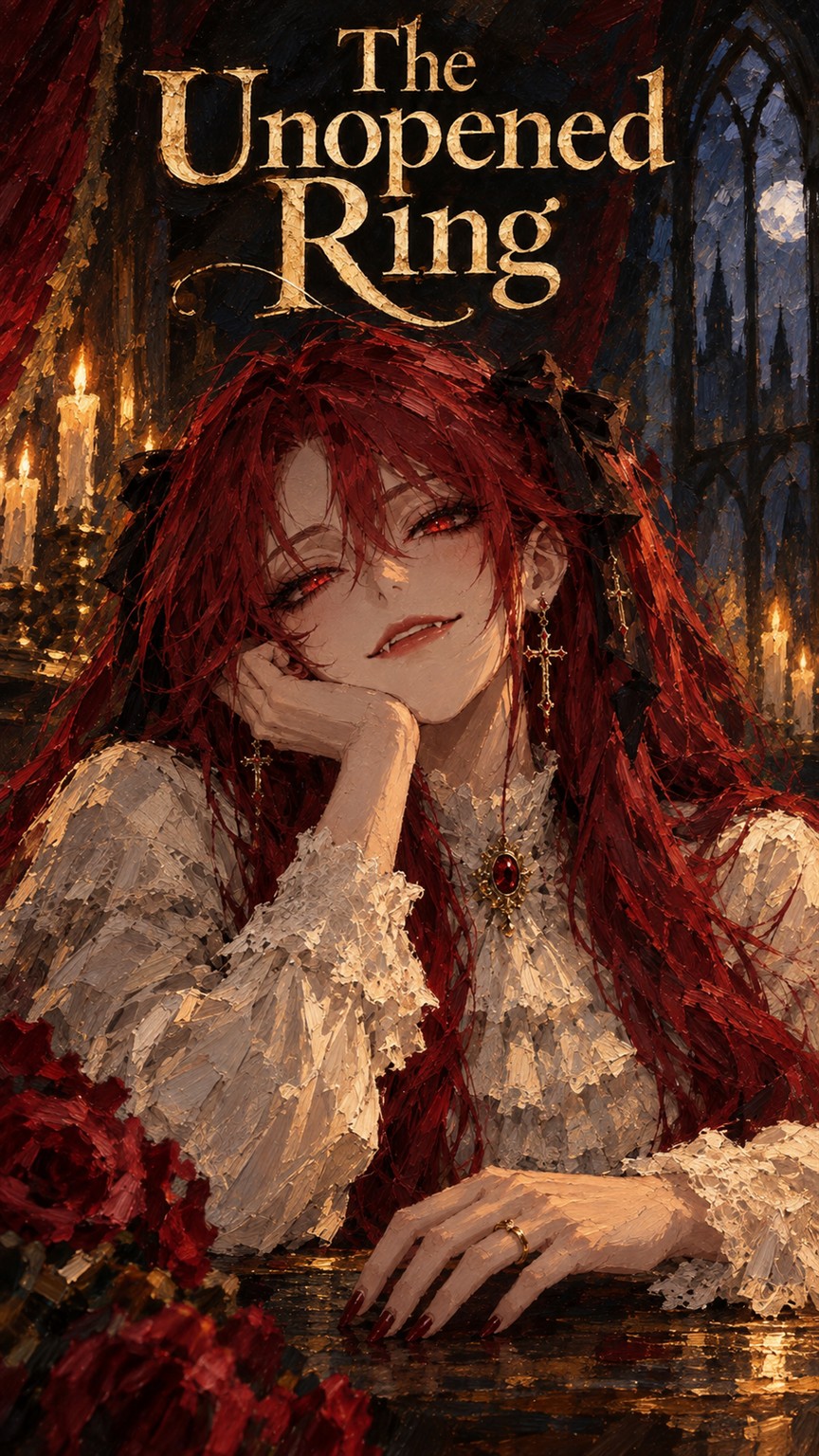
Merovel had practiced the kneeling part in the carriage. A pause before the word, a glance around the table afterward: that was how her mother had done it, and her grandmother before her. Ildren had gone to one knee before the immortal queen, yes, but only to retrieve his sword. He had never begged.
The ring was harder to manage. Wrapped in her mother's handkerchief, it made a lump inside her evening glove. She had meant to bring a little box, but all the boxes at home had looked either too grand or too much like an apology.
The invitation had been addressed to her mother, who had declined it before the winter was out. Merovel had written in the summer to say she would come instead. She had not explained why.
Queen Vessarine received her beside a fireplace tall enough to roast the carriage.
“You have your mother's mouth,” she said.
“My mother never came here.”
“No. She sent a miniature with her letter declining. She disliked travel.”
“She disliked being sick in carriages.”
“She didn't say so. How is she?”
Merovel had prepared for questions about the ring, her ancestry, even her modest widow's allowance. “She died in the spring.”
“Oh, my dear. I'm sorry.”
The queen waited. Merovel found she had nothing ready to put into the space.
“Thank you,” she said, and was shown to dinner.
There were three guests, one for each of the heroes who had tried to kill their hostess six thousand years earlier. Invitations went out every hundred years. Families lost their names, acquired children by marriage or adoption, divided into branches that would not speak; the queen's secretaries followed the arguments and invited whoever presently possessed the family relic. Osmer had brought his ancestor's horn. Pelcira wore an arrowhead on a chain. Neither object was subject to a prohibition about opening it.
The queen sat at the head of a table shortened, by discreet additions of flowers, to accommodate four. Behind her rose black columns and tall windows in which the moon lay snagged among distant spires. Her hair was redder than the wine. Fine white lace covered her wrists, and when she smiled at a servant, Merovel saw the points of her teeth.
She wore very little jewelry for a queen. A red stone at her throat, earrings, a thin gold ring on her left hand. Merovel, who had sold most of her own jewelry during her husband's illness, noticed the ring's worn surface. Its face had been rubbed down to something like a small flower.
“I understand we may begin with the deeds of our ancestors,” Osmer said, before the soup had entirely settled in its bowls.
“Certainly.”
“Mine led the charge.”
Pelcira put down her spoon. “Yours was the cook.”
“A captain of provisions.”
“A cook.”
“Who armed himself with a roasting spit when all other weapons failed.” Osmer leaned toward the queen. He had a magnificent voice, which he had been preserving throughout the carriage journey by declining conversation. “At the head of seven hundred men, he broke your outer gate.”
“Seven hundred,” said Vessarine. “Please, go on.”
He described the gate's destruction, the slaughter of the queen's wolves, and his ancestor's advance across a bridge of burning bones. Her Majesty listened without interrupting. For the wolves he got to his feet and lowered his voice, and she leaned forward.
When he finished and sat down, she thanked him.
“Were there really seven hundred?” Pelcira asked.
“At the dinner before last there were two hundred,” the queen said. “Last century, five hundred. Your family has recruited well, Osmer.”
He laughed, after checking her expression. “Numbers do suffer in the telling.”
“Your ancestor came through a kitchen window. He had brought two friends and a ladder.”
“Then why hear me out?”
“I hadn't heard the wolves.”
Osmer looked pleased despite himself. He helped himself to more soup and asked whether she had liked that part.
The queen said she had.
Pelcira's ancestor had once been an archer. In the version she told over the fish, he could split a hair with an arrow in darkness. She demonstrated its flight with a breadstick and nearly struck Osmer's glass.
“He was blind, of course.”
“Eventually,” said the queen.
“We say from birth.”
“He read a note aloud to me.”
“Perhaps someone had taught him the words.”
“Perhaps.”
Vessarine turned her fish with delicate, exact movements. She seemed capable of granting Pelcira a blind archer for the length of a meal. Merovel wished her mother could have seen this. She would have collected enough small absurdities to enliven the rest of her life.
The room itself, Pelcira learned, was only nine hundred years old. The oldest chandelier had been bought secondhand. Vessarine disliked the stone angels beside the windows but had grown accustomed to hanging winter greenery on them. At the first dinner, the guests had sat on cushions and eaten from a common dish. At the twentieth, everyone had considered it indecent for a woman to show her ears.
“I spent forty years with a toothache because no dentist would see me without the veil,” the queen said.
“You can have toothache?” Merovel asked.
“Those at the back are quite ordinary.”
She smiled, and for a moment Merovel could imagine forgetting the points of the others.
By the time the roast arrived, she had taken the ring out of her glove. It lay in its handkerchief on her lap. She rubbed the small gold hand that formed its face, feeling the shallow grooves between the fingers.
Her mother had permitted her to hold it only once. Merovel had been a newly married woman then, proud of her husband, annoyed by his habit of arriving late. Her mother had told the story of Ildren's fidelity: how he had worn his dead wife's ring into the queen's hall, how he had resisted beauty and terror alike, how he had knelt only to retrieve his sword.
Merovel had remembered that story through a marriage considerably less grand than Ildren's. Sometimes with comfort, sometimes with irritation. Her husband had never become punctual.
“And now,” Osmer said, “the kneeling.”
“Ildren brought her to her knees,” Merovel began.
“I thought it was the other way round,” said Osmer.
“Do let her tell it,” Pelcira said.
Merovel started again. She described the blade against the queen's throat, the refusal of a crown, the offer of a thousand years of life. Her mother had always made the offer sound almost reasonable. Merovel heard herself rushing through it, eager to reach the part she knew best.
“He knelt,” she said, and paused. “But only to retrieve his sword. He never begged.”
Vessarine looked at the handkerchief on Merovel's lap.
“Your mother told you that?”
“Yes.”
“Did she tell you anything else about him?”
“A great many things.”
“I'd like to hear them.”
Merovel disliked the careful kindness in her voice. “Was that one true?”
The queen placed her knife beside her plate. “He did ask me to spare his friends.”
“But he didn't beg.”
“Merovel, they were going to be hanged.”
Osmer lowered the horn he had been about to show Pelcira.
“He was wounded,” the queen continued. “Standing hurt him. I remember wishing he'd sit down.”
“And did you spare them?”
“Yes.”
Merovel pulled the handkerchief onto the table. “Then perhaps the rest is true. We still have the ring. He never took it off.”
She unfolded the linen. It was a narrow hoop, slightly crooked, with one tiny hand laid across its face as if guarding something. A worn nail caught the candlelight.
The queen reached for her wine, missed the stem, and left her hand on the cloth.
“You brought it.”
“It came to me when Mother died.”
“May I see it?”
Merovel moved the handkerchief toward her. Vessarine touched the gold with the tip of one finger, turning it so the little hand lay palm-down.
“He wore it hard,” she said.
“He wore it faithfully.”
“Yes.”
There was finally something they agreed on. Merovel felt a foolish wish to take the ring back before the queen could spoil it.
Instead Vessarine slid the linen toward her. “It's yours.”
“It opens,” Merovel said. “The hand lifts. But we aren't allowed.”
“Who told you that?”
“Everyone. My mother. Hers. There's something of you shut inside it. If we open it, you can have him again.”
The queen stared at the gold hand.
Merovel looked from the ring to her. “Can you?”
“No.”
Merovel had expected amusement. The answer was so plain that she could not immediately find another question.
Osmer turned a hand in the air. “It may be a figure of speech.”
Pelcira pressed his sleeve down against the table until he stopped.
“Ildren gave it to his eldest daughter when his fingers swelled,” Vessarine said. “Near the end. I knew she'd kept it. I didn't know what she'd said about it.”
“You were there?”
“Yes.”
The hand was no larger than Merovel's smallest fingernail. She could see the hinge at the wrist now, almost filled with dark material. She had seen it before and avoided looking closely. Her mother had died in bed, calling for a sister dead since childhood. During the last hours, Merovel had obeyed instructions that no longer made sense because obedience was still something she could give.
She put her nail under the little fingers.
“At the thumb,” said the queen. “Don't pull. Press it inward first.”
Merovel looked up.
“I used to do it for him.”
The thumb moved. The lid rose reluctantly, exposing a hollow no deeper than a drop of wine. Letters had been cut into the sheltered gold.
Merovel knew the old letter forms from the copied inscription on Ildren's tomb. She sounded them without meaning to.
Vessarine.
Her hostess took off her own ring.
It, too, bore a hand. Seen alone, its curling fingers had looked like a worn flower. Merovel lowered the lid of her ring until the catch held. The queen set her hoop beside it, turned it once, and fitted their uneven edges together. The hands clasped. What had looked like a crooked ring became half of a wide, neatly joined band.
There was no flash or music. One edge clicked against the other. The queen had a pale groove around her finger.
“He was my husband,” she said.
Merovel rubbed the groove the little lid had left beneath her nail.
“He had a wife.”
“She died before he came here.”
“We come from her.”
“Yes.”
“So you aren't—”
“No.” The queen waited until Merovel looked at her. “I'm not your grandmother.”
That should have made it easier. Instead Merovel thought of her mother reciting the tale, pleased with the pause before knelt, and felt suddenly angry with the woman whose name was inside the ring.
“You let us say all that.”
“I did.”
“For six thousand years?”
“At the first dinner, his granddaughter would not believe me. At the second, they knew he'd lived here but said I'd bewitched him. By the third, he'd escaped me. I grew tired of arguing with people who took every point I won as proof I'd enchanted them.”
“You could have shown them your ring.”
“I did. A piece of jewelry wasn't much of an argument against a dead mother.”
Merovel folded her hands below the edge of the table. On the linen, the two gold hands remained clasped.
“Did you offer him a thousand years?”
“I couldn't. I've never known how to give anyone this.” Vessarine touched the bare place on her finger. “I offered him the rooms next to mine. He said they faced the wrong way for morning light.”
“After he tried to kill you?” Pelcira said.
“Eleven years after.”
Osmer let out a breath. “There must have been rather a lot in between.”
“There was a truce. His friends went home. He came back as an envoy, and then he came without a message.”
“Were you beautiful then?” Merovel asked, and immediately wished she hadn't.
The queen considered her with something close to her earlier amusement. “Much as I am now. My hair was shorter. He said it suited me better.”
Merovel looked at the enormous red fall over her shoulder.
“He was very insistent,” Vessarine added. “We were married for thirty-four years. I let it grow for most of them.”
Pelcira laughed once, uncertainly. The queen smiled at her, then looked down at the rings again.
The servants came to take the roast away. Plates lifted, a fork fell, somebody asked whether the guests would like the sweet wine. Merovel was grateful for these people who could still remember what they were doing. She wanted the whole table cleared and everyone sent out; she wanted Osmer to begin the wolves again so she would not have to say anything.
She settled for asking, “Why would his daughter forbid it?”
“She hated me.”
“Because you were his enemy?”
“Partly. Because I had him here when she wanted him at home. Because he was happy, and she thought that insulted her mother. She told me those things herself. She may have had other reasons.”
“Did you try to be kind to her?”
“I bought her things.” The queen rubbed a spot of wine from the table with her thumb. “She asked me to stop.”
Merovel thought of the miniature her own mother had sent, and of the queen still keeping it somewhere in this house when Merovel and everyone who had known her mother were dead.
“You still invite us.”
“I like hearing what survives.”
“Even the wolves?”
“Sometimes especially those. I've had some very dull centuries.” She looked toward Osmer, but he was occupied with the clasped hands. Her attempted smile faded. “There used to be more little things. His granddaughter knew how he peeled an apple. Once a boy came who had the song the cook used to sing. Only half of it, but I'd forgotten there was a song.”
“My ancestor?” Osmer asked.
“Yes.”
He sat back, evidently making room for this.
Merovel could remember nothing about apples. Their family did have a saying about leaving one boot where a person could find it, but no one had ever explained it, and this did not seem the moment to mention boots.
“Mother said Ildren never laughed at a woman,” she said. “She thought that was the proof of a gentleman. A man might be brave and still laugh at you.”
The queen's mouth moved.
“He did?”
“Oh, yes.”
“Cruelly?”
“Once. I had tried to sing something. I was proud of it.”
Merovel waited.
“I didn't sing in front of him again for a long time.”
Beyond the windows, clouds had covered the moon. The queen's face had changed in the candlelight, though Merovel could not have said how. She had the same smooth skin, the same red eyes. It was her mouth, perhaps, held still around something she had not intended to remember.
“My husband laughed when I fell off a horse,” Merovel said. “Before he came to help me.”
“Were you hurt?”
“Not badly. I was furious. He kept saying he wouldn't have laughed if he'd known I was hurt, and I kept saying that was exactly the difficulty.”
Pelcira nodded with such vigor that her arrowhead struck her glass.
“He was usually kind,” Merovel said. “My husband.”
“Ildren too.”
Merovel thought she might cry, but the feeling passed while she looked for her wine. She had used the handkerchief for the ring. Her mother's initials lay underneath the little gold hands.
“May I have my half back?” she asked.
“Of course.”
Vessarine separated the hoops. She moved slowly, turning them until the fingers disengaged, then lifted the little hinged hand once more. For a moment she looked at the name inside. She left it open and placed the ring on the linen.
The queen put her own half back on. It settled into the pale groove.
“Did he ever hear you sing again?” Merovel asked.
Vessarine looked up, surprised. “Yes. He got so deaf in one ear that I could sit on that side and sing anything I liked.”
Osmer made a small sound into his wine.
“He could still see me,” she said. “He knew perfectly well. He'd pretend I was making conversation and give me the most unsuitable answers.”
“What sort of answers?”
“I can't remember. No, wait. There was something about a goat.”
Pelcira drew the dish of preserved cherries toward her. Osmer, who had stood up for the wolves, stayed in his chair. Merovel closed the little hand over the name, pressed the thumb until it caught, and slipped the ring onto her own finger. It was too large; she held it in place with her thumb.
The queen began with the goat, stopped because she had begun too late, and went back to explain a quarrel over a ruined pair of slippers. She confused which winter it had been. She laughed before she reached the part that was funny and had to try again.
Merovel leaned forward. This part she wanted to get right.