The Upward Rain
Once in a lifetime, a coastal region’s rain reverses and carries the sea into the sky, exposing the ocean floor for a single day. Two rival explorers descend expecting the ruins of a legendary drowned kingdom.
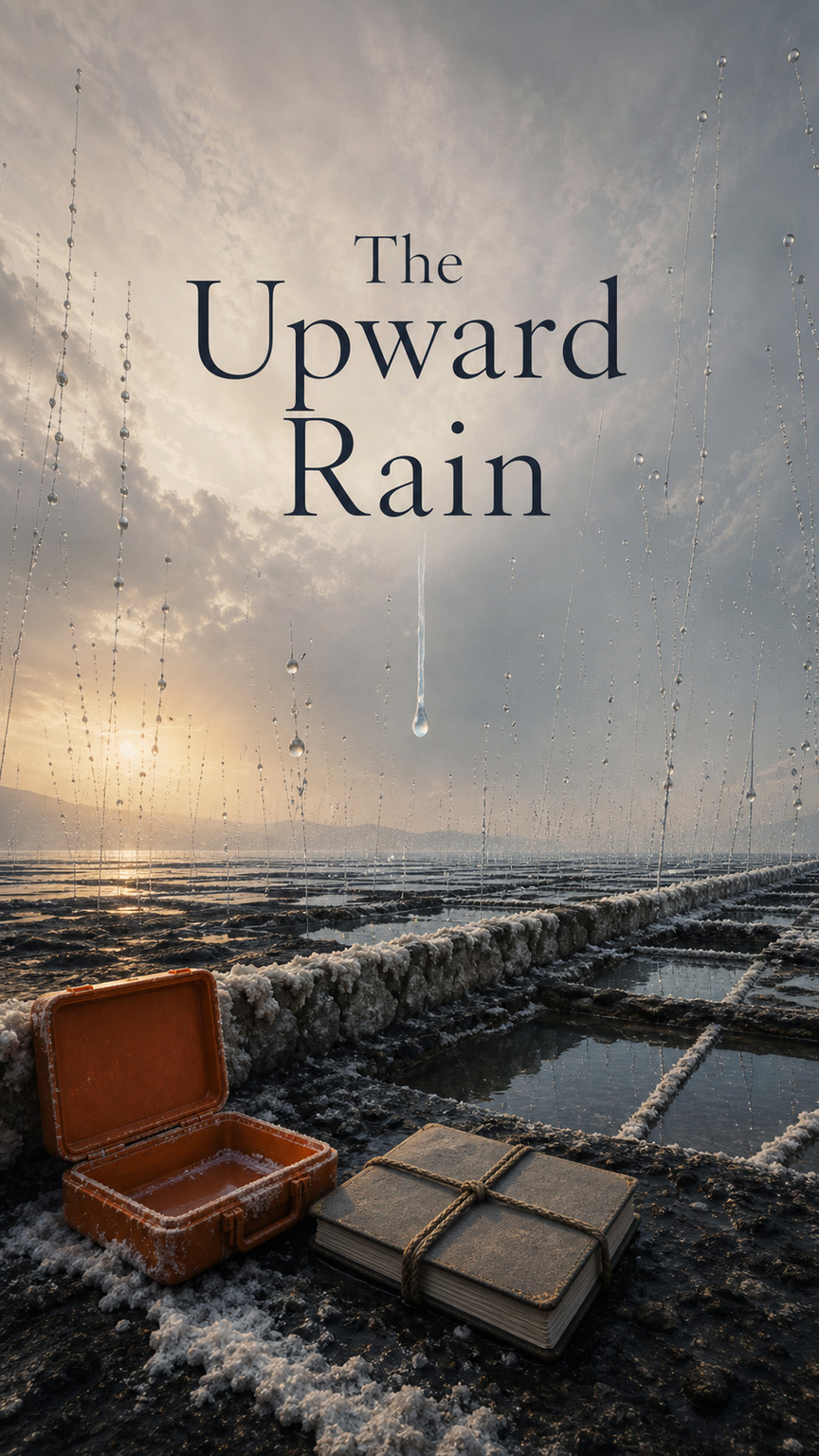
At 06:11 the sea began to leave by falling upward.
Anouk Verren watched the first beads lift from the black water beyond the breakwall. They rose separately at first, each catching the work lamps, then in silver ropes. Within minutes the ropes became a sound like grain poured onto canvas. The open sea lowered while a white ceiling thickened above it, flat-bottomed and fixed over the coast. Rain striking the harbor reversed as it fell. Drops slowed, trembled, and went back to join the salt cloud.
The oldest mast logs had been written by crews now dead. No one on the coast expected to work this day twice.
Water remained under the loading pier and in every covered sump. Beyond them, isolated pools shone on the emerging shelf. Mud did not dry merely because the weight above it had gone.
Jessa Marn pulled the return line through Anouk’s harness buckle and slapped the gate shut. “Say your ceiling.”
“Seven-point-two kilometres outward. No extension.”
“Turn signal?”
“Three pulses, continuous tone.”
Jessa looked past her to Kasim Orrel. He was retaping a camera latch that did not need retaping. “And what do you do when I send it?”
“Turn.”
“Say the rest.”
“Acknowledge, then turn.”
“Good. Noon estimate is an estimate. The mast tells me pressure and cloud shear. It does not tell me when your channel fills.” She tapped the radio on Kasim’s chest. “Primary records mirror to shore. Both recording streams running. Marker check every kilometre. Lines stay tied at the two cut channels. All gear is abandonable.”
Anouk rested a hand on her narrow orange sample case. Empty, foam-lined, almost weightless. “Understood.”
Kasim glanced at the case, then at her. “Everything?”
“Everything,” Jessa said before Anouk could answer. “Acknowledgement.”
“Understood,” Anouk said.
“Acknowledged,” Kasim said.
The exposed bottom widened by the minute. It was no clean descent into revelation. Weed lay in dark braids. Flatfish beat shallow hollows into mud. The air, chilled by kilometres of uncovered shelf, rushed seaward hard enough to shake the marker flags they had planted from boats during the previous week. Far overhead the cloud held the missing sea, its underside the colour of old salt.
They crossed the normal low-water line at 06:34.
At the first marker Anouk called range, wind and surface temperature. Kasim called the line knot and the marker’s lean. Jessa repeated the time and made each of them acknowledge. It was tedious, ordinary, and the only reason Anouk’s breathing settled.
Then they came to a stranded pool two hundred metres across, much of its surface sheltered beneath the broken lips of a rock basin. Small silver fish crowded its rim. Egg ribbons covered the weed, and a dozen broad-backed juveniles worked their fins under the surface, stirring the water cloudy.
Anouk’s plotted route went straight through the eastern shallows.
Kasim stopped. “North side.”
“Adds four hundred and sixty metres.” She checked the range wheel, then the pool. “Possibly five.”
“North.”
There was no safe argument for crushing a nursery to save nine minutes. She disliked that he knew she would calculate one anyway.
“Jessa, reachable pool at marker one plus eight. Juveniles, egg beds, likely oxygen stress by late morning. Sending coordinates. Shore team only; no shelf deployment.”
“Received,” Jessa said. “Nearest crew can reach the landward edge. They choose what they can handle. Continue north.”
Kasim had already started around. He did not thank Anouk, which was better than if he had.
At three kilometres the shelf became a rumpled plain of silt. The anomaly had lifted roughly thirty metres of water off the bottom here, more farther out. Unloaded sediment vented gas in blisters that burst with a rotten mineral smell, then slumped into soft-edged bowls. Anouk kept them east of the largest pockmarks and took a section photograph at every change in grain.
Kasim angled toward a pale ridge barely higher than the mud.
“That bends south,” Anouk said.
“It comes back.”
“After six hundred metres. My contour reaches marker four in three-fifty.”
“Your contour crosses breath ground.”
She waited for more. He crouched and pinched shell gravel from the ridge, his silence deliberate.
“Is that a measured condition?” she asked.
“It is a route condition.”
“That isn’t an answer.”
“It was an answer before your institute changed it to ‘unverified coastal recollection.’”
The old wording was not hers, though it had appeared beneath her lead authorship. She had corrected recollection to route tradition in the second proof. She had not delayed publication when the correction disappeared.
Anouk set her pole toward the shorter contour. “I’m taking three-fifty.”
“Not through the dark fans.”
“They are drainage stains.”
He let three steps pass. “Left. Now.”
The ground inflated beneath her boot.
Kasim caught the back of her harness and pulled. The mud ahead opened without drama, a two-metre slab sliding into a hollow as pale gas hissed through it. Anouk fell to one knee. Her section probe, clipped along her pack, struck the edge and bent at the coupling.
“Back on my prints,” Kasim said. No grievance now, only direction. “Heel to shell. Don’t load the grey.”
“The stable strip is point-six wide.” Fear sharpened every number. “Your left boot is eleven centimetres from the boundary.”
“Then use the middle.”
She did. Once on the ridge, she checked the probe. Its casing had split; the sensor answered with a salt-noise error.
Jessa cut across their report. “Injuries.”
“None,” Kasim said.
“Anouk?”
“No injury. Probe compromised. We lost four minutes, thirty seconds, plus route correction.”
“I asked for injury.”
“None.”
“Acknowledged. You are both on the raised route now?”
Anouk looked at the shell gravel under her boots. It was too evenly graded to be a natural bar. “Yes.”
“Say it, Kasim.”
“Both on route.”
They moved.
The ridge had not merely survived the sea. People had kept making it survive.
Kasim saw the repairs in sequence as the light strengthened: fist-sized shell packed over older crushed beds, stone curbs reset with their worn faces turned inward, gaps bridged by slabs whose tool strokes came from different hands and different methods. The route rose no more than a boot above the shelf, but wherever the mud had slumped, it held.
His grandmother’s tide verse had named no king. It counted safe bearings from a split headland to a reef shaped like a sleeping hand, then to “the six works where fresh meets bitter.” At the institute table, spoken measures had become atmosphere while Anouk’s contours became evidence. Since then he had learned to spend context carefully.
At marker five the pale ridge met what the old charts called the royal avenue. Anouk planted the range pole and stared at the cut face of a collapsed bank.
“Stop,” she said.
Kasim waited.
She scraped three narrow windows in the silt with her trowel, one above another. “The avenue surface crosses this lower storm bed. Twenty metres on, it sits above the upper bed. Farther west it cuts both. A single paved approach can’t occupy three sediment ages unless it moved or was repeatedly rebuilt.”
“Or unless it isn’t an avenue.”
“That remains an alternative.”
He almost laughed, not because it was funny. Alternative was Anouk’s word for the door she left unlocked when she did not want to enter a room yet.
He pointed down the pale route. “Three curb styles so far. Pecked sockets, split wedges, then the narrow chisel. Repairs come from both directions. This stretch was relaid after the west branch failed.”
“Can you reproduce that order from the marks?”
“Camera.”
She gave it to him instead of asking again. He recorded the joins, running one gloved finger beside the changes without touching them. Anouk laid scale tabs. Her paper notebook received a quick section: lower bed, upper bed, road metal, cut relationships. His route map received arrows for the repair sequence.
Neither evidence made the other true. Together they made the royal avenue unlikely.
At 09:17 the ridge delivered them to Namarra.
The legendary crown court stood only waist-high. Its roof and upper walls were gone, leaving ranks of stone cells open to the salt cloud. Sluice sockets pierced the partitions. Pale lime coated some basins in thick, repeated layers; others held oyster scars and small branching reefs, still wet and bright. Rectangular absences lay between them where entire structures had been lifted from their seats.
Kasim walked the perimeter first. Every opening had wear on the waterward edge. The supposed throne at the centre narrowed into two low wings, one face smooth from centuries of flow.
Anouk stopped beside it. “Divider.”
“Yes.”
“Not a seat.”
“No.”
Wind moved through the empty cells with a bottle note. For a while they said nothing.
Kasim knew the old public rendering: a gold-roofed hall, the drowned king holding court while divine rain swallowed his capital. Children along the coast knew it too. But these floors sloped. These sockets had taken gates. Fresh water, when it came down from land, could have been held and mixed here with the tide. The cells might have grown shellfish, nursed reef, settled silt, or done all three in different seasons. A commons was not less difficult than a palace. It was only harder to put on a coin.
“Marks,” he said.
At the base of the divider, shallow quarry signs repeated in clusters. He counted aloud while Anouk filmed.
“Forked line. Two cups. Bar and notch. Closed eye. Three strokes. Crescent cut.”
“Six groups,” she said.
“Six marking groups. Don’t call them six communities yet.”
She lowered the camera a fraction. “Correction recorded.”
The shell-lime told its own sequence under her lens: coarse white aggregate, darker repair, white again, then a red-flecked cap. Kasim found sockets narrowed with inserts, cracked gates reseated, and a drain mouth polished by more water than a ceremonial room should ever admit.
Behind the cells, paired grooves ran upslope toward the distant coastal rise. Dismantling scars stepped across the empty building seats: wedge cuts, lever bruises, clean gaps where fitted blocks had been removed rather than broken.
“Haul line,” he said. His voice came out too softly for the recorder.
Anouk angled it toward him. “Repeat.”
“Possible uphill haul line. Components removed in an order. Gates first, capstones after. They had time.”
“Or returned over multiple low-water seasons.”
“Look at the socket fill. Same growth boundary.”
She knelt, measured, then changed pencils. “Dismantling within one bounded interval is better supported. Planned retreat remains an interpretation.”
“Better than a king who waited on his chair.”
“It does not identify their politics, Kasim.”
“I didn’t say it did.”
He turned away before they could rebuild the institute table here. There was work: six mark groups, four lining phases, three gate widths. A channel map to draw. A place that had been maintained by many hands and emptied with care.
He could call this much without calling the rest: a floodable reef-and-water commons, kept by several work groups and dismantled uphill in a planned retreat. No king proven. No capital, no cause of the drowning, no claim over whatever else Namarra had been. Beyond the mapped works, his page stayed blank.
The red-flecked lining moved under Anouk’s pick.
Only half a millimetre, but enough to promise a clean flake. Mineral analysis could separate the repair phases, perhaps source the aggregate. She set the sample case beside the basin and slid a thin blade under the lifted edge.
Kasim put two fingers on the case lid. “No.”
“It’s already detached.”
“It keys the lining beside it.”
“I need less than three grams.”
He pointed, not at the flake but at the hairline cracks radiating into the damp wall. The basin had lost the water pressure that normally supported it. Even Anouk’s breath seemed to trouble the surface.
“You take that,” he said, “the next course opens.”
“A consolidator can—”
“No one gets here before the return.”
She held the blade still. Three grams would turn possible phases into ratios, dates, provenance. Three grams could also take a palm-sized skin with it, and the water coming back would finish the tear.
Anouk withdrew the blade. “Scale and oblique light.”
Kasim released the case. “I’ll hold the reflector.”
They recorded the flake in place.
At the uphill edge, however, Kasim kept looking toward the paired grooves. They passed marker seven and continued to 7.08 kilometres, where the grooves climbed through a tumble of dressed blocks. Above, the exposed line pointed toward a dark shelf at the base of the coastal rise.
“We can reach the first seat,” he said. “Twenty minutes.”
“Twenty-two outward at our present grade. Twenty-eight back if the mud remains unchanged.”
“You can’t know twenty-eight.”
“I can bound it. We have forty-one minutes of return reserve, excluding a channel delay. At the seat we’d have minus nine to plus four.”
He stared uphill. The route annotations in his hand had become tight black layers. “One image. Not a survey.”
“No.”
“The haul direction is the custody chain.”
“And it will still point uphill after today. We won’t.”
For three breaths he said nothing. Then he drew a hard stop across his map at 7.08 and wrote the bearing beside it.
“Turn point,” he said.
Anouk called it to Jessa.
Static burst over the reply. “Turn confirmed. Cloud base has begun shearing east. Earlier than the weather pairs. I am not giving you a minute. Start return documentation now, ten minutes maximum.”
“We need eighteen,” Anouk said.
“You have ten. Acknowledge.”
A cold drop struck Anouk’s wrist. Unlike the silver beads still streaming upward from exposed channels, this one ran down into her glove.
“Downward rain at seven-point-zero-eight,” she reported.
“That is the warning. Acknowledge ten.”
“Ten acknowledged.”
Kasim keyed his radio. “Acknowledged.”
They worked without a thesis. Anouk numbered section drawings and read only orientations and uncertainties into the recorder. Kasim corrected gate direction twice. He mapped repairs, not meanings. The camera passed between them until salt condensed along its grip.
At minute six Anouk’s recorder gave a long digital chirp. Every level on its screen rose to white.
“Salt bridge,” she said. She pulled the power. “Local file may be corrupt from 09:03.”
Kasim had already spread her paper sections across the closed sample case. “Camera time is good. My route notes start at marker two.”
“Your page order?”
“Blue corners outward. Green return.”
“Jessa, prepare composite ingest. One failed recorder. Sources are paper sections, annotated route sheets, camera audio and image.”
“Ready. Give custody before files.”
Kasim looked at Anouk. Rain ticked downward among the upward streams, two directions briefly sharing the air.
She said, “Joint discovery credit. Separate responsibility: Verren, sections and stratigraphic alternatives; Orrel, route sequence, masonry repair and practice.”
“Coastal archive receives the same set,” Kasim said. “Coordinates embargoed.”
“Embargo pending site protection review. Neither party may publish coordinates or authorize removal alone.”
“Both retain full copies,” he said.
“Both retain copies. Checksums to Marn and archive at transfer.”
Jessa interrupted. “I need each voice on all terms. Kasim first.”
He repeated them, less neatly, looking at the grooves that continued uphill. Anouk repeated them after him. Joint credit; named separate responsibilities; mirrored full files; two checksum recipients; location embargo; no sole publication of coordinates, no sole authority to remove material.
“Received and mirrored,” Jessa said. “Archive handshake pending. Pack. Turn now.”
Anouk closed the empty sample case.
The first old channel filled before they reached marker six.
Kasim heard it ahead, a low cluttering rush. Downward drops had become steady rain, collecting in every crease while open water continued to bead skyward from the deeper cuts. The mixed motion confused distance. A shallow runnel could look like a solid grey path until it folded around a stone.
Anouk led them onto a series of sandstone ribs above the forming flow. She moved by numbers now.
“Bearing two-eight-four. Rib width one-point-three. Gap in eleven metres.”
“Your right side is rotten,” Kasim said.
“The contour holds.”
He struck the rib with his heel. The surface answered hollow. “The contour isn’t footing. Left seam.”
She shifted without argument. At the gap he found a chain of fitted stones under the weed, remnants of the raised route, and placed each boot before waving her across.
Behind them gas burst through their earlier shortcut in a row of pale fountains. The mud sagged. The direct contour vanished into a widening bowl.
“Marker six line?” Jessa asked.
“Visual,” Kasim said. “Channel between.”
“Depth?”
“Growing.”
“I need a number.”
Anouk crouched at the edge. “Eighteen centimetres at the staff. Plus four per minute, uncertain by one.”
“Cross now. Acknowledge.”
“Acknowledged,” they said, not quite together.
The preplaced line bowed in the current. Kasim clipped in first and crossed sideways, testing for the buried curb with his toes. Halfway through, the damaged probe on Anouk’s pack caught the line and swung her downstream.
“Drop it,” he said.
“The memory unit—”
“Is salt noise. Drop.”
She unclipped the probe. It vanished into the brown water. At the far bank the orange sample case wedged between two stones. Empty, it pulled hard enough to tilt her.
“Case too,” Kasim said.
She cut it free.
At marker four the salt cloud darkened from below. What had been a ceiling became a hanging sea, mottled by currents no shore instrument could see. Jessa’s continuous tone sounded in their radios, three pulses first.
“Turn signal already obeyed,” Anouk said, breath clipping the words. “Why repeat?”
“Return ceiling,” Jessa replied. “You have seventy-three minutes to the high line by present pressure trend. That is a warning, not a promise. Acknowledge.”
“Seventy-three. Not a promise. Acknowledged.”
Kasim pressed his transmit key twice before he had air. “Acknowledged.”
The nursery pool had overflowed its eastern rim, exactly where Anouk’s original route would have taken them. The juveniles still circled in the deep centre. At the landward edge, two shore workers in orange suits had reached the basin with aeration packs and small transport tubs. They had not saved the shelf. They had chosen what could be reached.
Kasim took the northern detour again.
“Shorter across the rim now,” Anouk said.
He looked once at the stirred water.
“North,” she said, correcting herself. “Four hundred and twelve metres.”
By marker two their speech had worn down to parts.
“Rib.”
“Soft left.”
“Line.”
“Clipped.”
“Foot.”
“Found.”
At marker one the archive tone sounded: three clean notes from Kasim’s radio. He nearly stopped.
Jessa did not let him. “Archive checksum matches both mirrored sets. Coordinates sealed. Keep moving.”
Anouk breathed beside him, each exhale a small raw sound. “Paper?”
“Inside layer. Dry.”
“Camera?”
He slapped the chest pouch. “Here.”
That was all.
They reached the high line as the upward beads thinned. Jessa came down the last stones, clipped a second rope into Anouk’s harness, then Kasim’s, and hauled without asking what they had found. Together they dragged the surviving packs above the breakwall.
The salt cloud released before they cleared the instruments.
The sea did not fall as drops. It came down as one white moving wall beyond the harbor, swallowing the exposed shelf from its channels outward. Wind flattened the three of them over the mast case. Jessa counted the latches as they crawled it inland.
“One.”
Kasim locked the lower catch.
“Two.”
Anouk locked the upper.
“Cable.”
“Clear,” Kasim said.
“Say it, Anouk.”
Anouk looked once toward the place where Namarra had been visible: no throne, no court, only gates, repair marks, emptied seats and a route continuing uphill under the returned water.
“Clear,” she said, and they pulled.