The Vacant Throne
Fifteen years ago, the human king and the demon queen fought a legendary battle that resulted in the king's death. The throne remained vacant until a half-demon child appeared bearing the royal sword.
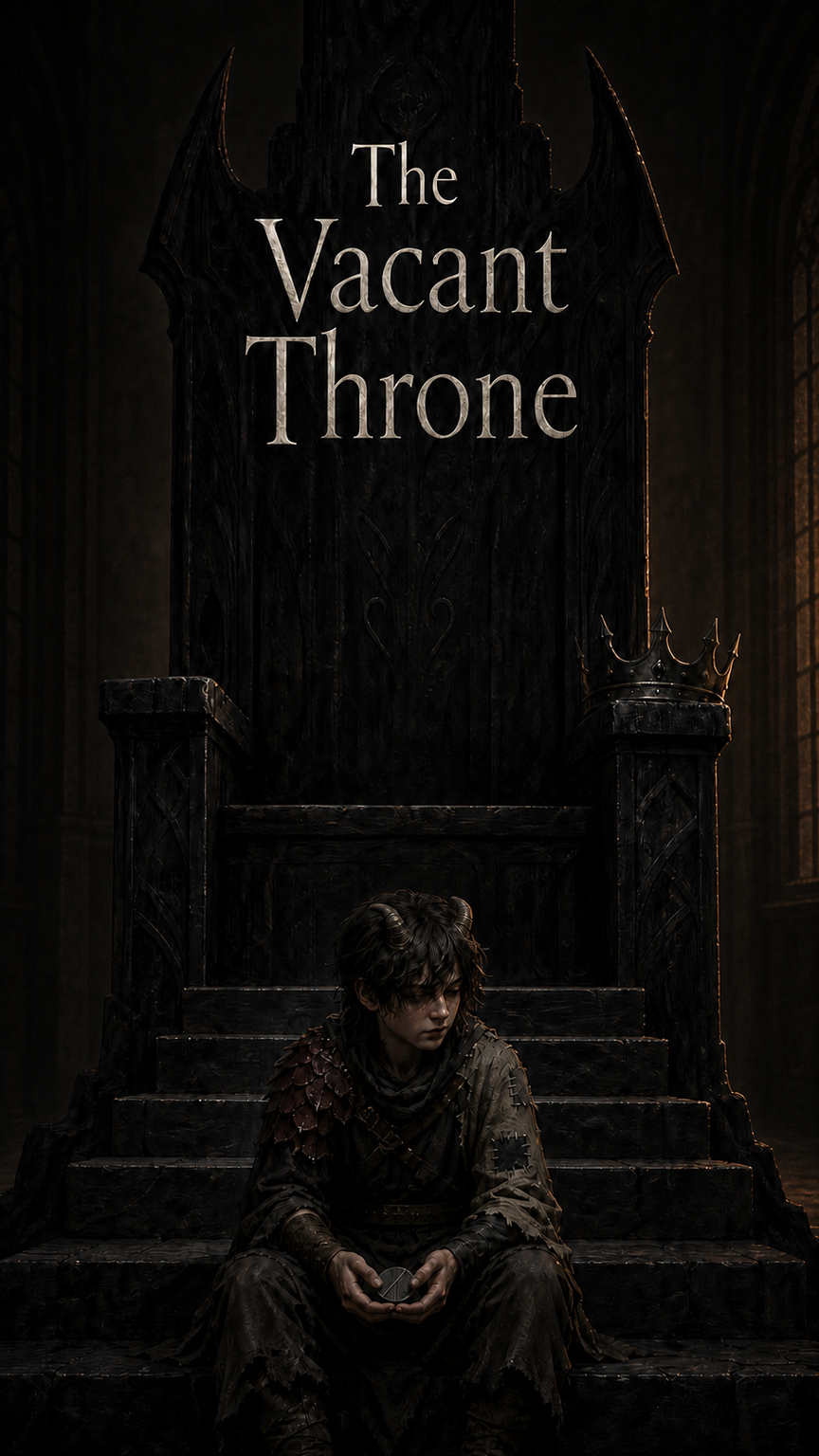
Before dawn, the Seatkeeper found a dead moth in the hollow of the throne.
It had battered itself pale against the high windows and fallen between the seat and the carved back, where no servant had dared reach beneath the mourning cloth. She pinched it by one powdery wing and carried it down the seven steps. The throne had been vacant for fifteen years. Dust might touch it. Sunlight might. No living hand had.
At the foot of the dais waited the crown and the succession skin. Her seal lay beside them in a cedar box. By sunset the red wax would hold either a new sovereign’s mark above her bounded regency, or her mark alone above the closing line of the caretaker compact. She had spent half her life preventing that second impression from looking like hunger.
The silence had begun at moonset. Black cords bound the court’s sleeves, and until the sun dropped behind the western wall, no human voice could take part in the anniversary. The custom was older than her brother’s death, meant to deny boasting to victory and excuses to defeat. In fifteen observances it had become chiefly a way to survive remembering him.
The First Captain stood below the open doors with his sword belted and his command staff under one arm. His hands had already rearranged the palace. Two fingers sent guards to the gallery. A flattened palm closed the river gate. A turn of his fist thickened the line before the throne room. He wore no mourning cord.
The Seatkeeper looked through the doors at the crowded antechamber. Three rival houses had arrived before midnight, each carrying enough cousins to become a future. Their banners hung furled by law, bright fringes showing beneath their black covers. At sunset the compact expired. If she did not take the crown, someone would try to take the room.
She closed the cedar box and began the coronation route backward.
Her brother had once walked it from gate to throne through thrown petals and ringing bronze. She had followed six paces behind, watching a loose thread tremble on his shoulder. Now she passed from the throne room into the memorial court, where his stone likeness lay with both hands empty; through the long gallery of ancestral faces; across the rain court; and down toward the outer gate. At each threshold she tested the seal and counted the guards. The Captain followed, correcting her counts with small movements of his staff.
The sky had paled enough to show the gate towers when the wicket opened from outside. The gatekeeper stumbled backward. A child came through after him.
They were perhaps fourteen, perhaps younger beneath the dirt. A hood covered most of their head, but two blunt horn tips had worn holes in the cloth. Dust made a mask of their face except where sweat had cut tracks from the temples. Their coat was demon work, scaled at one shoulder with overlapping red leather, and human work at the other, patched in square stitches by someone impatient. A round iron signet hung against their chest.
The royal sword hung at their hip.
It was too long for them. The scabbard struck every third paving stone, and their hand stayed locked around the belt to keep its weight from dragging the buckle loose. The blue enamel of the pommel had been burned brown on one side. Below it, just visible through a split in the grip, ran a wire repair no court copyist had ever recorded.
The Captain’s staff came level. Spears crossed behind the child.
They stopped. Their gaze moved from the spearheads to the walls, to the wicket still open at their back, and then to the Seatkeeper. Their eyes were dark red around human-gray irises. Not flame. Not omen. Merely eyes narrowed against a dawn they had been awake too long to meet.
The Captain opened one hand for the sword.
The child’s fist tightened on the belt. With the other hand they covered the signet at their chest. Their shoulders rose, ready for a blow or flight, though the scabbard had already trapped itself between their ankles.
The Seatkeeper stepped under the Captain’s staff.
Up close, the sword was worse than any replica would have dared. The scabbard bore white scratches beneath newer travel stains. A crescent of the guard had melted. One side of the grip had been rebound in black cord, but the old repair remained: a double strand of copper passed through three holes in the sharkskin, crossed once, and knotted under the king’s forefinger.
She had made that repair at sixteen, furious with her brother for breaking the grip against a pear tree. She had used wire stripped from their mother’s ruined astrolabe and hidden the knot because her work was ugly. Her brother had liked the roughness beneath his finger. On the morning of his last campaign he had rubbed it while she fastened his cloak.
The sword did nothing now. It gave off no heat. It leaned with all its ordinary weight against a hungry child’s hip.
The Seatkeeper raised both empty hands. Then she took one step back and turned toward the palace. After a moment, the child followed. The Captain lowered his staff, but he did not dismiss the spears.
On a coronation morning, the long gallery displayed bowls of saffron, salt, coins, and winter fruit, each an old promise made visible. No one had thought to remove them for a succession expected to begin at sunset. The child reached the first bowl, seized a plum, and bit through its bitter skin.
Purple juice ran over their knuckles. A court usher flinched as if a treaty had been torn. The child saw him, looked at the row of untouched bowls, and chose a second plum. This one disappeared into their coat.
The Seatkeeper almost smiled. The impulse hurt more cleanly than grief had in years.
She led them beneath the painted kings. The Captain kept to the child’s sword side. Behind him came the keeper of seals, two judges, six guards, and the boldest members of the waiting houses. The procession swelled whenever a side door opened. It was already turning the child’s hunger into pageantry.
At the portrait of the late king, the child stopped.
The painter had given him a broad, painless face and a hand resting lightly on the sword. Nothing in it resembled the man who had climbed wet roofs, hoarded quince paste, or laughed with his whole spine. Nothing resembled the body returned from the battlefield either. The child studied the painted hand. Their own thumb began to scrape across the first knuckle of the forefinger.
Her brother had worn that patch of skin smooth whenever he waited for someone else to decide.
The Seatkeeper reached before she meant to. The child recoiled so sharply that the sword struck the wall. Guards caught their hilts. The Captain’s staff snapped upright.
No metal cleared leather. In the held breath afterward, the Seatkeeper lowered her hand. She had intended to turn the child’s wrist toward the light, to find proof in bone and habit. What she had shown instead was how quickly kinship could become inspection.
The child rubbed the bumped scabbard with their sleeve. They would not look at her.
She turned to remove the line of people behind them. It took time. The rival houses mistook the first sweep of her hand for an invitation forward. The judges mistook the second for a demand that they surround the child. One guard backed into a saffron bowl and stood in yellow dust while the child watched with exhausted, unwilling amusement. At last the Seatkeeper pointed every unnecessary witness toward the side doors and waited until obedience became less embarrassing than refusal.
The gallery emptied to the child, the Captain, the keeper of seals, and one judge from each rival house. The spears remained at the far end.
The Captain’s jaw worked beneath the scar that divided it. Yet when the child resumed walking, he moved half a pace farther away from the sword.
At the rain court, sunlight found the signet on the child’s chest. The Seatkeeper knew its shape from old border documents and the broken standards carried home after the battle: an iron disk wider than two fingers, its face divided by a deep diagonal groove, one half polished, the other stippled. The demon queen’s seal had authorized granaries, marriages, troop roads, and executions long before human songs reduced her to horns above a field of fire. This signet was battered at its edge and dark with the grease of constant handling. It might have been stolen. So might the sword. Together they proved possession, not birth, and possession proved no purpose at all.
The child shifted the disk under their coat when they noticed her attention.
The Seatkeeper turned her eyes away first.
The memorial court had been built around an accusation.
Her brother’s stone figure lay at its center, his empty hands lifted upon his breast. Above him, a wall mosaic showed the last battle as the survivors preferred it: the human king in white mail; the demon queen enormous beneath a red sky; their blades meeting in a burst of gold. Along the floor, a black stone band represented the burned field. Visitors placed human mourning tokens on the raised bier and cast enemy tokens into a bronze ash basin at its foot.
The child entered and became still. The Captain indicated the sword rest on the bier. The keeper of seals uncovered the ash basin. Every trained gesture in the room offered the same bargain. One inheritance could be honored. The other could be discarded.
The child looked at the Seatkeeper.
She had meant to give reassurance. Instead she glanced at the sword rest, too quick and too plainly. The child’s mouth hardened.
They unbuckled the royal sword. The Captain leaned forward. The child carried it past the bier and laid it on the black floor band beneath the place where the two mosaic blades met. Then they took off the demon signet.
For an instant the Seatkeeper expected iron to strike bronze. The child set the signet beside the sword.
They knelt on the battle line, not on the king’s white marble and not on the red field assigned to the queen. Their head bowed until the horn tips touched the scabbard. One hand closed around the signet; the other held the ugly copper knot in the grip. The pose had no place in court ritual. It was unbalanced and uncomfortable. After a few breaths, the child’s knees slid on the polished stone, and they caught themselves with an elbow.
No one moved to help.
The Seatkeeper saw then what the court had required of them: not evidence, but amputation. It had made her brother easier to mourn by leaving no space beside him for the child who had survived him. It had made an enemy eternal so no one need wonder what had passed between king and queen before the killing blow, or why the sword had crossed the border in her keeping.
She did not know whether the demon queen lived. She did not know whether the queen had sent the child as heir, hostage, weapon, or burden. The child’s bent head answered none of it. Grief was not testimony, but it was still grief.
The Seatkeeper lifted the bronze ash basin and carried it to the wall. Its feet shrieked faintly across the stone. She set it beneath an old rain stain, far from both child and bier. Then she sat on the black band, not beside the child but near enough that they could choose the distance.
Around the court, certainty broke unevenly. The keeper of seals lowered his eyes. One judge knelt on the white marble; another remained standing. The Captain watched the passage behind them, counting bodies and exits because that was the shape fear took in him.
The child raised their head. Their cheeks were dry. After considering the Seatkeeper for several long breaths, they took the hidden plum from their coat and rolled it across the black stone. It stopped against the hem of her robe. The Seatkeeper set it between them. She did not eat it. Neither did the child.
At the throne-room doors, the First Captain barred the way.
Sunlight had reached the upper windows. Less than an hour remained before it touched the western wall, and the antechamber beyond the Captain had filled again. The rival houses stood in ordered blocks. Their covered banners were now upright. The silence had sharpened every shuffle, buckle, and drawn breath.
The Captain planted his command staff across the threshold. He pointed to the royal sword, then to the hands of the waiting guards.
The child stared at him. Sweat had pasted their hair to their temples beneath the torn hood. The sword belt was slipping again. For one ugly moment the Seatkeeper feared they would draw. Not because the sword had willed it, or blood demanded it, but because tired children made terrible choices when adults arranged the room to leave only terrible choices.
The child turned around, walked back into the memorial court, unfastened the belt, and placed sword and scabbard in the center of the open floor. Then they returned empty-handed. The weapon lay beyond their reach and beyond the Captain’s threshold. It belonged to no one’s custody but the witnesses’.
The Captain kept his staff raised. The Seatkeeper removed the audience again.
This time there was no confusion in her gesture. She pointed to the outer gallery, then to each house in turn. Silk shifted. Faces flushed. One by one the blocks broke apart and withdrew until only the three judges, the keeper of seals, and six palace guards remained. The Captain tightened his grip. She pointed the guards out as well.
His eyes found hers. Fifteen years of service stood between them: riots contained, borders held, assassination letters burned, nights when his soldiers had been the only thing between caretaker and crown. She knew what he protected. A command without a monarch became a private army by increments, each defensible on the day. He knew what she had permitted. A vacant throne had let them both call possession duty.
The Captain looked past her to the child. They had begun picking dried plum skin from beneath one thumbnail.
His staff lowered a finger’s breadth. The child noticed. They straightened and attempted the soldiers’ closed-fist salute. They used the wrong hand, struck their collarbone too hard, and winced. It might have been mockery. It might have been effort. The Captain’s face passed through offense, surprise, and something close to shame.
He stepped aside before anyone had sworn loyalty. The child crossed the threshold.
The vacant throne made them look smaller.
It made everyone smaller; that was part of its design. The blackwood back rose twice a person’s height, carved with human victories until no bare grain showed. The child approached only as far as the first step. Their attention fixed on the side passage through which they had entered. The route back to the sword remained open.
From gate to throne, the Seatkeeper had weighed the claim. The private repair and battle damage made the blade more than a court copy. The signet matched the queen’s old impressions down to its chipped rim. The child’s age, mixed features, and unconscious family habit made theft alone a poorer answer than inheritance. Any piece might deceive; together they met the old law’s threshold for a minor claimant under witnessed regency. They revealed nothing about the queen’s purpose, and promised nothing about the ruler the child might become.
The Seatkeeper laid the succession skin on the low table. Its old marks were simple: a sovereign’s chosen figure in the upper circle, a regent’s seal inside a boundary below, military submission at the foot. No mark could prove parentage. No wax could make a good ruler. The instrument could only record what living people had risked in one another’s sight.
She opened the cedar box. Her seal showed a key laid across an empty chair. For fifteen years it had granted her power to preserve the estate, collect revenue, appoint judges, and command defense without occupying the throne. At sunset the outer ring would become void. A minor sovereign could renew her service only inside a smaller ring, ending at majority and forbidding her to alter the succession, begin a war, or dispose of the royal household. Those limits were cut into the bronze rim as notches any witness could count.
She warmed the wax. Before the child touched stylus or crown, she pressed her seal into the bounded circle.
The impression came out crooked. One side of the chair vanished into red. Good. Let it be plain that she had bound herself before she knew whether they would choose her.
She placed the stylus beside the upper circle and retreated from the table. Then she took the crown from its cushion and set it on the lowest throne step, leaving both the side passage and the main doors clear.
The child could walk out. The Captain’s staff no longer blocked the way. Their sword waited in the memorial court. Whatever the queen intended, whatever the kingdom desired, the space around the succession table held no hand but theirs. The light climbed the western wall.
The child approached the skin. They examined the Seatkeeper’s impression, tracing the boundary notches without touching the wax. Their hand went to the demon signet, still hanging at their chest. The keeper of seals offered a shallow dish for it. They ignored him.
With the signet clenched in the left hand, they took the stylus in the right. The first stroke tore the prepared surface. The second wandered. They frowned, scraped a patch smooth with the stylus handle, and began again. This time they made a small figure of three joined angles, cramped but unmistakably deliberate. Then they put the stylus down.
No fire passed through the room. The sword remained on the memorial floor. The mark was valid because the child had made it freely before witnesses, and because the adults present would now be answerable for honoring it.
The First Captain came to the table. His command staff ended in an iron cap worn bright by his palm. Once impressed beneath a sovereign’s mark, it submitted the palace garrison and dissolved every emergency authority he had accumulated during the vacancy. He held it above the wax long enough for the sun to touch the final row of carvings.
Then he pressed down.
The keeper of seals folded the skin. The three judges set their plain witness marks along the seam. The caretaker compact ended inside the same breath as the regency began.
The Captain went to one knee. The judges followed, one readily, one stiffly, one after looking toward the empty gallery. The Seatkeeper knelt last. She did not bow to the sword, the signet, or the mingled blood courtiers would soon make into a story. She bowed to a tired child who had been given room to refuse and had chosen an obligation no child should have needed to carry alone.
On the western wall, the last light withdrew.
Somewhere beyond the palace, bells began to strike the end of silence. The child flinched at the first blow. The crown waited on the step, too large and much too clean.
They picked it up, turned it over, and set it on the throne’s broad arm. Then they sat on the lowest step with the iron signet safe in both hands.
No one mistook the seat for vacancy.
Night found the new sovereign in the family wing.
The Seatkeeper had opened her brother’s chamber. Its bed had been remade every seventh day for fifteen years, its shutters oiled, its winter robes aired and returned to cedar chests. The child stood in the doorway, took in the vast bed and the preserved boots beneath it, and backed away.
They chose the little map room across the corridor instead.
It had a narrow couch, shelves crowded with rolled borders, and a window seat deep enough to sleep in. The Seatkeeper sent the servants away before they could transform it into another shrine. She brought water, a basin, bread, and the royal sword herself.
The child had removed the torn hood. Their horn tips curved back close to the skull, one ridged, one chipped. They watched as she laid the sword on the window seat within easy reach. For the first time that day, their hand did not close around it at once.
The Seatkeeper placed the plum from the memorial court beside the bread. She indicated the bell pull, the water, the inner bolt. Then she stopped. Practical gestures multiplied when affection lacked permission. She could fill the room with provisions and still make it a cell.
She moved to the door and left it open.
Behind her, wood scraped softly over stone.
The child had hooked one foot around a low stool. They dragged it from beneath the map table, shoved it across the rug, and left it beside the window seat. Not close enough to touch. Near enough that two people could look through the same pane.
Their gaze met hers and darted away. One hand rested on the demon queen’s signet. The other, empty, held the stool steady.
The Seatkeeper came back into the room.
She sat where the child had put her, while the sword lay quiet between them and the door remained open.