The One Who Helped Everyone
you were the only person born with magic in your tiny remote village which means everybody came to you for help. You didn't mind you actually quite liked being helpful. That was until one day a trip of mages arrived and asked "where is the one with the absurdly massive amount of magical energy"
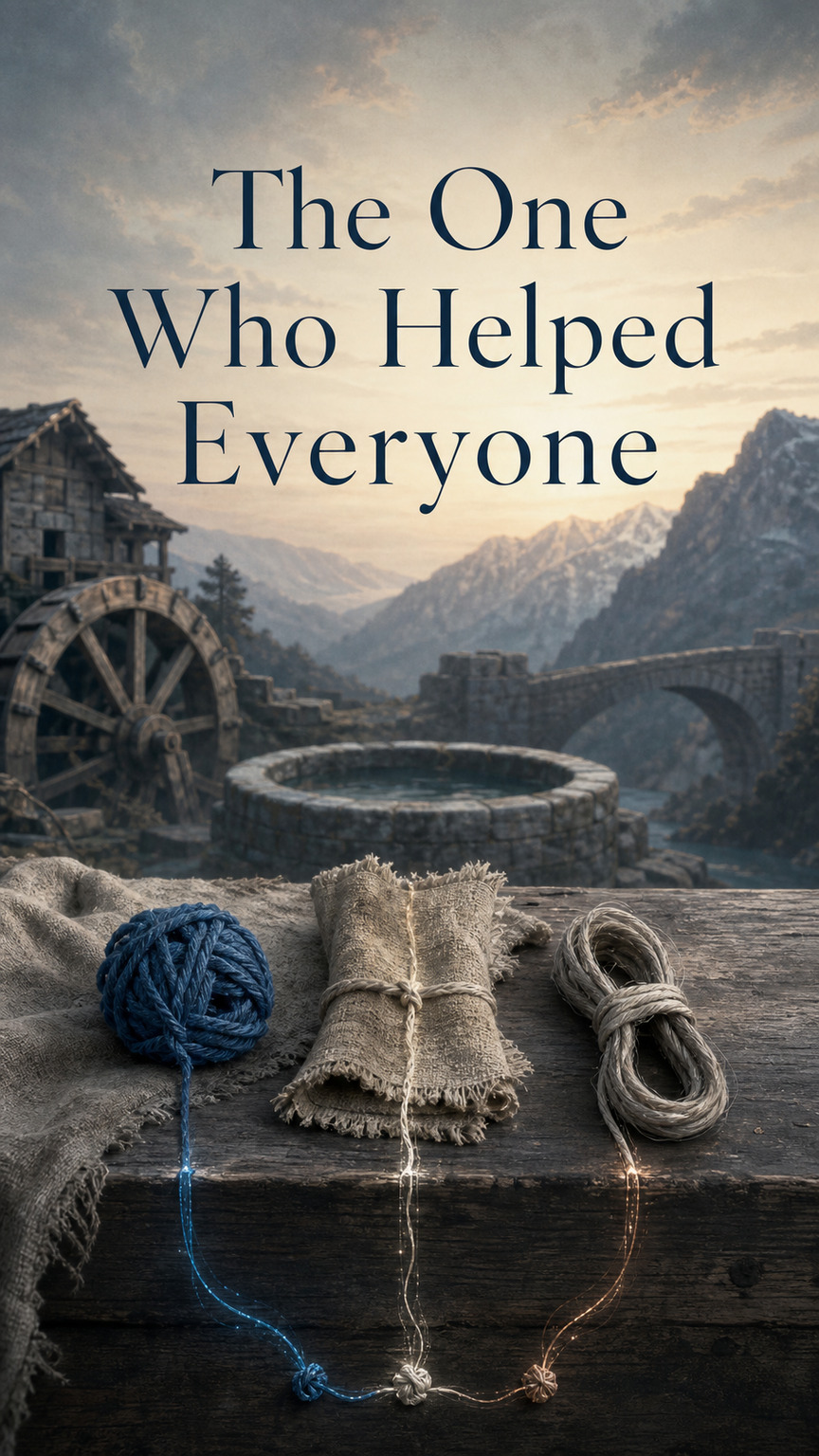
The mill had begun clicking again, once every seven turns, and Beskaret knew you could not abide a machine that counted badly.
You crouched beside the flour chute with your cheek near the warm boards. The stone’s rotation came through the frame into your teeth: six smooth revolutions, then the bronze bearing caught with a tick. Flour dust had pasted itself to the sweat on Beskaret’s forearms. He held the grain lever half-open while you reached under the housing and laid two fingers against the collar.
“Same catch?” you asked.
“Worse after noon.”
“I’ll true it. Just until you fit the new one.”
“New one’s been coming since spring.”
“Then until it gets here.”
You gave the bronze one small intention: turn as though its worn side were not worn. The work left you through your fingertips, no more effort than lifting a full cup. The collar warmed. Somewhere between it and the center of your chest, a thread drew taut, then settled into the familiar background pull.
The mill turned seven times. Eight. Nine. Beskaret opened the grain lever and listened, head tilted.
“There,” you said, pleased.
“There,” he agreed. “Now eat before somebody finds you.”
Someone had already found you. A hand appeared around the mill door, holding a child’s blue blanket.
“Aumiri? We’re done with the warm.”
You took the blanket from the child’s aunt. The old wool remembered what you had lent it three nights ago: keep this child comfortably warm. It was still feeding on your attention in a thin, sleepy way. You pressed your palm to the faded hem and took the intention back. The returning thread gave a little pluck, like a weed coming free whole.
“Fever?” you asked.
“Gone. She’s complaining about porridge again.”
“Good.”
“The east pen latch, when you’ve time.”
“Sticks or opens?”
“Opens. Only when the brindled doe leans on it.”
“I’ll come after the cistern.”
“Goats first,” Beskaret said. “They’ve gone above the scree.”
They had not gone far. At the upper pasture you touched the little iron bell you had taught to lean toward its herd, and it tugged against your fingers with the stubborn certainty of a goat choosing the wrong path. You followed the pull past two junipers and found the animals cropping leaves in a gully. The brindled doe watched you without remorse.
You liked this part: the moment a nuisance became a task with edges. Bring six goats down. Hold the cistern seam until the cooper came. Steady a ladder while someone repaired a roof. The village gave you its crooked, leaking, feverish things, and you got to feel the instant they eased.
By the time you returned the goats, there were four people waiting by the cistern and three strangers walking up the mountain road.
Lanternscrape did not receive many strangers. The road ended there because the mountain had seen no reason to continue it. These three wore dust pale to the knee and carried hard cases strapped across their backs. Fine copper vanes rose above one case and all pointed at you.
The broadest stranger stopped beside the water trough, stared at the vanes, then at the cluster of villagers.
“Where is the one with the absurdly massive amount of magical energy?”
The cistern cooper pointed at you. Beskaret, coming down from the mill, pointed too. After a moment, so did the child’s aunt.
You looked behind yourself.
“Aumiri,” Beskaret said. “They mean you.”
“No,” said the stranger with the case. “I mean the source that drew three survey needles off their stops from two ridges away.”
“That’ll still be Aumiri,” the cooper said. “Can they fix the needles?”
“Probably,” you said. “What are they supposed to do?”
The stranger opened his case on the trough wall. Inside, three silver needles quivered over nested circles. “Torrigan. Comparative load surveyor. This is a source locator, not the damaged instrument. It reads one field here at”—he tapped a scale, frowned, and shifted to another—“at considerably more than the scale allows.”
The tall woman beside him put down a narrow red case. “Velshia. Containment. Don’t touch anything in either case.”
“Nimoret. Fieldwright.” The third traveler had already crouched to watch the copper vanes. Their sleeves were patched at both elbows, and their case was soft-sided and crowded with spools. “Does the pull change when Aumiri moves?”
Torrigan walked six paces sideways. The needles barely stirred.
“It’s all around us,” he said.
“That’s less like a source,” Nimoret said.
“It exceeds a source.”
Velshia looked at you, not the scale. “Any pain? Heat under the ribs? Sound with no direction?”
“No. I was going to do the cistern.”
“Don’t.”
The cooper clicked her tongue. Water had begun beading along the patched seam behind her.
Torrigan adjusted a dial. “A locating wash will tell us whether the field is centered on Aumiri or merely passing through. It takes less than a breath. It cannot draw power.”
Velshia said, “It can make a connected system answer.”
“At survey amplitude.”
“One test,” you said. The cistern thread had begun nagging at you, a damp tug beneath the stronger pull of the mill. “Locate only. Then I do the seam.”
Velshia held your gaze. “You consent to a locating pulse. Nothing else.”
“Yes. One.”
Torrigan set two fingers to the leather pad inside his case. The silver needles steadied under his attention. The instrument supplied nothing of its own; you could feel his small current run into its nested wires, gathering shape. Nimoret stood abruptly.
“Wait. Those vanes aren’t pointing—”
Torrigan released the pulse.
Every unfinished favor in Lanternscrape answered.
The village did not explode. It lurched into doing too much.
The mill roared uphill. Water vaulted from the cistern overflow and struck the cooper from the waist down. The east pen gate slammed shut hard enough to split its old post. Somewhere above the roofs, three goats began bawling as the finding bell pulled toward every animal at once. Oven stones long gone cold breathed out summer heat. A ladder skittered sideways across a wall with nobody on it.
And you became aware of all of them.
Not as a list. As needs. Turn true. Hold dry. Stay warm. Lean home. Do not slip. Keep shut. More than you could separate, hundreds of small intentions returning through you in one bright, crowded instant. Your knees struck the road.
Velshia’s hand closed around your wrist. Cold ran from her living touch, not numbing you but giving the surge an edge to break against.
“Torrigan. Cancel.”
“The pulse is finished.” He had both hands off the pad. All three needles spun. “There should be no continuation.”
“There is,” Nimoret said. “Listen.”
For twelve heartbeats the threads quieted. Then they answered together again.
The second pulse came from inside you.
The mill kicked. The cistern boomed. Your back arched before you could stop it, and Velshia dropped to one knee to keep hold of you.
“Blanket cut,” she said. “All external lines. Now.”
“No.”
“You’re feeding a synchronized return.”
“Water,” you said. “Mill. Bridge.” The words arrived in the wrong order. “No. You don’t cut all.”
“A remote cut could recoil through every anchor anyway,” Nimoret said. They were unrolling three fine cords on the road, hands quick and voice uncertain. “If these are anchors. I think they’re answering in sequence, not unison.”
Torrigan stared at his scales. “The locator cannot have created a return interval. Its impulse is over.”
The cooper wrung water from her apron. “Your impulse woke what was already here. Is that different enough to be useful?”
Beskaret hauled the mill lever shut. The racing stone slowed, though the bearing’s thread still burned against your attention. “Argue while walking. Next one’ll come sooner.”
It did. Nine heartbeats this time.
Velshia touched two fingers to your throat and counted the next interval against your pulse. “We have perhaps an hour before the interval closes. I can sever the lot now or isolate lines one at a time if someone can identify them.”
“One at a time,” you said.
“That is not the safer choice for you.”
“It’s the safer choice for whoever’s on the north bridge.”
Nobody was on the north bridge. Beskaret knew because he had barred its lower path when the left parapet began shifting last winter.
Velshia released your wrist. “Then nobody touches an anchor until its keeper names the failure and the fallback.”
“I’ll track the interval,” Torrigan said, still too crisply.
“You’ll also cancel whatever remains of your query.”
“I told you, it ended.”
Nimoret handed him one of the fine cords. “Then cancel it again in reverse.”
He opened his mouth, looked at the spinning needles, and took the cord.
They began with the bread oven because it was nearest. You had warmed its stones two winters ago when the chimney cracked, intending them to hold a baking heat until the mason arrived. The mason had arrived. The oven had been rebuilt. Nobody had remembered to ask you to end the favor because there had been nothing wrong with a little saved kindling.
“Cold bricks won’t hurt us,” said the baker, shoving dough trays away from the wall. “Close it.”
Nimoret pressed a plain clay tag against the oven arch. It showed no magic until they laid their living fingers over it; then the answering thread showed itself as a line of pale condensation.
“This one returns through the lintel,” they said. “Aumiri, do you recognize—”
“Warm until chimney,” you said. “Done.”
You touched the lintel and withdrew the intention. The bricks cooled. A pulse passed through the village, lighter this time.
“Thirteen heartbeats,” Torrigan said.
“Longer,” Nimoret said.
“By four.”
“Which means?” the baker asked.
Torrigan watched the needles settle into a new, lower arc. “The reading isn’t stored power. Not in the way I measured it. The same modest output is circulating through many open returns.”
“Say the useful part,” Velshia said.
“Closures buy time.”
They closed the roof ladder next. The roofer brought two ropes and a man to foot it before you took away its determination not to slip. At the east pen, the brindled doe’s owner drove a fresh peg through the latch and tied a loop above it.
“Loop goes over at dusk,” she told her son.
“Unless she’s outside.”
“Especially if she’s outside. Fetch her, then loop.”
The boy nodded. Nobody thanked you when the magical hold came off. He was busy testing the peg with both hands.
At the sickroom, the child’s aunt showed Velshia three folded blankets, all ordinary now, and you lost half a minute insisting that you had already closed the blue one.
“You did,” she said. “Red one’s for the baby’s cot. Never had warm on it.”
“Blue,” you repeated.
“Done already. Come on.” She put the red blanket back without ceremony and took your elbow.
That correction steadied you more than Velshia’s cold had. One thing had ended. It could stay ended.
The visiting mages changed as they walked. Torrigan stopped announcing totals and began asking, “What changed here?” Velshia no longer named a line safe until the person who used it named what would happen without it. Nimoret abandoned their neat tags and let keepers knot scraps of local cloth around anchors instead: flour sacking at the mill, blue yarn by the cistern, goat hair at the pen. Their numbered clay had meant little to the villagers. Blue yarn meant cistern.
The intervals stretched with every closure, then shortened again. Thirteen heartbeats became sixteen, then twelve, then ten. Torrigan fed answering pulses backward through his instrument, cancelling one harmonic at a time. Velshia laid contained boundaries around clusters so that a failure in one would not jerk the others. Nimoret followed the return order with two fingers on their cords.
By sunset, the tiny conveniences were gone. A warming stone under Beskaret’s bench. A pantry hook that kept mice from worrying a sack. Three path lamps that brightened when fog came down. The remaining threads were few enough to feel separately and strong enough to frighten you.
Cistern. Bridge. Mill.
The query pulse came again. Five heartbeats later, its echo followed.
“Those three are phase-locked,” Nimoret said. “Maybe because they were all renewed in the same thaw?”
“Because they all pull from the same water,” Beskaret said. “Millrace comes off the cistern spill. Bridge footings sit below it.”
Torrigan looked from the uphill tank to the mill roof and then toward the north path. “My model treated distance as separation.”
“Mountain doesn’t,” Beskaret said. “We do cistern first.”
“Bridge first,” Velshia said. “A structural release is the worst failure.”
“Cistern first,” the cooper said. “Drain it, and the bridge footing stays dry while we prop. Open it by surprise and you’ll have three people in the runoff.”
Velshia considered her, then nodded once. “Drain line. Where?”
For the next quarter hour you did no magic. That was nearly unbearable.
You wanted to touch the sweating cistern seam and tell it to hold. Instead you carried buckets while the cooper and two neighbors fitted an old canvas hose to the cleanout spout. At the bridge, Beskaret’s mill hands wedged timber props under the cracked north rail. Below, villagers laid stones to send the draining water around their boots. At the mill, both stones had to be unloaded, the grain bagged, the race gate lowered by hand.
Everyone knew something you did not. Which hose split if bent. Which prop had a soft foot. Which goat would chew the marker knots. Your threads had made the tasks feel like yours because they returned to you. The work itself never had been.
Another echo crossed your ribs. You gripped the cistern wall and heard Velshia say, “Not yet.”
“I can hold—hold dry. Just—”
“No new intention.”
“Not new. Same. I can—”
“Blue line ready,” the cooper called from the spout.
That was language you could use. You knelt with your palm over the wet seam.
“Valve open,” she said. “Hose clear. Two barrels filled. Take it off.”
Velshia braced your forearm between her hands. Nimoret held the blue yarn marker, eyes shut, following its relationship through the wall. Torrigan watched the interval and began a low count.
You found the intention: hold this seam dry. The cooper had replaced the cracked stave eleven months ago, and neither of you had remembered that the patch still needed closing. You let the intention come home.
The seam sprang a bright fan of water across your knees. The hose bucked. The cooper swore and drove a wedge deeper. Then the water found the drain line and ran where hands and stones had prepared it to run.
Velshia caught the recoil inside her cold boundary. Torrigan reversed his count. Nimoret tore off the blue yarn.
“Closed,” they said.
The next pulse waited eight heartbeats.
On the path down to the mill, your hearing filled with its grinding complaint. Beskaret was shouting from three paces away, but his words reached you out of order.
“Upper stone—then collar—race last.”
You turned back uphill and put both hands on the bridge’s first timber prop.
“Not that,” he said.
“Bridge first.”
“Bridge is propped. Mill is next.”
“You said—upper—”
Beskaret stepped between you and the road. He walked you into the mill and put your right hand on the bronze collar inside its housing. “This piece. Feel the worn side. Grain is out. Upper stone is chocked. Close the bearing now. We keep the race until the stone stops.”
The concrete sequence cleared a narrow path through the noise.
“Bearing,” you said.
“Bearing.”
You withdrew turn true. From downhill came one brutal clank, then silence. No millstone ran loose; Beskaret’s people had unloaded it. The shaft stopped against the wooden chocks. Torrigan’s answering count faltered, started over, and lengthened.
“Twenty-one,” he said. “Only the bridge remains.”
The bridge did not care about being last. Its old intention strained as runoff pushed against the footings: hold the north stones in their places. The new timber props creaked under the weight. Two villagers stood clear with ropes around the rail, not to save the bridge if it shifted but to keep it from falling into the water.
Velshia planted both feet. “If the left prop walks, I contain toward the mountain. Nobody enters the span.”
“Left prop’s biting,” Beskaret said. “Right one needs a wedge.”
A mallet struck three times.
“Right is set,” called the cooper.
Nimoret touched the goat-hair cord they had tied around the first support. “The anchor is the lower stone, not the rail. I think. Aumiri?”
You could not answer. The thread occupied your mouth as if it had become a thing you were biting down on.
Beskaret did not ask again. He climbed down beside the footing, staying off the bridge, and knocked his knuckles against a dark stone streaked with old lime.
“Here,” he said. “Take your time. We’re holding the weight.”
You crouched. Your palm found the stone. Around you, occupied hands made a silence more useful than encouragement: Velshia holding her boundary, Torrigan poised over the cancelling pad, Nimoret tracking the last return, Beskaret watching the prop feet instead of your face.
You closed the favor.
The bridge dropped less than the width of a finger. Timber groaned. The right prop settled hard and held. A chip of mortar struck the water.
Torrigan pushed his living current through the instrument in the reverse shape of his first query. Velshia folded the recoil downhill and spent it shaking harmlessly through the runoff. Nimoret’s cord went slack.
Nothing answered.
For a while, nobody moved. Then Beskaret pointed at the right prop.
“Another wedge before anyone crosses.”
The cooper picked up the mallet.
You slept on a flour sack in the mill office because the walk to your own bed seemed unreasonably far. When you woke after sunrise, the world inside your chest was quiet. Not empty. Three deliberate threads remained: the goat bell until the herd came down for winter, a winter room kept dry until its roof cured, and a splint holding a pear tree’s new graft until leaf-fall. Each now wore a marker with an ending cut into it. Each had a named keeper and an ordinary fallback.
Torrigan’s needles read them as three separate workings.
“Comparable to what I’d expect from three modest sustained loads,” he said. He had written the fault intervals on the inside of the cooper’s tool chest, where rain could not take them. “Not one absurd reservoir.”
Velshia gave Beskaret a pair of red clips. “If two markers warm at once, put these on the keeper cords and fetch Aumiri. The clips focus separation only while a living person holds them. Don’t leave them clamped and assume they’re working.”
“How often do they bite fingers?” Beskaret asked.
“Every time if you grip the hinge.”
He tested one carefully by the ends.
Nimoret sat on the mill step showing the cooper how to read a return cord for strain. “A tremor means check the anchor. Heat means check Aumiri. If you can’t tell which—”
“Use the fallback and close nothing,” the cooper said.
“Yes. Exactly.”
The three visitors packed their cases. There was no invitation, no offer to take you somewhere larger, no claim that Lanternscrape had concealed a marvel. Torrigan did apologize, though not gracefully.
“The pulse was within its certified range,” he said. “The assumption behind it was not.”
Nimoret tapped his case. “Add a connected-system check before the pulse.”
Velshia shouldered her case. “Before the range check.”
Then they went down the road, arguing about how many survey forms required revision.
You found the village at work. The mill hands were seating the new bearing, which had apparently arrived four days earlier and sat unopened behind three sacks of rye. At the cistern, the cooper was replacing the drain hose with a fitted wooden line. Hammer blows carried from the bridge.
The child’s aunt caught you near the east pen.
“One thing,” she said, and held up a shutter with a split hinge. “If you’ve room.”
You examined the hinge. Beside her stood a carpenter with two clamps, three screws, and a strip of ash cut to size.
“What do you want the magic to do?” you asked.
“Keep the split aligned while we set the strip.”
“Until?”
The carpenter lifted the third screw. “Until this one goes in. If it slips, we clamp it and start again.”
“Keeper?”
“Me,” said the child’s aunt. “I’ll bring you the hinge when we’re done.”
You touched the wood and gave it one small, specific intention. The split drew true beneath your thumb. Across the yard, Beskaret shouted for somebody to hold the mill collar steady, and two people answered before you could.