The Warmest Person in the Room
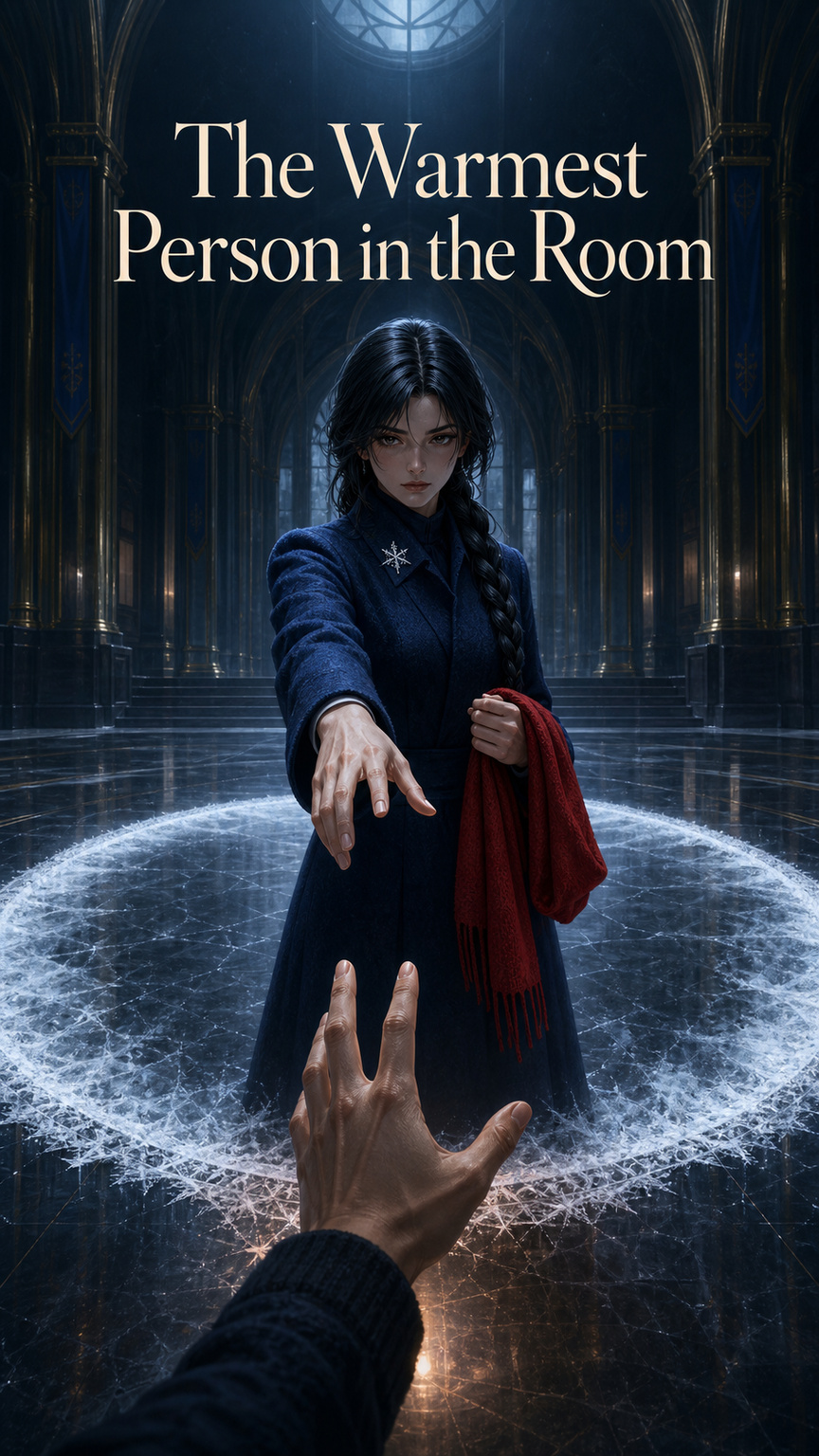
As the new student lost in a superhero college, you spot your girlfriend. Excited, you run up and hug her, saying “Hey Babe, can you show me around? I’m lost” The room goes silent cause you just hugged the “Blizzard Baroness” a cursed prodigy who’s cold hearted to basically everyone
By the third contradictory arrow, I had begun to suspect Brightward College tested navigation before it tested powers.
One blue ribbon of light insisted that NEW STUDENT REGISTRATION lay beyond a pair of brass doors. A painted arrow pointed back the way I had come. Above both, a paper sign read REGISTRATION RELOCATED TO THE EAST GALLERY, with east crossed out and north written underneath by somebody who believed compass points still meant something inside a round building.
I followed the paper sign into a hall full of capes, padded training jackets, floating luggage, and adults trying not to look as new as I felt. A woman with silver sparks nesting in her hair argued with a registration slate. Two students carried a glass tank between them while something inside knocked politely on the lid. Gold-sashed guides called directions which disagreed with the walls.
I had been at Brightward for forty-three minutes. I had collected a room key, lost the room key, found it in my pocket, and somehow signed a liability waiver meant for people who shed their skeletons during emergencies.
Then I saw Mirelle.
She stood near the center of the hall in her dark blue coat, one gloved hand resting on a stack of books. I recognized the severe line of her mouth, the black braid over one shoulder, and the tiny silver snowflake pinned crookedly to her collar because I had fastened it there that morning at the train station. She had made me redo it twice, then shifted it back to the angle I had chosen the first time.
Relief took both my bags and threw them out of my mind.
“Mirelle!”
She turned well before I reached her. Her eyes widened; then her shoulders dropped, and the corner of her mouth made the small private movement that had rescued several terrible breakfasts and one catastrophic attempt at wallpapering. She shifted her books out of the way and opened one arm.
I ran across the polished floor, caught her around the middle, and felt her arm close firmly across my back.
“Hey Babe, can you show me around? I’m lost”
“You have been here less than an hour.”
“Brightward has been very efficient.”
“At losing you?”
“At revealing my limitations.”
The room had gone silent.
Not gradually. A slate stopped chiming in the middle of a note. The gold-sashed guides forgot their competing directions. Even the thing in the glass tank quit knocking.
Mirelle still had me around the waist. Nothing in her had tightened. No white mist spread from her boots; no frost filmed the seams of her coat. I knew the signs as well as I knew the pale scar beside her thumb. A startle sent the cold out three metres. Once it began, she could turn it but not cancel it, and turning it away from people stole feeling from her hands. We had learned the rules through a cracked sink, a frozen luggage rack, and several domestic negotiations about approaching from behind.
This was not a startle. She had seen me coming. This was hello.
Someone near the brass doors whispered, “He hugged the Blizzard Baroness.”
Another voice said, with the solemn horror of a witness confirming a shipwreck, “She hugged him back.”
Mirelle let me go, though her hand lingered long enough to straighten my collar. She glanced at the motionless crowd.
“Why are they staring?” I asked under my breath.
“You ran indoors.”
“Ah. A serious campus.”
She bent, picked up my satchel, and handed it to me. “Registration?”
“Allegedly.”
“Come.”
The crowd opened for her. I had noticed the generous clear space around Mirelle when I first entered, but I had mistaken it for chance, the way people bend around a pillar or a sculpture. Now the space moved with her. Students tucked elbows close. A floating trunk climbed nearly to the ceiling to avoid passing over her head. Nobody crossed the faint damp prints her boots left on the floor.
I followed Mirelle through the brass doors while the Blizzard Baroness trailed us in a wake of whispers.
Mirelle’s tour began with no acknowledgment that we had become the most interesting event of orientation morning.
“Dining hall.” She pointed through an arch without slowing. “Clinic. East stair. If the red lamps flash, do not use the east stair.”
“What if the blue lamps flash?”
“Use it quickly.”
“What if they both flash?”
“Choose which kind of paperwork you prefer.”
We passed a cabinet of emergency masks labeled FOR SMOKE, SPORES, DUPLICATION, AND OTHER. Beyond it, students in padded jackets tried to push a stone ball through hoops that changed height whenever someone looked away. One player jumped, missed, and hung six feet above the floor until a teammate reeled him down by the ankle.
“Orientation brochure made this sound like an accredited institution,” I said.
“It is accredited.”
“By gravity?”
“Provisionally.”
There was my Mirelle: dry enough to turn nonsense brittle. At home she rationed smiles as if they required refrigeration, but she kept my jokes, improved the survivable ones, and returned the worst to me sharpened. None of that was news.
The people around her were.
Conversations thinned when we approached. Students glanced at the snowflake on her collar and then away so quickly the gesture became a kind of pointing. At a water fountain, someone abandoned a half-filled bottle rather than stand beside her. Two gold-sashed guides disagreed in whispers over which of them had authority to ask her to use the other corridor. Neither one did.
“So,” I said after we had turned a corner. “Baroness.”
“No.”
“I didn’t ask anything.”
“You had taken the breath.”
“Do I bow? Is there a tax? Have I violated a feudal boundary by calling you babe before the peasantry?”
Mirelle’s gaze moved beyond me. Three first-years at a notice board had gone rigid with the effort of not listening.
“Caleb.”
“Yes?”
“Do not perform at them.”
“I perform naturally.”
“That is the problem.”
She continued toward a covered walkway. I followed, less quickly.
Brightward had been part of her life before me. I knew the train she caught, the courses she hated, the professor who wrote comments too small to read, the bench where she ate lunch when the weather was bad and the roof when it was worse. Yet she had never once called herself a baroness, jokingly or otherwise. The title belonged to this place, and everyone here seemed to have received the same instructions for it except me.
Halfway across the walkway, wind lifted the loose end of her braid. Mirelle adjusted her books and missed the bottom one when it slid. I caught it before it fell.
“How long have your fingers been numb?” I asked.
She flexed her gloved hand. The movement stopped short of a fist. “First demonstration.”
“How many demonstrations?”
“Three.”
It was not yet ten in the morning.
I unwound the red scarf from my neck and held it out. Mirelle looked at it with the same disapproval she had shown when I bought it.
“The color has not improved,” she said.
“The color has depth and emotional courage.”
“It is red.”
“An important depth.”
She gave me her books, stripped off her gloves with her teeth, and wound the scarf around her hands. I held the books against my chest while she did it. This, too, we had done before. Cold left her fingers pale and unreliable; warmth came back slowly. She disliked being fussed over but accepted useful things if I did not dress them as rescue.
Behind us, one of the first-years whispered, “Maybe it restrains her.”
His friend whispered back, “It’s wool.”
I turned my head. Both of them fled into a classroom marked CONTROLLED IMPACTS ONLY.
“The scarf now has a myth,” I said.
“It had to acquire some value.”
We reached the equipment corridor, where shielded windows displayed training gauntlets, impact rods, restraint webbing, and a mannequin whose head repeatedly vanished and returned facing the wrong direction. A student in a silver-piped practice vest stepped out of an alcove. He left enough room to pass, but not enough to pretend he had met us by chance.
“Baroness.” His eyes touched the scarf around her hands. “About tomorrow’s resistance practical.”
“No.”
“You don’t know what I’m asking.”
“You want me to supply the cold source.”
He pressed a slate against his chest. “The instructor says we can’t certify the new shields without a live test.”
“Then you cannot certify them.”
“It’s ten minutes.”
Mirelle began walking. He matched her from outside arm’s reach.
Fear did not keep him away. It only made him polite about pursuing her.
I had spent the last several minutes watching people mistake Mirelle for a weather warning. Here, finally, was a person willing to speak to her. I mistook that for courage.
“She’s showing me around right now,” I said. “First-day disaster. Maybe after lunch, if she’s recovered from the morning?”
Mirelle stopped.
The student stopped. So did I.
“Not after lunch,” she said.
“Sure,” I said, hearing only the timing because timing was easy to fix. “Tomorrow, then, if your schedule—”
“Caleb.”
One word. Not loud. I finally listened to the shape of it.
The student lifted the slate. A form glowed on its surface, and beneath MIRELLE—SPECIAL CAPABILITY PROVIDER, a diagram showed a human figure standing inside a restraint frame. Blue arrows radiated from the figure toward four shield emplacements. A blank line waited beside the heading ACCEPTABLE LOSS OF SENSATION.
“I only asked,” he said.
“You filed my name as equipment before asking,” Mirelle replied. “You were told to remove it.”
Color rose into his face. “The slot would’ve gone.”
“It did.”
“I changed the classification.”
“You changed equipment to provider.” She glanced at the restraint diagram. “No.”
He looked at me. It was astonishing how much appeal a frightened person could put into avoiding someone else’s eyes. He wanted the version of her who hugged me. He wanted me to produce her.
The words rose on habit: She doesn’t mean—
But she did.
I held his gaze and said nothing.
He lowered the slate. “Fine.”
“No,” Mirelle said, “was fine.”
He left through the equipment doors. They shut hard behind him.
I gave Mirelle back her books. Around us, the corridor had developed urgent interest in wall notices and inventory glass.
“I was trying to make him understand,” I said.
“He understood.”
“He sees a title and a walking catastrophe. I thought if he saw that you were—”
“Available?”
“Human.” The word came out too fast. Too pleased with itself.
Mirelle’s face emptied of even the private irritation I knew how to read. “Do not make me easier for them by making my no smaller.”
My ears burned. “Could we have this conversation somewhere without an audience?”
She looked at the equipment windows, where three faces found urgent business in one pane of glass.
“Yes,” she said.
She took me through an unmarked door.
The service stair smelled of wet concrete and old dust. Pipes ran along one wall under wire cages. A narrow window showed the practice roofs and, beyond them, the city pressed blue-gray beneath late-morning cloud. On the landing sat an emergency bin of sand, two pairs of rubber boots, and a folded sign that said TEMPORARILY UNSAFE.
“For what?” I asked.
“It is reversible.”
“That explains everything except my question.”
Mirelle sat on the fourth step. I sat beside her. The stair was narrow enough that our shoulders touched, hers cold through coat and sweater. She left them that way.
For a while she warmed her hands inside my scarf. I watched a drop of condensation travel along a pipe. Nothing in the hall had made her unfamiliar. She was the same Mirelle who had stolen the train’s window seat and rejected half my breakfast. What I did not know was why Brightward needed another name for her, and why she had found it useful enough to leave standing.
“When did they start calling you that?” I asked.
“Last winter.”
“Because of something you did?”
“Because of many things they say I did.”
I waited. When Mirelle wanted to be exact, questions could make her narrower. Silence sometimes gave her room.
“I iced the south practice court during an evacuation,” she said. “They say it was two buildings. I failed a group whose shields cracked. They say I froze them deliberately. I told someone not to touch me from behind. They say I threatened the entire dining hall.”
“Did you?”
“I threatened his hand.”
“Less architectural.”
“He kept it.”
Below us, the door opened. Someone saw Mirelle’s boots between the railings, whispered an apology to nobody, and withdrew. The latch clicked softly shut.
“And the title?” I asked.
“Appeared on my locker.”
“You never told me.”
“It does not live where we live.”
The answer was so completely hers that it settled the question. Baroness was not a secret self she had hidden from me. It was Brightward’s account of the space around her.
“You let them keep using it,” I said.
“They warn one another. They leave distance. They stop trying to test whether I am as dangerous as they heard.” Her thumb worked against the stiff red wool. “Most days, that is useful.”
“And on the other days?”
She looked toward the door through which the student had gone. “They leave my name on forms. They assume fear is respect. They ask you after I answer.”
I leaned forward, elbows on my knees. My first instinct was still to build a case for the defense. I could tell the campus about the Mirelle who peeled the burnt edges off toast and left the good middle on my plate, who said she hated dancing but kept count under her breath when we tried, who carried spare hand warmers for strangers and called it inventory management. I possessed a treasury of evidence that she was more than their title.
It was also none of their business. Worse, I had almost spent it to purchase cooperation she had refused.
“I changed your answer,” I said.
“Yes.”
“I’m sorry.”
Mirelle’s shoulder remained against mine. “Good.”
Her left boot rested against mine, heel to heel, the old signal she used when conversation was finished but company was not.
After a moment I said, “I wanted them to see you.”
“They see me.”
“They see weather in a coat.”
“That is their failure.” She freed one hand from the scarf and flexed it. Color had returned except at the fingertips. “Do not correct their failure by offering them what is mine.”
I nodded. “You want me beside you, not translating you.”
“I want you to stop when I say Caleb.”
“A narrower and more measurable learning objective.”
“Brightward may be able to accredit it.”
I laughed. Mirelle’s boot pressed once against mine.
When we left the stair, she kept my scarf around her hands and looked faintly offended by the color. People noticed it. Their eyes moved from the scarf to me, and a rumor began somewhere behind us in a breathy fragment: binding cloth. I did not improve it.
At the next junction, a gold arrow marked REGISTRATION pointed into a wall.
“Finally,” I said. “An honest sign.”
“Registration is two floors down.”
I waited.
Mirelle considered the official stair, then pushed open a service door beside it. “This way is shorter.”
The route threaded between practice rooms, under a gallery where students learned to land without damaging the tiles, and through a courtyard full of scorched benches. Mirelle pointed out the clinic entrance that stayed open at night, the door that stuck in rain, and the vending machine that took exact change and kept it anyway.
“My old enemy,” I said.
“Try diplomacy this time.”
“It has my money, Mirelle.”
“Then you have already paid for talks.”
Twice, students approached her. The first carried a stack of petitions and held one out at maximum reach.
“Baroness, could you sign to move cold-practice hours out of the west court?”
Mirelle read the top line. “No. The proposed hours are during my seminar.”
The student looked at me. I adjusted the strap of my satchel. After a moment, she took the petition back.
The second student hurried from a laboratory with frost whitening one sleeve. “Is the drop in there yours?”
“No,” Mirelle said. “The valves make that sound before they fail.”
The student’s alarm sharpened. “What do I do?”
“Pull the red handle outside the door. Then call maintenance.”
He did not hesitate because her answer frightened him. He ran.
Mirelle watched until he reached the handle. Then she continued walking.
Legitimate question, useful answer. No softened refusal, no glimpse behind the curtain. I had imagined standing beside her would mean introducing the person I knew. Instead it meant letting her decide which part of herself the moment required.
At last we reached a narrow landing above the central hall. Through the railings I could see the three contradictory arrows that had started my trouble. A new paper sign had been added. It pointed straight up.
“I am going to graduate here by accident,” I said.
“You have to enroll first.”
“Cruel.”
“Realistic.”
The registration line below was shorter now. A few students noticed Mirelle and quietly left it. Others watched the red scarf around her hands. Someone whispered Blizzard Baroness, and the title passed through the queue without anyone needing to repeat the story behind it.
I shifted my satchel and left Mirelle room to choose the distance between us.
“I can take it from here,” I said.
She glanced down at the arrows. “Can you?”
“No. But getting lost alone will restore some dignity.”
“You signed the molting waiver.”
“My dignity has survived worse administrative errors.”
Mirelle unwrapped one hand from my scarf. She stepped close and put both arms around me, brief and firm, her bare hand cold against the back of my neck. I held still until her arms tightened, then hugged her back in the familiar shape of us.
The hall went quiet again.
This time I understood the silence. It was not about danger arriving. It was about the Blizzard Baroness choosing tenderness where everyone could see it, and the hundred meanings they would invent because none of them knew the ordinary one.
Someone below whispered, “Does that mean she’s safe?”
The question reached us. Mirelle’s fingers shifted once against my neck.
I could have answered. I knew exactly how warm she liked the bedroom before sleep, which shoulder stiffened first when the cold had cost her feeling, how long to wait after calling her name before touching her. I knew she loved me. None of that made her safe for them, available to them, or explainable by me.
So I held the warmest person in the room and kept my mouth shut.
Mirelle leaned back enough to study my face. “Improving,” she said.
“Unverified.”
“I have standards.”
She let go first and pointed to the left-hand stair. “Two floors. Ignore every arrow.”
I started down. At the first landing I looked back.
Mirelle was waiting to see which stair I chose.