The Way Around
A young relic hunter enters a forbidden desert labyrinth to prove she deserves a place among the great explorers, relying on an uncanny talent for making shots everyone else calls impossible—bouncing arrows off stone, threading gaps she cannot see, striking targets around corners. But when her small expedition uncovers something vast and ancient beneath the desert, her gift begins escalating beyond reason, until distance, walls, dimensions, and eventually reality itself seem to become nothing more than obstacles her arrows can find a way around.
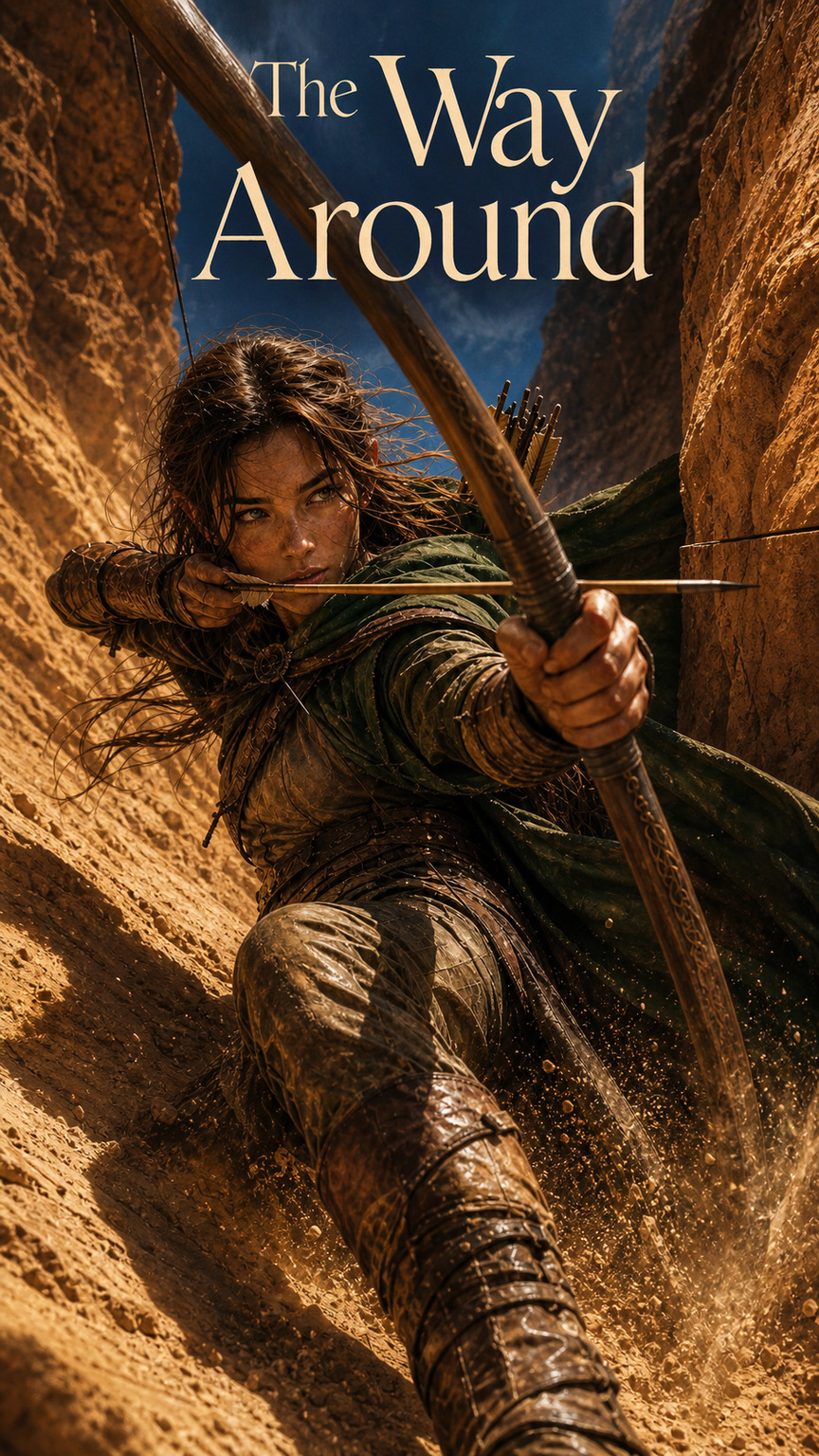
At the mouth of the Azhra Labyrinth, Ivara aimed away from the door.
The bow nearly spanned the sandstone slot. Its upper limb scraped a sunlit wall; its lower tip hovered beside Tressa’s boot. Ivara set her shoulder against the opposite rock, weathered green cloak bunched over a dust-brown leather coat, and drew until the string pressed a line into her bracer.
Mazin flattened himself around the water skins. “If it comes back at us, I want it recorded that I objected.”
“If it comes back,” Ivara said, “duck.”
Tressa had already opened her ledger. “I will not record that as a safety plan.”
Ivara smiled without looking at either of them. A shelf of stone hid the old entrance latch. The arrow had no clear road to it, only a pale patch on the left wall, a dark chip high on the right, and the narrow breathing slit above the door. She could feel the shot anyway: not as a line, exactly, but as three small certainties waiting for one another.
She released.
The blunt head struck the pale patch, skipped upward with a sound like a snapped cup, kissed the dark chip, and vanished through the slit. A heartbeat later, iron clacked behind the sealed door. Sand poured from its seams. The stone sank into the ground.
Mazin peered after the arrow. “Now ask it to open again from this side.”
“That was opening.” Ivara slid through before the sinking slab could reconsider.
Tressa lingered long enough to touch both impact marks. Brown hair had escaped Ivara’s braid and stuck to her damp cheek; she pushed it back while waiting for the verdict.
Tressa wrote. Her pencil made a dry, stingy noise.
“Well?” Ivara asked.
“Two observed deflections. One concealed impact.”
“You could write impossible.”
“I could also draw you taller.” Tressa stepped into the dark. “Neither would improve the evidence.”
The door opened on stairs too steep for comfort and too clean for a ruin. Their lamps found treads, a wall, and then nothing. Above, the afternoon remained a hard blue strip between the cliffs. Below, Azhra swallowed light as if the desert had been built over a well.
Ivara retrieved her arrow from the latch and led them down.
The warning pillar outside had called the labyrinth forbidden in three surviving scripts. Tressa had copied all three. Mazin had read the row of older expedition marks cut beside it and asked why people who wanted to be great explorers so often began by ignoring dead ones.
Ivara had not answered. Tressa’s signed account could carry a find past tavern disbelief and into the expedition halls, where the wall maps held names she had known since childhood. Those names crossed white wastes, drowned archives, cities under roots. None belonged to a hunter hired to fetch other people’s relics from places already measured.
She needed one place the maps had failed to contain.
The stairs ended at a sandstone shutter. Its release lay beyond a gap no wider than two fingers, around a bend in the wall. Ivara knelt, laid her cheek to the stone, and listened while Mazin tapped the far side with a knife pommel.
“Again,” she said.
He tapped.
She sent a narrow arrow through the gap. It scraped once out of sight, struck something with a bright metallic note, and the shutter folded downward in four slabs.
Beyond it, rings filled the earth.
They were not wheels. Some stood on edge, some lay flat, some entered the walls and continued on the other side. The nearest was broad enough for a wagon road. The farthest rose through the lamplight until its curve disappeared, suggesting a circle large enough to cup a city. Each ring was built of close-fitted blocks scored with shallow channels. Dust lay everywhere except inside those channels.
Mazin lifted his lamp. “You wanted something that wouldn’t fit in the ledger.”
Tressa turned a page. “I brought more paper.”
Ivara laughed, and the rings gave the sound back from places too distant to see.
They followed a ledge between them. The route curled downward, passing square windows that looked only onto stone. At the third window, a slab sealed the ledge from wall to wall. Somewhere beyond it, a loose chain ticked in a draft.
Tressa put a hand on Ivara’s quiver. “We have enough. The size, the construction, the entrance mechanisms. We leave, bring a lawful party, and return.”
“With whose claim?”
“Ours, if we stop making it easy to deny.”
“A door and some circles are a rumor with measurements.” Ivara eased Tressa’s hand away. “The chain is a latch.”
“You cannot see the chain.”
“You came because I don’t need to.”
Tressa’s face closed in the particular way that meant Ivara had struck what she aimed at and should have aimed elsewhere.
She nocked the recovered narrow shaft. The expected route bent left off the ledge, glanced from the window’s inner edge, and entered the hidden space behind the slab. She held the ticking chain in mind. Its sway. Its height. The small oval link her arrow would catch.
At full draw, another route appeared.
It used no surfaces. It cut through the slab’s thickness: the fact of the arrow here and the chain there, with the troublesome stone made unimportant.
Ivara released before the feeling could vanish.
The arrow flew left. There should have been a scrape, then a ricochet. Instead came a heavy knock from directly behind the slab. The concealed chain snapped taut. The whole barrier lifted.
Her arrow lay on the other side.
There was no slit. No hole. Fine red powder coated the head, but the wall stood whole.
The nearest ring answered with a pulse too low to be sound. Dust jumped from its channels. The pulse passed into the next ring, then the next, descending and rising through the dark until Azhra seemed to take one immense stone breath.
Tressa shut her ledger. “Now we go.”
Ivara stared at the arrow. The impossible route remained in her mind, faint as an afterimage. It led through the wall, though it had already been used.
“Ivara.”
“You saw it.”
“Yes.” Tressa’s voice had lost its dry edge. “That is why we go.”
They turned back. The ledge carried them around one curve, then another, and brought them to a chamber none of them had passed before.
It stood beyond a waist-high opening, near enough to touch and entirely enclosed. Pale sand covered its floor. A stone peg protruded from the far wall beneath a carved relief of nested rings. Cold air breathed from the opening, although no opening existed on the chamber’s side.
Mazin took the chalk from Tressa and marked the ledge. “One look. Then we follow our mark out.”
“That chamber is inside the ring,” Ivara said.
“Wonderful. It can stay there.”
The stone peg held a dark metal loop. A small relic. Portable proof. Ivara pictured an arrow curving through the enclosed chamber and clipping it free.
Tressa saw her reach for the quiver. “Don’t.”
“One shot.”
“That is what the last one was.”
Ivara loosed.
The arrow crossed the opening, entered bare stone, and emerged inside the chamber without breaking either surface. It struck the peg. The loop rang loose onto the sand.
For one bright instant, Ivara felt the clean snap of every locked door in her life coming open. No wall. No angle too sharp. The arrow had found a way because she had asked it to.
Then the path stayed open.
An arrow-thin line joined the ledge to the sealed chamber. Cold air hissed along it. The line widened to a black seam, and pale sand began spilling through—not down, but sideways, spraying past Ivara’s boots into the dark.
All around them, the rings moved.
Mazin caught Ivara by the back of her cloak as the ledge tipped. Tressa fell to one knee, clutching her ledger. A wall dropped between the three of them. It missed Ivara’s hand by less than a finger and came down across Mazin’s rope.
When the stone stopped, Ivara and Tressa stood together on one side.
Mazin’s lamp shone from a square window twenty paces away, though his muffled swearing came through the wall at Ivara’s shoulder.
“Are you hurt?” Tressa shouted.
“Only in my judgment.” His voice arrived again, much fainter, from somewhere below. “And I have one skin of water. You have the other two.”
Ivara put both palms to the partition. The old way to judge distance—echo, grain, the minute change of air against her face—broke into several answers. Mazin was an arm’s length away. He was twenty paces away. He was below them, above them, and standing in the cold chamber with sand flowing past his knees.
She snatched her hand back.
Tressa reopened the ledger. “Describe what you see.”
“A wall.”
“Mazin.”
“Several walls. One has teeth.”
Ivara paced to the window. Mazin’s lamp vanished before she reached it. In its place, for half a second, she saw a slice of night sky freckled with unfamiliar stars. Then stone covered it.
“The chalk mark is gone,” Tressa said.
“The ledge moved.”
“After your shot.”
“I noticed.”
“Did you? You looked pleased.”
Ivara rounded on her. “Would you prefer I couldn’t do it?”
“At present, very much.”
The wall pulsed. A trickle of sand rose from the floor and crawled into a channel overhead.
Mazin knocked three times from inside the stone.
“I would prefer,” he called, “that you save the quarrel until I can enjoy it properly.”
Tressa drew a line across the page. “Tell me about the teeth.”
His answers came in pieces, sometimes through the wall, sometimes from the floor. A row of triangular blocks. A dark loop beside the fourth, or perhaps the fifth. The floor sloped toward him unless the water was lying. He could reach the loop but not pull it; the block above it shifted whenever he put weight on the rope.
“How large is the loop?” Tressa asked.
“Thumb-sized.”
“Whose thumb?”
“Not Ivara’s. She has absurd little thumbs.”
“They fit an arrow nock,” Ivara said.
“Everything comes back to arrows with you.”
Tressa’s pencil paused. “Can you put the rope through it?”
After some scraping and a bitten-off curse, the trapped length of rope jerked beneath the fallen wall. Mazin tugged twice. The second tug came from the square window, now visible high above them.
Tressa drew what he had described, then turned the ledger sideways. Her neat diagram made no sense. She rubbed out half of it with her thumb.
“Stop making it a room,” Ivara said.
“It is a room.”
“Not from here.” She crouched over the trapped rope. Its fibers tightened at an angle the floor denied. “Give me the part that matters.”
Tressa’s mouth tightened. Her pencil shook, but it kept moving. Then she tore a strip from the margin of her precious ledger and folded it twice. “The loop is here. The shifting block bears here. If Mazin pulls, the bottom edge lifts.” She held the folded paper against the wall, not as a map but as an angle. “You need to strike behind the loop, upward.”
“I said the fourth tooth,” Mazin called.
“You said perhaps the fifth.”
“It became the fourth when I counted again.”
Ivara closed her eyes. She felt Tressa’s paper angle against the back of her fingers. Mazin tugged once, then twice. The rope’s strain gave her a direction no corridor could be trusted to provide.
She fired at the floor.
The arrow vanished point-first into sandstone. Mazin yelped. A hard crack followed, then the clatter of a released block. The partition rose one handspan.
Mazin came through it sideways, shoulder first, clutching the water skin. Gravity changed its mind halfway. He struck the floor beside them in an explosion of chalk dust and dignity.
“Fourth,” he gasped.
Then every route opened.
Cold air poured from the sealed chamber. Hot wind rushed from a corridor that showed blue noon at its end. The slice of starry sky spread across a wall like spilled ink. Sand fell up, down, and across. One of Tressa’s water skins sailed into the noon corridor and vanished; the other struck a rising block and split, its stream crawling up the wall. An arrow Ivara had lost minutes ago flashed through three rings at once, each copy casting the same crooked shadow, before all of them vanished.
Tressa hauled Mazin upright. “Can we leave now?”
Ivara looked for the stairs and could not remember what up felt like.
“I don’t know where they are,” she said.
It was the first admission that silenced both of them.
The rings shuddered again. Their ledge cracked. Beyond the fracture, every available passage curved toward the same dark opening.
Mazin wiped chalk from his beard. “Then I vote for the hole not pretending to be daylight.”
They went inward.
The central hollow had no proper floor. A bridge of fitted blocks crossed its middle, curving beneath their feet and above their heads until the distinction failed. Rings crowded the dark in all directions. Their channels glimmered only when an old arrow route passed through them, a brief polishing of stone by something that had no business touching it.
The oil windows on both lamps showed almost empty. It had been afternoon at the entrance. Whatever the routes had done to distance, ordinary hours had carried on without them.
On the bridge’s central plinth, the nested-ring relief appeared again. Tressa set her lamp close. No writing surrounded it, only grooves: circles within circles, each cut open at one point. All the openings connected by a single wandering line. At the relief’s upper edge, the line ended against an uncarved wedge.
“A shut-stone,” Tressa said. “The outer closure, perhaps.”
“Perhaps is doing heroic work,” Mazin said.
Ivara traced the grooves without touching them. Every route she had fired still pressed at the edge of her awareness. They crossed, shared pieces, and reached for fresh ways around one another. The relief’s blank wedge was the only place none entered.
The lattice had not chosen a thing. It had taken the aim she supplied and made more road than the shot required. Each arrow had left it another answer. Now those answers were tangling the place apart.
A section of bridge disappeared. It did not break; it was simply gone. Through the gap lay a white chamber where dust hung motionless in the air. Mazin jerked back before his foot crossed into it.
“Can you hit the wedge?” Tressa asked.
Ivara set an arrow to the string and aimed at the relief. The target felt dead beneath her attention. A picture of a closure was not a closure.
She lowered the bow. Four arrows remained. Only one had the narrow hardened head that had survived the stone.
“It isn’t here,” she said. “This is showing the outside.”
Mazin looked around at the inward-curving dark. “Excellent. We’ll step outside.”
The cold route widened with a boom. The lamp flames bent toward three different drafts. Somewhere, far off or immediately behind them, stone began to fall.
Tressa flipped backward through her ledger. “The entrance faced northwest. The first stair descended roughly east, then the large ring carried us south—”
“No.” Ivara’s own sense of those directions turned over like a sick stomach. “Don’t give me a route.”
“You need a target.”
“I need the stone itself.”
Tressa pressed her lips together and flipped another page, still trying to arrange observations that would not hold still. Mazin, meanwhile, was staring at the relief’s blank wedge.
“There was a dark cap near the entrance,” he said. “Outside. I put the water against it while you two admired the warning.”
Tressa frowned. “A capstone?”
“A hot rock.”
“Shape?”
“Rock-shaped.”
The plinth lurched. Ivara caught Tressa’s ledger before it slid into the white chamber. A loose page crossed the boundary and stopped, hanging flat in the air a pace below and impossibly far away.
“Mazin,” Ivara said. “Put your hand how it lay.”
He planted his broad palm against the plinth, fingers slanting down. “Like this. It was hotter here. Gritty at the edge, smooth in the middle. There was a little groove under my second finger.”
Tressa caught his wrist. “Crescent groove.” She found the first page of her entrance sketch. “I drew its shadow. The exposed stone tilted eleven degrees from the doorway face.”
“Eleven?” Mazin said. “It tilted a bit.”
“Your bit is not reproducible.”
“Neither is eleven degrees while we’re falling through the world.”
“Stop.” Ivara had already lost the picture by trying to decide which of them was right. Around her, the routes hummed through stone, eager without wanting, multiplying without thought. “One at a time.”
They looked at her.
She swallowed. Her mouth tasted of old dust. “Tell me what I didn’t see.”
Tressa started with the doorway because that was where her certainty lived: the capstone’s upper edge, the thin shadow it had cast, the relation between its crescent groove and the warning pillar. Halfway through, Mazin interrupted to say the groove was chipped on the left. Tressa snapped that the shadow proved the chip was on the right.
“From inside or outside?” Ivara asked.
Tressa stopped. Looked at her sketch. Turned the ledger around.
“His left,” she said.
Mazin gave a short, frightened laugh. “A historic day.”
Then he described the stone by touch: sun-hot center, coarse rim, one pocket that held cooler sand. He could not explain the smell until Ivara offered words—baked clay, lamp soot, rain—and he rejected all of them.
“Like the first hot day after you store a blanket all winter,” he said at last.
It made no sense. It was exactly what she needed.
Tressa held two fingers at the capstone’s slant. Mazin set his palm beneath them. The ledger gave the wedge a relation to the buried rings. His skin gave it heat and grain. Neither knew the stone whole. Ivara let their incompatible pieces remain incompatible and held them together anyway.
The target arrived.
Not north. Not above. Not a distance. A sun-warmed shut-stone on the exterior of the vast thing enclosing them, chipped on Mazin’s left, crossed by Tressa’s crescent shadow. A place Ivara had stood beside and failed to notice because she had been looking at the door.
She nocked the hardened arrow.
The bow resisted as though the string had been tied around all the rings of Azhra. Her shoulders shook. The routes crowded her mind: through wall, under bridge, across cold chamber, into the false noon, along the strip of stars. Every one ended inside.
She did not choose among them.
She held the outer stone and drew.
Tressa’s fingers stayed angled in the corner of her sight. Mazin’s palm stayed braced below. Neither spoke. The bridge dropped a fraction beneath them.
Ivara released.
The arrow did not fly across the hollow. Its head departed first, then the shaft followed into a point in the air too small to contain it. The fletching twisted once and was gone.
For a breath, nothing happened.
Then an impact struck from beyond every wall.
It came up through Ivara’s boots and down through her teeth. The nested channels flared with rushing dust. One by one, the wrong spaces pinched shut: the white chamber folding to a line, the noon corridor going dark, the stars snapping to a single point. Cold sand splashed to the bridge and fell in one ordinary direction.
The rings stopped.
Weight returned so hard Ivara dropped to both knees.
Across the hollow, blocks ground aside. Behind them lay a steep stair packed with sand and open at the top to a thread of predawn gray.
Mazin stared at it. “That had better be the real sky.”
Tressa closed her ledger around the loose pages. “If it isn’t, don’t tell me yet.”
They climbed.
No route shortened the stair. Sand collapsed under their boots. Mazin’s remaining water skin had split at the neck, and they shared what was left in three mean swallows. Tressa had to be pushed through the half-sunken entrance; Ivara lost a glove digging Mazin free when the last tread gave way. By the time they crawled beyond the warning pillar, dawn had bleached the desert and all three of them were too tired for greatness.
For several minutes they lay in the cooling sand.
Then Tressa sat up and opened the ledger.
“I am not writing that the arrow went around reality,” she said.
Mazin had draped a sweat-dark cloth over his face. “Write that reality was unhelpful.”
“I can substantiate walls, discontinuous chambers, conflicting orientations, and one appalling use of my margin.”
Ivara rolled onto an elbow. The labyrinth entrance was stone again. The dark cap beside it bore a fresh, pale chip across its crescent groove.
“Write the impact,” she said.
“I did not see it.”
“You felt it.”
“Feeling is not location.” Tressa looked toward the chipped cap, then down at her first sketch. “Mazin saw the stone. I fixed its angle. You did whatever that was.”
“And carried the water,” Mazin said from under the cloth. “Until architecture attacked it.”
Tressa tapped her pencil against the page. “The finding needs a primary name.”
Yesterday, Ivara would have answered before the pencil finished rising.
Something hissed overhead.
All three looked up too late. An arrow dropped out of empty morning, struck the sand between them, and buried itself to the fletching. The hardened head was gray with dust from the outer capstone. A thin crescent of dark stone had lodged behind one barb.
Ivara’s hand moved toward it, then stopped.
Tressa went still. Mazin pulled the cloth from his face and stared.
Only when both of them had seen the arrow standing there did Ivara reach for it.
Tressa lowered her pencil to the ledger. Beside the fresh entry, she ruled one line wide enough for three names.