The Weight They Never Counted
You are the weakest, the absolute bottom of the barrel in your Village. After joining a trading caravan the second you turned 18 to escape the constant bullying, the Leader of the Caravan asks you how in all thats holy you are lifting and comfortably carrying 200kg without even breaking a sweat.
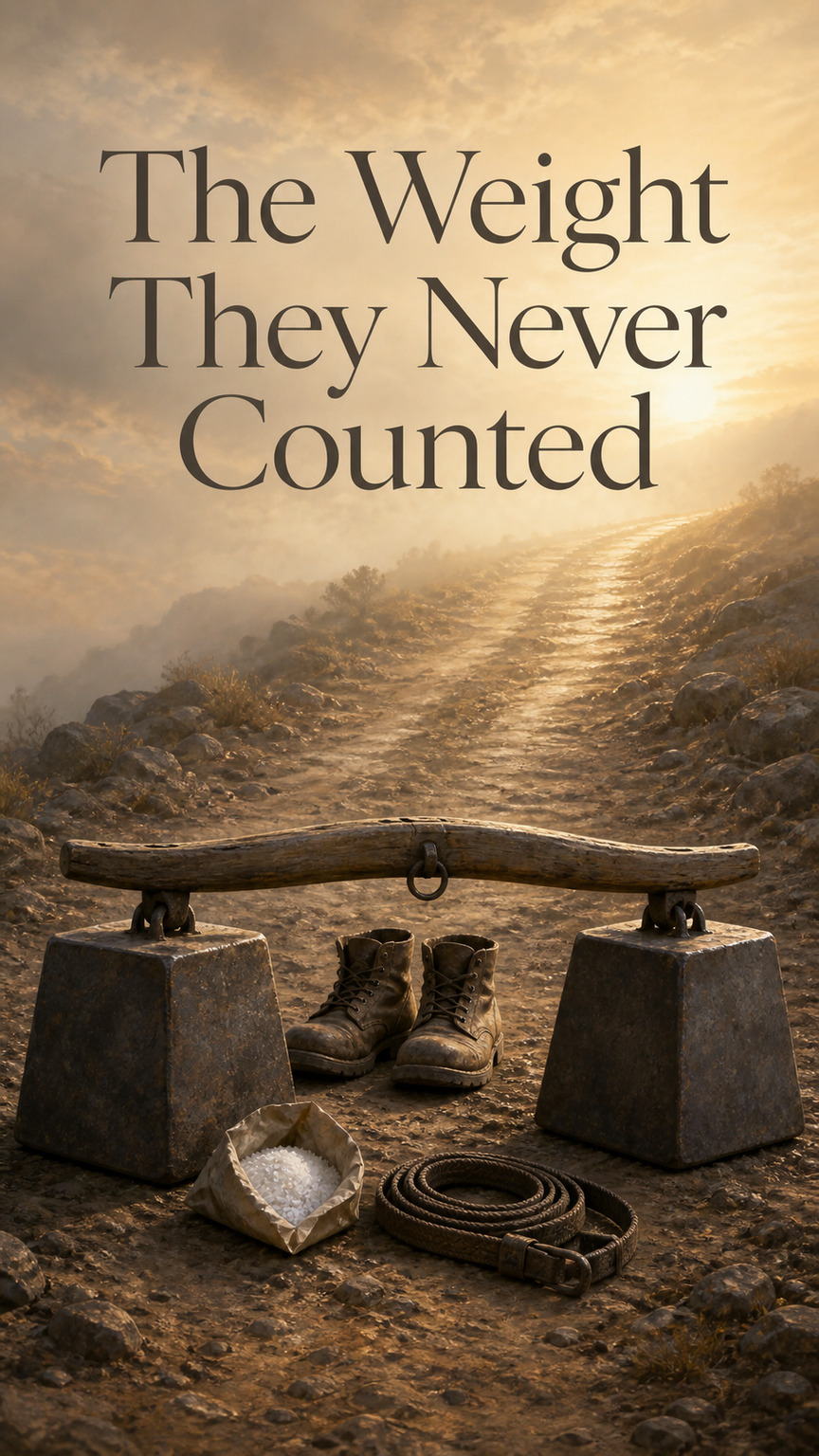
The clerk struck the adulthood chime at sunrise.
“Eighteen,” she said, turning your slate from its child side to its adult side. “Your standing is now your own concern.”
You stepped over the whitewashed boundary before the bronze note had faded.
That was how quickly the village let a person go, provided the person left owing nothing. Your bundle had been hidden under the clerk’s bench since dark: two shirts, a blanket, four heel cakes, a twist of salt, and the work token the caravan leader had given you the evening before. The token promised the cheapest position on the road. Board would be deducted. Breakage would be deducted. Wages, what remained of them, would be paid at the market.
Someone behind you laughed. “Careful with that bundle. It may be the first thing heavier than your pride.”
Another voice, less amused, called, “They’ll have you back before supper.”
The clerk had already reached for the next slate. “Ranks are settled at adulthood. Don’t block the line.”
You did not turn. The caravan waited beyond the last houses, eight wagons in the pale dust, their canvas covers damp with dawn. The leader stood beside the rear wagon checking tokens against a wax board. She took yours, pressed her thumbnail into its edge, and pointed toward a shovel lashed beneath the driver’s seat.
“Road hand. Dung, firewood, water, whatever the crew won’t stop to do. You asked for the low rate.”
“Yes. It’s fine.”
“Boots?”
You lifted one foot. The soles had been patched twice.
She looked at them without comment. “Walk near the rear. If a driver calls, answer. If you don’t know, say so before you touch anything.”
The lead teamster snapped two fingers in the air. Harness chains tightened, wheels creaked, and the village began sliding away behind a screen of road dust. You kept waiting for someone to call you back on a rule you had missed. Nobody did.
By noon, the houses were gone.
The rut looked shallow until the sixth wagon put its left wheels into it. Mud swallowed the rims. The mules leaned, traces humming, while the wheels turned in place and painted themselves brown.
“Hold them,” the teamster called. “No whip. They’ve given all the pull they’ve got.”
The loader ducked under the rear canvas and began naming what had to come off. “Two grain. Tool chest. Both scale blocks. Keep the lamp crate where it is.”
You climbed onto the bed because the other road hand had gone for branches. The scale blocks sat against the tailboard, squat iron shapes with lifting loops, each stamped 100 kg beneath a seal. The loader wrestled a grain sack onto one shoulder.
“Blocks take two each,” he said. “Wait for hands.”
The wheels sank another finger. Somebody shouted for haste. You took one loop in each hand, straightened, and stepped down.
The weight settled through your shoulders and hips, even and quiet. Less awkward than the village water yoke, because the blocks did not slosh. You carried them twenty paces to the firm verge and set them on two flat stones so their seals stayed out of the mud.
When you stood, the caravan leader was looking at your hands.
“How in all that’s holy can you lift and comfortably carry two hundred kilograms without sweating?”
Every nearby sound seemed to make room for the question: the mules blowing, a wheelwright hammering a branch under the rim, the loader’s sack settling against the road.
You checked the blocks. Both marks did say one hundred. Perhaps the seals were false. Perhaps you had moved the wrong things. “They’re balanced.”
“They’re two hundred kilograms.”
“Yes, but only just.”
“Only just what?”
You searched her face for the joke’s direction. “Only just carrying. I couldn’t run with them.”
The loader lowered his sack. “I couldn’t stand up with one.”
“I’m not very strong,” you said. It came out too fast. “At home, I mean. I’m the weakest there.”
The other road hand returned dragging brush. He stopped, saw everybody stopped, and said, “Are we freeing this wheel or holding a funeral?”
The leader’s attention snapped back to the wagon. “Freeing it. Grain to the verge. Crib the right rear before we pull. You”—she pointed at you—“no more blocks until I check the marks.”
The order felt like the beginning of a punishment. You obeyed it with relief.
The seals proved sound. After the wagon came out, the clerk cleaned the blocks and compared them against the cargo papers. Two hundred kilograms, no mistake. For the rest of the afternoon, nobody asked you to lift anything heavier than sticks. That was worse than being laughed at. Laughter told you the rules. Silence kept changing them.
At camp, the leader called you behind the supply wagon. The loader came too, carrying a portable beam scale and three slings.
“Private,” the leader said when the cook craned her head from the fire. “Unless we discover an appetite. Then it becomes your problem.”
“Every appetite becomes my problem,” the cook said. “That’s why none of you die ignorant of it.”
The canvas screened you from the rest of the crew. The leader inspected your palms, asked where old calluses came from, counted your pulse, then made you lift nothing at all until she had looked inside your boots.
“Soles are thin,” she said.
“They’re still usable.”
“That wasn’t my question. Any pain?”
“Not much.”
“That means some.”
“The left heel rubs.”
The loader grunted. “A bad foot drops good cargo. We pad it before testing.”
He cut felt for your heel, then rigged a broad yoke with equal slings. They began with fifty kilograms. You lifted it. The leader watched your knees and breathing, not your face.
“Walk to the ash tree and back.”
You did.
At one hundred, the yoke felt worth noticing. At one hundred sixty, your soles pressed hard enough to read each pebble through the leather. At two hundred, the familiar deep warmth began along your thighs and lower back, the warmth of carrying grain jars from the communal storehouse. You could have gone farther. You did not volunteer that.
“Pulse up, but not much,” the leader said. “Breath even. Any strain?”
“A little, maybe.”
“Where?”
You indicated the yoke edge against your shoulder.
The loader slipped two fingers beneath it. “Harness problem. Not body.”
They added twenty kilograms. Your steps shortened. At twenty more, something pulled behind your right knee, faint as a thread catching on a nail.
“Stop,” you said.
The loader had the sling down before you finished the word.
The leader wrote on her wax board. “Good. What changes it?”
“Uneven sides. Soft ground. Anything that moves inside its container.”
“Distance?”
“I don’t know in road lengths. At home, from the lower fields to the storehouse. Then food.”
“How much food?”
You described two morning bowls, bread in the fields, the noon pot, nuts or fat in the afternoon, and broth salted until a spoon nearly stood in it. The loader stopped coiling the sling.
“That’s for everyone?” he asked.
“Most adults take more. I didn’t earn the full field share.”
The leader made another mark. “What did everyone carry?”
“The usual things. Water jars. Stone baskets. Grain. The others carried more.”
“How much more?”
You gave her the village ranks because there was no safer answer. At the bottom stood your name, though you did not say it. Above it began capacities that would have required teams anywhere else on the road.
The cook pushed through the canvas with a bowl and your four heel cakes in one hand. “These were all you brought?”
“They last if you soak them.”
“For half a day.” She set down a bowl filled to the rim. “Eat. Then another.”
“It can come from my wages.”
“It will come from somebody’s figures. Right now it’s coming from my pot.”
The leader fetched a waterproof packet from her chest. Between route permits and faded toll schedules lay a copied page, the letters crowded and patched by several different hands. She read only fragments aloud: hill populations fitted for sustained freight, dense bones, layered load-bearing tissue, high requirements for food, water, salt, and recovery. The original survey had been found broken. The copy did not say who had changed those people, or when, or whether they had agreed. Two later copyists had argued in the margins over whether the old word meant bred, built, or repaired.
“Does your village teach any of this?” the leader asked.
“We’re told our backs are good because our habits are good.”
The loader snorted.
“And yours?” she asked.
“Mine isn’t. Not there.”
The leader folded the page. “Here, two hundred kilograms moves without four wages. It also tears through our rations and gives us one worker whose safe limits we don’t know. That’s not a miracle. It’s an unpriced risk.”
The words should have disappointed you. Instead, they gave the strange fact edges. Risks could be measured. Prices could be written down.
You scraped the bowl clean. “Could we measure it properly? If it’s not too much delay.”
“At first light,” she said. “Tonight you rest.”
The test at first light ended with a working number lower than what you could lift.
On level, packed ground, with matched slings and a loader watching, you carried two hundred kilograms for two hundred paces. At two hundred forty, the pull returned behind your knee. When the loader suspended a half-filled water cask at one side, you stopped at eighty. The water struck the barrel wall after each step and dragged your balance after it.
“There,” the loader said. “Half a cask and your stride’s gone. That sling needs a second belly-band.”
The wheelwright, passing with an oiled hub pin, glanced at the yoke. “Put that much in the wrong quarter of a bed and you’ll bow the axle. I’ll leave the whole wagon for you to carry.”
The teamster heard and called from the picket line, “And don’t make the mules match your pace. They get the hill they get.”
The cook handed the leader a tally of meal measures. “This is the number you forgot.”
The leader studied all four contributions. “One hundred eighty for ordinary flat-road assignments. Two hundred only when the loader clears ground and rigging. No catching, no rolling loads, no live animals, no tilted beds. We revise after a week.”
“That sounds generous,” you said.
“It’s cautious.”
“I meant the work.”
“Work isn’t a favor. Neither is pay.” She turned to the clerk. “Price porter rate, additional ration, salt, and boot leather. Show deductions separately.”
The clerk’s mouth tightened at the board. “The rate for four hands assumes four hands can split.”
“Then price one hand and a required spotter.”
“That saves less.”
“Write what it saves, not what you hoped it would save.”
The loader took apart the test sling because the stitching at one corner was wrong. The cook demanded her measuring cup back. You ate a third breakfast portion and fell asleep against a wheel before the harness bells rang.
For the next four days, the caravan taught you all the ways weight could become somebody else’s problem.
The loader taught you to distrust a neat stack. He rapped crates and listened, checked seals for damp, and rejected rope that looked strong but had gone furry between its twists. His instructions came in clipped pairs. “Loop high. Pull low. Again.” When you apologized, he usually answered, “Again.”
The teamster cared less about cargo weight than where it made the animals work. “Hear that breathing?” she asked on a long rise. “That’s the pace. Not the schedule.” She would postpone a wagon to cool a mule, then curse for ten minutes when anyone delayed the same wagon through carelessness.
The wheelwright spoke to wheels as if they were defendants. “You’ve been overloaded right rear,” he told a hub. “Don’t deny it.” To you he said, “A road leans even when your eyes don’t. Check the gap above the springs.”
The clerk let numbers keep their full sharpness. “Gross is not freight. Freight is not chargeable freight. If you sign the wrong one, hunger will not improve the arithmetic.”
You said yes to all of them.
Yes, you could hold the axle while the wheelwright set a pin. Yes, you could move two flour chests after unloading your assigned copper. Yes, you could fetch water before eating. Yes, you could stand in place while the loader fetched a better strap. The tasks were each small compared with what people at home demanded, and every request sounded like another day’s permission to stay.
On the fourth evening, the cook found you beside the water wagon rubbing salt into your gums from the empty twist you had brought from the village.
“You missed the noon pot,” she said.
“There was axle work.”
“The axle did not eat your portion. Somebody else did.”
“That’s all right.”
“Not to my count.” She shoved bread folded around cold beans into your hand. “Tomorrow, answer me when I call. I don’t chase freight.”
The next morning your right knee had stiffened, and the patched heel had opened into a raw crescent. The leader saw the shorter step before you reached the wagons.
“Report.”
“It’s not bad. I can still carry.”
“That is not a report.”
Under her questions, the missed meal, extra lifts, and soreness came out in scraps. Your answers shortened as her wax stylus cut deeper lines.
“Who assigned the extra work?”
“No one exactly.”
“Then who accepted it?”
You looked at the board.
The loader arrived with a sling over one shoulder. “Not loading them today.”
“I could do a lighter—”
“No.” He pointed toward the clerk’s seat. “Copy the third and fourth wagon columns. No lifting.”
The leader changed the roster. It cost the caravan time. The other road hand carried your ordinary share and did not pretend to be pleased about it. At noon he dropped beside you, accepted his second bowl, and said, “If you volunteer me into this again, I’ll hide your boots.”
“Sorry.”
“Eat.”
You did.
The road on the seventh morning narrowed along a slanted shelf of clay. Rain had passed in the night, leaving the high-side drainage strip sticky while the lower wheel track shone hard and wet. The wheelwright walked ahead prodding the surface with an iron rod.
The fifth wagon’s uphill wheel broke through the crust over a drainage hollow.
The bed tilted. Harness snapped tight. Inside the canvas, something heavy slid and struck the sideboards hard enough to bow them.
“Hold the team!” the teamster shouted.
“Uphill side clear,” the loader called. “Nobody beside the lean.”
You were behind the wagon, clear of the sideboard but close enough to see the uphill end of the rear frame dropping. The wheelwright thrust a crib block beneath it, but the block skated in mud.
“Shoulder here,” he said. “Steady only.”
You set your back beneath the frame and took the corner’s weight. It was not two hundred kilograms; it was a changing fraction of wagon, cargo, and slope. For one breath it pressed cleanly down. Then something rolled inside. The force twisted across your spine.
The loader reached for the rear ties.
“No,” you said.
He stopped.
The old reflex tried to finish the sentence with an apology. Another object shifted against the sideboard.
“Don’t open that. It’s moving into the uphill board.”
The leader came up behind you, her boots sinking at the heels. “How long can you hold?”
“I can’t. Not if it moves again.”
“Then we set it down. Wheelwright?”
“Need two blocks under the rear frame, one broad pad under the buried hub. I can’t place the pad while it’s settling.”
The clerk had abandoned her seat with the manifest hugged beneath her coat. You had copied that wagon’s column the day before: copper coils high at the rear, sacks of meal along the center, lamp crates forward, two half-filled oil casks wrongly returned to the uphill rail after inspection.
“The oil casks are what rolled,” you said. “Rear, uphill side.”
The loader swore once. “They were meant to be wedged.”
“Can we take the copper out through the downhill flap first? It’s high now. Then pass meal sacks downhill for ballast. The casks stay shut until the bed is on blocks.”
The leader looked to the loader.
He was already reaching across the raised side for the cover ties. “That gives me a safe opening.”
“Teamster?”
“I can slack the rear pair. Leaders stay braced.”
“Wheelwright?”
“If steady means steady.”
The leader pointed, assigning hands. The cross-talk collapsed into work calls.
“Copper coming.”
“Hands high.”
“Block seated.”
“Trace slack.”
“Meal downhill.”
Mud squeezed under your boots. Your shoulder trembled, not from the clean downward weight but from small corrections as the crew removed it in pieces. When the second crib block seated, the wheelwright slapped the frame twice.
“Lower.”
You bent slowly. The wagon came to rest on wood instead of your back.
The loader made everyone stand clear while he opened the rear and wedged the oil casks. The teamster walked both mules for cuts. The clerk crossed out a delivery estimate. The leader sent you to the cook for salt broth, then stood over you until you drank it.
Two hours later the wagon was upright. The wheel held. The caravan moved at half pace, and the loader walked beside the repaired corner with one hand on the rail, feeling for every shift.
You walked empty-handed.
At the market, the clerk laid the proposed contract on an upturned crate. Around you, awnings cracked in the afternoon wind. Porters rolled handcarts between the wagons, shouting ordinary warnings about toes and corners. Nobody knew you had been the weakest person in a village beyond the hills. Nobody asked.
The leader tapped the first figure. “Porter premium, less board. Full crew ration plus the cook’s added measure. Salt issued daily. New boots charged over six pay periods.”
You read the load clause twice. “It says one hundred eighty.”
“That was the tested ordinary limit.”
“On flat ground, yes. Most of the road isn’t flat.”
The clerk looked up. The leader waited.
Your mouth had gone dry. “I think one hundred sixty should be ordinary. If that’s workable. Two hundred on level ground, with the loader checking the sling. Nothing that rolls or shifts. No holding wagons.”
“Emergencies don’t read contracts,” the leader said.
“Then I put it down.”
The sentence was small. It stayed where you set it.
The leader tapped the wax board against her palm. “If putting it down endangers someone?”
“I call it before I lift. If the ground changes, we stop and crib it. If someone orders a catch, I refuse.”
“That costs time.”
“Yes.”
The loader, sorting hooks nearby, said, “Costs fewer knees.”
The clerk drew a line through one hundred eighty. “Recovery?”
You almost said whatever was usual. “Meal calls. I stop for them. One full rest day in seven, and no extra lift added while I’m already under load.”
“Training hours?” the leader asked.
“Half a shift with manifests and load plans. If you still need that.”
“I need the wagon planned before it’s loaded. Apprenticeship rate until you can do one without the wheelwright sending it back.”
“Paper deserves what it gets,” the wheelwright said from beneath a nearby bed.
The leader ignored him. “Six-week trial. We revise limits only after another controlled test. Either side can end at a market stop.”
The clerk added each term in cramped script. The cook came to check that “full ration” meant her measure, not the clerk’s. The other road hand complained that the rest-day roster would have to change. The teamster wanted the route grades copied before dawn. By the time everyone had protected their own work, the contract was ugly with insertions.
You pressed your thumb into the wax.
The next morning, the loader assigned you two sixty-kilogram cloth bales in a matched shoulder rig. A modest load, stable and dry. The clerk handed you the manifest board as well.
“Third wagon,” she said. “Check gross against axle allowance. Mark the steep grade after the noon well.”
The cook pushed a paper twist of salt into your pocket. The teamster called the start. Harness chains tightened down the line.
You checked the sling, checked the figures, and took your place beside the third wagon. When the road began to rise, you were already looking at its angle.