The Wolf in the Mirror
You were fully prepared to watch over your cursed partner while they transform into werewolf on the full moon. What you were not prepared for was them chasing their tail for 2 hours and then barking at themselves after walking in front of mirror.
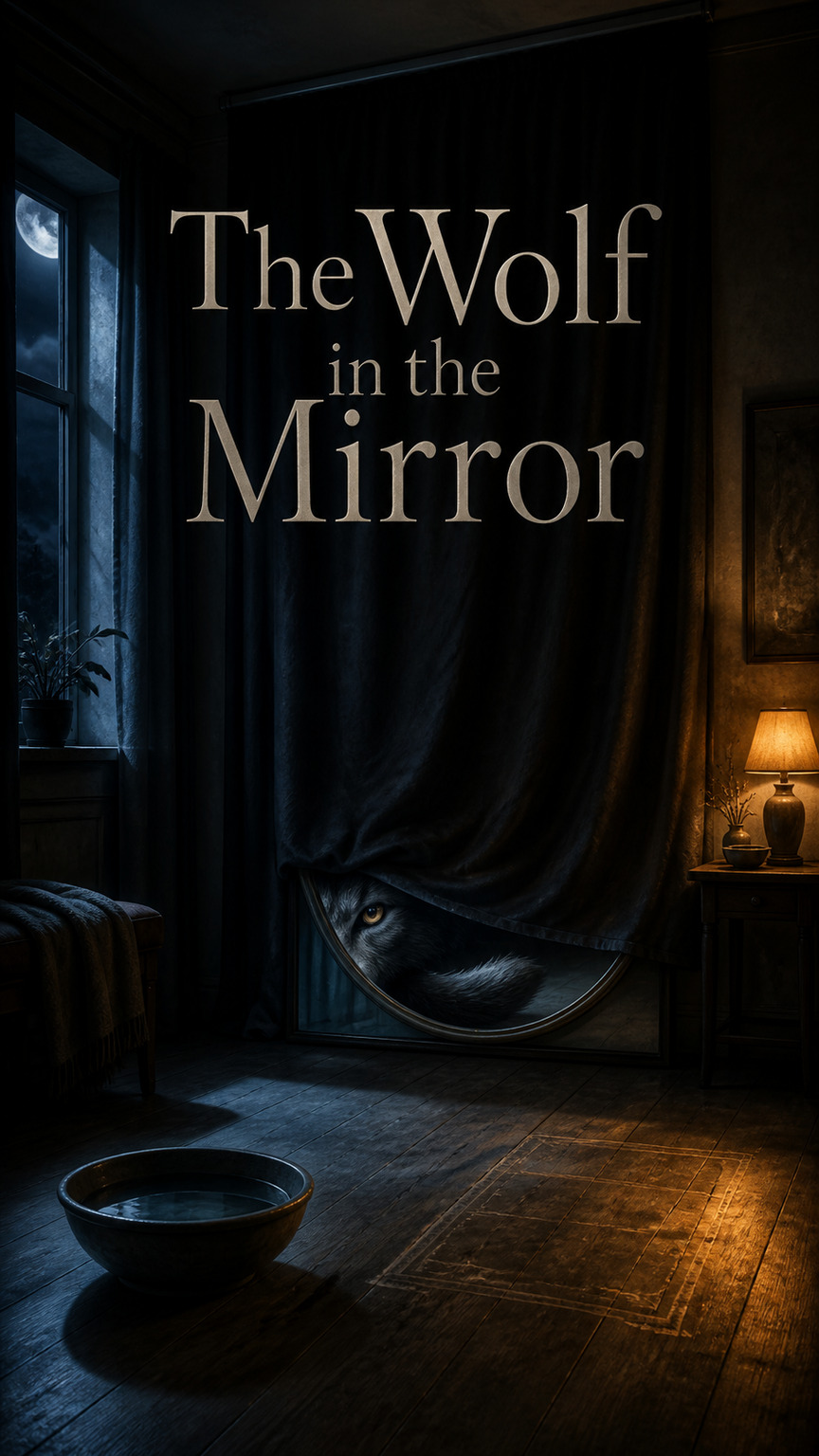
Forty-three minutes before moonrise, my partner moved the water basin six inches to the left and ruined my diagram.
“If you turn on the west half of the room,” I said, “you’ll hit it before you see it.”
They nudged the basin again with the side of one bare foot. “Then I will discover water.”
“At speed.”
“I have encountered water before.”
“Not with four feet.”
They looked at me. The laugh arrived in their eyes, then stopped at their mouth. “Don’t start doing that.”
“Doing what?”
“Making everything I choose sound like a defect you have to compensate for. The basin goes here. I can reach it from the blue light, and I won’t have to drink with my back to the gate.”
That was true. I erased the basin from the floor plan on my clipboard and drew it again where they had put it.
The room had once been a ground-floor studio with a mirrored wall and a door to the garden. During the past three weeks it had acquired a second skin: reinforced panels behind the plaster, a floor that would yield under a fall but not tear under claws, and an observation vestibule where the garden door had been. Two gates separated the inner room from the rest of the house. Neither looked domestic. We had tried covering them with curtains and discovered that curtains made them worse.
The mirror was fixed to the wall in a frame built to take an impact. A dark cover waited in a ceiling track above it. I could draw the cover from inside the vestibule without opening the gate, but only if my partner cleared the strip of floor beside the mirror.
“We could start with it covered,” I said.
“No.”
“It removes one variable.”
“It’s my room eleven months out of the year. I’m not waking up to find you’ve preemptively hidden it because I might be ugly.”
“That wasn’t the variable.”
“I know.” They pressed both palms to the cool glass and checked the frame for movement. “Still no. If I need it covered, we use amber. I move to blue. You pull it. That’s the agreement.”
I put a check beside MIRROR TRACK.
“You could say yes without writing it down.”
“I could also forget what yes referred to at three in the morning.”
They turned from the mirror. “Show me space.”
I held one palm upright at shoulder height: I see you; I am not coming closer.
“Orientation.”
I closed my hand and touched the knuckles to my chest.
“Approach request.”
I lowered my open hand, palm up. It was a request, not a command. If the wolf chose to cross into the blue pool of light near the water and remain there, I could work the mirror cover or come to the inner gate. If they stayed where they were, I stayed where I was. We had practiced the shapes at odd moments all week: while carrying laundry, while waiting for toast, once in the middle of an argument about the cost of the floor.
My partner answered the last shape by walking to the blue-lit patch and sitting cross-legged in it.
“Satisfied?” they asked.
“With the response, yes. Your attitude remains outside the scope of the test.”
“There you are.”
The two tones came from a brass box bolted high in the vestibule, ugly and unlike any sound in the house. One low note meant orient toward me. Two descending notes meant break attention and find the blue light. We did not pretend either sound was a sentence. The specialist who had built the box had been careful about that, and my partner had been more careful.
“Thresholds,” I said.
They groaned, but held up a hand before I could apologize. “No, go on. Last time.”
“I use the emergency partition if you strike the same surface twice without backing off, if you can’t recover your footing, or if your breathing doesn’t ease during the ninety-second blue interval. I call for outside help for blood, gate displacement past the marks, or loss of response to light and sound together. I don’t open the inner gate before dawn. After dawn, I don’t open it just because you look like yourself. You ask, and you give me space.”
“I give you the hand shape for space.”
“Yes.”
“Because I am myself the whole time.”
“Yes.”
They studied my face, making sure I had not merely completed the verbal part of the checklist. Then they nodded. “And if I do something embarrassing?”
“I report accurately.”
“Privately.”
“Privately.”
The small safety camera over the gate showed a green live-feed light. Its storage would erase itself after dawn. My partner could choose afterward to preserve a section, but nothing survived by default.
They pointed at it. “No clips to the specialist. No anonymous training reel. No telling your sister a cleaned-up version that becomes funny at dinner.”
“She doesn’t know about the curse.”
“People can make an anecdote without knowing what it means.”
I set down the clipboard. “Live feed only. It expires. You decide afterward.”
“I decided now. It expires. If I change my mind when I can ask, then I ask.”
“All right.”
They exhaled. “And you watch. You don’t hide in the hall because you think privacy means abandonment.”
“I watch.”
The moonrise alarm vibrated against the table between us. My partner’s shoulders rose toward their ears.
“Vestibule,” they said.
I went in, closed the outer gate, then the inner one. The latches seated with three heavy clicks. Through the clear panel, my partner seemed suddenly farther away than the width of the room allowed.
They put a folded robe in the recovery bench and faced me. “Turn around for the change.”
I turned.
Behind me, their breathing lost its human measure. Cloth whispered over the floor. The panels gave several soft complaints as weight shifted against them, and then there was a long interval in which the only sound I could identify was my own thumb rubbing the edge of the clipboard.
One scrape against the floor. A breath, deep enough that I felt it through the soles of my shoes.
I waited for the agreed knock. None came. Human hands were no longer part of the arrangement.
When I looked back, a wolf stood where my partner had been.
Power had changed the scale of the room. Their back was level with the lower hinge of the inner gate; their winter-dark coat rose high over the shoulders, and each breath opened the ribs under it. They did not look at the water, the mirror, or me. Their nose worked over the floor as if the room had been rebuilt out of smells.
Then they hit the gate.
The clear panel flexed in its frame. I stepped backward so hard my shoulder struck the outer gate. The wolf landed, skidded half a body length, and came forward again with their head low.
“Gate contact once,” I said aloud. “Recovered footing. No displacement.”
The wolf’s ears twitched. Mine might have, too, if they could.
I pressed the first tone.
The low note filled the vestibule and went on filling it after the box fell silent. The wolf’s head turned. Their eyes found the brass box, then moved to my fist at my chest.
For one second, perhaps two, they held there.
Recognition was too generous a word. I wrote ORIENTED, because that was what had happened. The wolf huffed, paced the length of the barrier, and put their nose near the seam without striking it. I kept the gate between us.
At 9:18, after eleven minutes of mapping every corner by scent, the wolf noticed their tail.
It happened behind them. Their hindquarters flicked away from something; the something followed. They spun, fast and clean, jaws closing on empty air. The tail vanished behind the other hip. They reversed and missed it again.
I watched a third circle before I understood.
“Oh,” I said.
The wolf stopped and looked at me, mouth open.
“No commentary. Sorry.”
Their tail swept once across the floor. Their head snapped around to follow it, and the chase began in earnest.
Our preparations had included a floor plan for pacing, a response tree for gate impacts, and three different ways to summon help without taking my eyes off the room. Nothing on my clipboard addressed a creature powerful enough to bow a reinforced gate pursuing a body part attached to their own spine.
The first five minutes were almost graceful. The wolf tightened into a dark wheel, paws placing themselves with astonishing precision. Then speed made precision expensive. A hind paw slipped. Their shoulder struck the yielding wall with a sound that emptied the joke from my chest.
They regained their feet immediately and stood panting, tail low.
I lifted the upright palm. Space. No entry.
The wolf looked toward the water. I turned on the blue lamp. They crossed to it, drank long enough to darken the fur under their jaw, and stood with their sides working.
The rest interval began. I watched the clock rather than guessing at their breathing. It eased before the interval ended.
Then the tail moved across the blue light.
The wolf lunged after it.
At 9:34, I used the orientation tone. They stopped with their body wound almost in a knot, stared at me, sneezed, and resumed in the opposite direction.
At 9:47, they caught the fur at the tip for less than a second. Surprise broke their grip. They jumped sideways and barked once at the floor.
I laughed. It escaped before I could decide whether it was kind.
The wolf went still.
Every line of their body aimed at me. Their mouth had closed. The room seemed to remember the first gate strike.
I set the clipboard down and raised the space sign. “I am here. I’m staying out.”
Human words meant little or nothing, but the voice was mine and the distance was the distance we had chosen. After a moment, one ear turned away. Their attention loosened. They shook from nose to tail, paced to the water, and drank.
I picked up the clipboard. If they asked after dawn, I would tell them I had laughed.
By ten, the chase had stopped looking like a single event. It had phases. There were tight, efficient circles in the middle of the room; broad loops around the recovery bench; sudden ambushes when the tail appeared beside a hind leg as if it had broken a treaty. There were also pauses in which the wolf stood with their head down and saliva shining at the edge of their mouth, and those pauses kept my finger near the emergency partition control.
At 10:08 they lay down without a cue. I began the rest interval. Their breathing eased. They chose the water, drank, and remained still while I counted another minute.
The plan said voluntary recovery reset the threshold.
My fear said fifty minutes was already too long and I should stop it.
My partner, forty-three minutes before moonrise, had said, Don’t make everything I choose sound like a defect you have to compensate for.
I did not touch the control.
The wolf rose, took three measured steps, saw their tail curl past a back foot, and whirled after it again.
“Rest interval complete,” I told the empty clipboard stand. “Voluntary resumption.”
I repeated that last phrase until it began to sound like an excuse.
At 10:29, the wolf changed tactics. They backed toward their tail while turning their head the other way, creating a slow sideways crescent that should not have worked and did not. At 10:41, they sat abruptly on the offending part. The resulting stillness lasted twelve seconds. At 10:42, they stood, looked behind themselves, and began again with renewed conviction.
I did not laugh that time. I put both hands over my face, which was not one of our signals, and felt my shoulders shake.
When I looked through my fingers, the wolf had stopped. They stood watching me from across the room, tongue out, sides heaving. The look gave me no answer. It was simply attention.
I lowered my hands. “Accurate report,” I said. “No editorial additions.”
They turned away before I finished.
At 10:56, one front paw dragged on the turn. I pressed the low tone too quickly. Then, because the wolf did not look up at once, I pressed it again.
“Orient. Orient toward the vestibule. Blue is available. Water is available.”
Procedure crowded my mouth. The wolf kept circling, slower now. I reached for the tone a third time and stopped with my finger above it. Repetition had not made the cue clearer. It had only made me louder.
The tail crossed in front. The wolf’s jaws snapped, missed, and they stood there swaying slightly.
I lit blue and waited.
After eight seconds they walked to the water. After drinking, they lowered themselves into the blue pool with a graceless collapse that sent my hand to the control. Their head stayed up. Their breathing eased. One paw stretched, then the other. Nothing had crossed a threshold except my patience.
I sat on the vestibule floor so they would not have to watch me hover.
At 11:16, the wolf stood. For the first time since the chase began, their tail moved without taking the rest of them with it.
They walked away.
The clock read one hour and fifty-eight minutes. They crossed the room at an angle, passed the recovery bench, and entered the bright length of the mirror.
The reflected wolf appeared all at once.
My partner froze.
The wolf in the glass froze with them: shoulders high, tail rigid, mouth partly open. No scent came from it. No footfall. Yet it occupied the room perfectly, huge and close and staring straight back.
My partner barked.
The force of it struck the clear panel. They barked again, deeper, and the mirror answered in exact silence.
I pressed the orientation tone.
Nothing.
The wolf advanced. Their reflection advanced. They stopped with their nose a hand’s width from the glass and jerked sideways. The other wolf matched them. A paw scraped the floor.
“One surface,” I said. “No impact. Footing stable.”
I sounded procedural because I was afraid. I repeated the conditions under my breath until they nearly became permission for whatever happened next.
The wolf dropped their head and gave a rolling warning that I felt in my sternum. The reflection did the same. They feinted left. It followed. They feinted right, faster, claws finding the floor.
I killed the overhead white lights. Blue remained near the water. Amber waited dark above the vestibule. With the room dimmer, the reflected animal lost some detail but none of its size.
My partner struck the mirror with one forepaw.
The frame took it. The panel held.
One impact.
I pressed the two descending notes once.
The wolf’s ears flattened. Their head turned halfway toward blue, then snapped back when the reflection turned too. They barked until the sound frayed. I kept my hands visible and still. No more tones. No chain of instructions they could not answer.
After a while, they began to test the thing in front of them.
They backed away. The rival gave ground. They stepped toward one edge until only a shoulder and one pale eye remained in the glass; the fragment tracked them. They approached from the other side. Nose high, they sampled the air beside the frame, along the floor, under the recovery bench. There was nothing for me to name as understanding. Their body simply stopped preparing to launch.
At last they looked toward the vestibule.
I touched my fist to my chest.
The wolf’s ears shifted forward. Behind them, the mirror-wolf did the same.
I turned on amber and lowered my open hand: a request to approach the barrier, and with it permission for me to move the cover.
They looked at the amber lamp. They looked at the blue pool across the room. Then they looked back at the mirror and barked once, sharp enough to make me flinch.
They did not move to blue.
So I did nothing.
The wolf paced in a tight line between the mirror and the middle of the room. Twice they glanced at me. The second time I repeated the open hand, slower. My mouth wanted to add the rule, the threshold, the correct response. I bit the inside of my cheek and let the shape stand alone.
They crossed into blue.
Not neatly. One hind foot remained outside the light, and their head stayed angled toward the mirror. But the strip beside the glass was clear. They lowered their chest to the floor.
I pulled the cover lever.
The dark fabric traveled down its sealed track. The reflected wolf narrowed to a dark muzzle, one eye, a stripe of fur, and disappeared.
My partner sprang up. I let go of the lever, ready to stop the cover where it was, but they did not charge. They crossed the room, smelled the fabric from end to end, and pushed their nose against the place where the rival had been. The cover swayed. Nothing answered.
They returned to blue on their own.
At 12:07, the wolf lay down facing the vestibule. Their tail curved along one hind leg. They did not chase it.
The rest of the night did not become safe. Once, a vehicle passed outside and they struck the floor hard enough to wake me from a blink. Once, they stood over the water and stared toward the covered mirror for eleven minutes. At two, they paced the whole perimeter, testing the seams with their nose. At three-thirty, they slept, but lightly, their paws twitching against the floor.
I remained in the vestibule. The camera’s green light remained on. Every hour, the storage indicator lost another bar.
Near dawn, gray light collected around the edges of the blackout panels. The wolf woke before the alarm and stood with their head lifted. I moved into the corner they had chosen for me and turned my back.
The change announced itself in breath and shifting weight. I heard the recovery bench open. Fabric dragged over skin. A long time passed before my partner spoke.
“Open the gate.”
Their voice was scraped thin with exhaustion.
I turned. They wore the robe, sitting with their back against the bench. I waited.
Annoyance tightened their mouth. Then they raised one palm at shoulder height. Space.
I opened the inner gate and retreated to the outer one. They got to their feet, waited until the passage was clear, and entered the vestibule, smelling of sweat, damp fur that was no longer there, and the plain soap from the robe pocket. Only when they lowered their hand did I touch their arm.
“Water,” they said.
I gave them my bottle. They drank half, sat on the outer threshold, and looked through the gate at the covered mirror. The live-feed light had shifted from green to blinking amber. Seven minutes until deletion.
“Tell me,” they said.
“You tested the gate once. The first tone oriented you. You found water without help.”
“You’re arranging the facts.”
“I am giving them in order.”
“You’re delaying.”
I sat beside them, leaving the width of the bottle between us. “You chased your tail.”
They closed their eyes.
“For one hour and fifty-eight minutes,” I said.
“Two hours.”
“Approximately.”
“Please don’t rescue my dignity with arithmetic.”
“You told me to be accurate.”
“I have changed my mind about accuracy. What happened to the mirror?”
“You barked at it. There was one paw impact. You checked angle, distance, and scent. I requested the cover. You cleared the track. I lowered it.”
They opened their eyes and looked at me then, not grateful, not wounded. Checking.
“You waited?”
“Yes.”
“Even after the hit?”
“It was one. You backed off.”
Their shoulders came down a fraction. “Good.”
The camera blinked faster.
“Do you want any of it saved?” I asked.
They watched the light through two flashes. “Did the tail part look funny?”
I thought about lying. They waited.
“Yes.”
“Delete it.”
I passed them the small control from the wall. They pressed the recessed key themselves. The amber light went out.
We sat in the new quiet. Their knee leaned against mine, whether from fatigue or choice I did not ask. Beyond the inner gate, the basin waited six inches left of where I had drawn it, beside a fan of wet pawprints.
“Next month,” I said, “we could revise the mirror condition.”
“Cover it before moonrise.”
“Without amber?”
“Without a committee.”
I nodded.
They rested their head briefly against my shoulder, then pushed the empty bottle into my hands. “And leave the water where I put it.”
I left it there.