There Goes Your Name
"There goes your name" the fae cooed. "Now, go ahead and pick a new one!" name magic is over rated anyways...
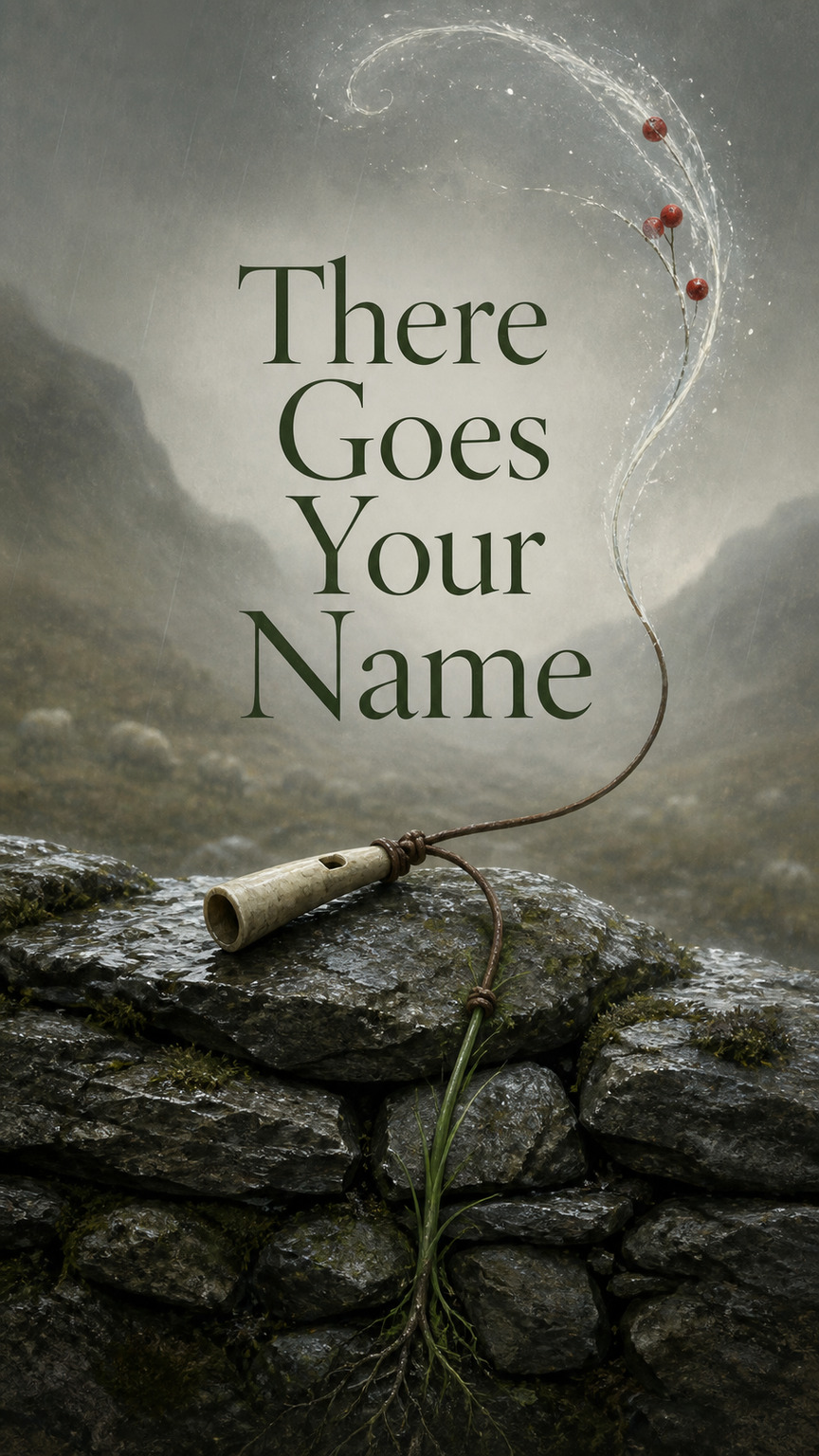
The first fog came up while we were arguing over a lame ewe.
My sister had the flock’s rear, which meant she also had the mud, the stragglers, and every good reason to be cross. I was ahead at the spring, laying the back of my hand against the water to judge whether the cold rain would reach us before dark. Between us, a hundred and six sheep blurred into a long grey drag across the hillside.
“She’s putting the bad foot down,” my sister called.
The fog carried her voice wide. I could not see her through the sheep, but the name-call tucked my old name into the sound and sent it to me from exactly where she stood: forty paces uphill, a little west, by the scattered thorn. Name-work was useful that way. It was also useful in the way a gate-latch was useful. Nobody wrote songs to a gate-latch.
“Bring her slow,” I shouted. “We’ll wrap it at the fold.”
“And the lamb?”
“With her.”
“You counted it?”
I had not. “I can see it.”
“You can see fog.”
She was fourteen and had recently discovered that accuracy could be sharpened into a household weapon. I found the lamb beside its mother’s shoulder, barely more than four trembling legs under a wet fleece, and waved my crook so my sister might glimpse it.
“There. Save your breath for the climb.”
“I’m going down.”
“Then save it for complaining.”
I turned back to the spring and found someone sitting on my pack.
The fae was no taller than my elbow to my fingertips, though its legs hung almost to the ground. It wore no shoes. Pondweed lay slick between its toes, and a spray of rowan berries was braided into hair the brown-green of water seen through peat. It had opened the flap of my pack and was smelling my bread as if deciding which season it belonged to.
“Move,” I said.
It lifted its face. Its eyes were pale and round, with no more expression in them than two drops of whey. “You have a lovely sound tied to you. Worn soft at the edges.”
My hand went to the horn whistle under my shirt. Father had cut my old name into its flat side when I was seven, two plain syllables in cramped letters because his knife had been too broad for the job.
“That’s not for you.”
“Oh, the whistle is hard and greasy.” The fae wrinkled its nose. “I meant the other thing.”
It moved before I did. Two damp fingers touched the hollow of my throat, light as a moth landing. Something snagged—not in my skin, but in the direction of me—and pulled free.
The fae sprang off my pack. It cupped both hands beneath its chin as though carrying a warm egg I could not see.
“There goes your name,” the fae cooed. “Now, go ahead and pick a new one!”
“Put it back.”
“That one had gone dull. Pick something green. Or round. A name with a bit of rain held in it.”
I caught it by the wrist.
Cold ran through my palm. Not winter cold; spring-water cold, so clean it hurt. The fae laughed and folded somehow, its wrist narrowing like a ribbon through my grip. It landed on the stone rim of the spring three steps away, still holding its cupped hands level.
“Give it back,” I said.
“But you haven’t even tried being without it.”
I knew the old name. I knew how Father had said it when I had left a hurdle open, clipping the second syllable because the sheep were already in the beans. I knew my sister stretched the first when she wanted me to answer across weather. In the flock ledger, my name stood beside the winter feed accounts and the note about the north wall. It was mine in all the usual ways.
“I have work.”
The fae lowered one hand to trail its fingers in the spring. The other remained closed. “Work has so many noises. Scuff, huff, clack, tear. A name gives only one.”
Behind me, the dog gave one sharp bark.
The flock had begun to bunch. Fog thickened across the slope, swallowing the thorn and then the backs of the last sheep. I put two fingers to my mouth and whistled the dog round to the west. It knew that signal. The sheep turned downhill, shoulder pressing shoulder, wool brushing with a sound like rain in dry grass.
“You,” I said to the fae. “Stay there.”
It smiled. “Which you?”
I left it at the spring because the lame ewe was moving and my sister had sense enough to follow.
For perhaps five minutes, that was true.
Then the lame ewe veered downhill past the old sheepfold, her lamb at her shoulder. The dog went after them. I stepped into the open side of the fold, driving the leaders around the dry-stone wall, and the fog closed behind them so neatly it seemed to cut the flock in two. Bells knocked. Hooves scraped. I whistled twice for my sister to tighten the rear.
No whistle came back.
I called her by her name. The call went to her, wherever she was, but no answer came back.
“That’s poor,” said the fae from the wall above me. “Throwing a voice without a string.”
“What did you do?”
It opened its palm for a moment. I saw no written word, no glowing mark, only the faint bend of light above its skin, as if sun lay under moving water. Then its fingers closed again.
My sister called my old name.
Her voice came from the wall where the fae sat.
I looked up so fast the rim of my hood struck my cheek. The fae tipped its head, listening to the call arrive. It breathed across its fist and turned its wrist. My sister’s second call slid left with that motion and faded toward the upper path.
“Stop that.”
“I carry it. That is where it goes.”
“You are carrying it. You are turning her voice.”
“Yes.”
No shame. No threat, either. It said yes as my sister might say the ewe had four feet. I climbed the loose outer face of the wall and reached for it. The fae hopped down inside the fold, brushing past the damp noses of three ewes. They flinched because it touched them, not because they knew what it was.
My sister called again. The fae ran toward the uphill gap, cooing the two syllables back to itself—not answering, only savoring their shape. The call followed it.
I ran after.
The upper path climbed between heather and broken stone. It was the wrong road for the lower pasture, the wrong road for a lame ewe, and the wrong road under a sky holding that much rain. I knew all three facts. I also heard my sister’s breath behind every call bent uphill, and knowledge became a poor thin thing beside it.
The fae stayed just ahead. Now and then I saw rowan-red beads in the fog. It paused on a boulder, both hands closed around what it had taken, and offered, “You could be called moss. You step like moss trying not to be a boot.”
“How far can she be?”
“From what?”
“From the name-call.”
“Near enough to want you.”
“A mile? Two?”
It considered. “Not two. Two has too much road in it.”
“Can she hear me?”
“If you make a noise.”
I blew the horn whistle: one long note, two short, our ordinary recall. The sound flattened in the fog, directionless but loud. I waited.
Nothing answered.
The fae dangled from the boulder by its knees. “Try a softer name next. This one has been said across too many fields.”
I pulled the whistle from its thong and held the carved side toward it. “My father gave me this name.”
“Your father put scratches on bone.”
“Horn.”
“Horn, then. It smells of your neck.”
“He gave me the word before he carved it.”
The fae swung itself upright. “You still have the word. Look. Say it to yourself.”
I did, silently. Every sound remained where memory kept it. That did not make the fae’s theft small.
“He is dead,” I said. “I can’t ask him for another.”
The fae leaned close enough that I smelled crushed mint and sheep dung on its breath. “Dead people leave old sounds. This one drags at the end. Can’t you feel it?”
Below us, the dog barked twice.
I turned. Its shape was only a dark patch in the fog, down by the fold. It stood facing downhill, ears pricked away from me.
The fae had followed my gaze. “It doesn’t know your new sound.”
“It doesn’t need one.”
On the path at my feet, every hoofprint pointed down.
Not many: the narrow print of the lame ewe, the two neat punches of the lamb, and my sister’s boot heel smeared through the edge of both. A strand of wet wool clung to a low juniper on the downslope side. There were no fresh marks continuing uphill except mine.
My sister called again. Her voice came from behind me.
The fae stood behind me.
It raised its closed hand as she called and drew the sound toward itself with a long inhalation, pleased as a child smelling cakes. I wanted to reach for that fist again. I tightened my grip on the crook instead.
“I’m going down,” I said.
It smiled. “But I’m up here.”
I dropped to one knee beside the prints. Rain had not yet filled them. The lame ewe was setting the bad hind hoof along its outer edge, as she had in the morning. My sister had kept her on the softer ground until the juniper. Beyond it, the slope broke toward the scree channel.
The dog whined.
“Go find,” I told it, and gave my sister’s ordinary hand-signal: palm low, two fingers forward. No magic in that. Training, meat scraps, years.
The dog vanished downhill.
The fae skipped beside me when I followed. “Moss is still available. Or milkcap. You have the look of something found under a leaf.”
“Do you have to answer when she calls?”
“I don’t answer. I turn it.”
“Do you have to turn it?”
The fae’s toes tested a slick stone and withdrew. “No.”
“Then don’t.”
“But the way she worries your old sound is lovely.”
I stopped so sharply it nearly walked into me. “She’s on bad ground with a lame ewe. If you send me wrong again, she may fall.”
For once, the fae did not fill the space. Rain ticked in the heather. A sheep coughed somewhere inside the fold.
Then the fae said, almost complaining, “I didn’t tell her to stand there.”
“No. You only kept me from finding her.”
It rubbed its closed fist with the thumb of its other hand. “People usually chase what I take.”
“I did.”
“You stopped.”
A thin whistle rose below us, one long note. It broke halfway through the second, ended in a breathy crack, then did not come again.
My sister’s reed whistle. She had mended the mouthpiece twice with thread and wax and claimed it would last the winter. It had not lasted the afternoon.
The dog barked from the same direction.
I went down.
The fae followed without speaking. It came upright now, using hands as well as feet on the wet rock, still keeping the fist with my old name lifted away from every scrape. The slope steepened below the juniper. Grey stones shifted under brown grass, all of it slick as fat. I found where the ewe had slid: four furrows, a tuft of belly wool, blood no larger than a berry on one sharp edge.
“Stay high,” my sister shouted. No name this time. Her voice came from below and a little east, plain direction carried by the wind when it happened to be kind. “The middle’s loose.”
“Can you move?”
“I can. She can’t. Lamb’s here too.”
“Anything broken?”
“Whistle. Maybe my backside.”
“That will heal your manners.”
“Come say that down here.”
There she was: crouched on a shelf of stone scarcely wide enough for her boots, one arm braced behind the lame ewe’s neck. The lamb was wedged between her knees, shivering but upright. The dog stood on a firmer lip below, looking up and refusing to climb the shifting fan between us.
My sister had mud to one eyebrow and the furious, frightened look she got when fear seemed an accusation against her competence.
“Don’t move the ewe,” I said.
“Hadn’t planned to throw her.”
“I need the rope.”
“You have it.”
I reached for the coil at my belt and found an empty hook.
She closed her eyes. “You left it on the gate.”
“I did.”
“You told me to mind the gate.”
“Yes.”
“I was minding a sheep.”
“Keep doing that.”
The fae crouched above the scree, peering at my sister. “She’s red under the mud. Like a rowan fruit dropped in broth.”
My sister stared at it. “What’s that doing here?”
“It stole my name.”
“Ugly little midden-pip. Give it back.”
The fae drew itself up. “I am not ugly.”
“Then stand somewhere useful.”
I signaled the dog toward the fold, then tugged an empty fist toward me: fetch the rope. We had taught it that during lambing. It hesitated, glanced at my sister, and went when I repeated the signals. While we waited, I tested the slope with the crook. The middle ran at a touch. The safer line curved east across a narrow band of grass, down to the dog’s ledge, then back under my sister’s shelf. We would need the rope for the ewe. We would need my sister to move first.
“The lamb goes inside your coat,” I told her. “Feet down.”
“It kicks.”
“So do you.”
“Not when folded.”
She managed it. The lamb disappeared against her belly, its nose poking between two buttons. She looked absurdly pregnant and entirely unable to laugh about it.
“Left foot to the grass,” I said. “Not the grey stone.”
“It’s all grey.”
“The one with the black edge. Reach past it.”
She shifted. Pebbles ran from under her boot. The ewe lurched against her hip.
“Wait,” I said.
“I’m waiting.”
“You’re moving.”
“The sheep is moving.”
Her sentences came apart with her breath. Mine had shortened until every word seemed to have a job and resent the others.
The fae watched the stones move. “They sound like dry seeds in a pod.”
Neither of us answered.
The dog returned dragging the lambing rope by one loop. It had caught twice on heather and collected half the hillside. I climbed down to take it, tied one end around my waist, and threw the cleanest loop toward my sister. The first fell short. The second struck her shoulder.
“Under your arms,” I said.
“Ewe first.”
“You first.”
“If she goes, she takes me.”
That was true. She threaded the rope behind the ewe’s forelegs instead, working one-handed around the lamb beneath her coat. I braced on the lower ledge and took the weight while she urged the ewe across. The animal placed its sound hoof, dragged the sore one, and tried to turn back. The dog dropped flat where she could see it. My sister pressed her shoulder to the ewe’s rump.
“Easy,” she said. “No, not there. Here. That’s grass. Put your stupid foot on it.”
The ewe listened to pressure, footing, and the dog’s stillness. She did not need a name. She reached my ledge trembling. I worked the loop free, then eased her down to the dog, who stood and kept her from turning uphill.
I threw the loop back to my sister. She passed it under her own arms, then crossed with the lamb. Halfway, the black-edged stone rolled. Her left foot went out.
She did not call my name. She said, “Rope!”
I dropped my weight backward. The line snapped tight under her arms. She struck the slope on one knee, showering us both with shale, but her right boot found the grass band. I hauled while she crawled. The lamb bleated once from inside her coat, offended but alive.
When she reached me, she pushed the lamb into my hands and sat down hard.
“You took your time,” she said.
“I went uphill.”
“Why?”
I looked at the fae. It had come down to the shelf we had left and was tracing the ewe’s blood-speck on the stone with one damp finger.
“Because it moved the call,” I said.
My sister wiped mud from her eyebrow and made the smear worse. “You always say calls make people lazy.”
“I do.”
“You were right, then. That’s annoying.”
“Get up.”
She got up.
We brought the ewe and lamb back by the long lower curve. The rain arrived properly, needling the backs of our hands and turning the dog’s coat black. Behind the fold wall, the flock had divided itself according to no scheme useful to us: yearlings in the corner meant for ewes, two rams nosing the broken hurdle, and one lamb perched on the feed stone as if supervising.
My sister took the far wall. “Let’s see where the old one sends me now.”
She called my old name. Her voice came from the fae under its dock leaf instead of from her.
“Still broken,” she said.
“Mine, not yours.”
The fae sat on the wall under a dock leaf, keeping one fist closed. “Broken is harsh. Empty has more room in it.”
“Give back the old one,” my sister said.
“No.”
“Why not?”
“I like how it has been used.”
My sister took one step toward the wall. I caught the back of her coat.
“Leave it,” I said.
“I’m not leaving it. I’m knocking it into the nettles.”
“We have a lame ewe, a wet lamb, and a gate that won’t hold.”
“Also that.”
“The gate first.”
She gave the fae a look that promised future nettles and went to lift the dropped hurdle. I stood in the rain with Father’s whistle against my chest and listened to the flock shove and mutter. My old name was not empty of use. It belonged to his voice, to my sister’s, to the cut letters under my thumb. The fae could keep carrying the bent call for now. It could not take those.
But my sister still needed a sound that would reach me straight when the weather hid us.
At the spring, long pale sedge bent under the rain and rose when each gust passed. We cut it every winter for bedding. Its roots held the black edge of the bank where sheep would otherwise punch through.
Nothing truer than that. Something useful.
I went to the fold entrance where my sister could see me. “I’ll use Sedge.”
She stopped with the hurdle against her shoulder. “You will?”
“For calling.”
“All right.”
“Say it back. Mean me.”
Her face tightened with concentration. She had known me all her life, which did not prevent her from doing things badly on principle. This she did carefully.
“Sedge,” she called.
The sound reached me from her place at the far side of the fold. Not louder. Not sweetened. It came through rain and milling sheep with its direction clean inside it.
The fae opened both hands. A bend of light remained above the palm that held my old name; the other palm was bare. It laughed, delighted rather than defeated.
“One weather-stem,” it said. “And one old bell-sound.”
“Are you keeping the old one?” I asked.
It tucked its closed fist beneath its chin. “For a while.”
Then it dropped from the wall into the fog. Rowan berries flashed once and were gone.
My sister set the hurdle back into its sockets. “Sedge.”
“What?”
“Nothing. Trying it.”
“Try it while you sort the yearlings.”
She went left. I went right. The dog brought the first six through the narrow gate, and for several minutes there were only wet backs, reaching hands, the knock of wood, and my sister telling a ram exactly what she thought of its mother.
Then her voice found me cleanly from behind the flock.
“Sedge, your side!”
I turned in time to block the lame ewe from following the yearlings through. Her lamb squeezed under my arm. My sister laughed once, breathless, and shoved the hurdle closed.
“Wrap that foot,” she said. “Rain’s getting in.”
I reached for the wool bandage in my pack. “Count the flock first.”
“I already did.”
“How many?”
She held up both muddy hands because she knew I hated waiting while she counted on her fingers. The dog shook rain across my legs. Somewhere beyond the wall, the fae made a small pleased sound, or perhaps it was only water slipping under the stones.
My sister got to one hundred and six. We started again to make sure.