Transitions in Common
Your friend got so excited when you said you're trans like them. You just figured out too late they meant transgender, not actually a shapeshifter like you.
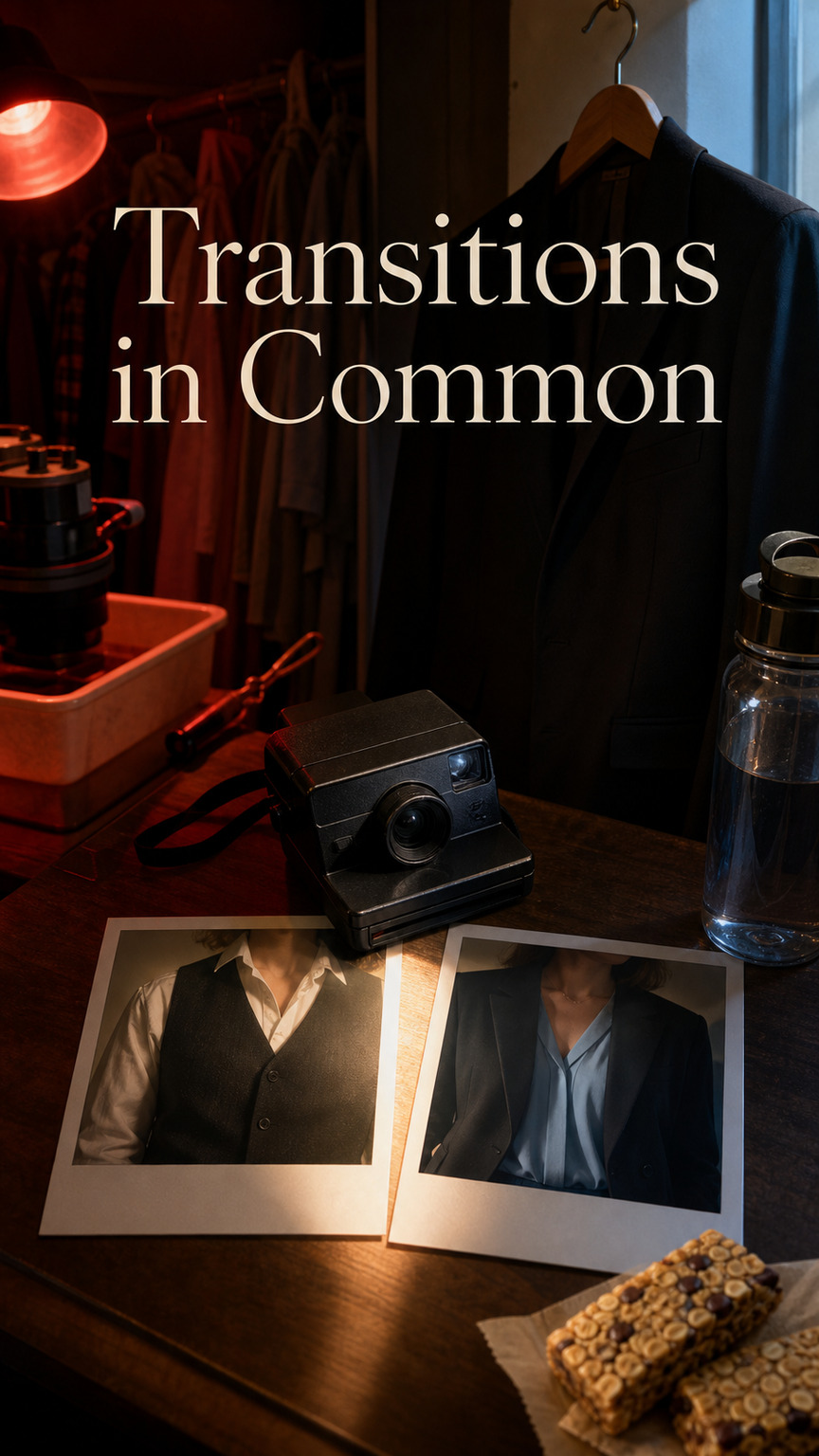
The black jacket was going to betray me by fitting perfectly.
I stood in the costume-room mirror late Friday, one arm through a sleeve, and watched the shoulder seam land exactly where it should on the masculine body I wore to school. On my practiced feminine body, the same seam would slide down my arm and the button would pull. The jacket didn’t know that. Clothes were loyal to measurements, not people.
“Are you planning to return that,” Hugo asked, “or form a permanent attachment?”
“I’m waiting for it to admit it has limitations.”
He usually would have told me the jacket’s greatest limitation was me. Instead, he checked the corridor, shut the costume-room door, and tested the latch twice.
“I need to ask you about the portrait,” he said.
Monday’s arts-night display required a self-portrait. Hugo had been avoiding his with the dedication of someone studying for an exam in avoidance. I pulled my arm free and rehung the jacket.
“I can take it. You can veto every shot.”
“That’s part of it.” He flattened a crooked paper label on a box of gloves. “I want to control the clothes and who sees it. And I want you to understand why.”
The room held its usual smells of dust, hot stage lights, and fabric that had survived too many imaginary centuries. Beyond the door, a rack squeaked along the auditorium floor and faded away.
Hugo said, “I’m trans.”
I knew the common meaning of the word. Of course I did. But he had locked the door. He had mentioned photographs and clothes and being seen as the wrong version. For years, I had shortened my own impossible secret to the same four letters inside my head, because naming a thing privately was safer than explaining it aloud.
Hope reached the sentence before sense did.
“Me too,” I said.
His whole face changed—not into another face, which should have warned me, but from braced to bright. “You’re serious?”
“Completely. Nobody at school knows.”
“I had no idea.” He laughed once, mostly breath. “I thought maybe, because of the they/them, but I wasn’t going to decide for you.”
I heard decide for you and thought of body maps held behind my teeth, each one mine and none safe to show. “Thank you.”
“How long have you known?”
“I started changing a few years ago. I got better at it slowly.”
His excitement softened. “Yeah. Slowly sounds familiar.”
That could have been the moment. So could half a dozen moments after it. Instead, we traded truths with the important noun cut out. He said photographs could pin other people’s expectations to you. I said one version of me had ended up on every school record, so I kept using it even when another fit better. He said telling parents could be complicated. I said mine expected consistency.
Neither of us asked the question that might demand an answer we weren’t ready to give.
“This stays here,” Hugo said at last. “You don’t tell anyone about me.”
“Never. Same for me?”
“Obviously.” He looked offended that I needed to ask, which made me trust him more. “Will you help me find something tomorrow? For the portrait. Then Sunday, we can change here and take it before anyone arrives.”
I looked at the jacket, then at my friend, and imagined opening one locked door in my life.
“Yes,” I said.
We meant different doors.
At the secondhand shop on Saturday, Hugo rejected three vests for being too shiny, too square, and “designed for a child magician with tax problems.”
The fourth was charcoal gray and plain enough that he went quiet when he saw himself in it. He rolled the sleeves of an open-collar shirt beneath it and shifted under the fitting-room lights, checking the line from shoulder to waist.
“That one,” I said.
“You didn’t even make a joke.”
“I respect the vest.”
“Terrifying.”
I had kept my school body for the trip. It matched the face people knew, and shopping already required enough arithmetic without changing height halfway through. Still, I took a soft blue blouse from the next rack and pulled it over my T-shirt. Its narrow cut sat oddly across my current shoulders, but I liked the drape of the sleeves.
Hugo glanced over. “Also that one.”
“It doesn’t fit.”
“It doesn’t fit like that.”
I stared at him. The sentence was so exactly right under my meaning that it felt like a hand offered in the dark.
I added the blouse to our basket, then found a sharply cut jacket one size larger. The jacket worked over the blouse. Neither garment changed who was inside it, but together they made my reflection feel less like a form waiting to be filed under one heading.
Hugo watched me gather trousers in two sizes and another shirt in a third. “Planning several lives?”
“Same life. Unreliable measurements.”
“Bodies are inconsiderate that way.”
“Do your shoulders take long to settle?” I asked.
His attention snapped from the mirror to me. “I’m not discussing my body in detail. Or medical decisions. If I bring something up, fine. Otherwise, no.”
Heat reached my ears. I had been trying to ask how quickly he transformed without making him prove anything. I had managed to be invasive under either interpretation.
“Right. Sorry. You don’t owe me mechanics.”
He studied me for another second, then tugged the vest straight. “Bodies don’t move on command just because someone wants them to. That’s all I’m saying.”
I nodded, privately impressed by what I mistook for discipline. My own first changes had taken months of failed concentration before I learned the trick of holding a body-map and releasing my breath into it.
At the shop’s little counter, Hugo paid for the vest and shirt. Outside, we divided the bags and reviewed Sunday as if precision about logistics could compensate for the noun neither of us had supplied.
“No portrait gets displayed unless I approve the exact picture,” he said. “No posting it.”
“Agreed. And when I’m changing: no camera, no coming in, no touching.”
“I wasn’t planning to tackle you into your trousers.”
“Good. They’re fragile.”
The joke landed badly enough that I hurried on. “We could each show the other a version not many people see. If you want.”
Hugo adjusted the paper handles cutting into his fingers. “You first or me first?”
“Same time? Screens between us.”
“Then we come out when we’re ready.”
“Yes.”
“Okay,” he said. “I trust you.”
That should have slowed me down. Instead, it felt like permission to run.
On Sunday, I put a PRIVATE FITTING sign on the costume-room door, checked the latch, and turned Hugo’s instant camera facedown on a table. I set my water bottle and two oat bars beside it. A full change always left me thirsty, hungry, and weak in the muscles, and it made another full change unreliable for twenty minutes. Preparation was how I made danger look like tidiness.
Hugo arrived carrying the vest and shirt. “You brought emergency rations?”
“Wardrobe is strenuous.”
He gave the food a puzzled glance but took his clothes behind the left screen. I went behind the right in loose trousers and a sweatshirt with enough room to forgive several versions of me.
Fabric rustled on his side. A button clicked against the floor, followed by a quiet, heartfelt complaint. Then Hugo said, “Ready.”
I put my hand on the screen’s wooden edge. “Ready for me to change?”
“Yes.”
He had agreed to witness a change of clothes. I had asked permission to do something I had never named. My excitement called the difference unimportant.
I chose the familiar map of my feminine body. I held it whole: shorter reach, lighter frame, a different line to my face, longer hair, a voice that resonated higher without becoming anybody else’s. Then I let out the breath I had been holding.
Warmth spread from my ribs through my shoulders and down my legs. The sweatshirt loosened, then caught at one hip as my balance shifted. My heels pressed differently into the floor. The top of the screen rose in my vision as I lost a few centimeters of height. I kept breathing. My jaw eased under my fingertips; hair brushed my neck, then the cloth between my shoulder blades. Every few seconds, the remembered map tugged against the body I was leaving, not painfully, but with the deep fatigue of holding a difficult pose.
At thirty seconds, my hands were trembling from effort. At forty, the warmth settled. I was still Cody. I had the same scuff on my left knee, the same promise to protect Hugo’s secret, and the same terrible habit of believing preparation made me careful.
I stepped out.
Hugo emerged at the same time in the charcoal vest and open-collar shirt. It was exactly the look he had chosen: simple, sharp, entirely his.
Then he saw me.
My hair was still shortening by a final fraction around my face, and the last warmth was leaving my throat. His hand tightened on the screen.
“Hey,” I said. My changed voice made the ordinary word unmistakably strange. “It’s me.”
His gaze went from my face to my unchanged sweatshirt to my face again. “Cody?”
“Yes.” I waited for astonishment to become delight. “So. When do you change?”
He looked down at his vest. “I did.”
“No, I mean—”
“I changed my clothes.”
We stood there, each waiting for the other to catch up.
Hugo said, very carefully, “When I told you I was trans, I meant I’m a transgender boy.”
Every double-edged sentence from the last two days turned at once. Not magic. Not body maps. Not a secret ability. Hugo had trusted me with himself, and I had answered from a private dictionary he had never seen.
“Oh,” I said.
His face closed. “Did you understand what I told you?”
“I thought you meant—what I can do. I use it as a shortened word. For transmutable. Only in my head, mostly, but everything you said about changing and pictures and—”
“Did you know I might mean transgender?”
The technical defense crowded my mouth. I hadn’t lied. I had told him something true. We both had secrets and complicated clothes and versions other people expected to see.
“I knew that was one meaning,” I said.
“The usual meaning.”
“Yes. But with the locked door, and you said—”
“You let me keep talking.” His voice narrowed rather than rose. “You said ‘me too.’ I told you more because I thought you understood that part of my life. Did you?”
“I understand hiding. And people deciding what they see. There are similarities.”
“That’s not what I asked.”
I reached for the body-map of my school form. If I changed back, maybe the room would contain one less impossible thing. I pulled in a breath.
“Stop,” Hugo said. “Don’t turn into someone else to win the argument.”
“It’s not someone else. It’s all me. I can show you.”
“I said stop.”
I should have listened. Panic made the choice for speed, though the power still waited for me to initiate it. I released my breath too soon.
Heat lurched through me and stalled. My shoulders shifted wider; my height returned halfway; my face found a stable line between two practiced maps and refused to move farther. Dizziness tipped the room. I caught the screen, but my hand shook hard enough to knock a hanger from its hook.
The metal clattered across the floor.
Three knocks struck the door. “Hello? I need the rolling rack.”
The handle pushed against the latch.
My school face was gone. The feminine one was gone too. The mixed body I had once imagined showing Hugo with a ridiculous flourish now felt like evidence under a bare bulb. Another full change wasn’t available. The camera was facedown, but memory needed no lens.
Hugo stared at the door, then at me. He could have picked up his bag and left the problem with its owner.
Instead, he stepped into the corridor, pulling the door shut behind him.
“Private wardrobe fitting,” he said through the thin panel. His voice had gone calm in the way it did when calm was work. “I’ll bring the rack out. Give us ten minutes.”
Wheels rattled. The other student said something too muffled to catch. A minute later, Hugo returned alone and locked the door.
“Thank you,” I whispered.
He picked up the camera and capped its lens. “I protected your secret. That wasn’t forgiveness.”
“I know. I’m sorry, I just thought the word meant the other thing, and you have to understand I’ve never told anyone, and—”
“You’re doing it again.”
The sentence stopped me more cleanly than the cooldown had.
Hugo folded the charcoal vest with exact, angry care. He put it beside the reflector and spare film instead of in his bag. “I don’t want your explanation right now. I don’t want to take a portrait. I want to leave.”
This time, I listened.
He took his camera and shirt. The vest and the rest of the gear stayed behind. The latch clicked after him.
I sat on the floor in the body I had wanted him to see, drank water with both hands around the bottle, and waited until I was strong enough to go back to the face on my school records.
Twenty minutes later, the familiar map held. I ate both oat bars before walking home with Hugo’s vest, the reflector, and the spare film in a shop bag.
That evening, I wrote him four explanations and deleted them. One described body maps. One explained why transmutable was technically accurate. One listed all the things I thought we had in common. The fourth was six paragraphs long and contained the word but nine times.
I deleted that one twice.
What I sent was shorter.
I assumed what you meant instead of asking. I said “me too” and let you believe I shared an experience I did not understand. I accepted more of your private disclosure because of that claim. Today I asked if I could change, but I did not say shapeshift, and you did not give permission to witness that. I’m sorry.
What you told me stays private. My ability is a separate secret, and you can decide whether you want to keep it; you do not owe me a reply, forgiveness, or an explanation of being transgender. Tell me where to return the vest and portrait gear.
Nothing came back Sunday night.
On Monday, at lunch, my phone buzzed.
Costume room after school. Bring the gear. No shifting until we’ve talked. I still want my portrait.
It was not forgiveness. It was an appointment, which was more than I had earned the right to expect.
I arrived in my masculine school body because Hugo had named the limit plainly. The vest lay folded over my arm. The reflector and film were in the bag. I set all of it on the table and left the camera where he had placed it.
Hugo locked the door, but this time the sound offered no secret meaning.
“I’m sorry,” I said. “For all four things in the message.”
He leaned against the table, arms folded. “What do you think we have in common?”
My mind produced a careful twelve-part answer with definitions. I let it pass.
“People make guesses about us,” I said. “We both care who gets private information and what words people use. That’s some common ground. My body changing is not the same thing as you being a transgender boy. I don’t know your history or what you need, and I shouldn’t have claimed I did.”
“And what you can do doesn’t tell me your gender.”
It was not a question, so I didn’t treat it like one. “Right.”
He watched me long enough that I noticed every piece of lint on the vest.
“Can I ask what your gender is?” he said. “You can say no.”
“You can ask.” I looked at my hands, familiar in this form because school had made them routine. “I don’t have a finished answer. Cody is right. They and them are right in every body. Masculine feels good sometimes. Feminine feels good sometimes. Mixed feels good sometimes. None of that hands me a label. Questioning, maybe. Genderfluid, maybe. I’m not choosing today.”
Hugo nodded once. He did not tell me what I was.
“I don’t want questions about anatomy or medical history,” he said. “If I decide to talk about something, I start it. You don’t tell anyone I’m trans.”
“Agreed. I don’t want anyone told I can shapeshift. No filming a change, no touching me during one, and no demonstrations unless I say yes to that exact thing.”
“And ‘changing’ means clothes unless somebody supplies a better noun.”
“Yes.” A weak joke presented itself. I put it down before it could hurt anyone. “I’m retiring my private shorthand. Transmutable was never useful enough to cause this much damage.”
“Can I ask one question about the shapeshifting?”
“You can ask. I might not answer.”
“Can you look like anyone?”
“No. Only human versions of me. I can adjust them, but I can’t copy another person. And fear can ruin a change; it can’t start one unless I choose it.”
“Okay.” Hugo nodded and did not reach for a second question.
Hugo reached over and turned the vest so its buttons faced upward. “I’m willing to keep being friends. I’m not willing to pretend this didn’t happen. I may ask extremely literal questions for a while.”
Relief tried to make me promise everything forever. “Okay,” I said.
“Good. I still need a portrait.”
“Can I ask what you want the display to tell people?”
“That the vest was worth twelve.” His mouth shifted, almost a smile. “Nothing about what I told you on Friday. If that changes, I decide.”
That was how Hugo chose to continue: not with a speech, but by putting on the shirt and vest he had selected and standing on the strip of faded tape that marked the portrait corner.
I checked the latch. I asked whether he wanted the curtain in frame. He said no. I asked whether I could raise the camera. He said yes.
The first print caught him glancing toward the door. He studied it while the image developed, then handed it back.
“Again. Move left so the light isn’t flattening the vest.”
I moved. Hugo reset his shoulders, lifted his chin by a fraction, and looked into the lens because he had chosen to. The second picture emerged slowly: open collar, dark vest, steady expression.
“That one,” he said. “That one can go in the display.”
I wrote nothing on it. It was his image.
Hugo took the camera from me and set it down on the table. “Do you want a portrait?”
“Yes.”
“Do you want to change first?”
“Yes. Specifically, shapeshift.”
“May I stay in the room?”
“By the door. Don’t touch me. Camera down and capped until I say I’m finished.”
He placed it facedown, clicked on the cap, and moved to the door.
I changed with water and food ready, though Sunday was far enough behind me that the cooldown had long passed. I held the feminine map first. Warmth loosened my jaw and shortened my reach; the blouse settled closer as my shoulders changed. Then I chose deliberately between the practiced maps—not a truest body, not a compromise, simply the one I wanted for this picture. I stopped with my height and face in their mixed range. The same old scuff marked my knee. The same nerves made me check the jacket seam twice.
I put the sharply cut jacket over the soft blue blouse.
“Finished,” I said.
Only then did Hugo lift the camera.
“Name?” he asked.
“Cody.”
“Pronouns?”
“They and them.”
“Can I take the picture?”
“Yes.”
He waited until I chose how to stand. The shutter clicked.
As the print darkened between us, Hugo asked, “May I keep this?”
“One copy. Private. No display, no sharing.”
“Okay.”
We sat at the costume table with the two approved prints between us. Beneath the portrait in the charcoal vest, Hugo wrote HUGO — DISPLAY. Beneath the face no school record knew, I wrote CODY — PRIVATE.
We left them side by side while the images finished developing, each label in its owner’s hand.