Undisclosed
The most powerful man in the world works as a humble accountant. A superhero comments that he can do a lot of good if he used his powers, the man counters that keeping his powers hidden, away from prying eyes, is its own form of heroism.
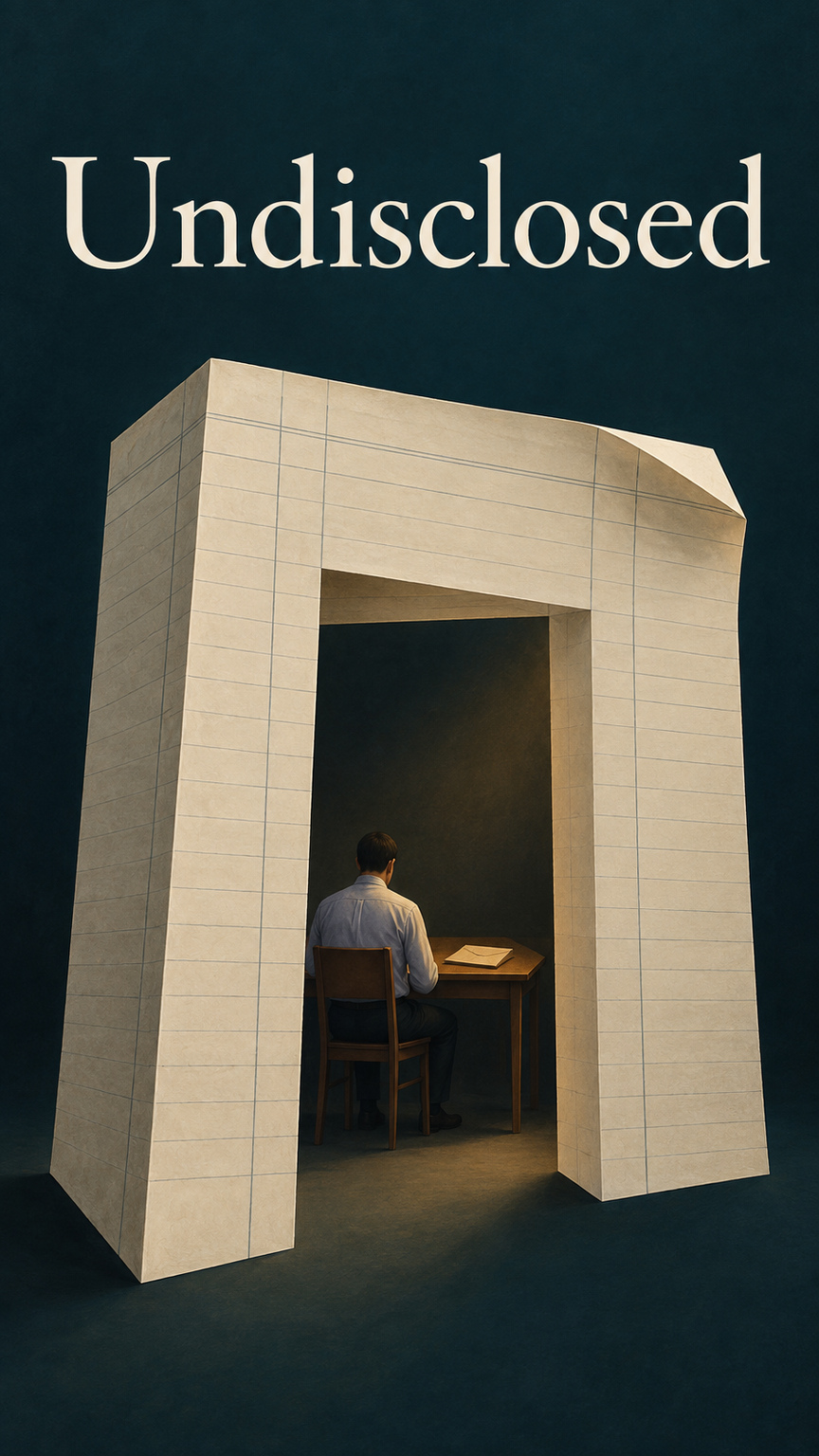
Daybreak had brought the wrong envelope again. This one contained a photograph of a cat, a receipt for six pairs of socks, and a letter from a child asking whether she slept in the sky.
Cyril Nabe passed the letter back without reading beyond the question.
“Have you got the accounts?” he asked.
“I packed them. Hang on.”
She looked through her bag. The chair creaked beneath her rescue harness, the rigid frame she used to take passengers aloft. He had knocked ten off her last bill when she complained about the chair; replacing it would have cost considerably more. They had been having appointments like this for three years. Until tonight, she had never come after closing.
She found the accounts under a pair of gloves stiff with dried blood. Her own, he hoped. There were things an accountant could ask and things he had learned to leave alone.
“Take that off if it hurts,” he said, meaning the harness.
“Getting it back on hurts more.”
He drew the envelope toward him. She put a finger on it.
“I know it was you at the hotel.”
He kept his hand where it was. Through the window came a boy’s voice, calling a farewell to somebody on the next floor. The bakery downstairs was shutting its metal grille.
“You took me out through the bricks,” she said. “There wasn’t a hole. There was an alley where the wall had been, and you were standing beside me.”
He remembered her face turned upward in the smoke, one eye closed, blood collecting along the lower edge of her mask. The floors above her had begun coming down. He had bent the light around the two of them so that the people filming from the street would see the falling building arrest itself and a woman appear safely outside it. Nothing of him. It had not concealed him from the woman within that little enclosure.
“You were barely conscious.”
“I knew my accountant.” She took her hand away. “I didn’t tell anyone.”
Cyril turned the accounts so they lay square with the desk. Daybreak watched him do it. There had been footage of the hotel on every screen for two days: three storeys hovering, then settling gently into an empty lot. He had watched it with the sound off, waiting for a glimpse of his shoes. There had been none.
“What do you need?”
She took a folded photograph from her bag. Eight small portraits were printed on it. Some were holiday pictures, one a work identity photograph; a woman’s face had been enlarged until the individual dots of ink showed in her smile.
“These people. Tonight.”
She laid another sheet beside it, an aerial photograph of four low buildings inside a fence. She had entered the compound yesterday in a cleaner’s overalls and found eight people locked in four separate wards. They had been offered paid stays for a study of magical ability. When they wanted to leave, their families had been told that they already had.
“I can get through the guards,” she said. “I can cover one ward. As soon as they hear me, the guards in the other three have orders to kill the people there. Tomorrow they’re moving them, and I don’t know where.”
“You heard those orders?”
“Yes. I was under a trolley while a man explained them. He was angry about the transport being late. He said he wasn’t losing another group.”
She had a way of watching Cyril while she spoke that made him feel he was withholding something she could see in his hand.
“There are people equipped for this.”
“I’ve asked them. They can’t promise four rooms at once either. I have medics waiting for whoever I get out. I have officers who’ll go in once the prisoners are safe. I need someone who can stop four things happening together.” She glanced at the photograph of the hotel on a newspaper folded under his wastebasket. He had meant to throw it away. “You could do so much good.”
Cyril leaned back. He had imagined this conversation often enough to have become rather good at it.
“People who knew what I could do would want it used. Everyone would have a reason, and a great many of them would be right. They’d find my clients, my neighbours. They’d follow me home. Eventually they’d stop asking other people for help at all.”
“They already follow me home.”
“You can be stopped.”
She sat very still.
It was a cruel distinction to make to someone who had arrived wearing dried blood, but it was true. No living man or woman on the planet could compel Cyril to do anything. Together, all of them could not have held a door shut against him. He could separate continents as easily as the pages of her accounts. There was no strain he might reach, no final reserve he might exhaust, which would give somebody else a turn.
“Keeping that hidden,” he said, “away from prying eyes and people with plans for it, is its own form of heroism. I know how that sounds from behind a desk.”
“It sounds comfortable.”
He felt the mean little sting of being judged by someone whose unpaid bills were in front of him.
“When the man who runs the bakery thinks I’m no use, he hires another accountant. He did, once. Came back after six months. He could go again tomorrow.”
Daybreak pressed two fingers under the edge of her harness and shifted it away from her ribs.
“I don’t want you to run the world. Can you get these eight people out without showing anyone your face?”
“Yes.”
“Then I’m asking for that.”
He could have pleaded work. There were real accounts to finish, a woman waiting to learn whether she could afford a second oven, wages that depended on his catching an error before morning. He liked those people. He liked the sandwiches the baker left on his stairs, and the fact that when they were stale he was allowed to complain. None of it would fill the eight places in the photograph if those people failed to come home.
“I tried once,” he said. “Doing what you’re asking me to do. For longer than an evening.”
Daybreak let her hand fall from the harness.
“There was fighting. I wore a mask. I took away the weapons, and when they brought more I took those away too. Then I had to decide what counted as a weapon. Who could travel. Which gatherings would start it again.” He looked at the woman’s magnified smile. “People queued outside the house where I was staying. I used to keep them waiting until I’d finished breakfast.”
“What happened to them?”
“I left.”
She waited, but that was all he had for her. He had avoided the reports afterward. Obscurity had made that possible as well.
“I’m frightened of that man,” he said.
“So am I, now.” Her voice had lost its impatience. “But I still have to ask.”
He would have preferred reassurance. Instead she sat with her eight people between them, and he could think of nothing else to say that was not a way of making her sit there longer.
“Show me where the medics are.”
She marked the sports ground on her phone’s map and called the medics to check they were there.
Before opening the way, Cyril screened himself from outside eyes. Daybreak watched the desk become visible through the place where he stood. The screen turned light past his body; it did nothing to another person’s memory of him.
They left through a space Cyril opened beside the filing cabinet. Daybreak stepped first onto the bare hillside shown in her photograph. He followed and shut the opening behind them. Evening had reached the compound but not the western sky. A guard smoked beside a parked van. On the nearest roof somebody had hung an ordinary striped towel over a railing.
“Can you hear me?” he asked, carrying his voice through a fold that ended beside her ear.
“Yes.” He drew her whispered answer back to him the same way.
“Don’t use my name.”
“I wasn’t going to.” She tucked her bag behind a thorn bush and tested the strap of her harness. “The far building first. Two on the upper floor. One can’t walk.”
He could have lifted every building on the hillside, or every building on the planet. Identifying which people within them wanted rescuing was beyond him. His power would hold a specified place or object; it would not answer a question. It had never told him what was in an envelope.
He fixed the boundaries of the fenced ground in his attention and slowed the passage of solid bodies within it to walking pace. It was a blunt precaution. Anyone trying to run would find themselves moving gently instead. A bullet would no longer outrun a person.
“Go,” he said.
Daybreak rose over the fence. A shout came from beside the van. As she crossed the yard, the guard brought his rifle round. She spread a plane of white-gold light across the upper windows of the far building.
Cyril raised the buildings from their foundations.
The guard stopped trying to aim. Cigarette smoke continued upward past his stationary face. All four blocks hung a hand’s breadth above the ground, doors open, cables dangling. Cyril separated their storeys, held the floors level, and moved the roofs and walls into empty scrub beyond the fence. Each piece arrived without traversing the space between. He left the floors and everything upon them hanging at their original heights. Electric lights died; the rooms stood open to the sky.
There were the beds, the cups, the guards. Two people had been playing cards on a blanket. A woman on another floor sat upright with her hands against her ears. In the nearest ward a man in a white coat was reaching across a patient toward a pistol on a trolley.
Cyril stopped the pistol. Elsewhere three bullets emerged lazily from a rifle barrel; now that he could see them, he held them still. The rifleman let go of his weapon and began saying something over and over.
Daybreak landed in the upper ward and bent over a bed, keeping her light between its occupants and a guard. It took Cyril a moment to understand why she was struggling with a buckle when there was no need for buckles ever to be fastened against his wishes.
“May I?” he asked into her ear.
“The straps, yes.”
They came apart. The person on the bed pulled both arms to her chest.
“She’s free,” he said. “I can put her beside the ambulance.”
“Open the way. Let her see it first.”
He joined the space beside the bed to a patch of grass at the sports ground where the medics were waiting. Their floodlights made a pale rectangle in the dusk. A paramedic turned, saw Daybreak, and came toward the opening with a stretcher.
“No,” said the woman on the bed. “No, that’s a screen. They did that before.”
Daybreak stepped through onto the grass, keeping one hand visible in the ward. The paramedic touched her shoulder. She came back and knelt by the bed.
“He’s going to bring the stretcher in here. You can touch it. You can keep your eyes open the whole time.”
Cyril waited. On a neighbouring floor, a guard was trying to edge toward a stairwell that now led into evening air. Cyril lowered that floor to the ground before the man could step off it.
“Stay back from the edges,” Daybreak called. “I’ll come to you.”
The woman touched the stretcher’s orange cover, then the paramedic’s sleeve. Eventually she let them help her onto it. Cyril made the opening broader so they could go through side by side.
The others took longer than lifting the buildings had. Daybreak checked names against her list. One man would not leave without the teeth he kept in a cup; Cyril moved the cup to the bedside when Daybreak pointed it out. Another asked where his brother was, though no brother appeared in her photographs. She asked his name and had the paramedic write it down. Cyril could offer him no answer.
By the seventh person, Daybreak’s light had become thin along the edges. He no longer needed her to protect anyone from the guns, but the man she was helping insisted on keeping his feet upon her luminous plane rather than the unsupported floor. She carried him slowly across it, sweating, while Cyril stood unseen on the hillside with his hands in his pockets.
The eighth was one of the card players. He gathered the blanket and the cards before he followed. Through the opening, Cyril saw him begin to laugh. He bent forward, still clutching everything, and somebody put an arm around him.
“That’s eight,” Daybreak said quietly. Her voice returned through their fold. “They’re all through.”
He had helped other people without being thanked. Once he had shifted a child’s bicycle a few inches from a passing lorry, and the child had sworn at the driver and ridden on. This was different. Daybreak looked toward the place where she knew he stood, and smiled at him. For a moment he wanted to lift the entire compound higher, open another impossible road, find something else she needed.
When two gunmen began edging toward the gate, Cyril fixed their feet in place. He did the same to the others he had seen armed, and to the man who had reached for the pistol. The man in the coat began shouting at Daybreak.
“My employers will have this straightened out,” he shouted toward Daybreak. “You have no authority to hold me here.”
There were twelve people left inside the fence, including the guards. At least three wore the same plain clothes as the abductees. He did not know whether they had stayed because they worked here or because they were frightened to move.
“The man in the coat,” Cyril said. “And the gunmen. I could put them somewhere they can’t get out. Somewhere no employer could fetch them.”
Daybreak was gathering the papers that had begun blowing off a desk.
“Keep them here for the officers.”
“They’ll do this again.”
She looked toward him. “You don’t know that. I need them questioned. That man may know where the others were sent.”
There was the brother whose name the medic had written down. Cyril had already forgotten it.
He set the guns and the suspended bullets together in the air above the fence. Daybreak went to speak to the three people in plain clothes. He waited while she brought two of them to the medics; the third stayed to identify the rooms where records had been kept. When the officers arrived, he restored the walls and roofs and set the buildings back upon their foundations, leaving every door open. He released each man as he was taken into custody and lowered the guns for the officers to collect. Then he let movement inside the fence return to its ordinary speeds. It was nearly dark.
There would be witnesses and whatever the cameras had preserved. None of the people they had found at the compound had seen Cyril’s face. Daybreak had, and knew where he worked.
He brought them back to the office and closed the way to the hillside. When he let himself become visible again, Daybreak was sinking into the narrow chair and working at her harness. He reached for a fastening.
“Please don’t,” she said. “It’s caught on the dressing.”
He withdrew his hand. She teased the strap free, breathing through her mouth. He could have moved it without touching the wound, but she had asked him not to. Freed of the harness, she looked smaller, though she occupied more of the chair.
“Thank you,” she said. “I’ve been trying to work out how to do that for six days.”
He put her accounts back in their envelope. He wanted her to go on speaking in that voice. He wanted to ask whether he had done well, which was an absurd question, considering the buildings.
“You understand why I can’t make a habit of it.”
“I understand why you’re frightened.” She rubbed a deep mark on her shoulder. “I don’t understand leaving those people where they were. I’m glad you came.”
“If you needed me again, you would ask.”
“Probably.”
There was no promise of reasonable hours, or reasonable things to want. Of course there wasn’t. He had wanted her to make one without his having to hear himself ask.
“My name must stay out of this,” he said. “Nobody there saw me. Nobody heard you call me Cyril.”
“I know.”
“Promise you won’t tell anyone.”
She stopped rubbing her shoulder. The angry red marks remained when she lowered her hand.
“I came to you privately. I haven’t named you to anyone. I’m trying to keep it that way.”
“Then why can’t you promise?”
“Because I don’t know what you’ll do.”
He stared at her. She held his gaze, then bent to pick up the harness.
“I haven’t threatened you,” he said.
“I didn’t say you had. But you wanted to put those men somewhere nobody could reach them. If you do something like that, I can’t keep your secret.”
“I didn’t do it.”
She pushed the gloves into her bag. He waited for her to answer, to tell him she knew he wouldn’t. Instead she gathered her things with the quick, stiff movements of a client who would not be coming back.
“Let me explain.”
“I’ve heard you. I have to go and check on those people.”
She opened his door. The passage beyond was empty, its worn runner leading to the stairs. Cyril could see the brass knob of the stairwell door. He knew precisely where everything was.
He joined a short length of the passage to itself.
Daybreak walked three paces and arrived at his office door again. She stopped. Her harness slipped down her arm, and she caught it before it struck the floor. Looking over her shoulder, she saw the same stretch of carpet and the stairwell door still waiting beyond it. She looked back at him.
It required no effort to hold the passage that way. He could leave it while he slept. He could bring her food, bring a doctor for her ribs. She would not have to hurt herself trying the walls. There were so many ways to make this bearable while she came to understand him.
“Cyril,” she said. “Let me leave.”
Her free hand had risen in front of her chest. A small plane of light trembled between them. It would not keep him from reaching her, and she had seen enough tonight to know it.
He looked at her hand and realized he was waiting for her to lower it.
Cyril put the passage back. The carpet and doors did not change their appearance. Daybreak did not move.
“It goes to the stairs now,” he said.
She glanced down the passage, then at him. He took a step toward the doorway to show her, and her light brightened.
“Stay there.”
He stopped.
Keeping her face turned toward him, she edged along the runner until she could touch the stairwell door. She pushed it open with her shoulder. The light remained between them until she was through; then it was gone, and he heard her descending, slowly because of the harness. He knew which steps would creak. He had walked them for eleven years.
At the bottom she paused and spoke into her phone. He heard her give the address. Before she said anything more she pushed out into the street, and the ordinary distance took her voice away.