The Voice of Silence
In a world where people must call out the names of their spells to use them, a mute person has managed to become an archmage.
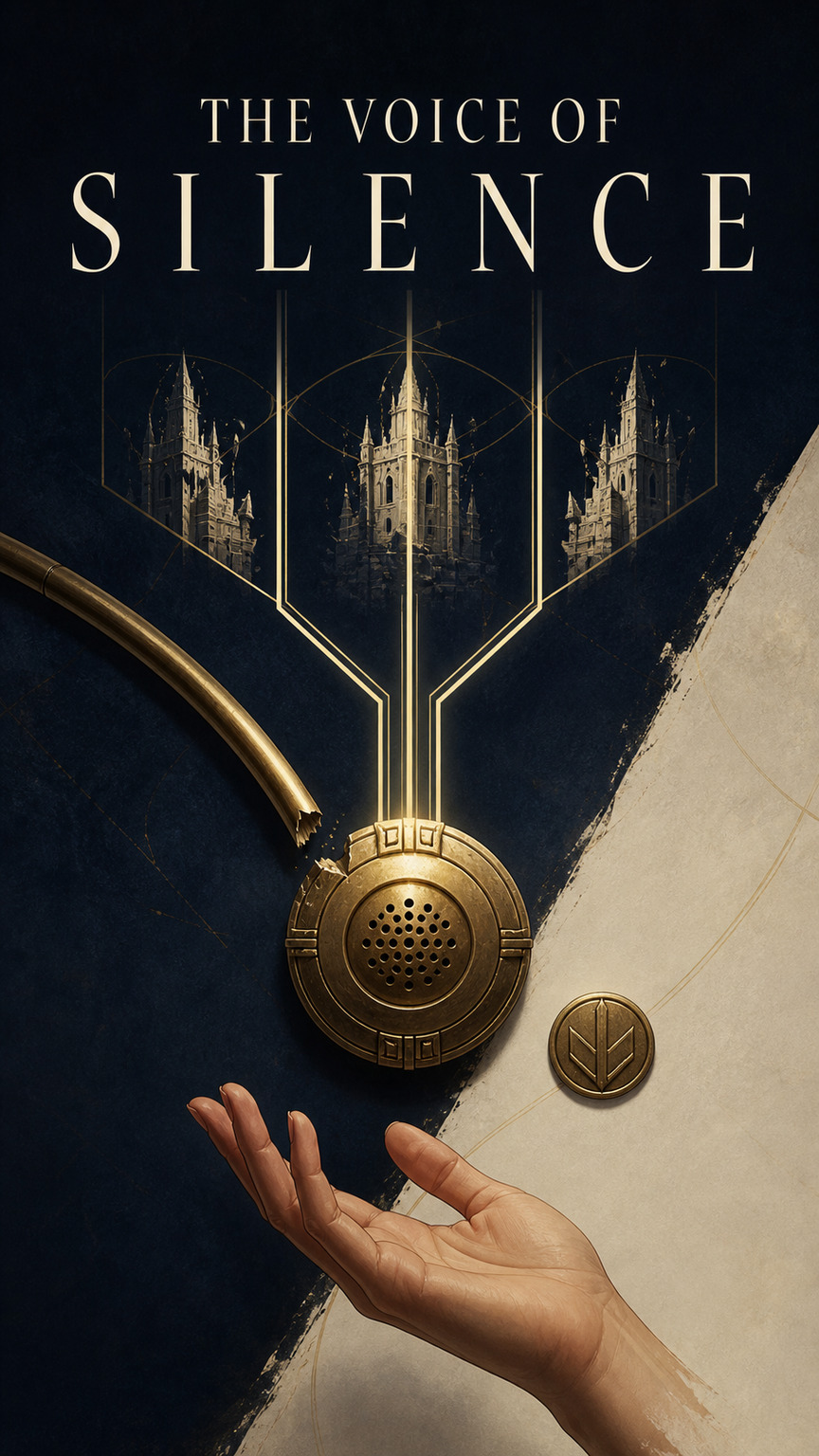
Kethra laid two fingers on the brass node and felt the examination tower through it.
Not heard it—felt it: the drag of the loaded gallery, the thrust of six stone ribs, the little wrongness where an old joint met new mortar. Those forces gathered in her mind as bright lines waiting to be bent. Around her, three floors of examiners and students watched from behind the railings. Above them, the tower crown glittered with the speaking rails she had spent four years designing.
Ulan placed his fingers beside hers. The brass was only brass. It could carry a living voice and mark the geometry of a spell, but it could not choose, consent, or supply so much as a spark.
Kethra marked the registered shape for Weightward against the node. Ulan signed yes.
One caller. One spell. One cell. The link would last thirty breaths unless either of them broke it first.
Kethra drew power up through her legs. It burned cold along her bones as she mapped the weight of a suspended block into the grounded rails. The pattern remained deliberately unfinished. In the callwright practice taught here, no spell could cross that last gap until its full name was spoken by its authorized living caller.
She gave Ulan the two-finger ready sign.
“Weightward!”
His voice traveled through the brass on one clear exhalation. Gold light raced along the load path Kethra held. The suspended block sank half a handspan, stopped, then glided sideways as she redirected its weight from one grounded rail to the next. Ulan’s hands stayed open. The shaping was hers; she felt every crushing measure of it.
Applause rose from the galleries. Kethra did not look up. She lowered the block precisely onto its painted square before letting the power go.
Dorram, the chief examiner, tapped four marks on his slate: original architecture, control, safe instruction, judgment. The four requirements of the local archmage office. Then he signed, A beautiful lattice. But is it mastery, or dependence hidden in brass?
There it was—the question she had built the glittering lattice to answer. Her pulse kicked, but her hands were steady.
Remove me, she signed, and there is no power, target, or spell. Remove Ulan, and the prepared pattern cannot release. Two necessary arts are not one art.
She turned the slate so the gallery could read what she added beneath: A caller completes. A shaper powers and directs. Neither is equipment.
Dorram studied the block, the rails, and Ulan’s empty hands. At last he drew a fifth mark.
“Proceed to the resilience trial,” he said.
Kethra let herself breathe. The title was not hers yet.
At the tower’s central table, Kethra briefed Ulan and the two apprentice callers again, although each knew the procedure.
She pointed to the three isolated cells of her voiced lattice. For each, shaper and caller would touch one node; she would mark one registered spell; the caller would choose yes or refuse. After her ready sign came a window of twelve heartbeats. The complete name had to arrive in order, on living breath, through an intact rail or directly into the shaped acoustic field. A late call, a broken syllable, or silence meant no spell—only a collapsed pattern and fatigue for her.
Kethra tapped the field signs painted on the table: yes, wait, and the crossed hands of stop.
“Stop cancels the cell,” one apprentice recited.
Kethra nodded and signed, Immediately. No penalty. No argument.
The apprentice signed yes. So did the other.
Ulan rubbed his throat. “Two safe calls left,” he said. His opening call had been clean, but Kethra heard the rough edge beneath it. “No more than two.”
Dorram glanced toward the panel. “A substitute caller is available.”
Kethra kept her hands still. The choice was not his, and it was not hers. She looked at Ulan.
He considered the rails, then signed, I stay. Two.
She wrote the limit beside his name on her caller roster and showed it to him before he initialed the mark. Two meant two, even if the examination turned on a third.
On the emergency edge of her slate she reviewed Crown Release and Safe Descent. Neither belonged in the ceremonial sequence. Both had been tested on stone frames in the court below, because preparation that assumed nothing would break was decoration, not safety.
As Kethra turned toward the first cell, a pale line near the western joint caught her eye. A crack no longer than her smallest finger crossed the old mortar.
She signed for a manual check. Dorram climbed the short stair, pressed both palms to the joint, and sighted along it while wind worried the high shutters.
“No movement,” he reported. “The masonry is within tolerance.”
It was. Kethra still erased the upper third of her planned load.
Dorram’s stylus hovered, then marked down her impressiveness score.
The loss stung. She had wanted the panel to see the lattice at its fullest: three spells held separately by one living mind, not a choir dragging her power behind their voices. Yet the hairline remained in her thoughts, a tiny white refusal.
She showed the revised loads to every caller. One by one, each touched a node and signed yes.
Kethra opened the first cell, then the second, then the third.
Three patterns pressed against the limits of her attention. The lattice kept them isolated, each aligned to its own caller and sound path. It did not make the work light. A tremor began deep in her left wrist as she placed the ceremonial loads.
Dorram raised one hand. The resilience trial would begin with the planned loss of a caller.
Wind struck the shutters.
The pale crack flashed across Kethra’s memory an instant before a grinding blow shook the floor.
This was not the trial.
The western joint split under the occupied gallery’s ordinary weight. Stone lurched. Kethra slashed the abort sign before the next spell name could be called, collapsing its pattern unspent. Pain bit up her arm anyway. Dust burst from the wall and erased half the room.
Somebody screamed. The long speaking rail tore from its brackets with a metallic shriek.
Through the dust, one apprentice found Kethra’s eyes and crossed both hands: stop.
Kethra dropped that cell at once.
The failed pattern struck her like a missed step in darkness. Her knees dipped. With the rail broken and a caller withdrawn, the rehearsed three-cell solution was gone. The lattice held no stored commands to play back. Even if it had, old sound could not complete a living link.
A slab broke free above the gallery.
Dorram moved before Kethra could finish mapping its fall. He planted his staff against the floor—not for power, only to mark the roof’s geometry—then caught the nearest brass node between his hands. With one hand he marked the registered shape for Roofstay; with the other he signed yes against the node, authorizing himself as both living shaper and living caller for that one cell. Amber lines climbed his arms as he gathered the familiar pattern into his body and selected the sagging ribs. When the shape was ready, he gave the two-finger ready sign to open the same twelve-heartbeat window Kethra used. One heartbeat later, he drew a single breath and called his own spell.
“Roofstay!”
The live name closed his pattern. The falling slab stopped with a crack that shivered dust from every seam. Around it, the roof ribs burned amber, sustained by Dorram’s power.
The gallery occupants stumbled toward the central exit. Then the exit arch buckled inward and jammed.
Dorram had caught the roof. He had caught it fast, alone, and wrong.
Kethra saw the load pouring down his target lines. Roofstay had concentrated the western weight on the central exit column. A black fracture was already climbing its face.
She seized his sleeve and pointed.
His expression changed as he followed the crack upward.
The examination was over. The rescue had begun.
Kethra swept dust from the floor and sketched in chalk: roof ribs, tower crown, trapped gallery, central column, broken rail. The map made the choice plain and terrible. If Dorram released Roofstay now, the roof would drop. If he sustained it, the exit column would split. They could preserve the tower or clear the people below it, but not both.
Coughing filled the chamber. Before anyone could follow her plan, they needed air.
Ulan stood beside the mouth of the one short rail still fixed to the central node. Kethra met his eyes, touched the brass, and marked Airclear. The previous link was gone; consent could not be assumed from it.
Ulan touched beside her and signed yes.
Kethra shaped one narrow corridor from the gallery to the open court. She could not clear the whole tower. She could not spare the power to try. When the pattern was ready, she raised two fingers.
“Airclear!” Ulan called.
His living breath traveled the short rail. Kethra’s power released in a cool spiral, and dust peeled away from the mapped corridor as if drawn through a glass tunnel. Trapped students bent into the cleaner air.
Ulan coughed hard afterward. When Kethra looked to him, he signed wait.
Every part of her wanted the final cell ready now. She closed her hand and waited.
Dorram stared at her chalk map. “Crown Release would destroy the upper ring.”
Kethra nodded.
“And your lattice with it.”
She nodded again. Four years of measured brass, revised diagrams, and evenings spent proving that a caller’s sound did not own the shaper’s art. Her masterwork shone above them through the dust. She wanted the title badly enough that the thought of tearing it apart felt like tearing out a bone.
The exit column cracked loud enough to silence the room.
Kethra drew three load arrows. She showed how Roofstay pinned the crown joints and drove force into the column. She crossed out every sustaining route. Then she marked the only sequence that left time for descent: ground the gallery; end Roofstay; separate the crown; lower the occupied platform and loose stone into the cleared court.
Dorram began to object. Kethra struck the chalk against the point where his spell met the column and signed in the standard field language, Your sustain lasts until your strength fails or the exit does. Either failure kills the route.
Another chip sprang from the column.
Dorram looked from the map to the people pressed inside the air corridor. Then he laid his staff down.
“Kethra has incident command,” he told the room.
She did not waste a heartbeat on relief. She climbed onto the examination table and tore the first ornamental rail free.
Her beautiful lattice became raw brass in her hands.
Kethra rebuilt for survival.
She bent one speaking rail down to the gallery footing and anchored it against sound stone. She ran another across the crown joints, following every fracture she wanted Crown Release to open and none she wanted spared. From the central node she mapped a descent field around the stranded platform and the loosened upper stones.
The rails chose nothing. Her diagrams powered nothing. Kethra held the three spell cells in her body and attention until her teeth ached.
An adult volunteer from the lower gallery stepped into the court and raised a hand. “I know Weightward. I can call.”
Kethra showed the volunteer the grounded path and its danger: the spell moved existing weight; it did not create support. A bad map could drive the load through the floor. The volunteer studied the chalk, touched the first node with her, and signed yes.
At the second node, Kethra marked Crown Release. Dorram checked the traced joints himself, then placed his fingers beside hers. He signed yes.
Ulan had rested against the wall with a wet cloth over his mouth. One safe call remained. Kethra showed him the descent target, the short duration, and the place the platform must reach before her power failed. She pointed to wait and stop as deliberately as she pointed to yes.
Ulan lowered the cloth. He touched the third node and signed yes.
Three living choices. Three isolated cells. Kethra’s maximum.
Her hands had begun to shake visibly. Holding the gallery’s map while tracing the crown and enclosing the descent field made each movement slow, as if the air had thickened around her. If one call failed, its collapsing pattern could tear the sequence out of her grasp. She looked at the volunteer.
The first ready sign.
“Weightward!”
The full name rang out at conversational strength, each syllable clear. The live call closed Kethra’s first pattern. Power surged from her into the grounded rails. The gallery settled with a deep stone knock as she moved its load away from the cracked exit and into the tower footing. She held the map until every gold line reached sound foundation.
One major release. Her left arm shook from shoulder to fingertips.
Kethra faced Dorram and made the cutting sign.
He ended Roofstay.
The amber ribs vanished. For one plunging instant the unloaded crown shifted above them. Kethra maintained the grounded gallery and thrust her second cell toward the joints. Two fingers rose.
“Crown Release!” Dorram called.
His voice was living and chosen; the spell was Kethra’s shaping, Kethra’s power, Kethra’s exact target. White light snapped along the repurposed rails. The upper ring split at its joints in a thunder of shearing mortar. Blocks peeled outward instead of crushing the exit column.
The tower crown—and the ornate lattice fixed across it—came apart.
Two major releases. Kethra’s vision narrowed. The second pattern tried to pull her down with the falling stone, but she held its separation long enough for the crown to clear the gallery.
Then the platform dropped.
Kethra turned to Ulan and gave the final ready sign.
The remote speaking rail snapped.
Its broken end lashed through empty air. Ulan’s call position was cut away from the shaped field. No matter how loudly he spoke, no living sound could reach the active node through a severed tube.
Twelve heartbeats.
Kethra could not call the name herself. Her throat could make no ordinary words, and neither terror nor magic changed that. The incomplete pattern burned inside her, draining strength with every beat.
She wrenched the third cell’s small brass node from its rail and carried it.
Eleven.
The target geometry pulled against her grip. She kept one hand shaped around the falling platform and ran with the other clenched on the node.
Ten. Nine.
Stone struck stone behind her. A fragment clipped her shoulder and spun her sideways. She stayed upright.
Eight. Seven.
Ulan saw what she was doing and pushed away from the wall. His face was gray beneath the dust.
Six.
Kethra reached direct speaking range. She could have ordered with her eyes. She could have treated his earlier assent as permanent because people were falling.
Instead she showed him the node, pointed once to his throat, and opened her hand in a question.
Five.
Ulan looked at the descending platform. Then he looked at her and chose yes.
Four.
“Safe Descent!”
The words came hoarse but complete on one living exhalation. The nearby node caught and modestly carried them into Kethra’s active field. Her third pattern closed.
Power tore through her. She spread it beneath the platform and falling crown stones, slowing rather than stopping them. The spell could not hold them aloft. It bought only a few breaths, and Kethra spent those breaths steering.
The platform sank into the cleared court. People jumped away as its edge touched down. Crown blocks followed in a grinding curtain, slow enough for rescuers to pull the last apprentice clear. Kethra guided the largest slab aside by half a pace—only half, but enough.
Three major releases.
Her legs stopped obeying. She remained standing until the platform rested on stone and the final white line faded. Then her knees struck the dusty floor.
For a moment she could hear nothing but her own pulse.
Then came crying, coughing, and the astonished noise of people discovering one another alive.
By dusk, the open court had become a place of cups, bandages, and blankets. The injuries were bruises and shallow cuts. The tower crown lay in ordered wreckage around the platform, its broken brass rails dull in the fading light.
The apprentice who had signed stop sat with a cup between both hands. No one blamed the apprentice for withdrawing. Kethra made certain of that before she allowed anyone to look at her shoulder.
The volunteer received water and thanks. Dorram’s voice had roughened on Crown Release, and a healer wrapped a warm cloth around his throat. Ulan declined every spoken question. He rested his voice and answered in sign, with his usual sharp precision.
Kethra sat before the panel with a blanket around her and her ruined masterwork behind them. She knew what they had seen: three voices where she possessed none; an examiner forced to intervene in her trial; a tower sacrificed on the day she was supposed to prove she could be trusted with one.
Dorram set the office seal on the table.
“The examination has four requirements,” he said, his voice quiet. “Original architecture. Precise control of power and consequence. A method others can learn safely. Discretionary command that values lives above prestige, property, and the candidate’s own work.”
He touched the first mark. “You designed the voiced lattice, then proved you understood it well enough to dismantle it.”
The second. “You diagnosed my error, mapped every load, and ordered three effects so none destroyed what the next required.”
The third. “Your callers understood their tasks, named their limits, stopped, waited, and chose again. That cost time. It also kept them people.”
The fourth. “You destroyed the work meant to win this seal, because keeping it would have killed those we teach.”
Kethra looked at the broken crown. She had spent years trying to make interdependence look like independence, afraid that any visible need would be counted as someone else’s mastery. Today the need had been visible, dangerous, and real. So had the limits of Dorram’s solitary spell.
“The calls were not yours,” Dorram said. “Their courage and labor belong to the callers. The architecture, power, diagnosis, sequence, and command were yours. I mistook resilience for self-sufficiency. The evidence corrected me.”
He pushed the seal across the table.
“The panel finds Kethra qualified for the office of archmage.”
Ulan grinned and applauded silently, striking one palm against the back of his other hand. Kethra laughed without a voice, shoulders shaking until it hurt. Nothing opened in her throat. No hidden word arrived. The rules of the practice had not bent for her, and neither had she been diminished by them.
The next morning, the office seal rested beside a fresh caller roster. Kethra had drawn spaces for voluntary assignments, individual voice limits, and the signs for yes and wait. The crossed hands of stop stood at the top, where no one could miss them.
Students gathered around the scarred court. Ulan sat among them, still resting his voice.
Kethra raised her hands and began her first safety briefing as an archmage.