What the Town Owed Her
The gothic witch that lives in apartment next to you looks incredible youthful but it seems like every family in town owes her something.
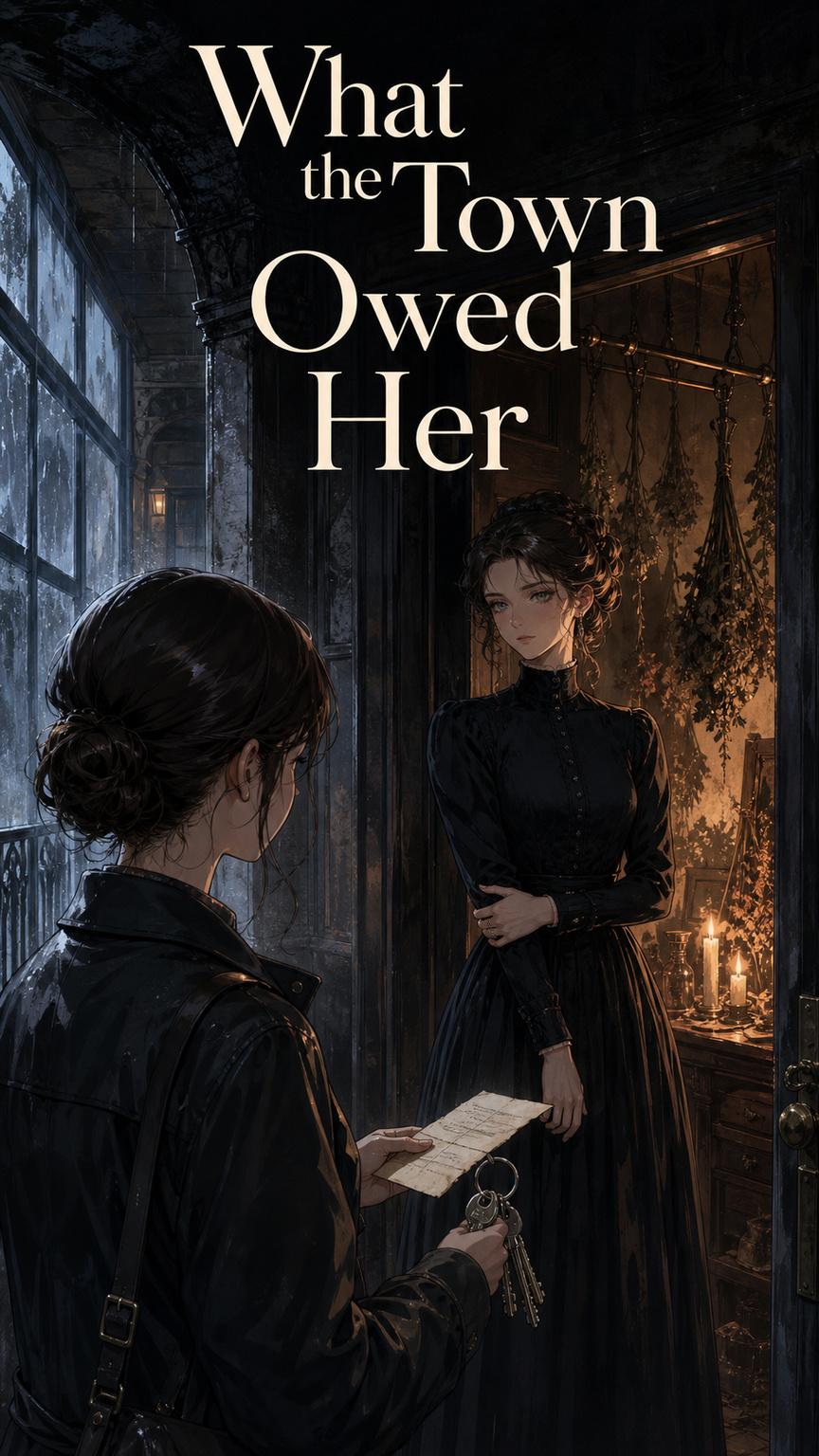
On the afternoon I came back to empty my grandmother’s apartment, the witch next door refused a jar of honey, examined a coil of copper wire, and sent a boy home for a different key.
The three offerings arrived within twenty minutes of one another. Rain followed each visitor up the stairs of Rookglass House and darkened the boards outside number six. The woman with the honey said her mother had kept bees because Evadne Trell once asked it of the family. The electrician carrying the wire said his father had told him never to arrive empty-handed. The boy held out a wardrobe key on a red ribbon and whispered that his grandfather’s promise was older than the building’s electric lights.
“That’s the wardrobe key,” Evadne told him. “Ask your mother whether I can borrow the long one for the east yard tonight.”
The boy ran. Evadne returned the wire and told the electrician to keep it dry. She was still holding the honey when she noticed me watching from number five.
She looked twenty-six at most. Her black dress had a narrow standing collar and enough old mending at the cuffs to defeat the illusion that it was costume. Black hair curved beneath her jaw. In my grandmother’s hallway hung a photograph of a summer procession taken when the stone angels over the front door still had faces; Evadne stood at its edge in the same dress, looking exactly as she did now.
“You’re the granddaughter,” she said.
“Leonie Sayer.” I glanced at the jar. “Are they paying you?”
“They think they ought to.” She handed the honey back to its owner. “Take it home. If I need help tonight, I’ll come and ask.”
The woman clutched the jar. “My mother said we owed whatever you named.”
“I remember.” Evadne kept her hand beneath the jar until the woman had it securely. “Go home before the lower road fills.”
The woman went. Evadne watched until the front door shut, then looked at the keys in my hand.
“I saw the surveyor here this morning. You’re selling?”
I had spent ten years pricing other people’s renovations. I knew what sellers concealed behind fresh paint and what water did when it found lime mortar. The surveyor had called Rookglass House damp but serviceable. The sale of number five was the one clean piece of work my grandmother’s death had left me: four rooms emptied, one signature, a train away from Mirehaven.
“As soon as I can.”
“If you’re putting boxes outside, leave the landing clear. We may have people coming in tonight.”
I moved a box with my foot and closed number five between us.
My grandmother’s apartment smelled of lavender polish and the gas fire she had refused to replace. Boxes waited under the sitting-room window. I packed her chipped bowls, the cardigans she had darned at both elbows, and the brass level she used to set shelves more accurately than any tradesman she hired. The easy objects went first. Her blue teacup remained beside the sink because I could not decide whether keeping it would be sentimental or cheap.
In the lowest drawer of her tool chest I found an envelope sealed with red wax. My name was on the front. Inside, in her square pencilled hand, she had written:
The spare blankets are for Evadne when the lower houses flood. Airing cupboard, bottom shelf. Go and see her before you leave.
Even now, an errand. I took the note next door.
Number six was darker than the corridor. Candles burned in saucers along a mantel, and bunches of drying leaves hung over black wallpaper. None of that unsettled me as much as the practical things: two storm lanterns fuelled and trimmed, rope coiled by the door, wool blankets stacked on a chair. Evadne had laid a pair of mud-caked boots beneath a copy of the procession photograph.
“What did my grandmother promise you?” I asked.
Evadne read the note. “She kept the extra blankets. There isn’t room here.”
“I didn’t ask what she kept.”
“No.” She smoothed the paper against her knee. “I pulled her out of a shop fire. She was seventeen. She said she’d help whenever I needed her.”
“And did she?”
“Usually before I asked. She’d hear someone crying on the stairs and come out in her slippers.” Evadne glanced at the blankets. “She used to give them her bed. I could never persuade her that the chair was bad for her back.”
I had argued about that chair myself. Its stuffing was coming through the seat, and my grandmother had refused to let me buy another.
On Evadne’s table lay a thin black notebook and a packet of photographs. She shifted them to make room for the note, exposing a picture of herself knee-deep in floodwater, bracing a sagging wooden stair while three people descended toward a boat. The date on the back was a hundred and fourteen years old. In another, she carried a soot-blackened child from a shop fire. In a third, she stood beside my grandmother, who was young enough to have both front teeth and furious enough to be recognizable.
The notebook held brief entries. A rescue, a date, the exact words blurted afterward. Anything you ask. Anything in my power. Call, and we will come. Beside them were addresses, some crossed out and replaced, and the names of children and grandchildren. Nearly every family I remembered was there. I found the same people in photographs taken decades apart, older each time. Some were missing from the most recent pictures.
Evadne had not changed.
I held my grandmother’s photograph beside the notebook. “She got old doing this for you.”
Evadne took her hand off the page.
“Is that how it works?” I asked. “You stay like this, and she—”
“No. I haven’t taken anyone’s years.” She reached for the photograph, then left it in my hand. “The promises keep me young. They also keep me here.”
She had been twenty-six when the first flood came. Twelve people were trapped upstairs; she had held the stair for them, and afterward they had promised her anything she wanted.
“I’d only asked for blankets,” she said. “I should have left it at that.”
A promise given to her after she’d worked magic could stay open until she released it, she told me. Keeping that first one had stopped her aging. Then she’d tried to leave Mirehaven and found she couldn’t get past the boundary. Every promise since had made it worse.
I ran my finger past the old entries to the names of children and grandchildren. “You put them in here too. That boy thought he owed you a key.”
“So I know whose door to knock on. I haven’t bound them, Leonie. They weren’t there to make the promises.” Evadne looked toward the door. “I’ve told his mother there’s no curse for refusing me. If she keeps the key, I find another way into the yard.”
“You need to tell him.”
“I know.”
I found my grandmother’s entry. “Cross hers out. She’s dead.”
Evadne covered the words with her hand. “It’s only a record. If I burned it, I’d still be here. I have to let the promise go myself.”
I waited. She moved her hand, leaving the page open, and bent to pull on her boots. For a moment I thought she meant to leave me standing there.
“I know she’s dead,” she said. “The first people died too. I was still here, and there was always another fire, another winter. I wanted someone to come when I asked.” She pulled a lace too hard and had to loosen it. “Each spring I think I’ll finish with the book. Then I put it away.”
“My grandmother didn’t need to be frightened into helping you.”
“No. She didn’t.”
Outside, a loudhailer crackled. We heard only the repeated words lower road through the rain. Evadne went to the window, and I joined her.
The drainage channel ran below the east yard, separating Rookglass House from the lower houses. A short stone footbridge crossed it, broad enough for three people abreast. On our side, the yard rose from the bridge to the upper road; the house stood beside that slope, well above the channel. I had taken that shortcut to school, dragging my bag along the gate’s iron bars until someone shouted from a window.
Now a man in a bright coat was knocking on the lower doors. The channel carried branches and brown foam toward the river. Evadne watched a woman emerge with a cat basket and a shopping bag.
“They’re bringing them up,” she said. “I’d better go.”
I retrieved my grandmother’s note from the table. “I’m trying to pack up her things, and she’s still giving me errands.”
“You owe me nothing, Leonie. Not because of her. Not because you live next door.” Evadne picked up a lantern. “You can sell the apartment.”
“I know I can.”
She nodded, accepting the sharpness. I folded the note and put it in my pocket.
“I’ll bring the blankets down. Then I’ve got things to finish.”
“All right.”
I fetched the blankets. The old man from the hardware family met us at the foot of the stairs. The long iron key hung from his fist.
“My daughter said yes,” he told Evadne. “The boy’s gone up to hers. I told him to stop hunting in drawers.”
He opened the yard gate and hooked it back. A retired carpenter from number four carried out a chair for anyone who needed to stop on the slope. The first evacuees were already crossing the bridge. A woman leaned into a pram with its rain cover pulled tight; two bakers carried a box between them and quarrelled over which end should go first through the gate. The man in the bright coat followed them over and began directing people up the yard.
Evadne asked a woman hurrying along the upper road whether she could stay to help people into the house.
“My husband’s on his own. He can’t manage without me. I’m going home.”
“Go to him.”
The woman stayed a moment. “What about what Gran said? After the fire?”
“I’ll release it. You’re needed at home.”
The woman pulled her collar up and ran. Evadne took the blankets from me and laid them over the chair’s back. I could have gone upstairs then. Instead I held the lantern while she separated two blankets that clung together with an old safety pin.
Across the channel, an elderly woman stood outside the last open door, refusing to put her hood up. The electrician was with her. He offered an arm; she took it, then turned back for something. He bent into the doorway and came out holding her walking stick.
They started across. Evadne went down to meet them, and I followed with the light. We stood on the firm gravel at the near end of the bridge. The woman was telling the electrician that her stick had belonged to her sister when I heard roots tearing upstream.
A tree leaned out of the far bank. Its crown caught the rushing water, and the root plate lifted, black earth pouring from it. The trunk swung broadside into the bridge.
The blow threw spray over us. Stone cracked. The far end of the parapet broke away, taking part of the roadway with it, and the elderly woman fell to her knees. The electrician caught her coat and went down beside her. Beneath them the remaining span sagged toward the channel.
Evadne dropped beside the near abutment, both knees on our bank, and pressed her palms against the stone. Light rose under the skin of her wrists and branched through the joints. The sagging stopped. Water thundered through the new gap at the far end, carrying away the woman’s stick.
For a moment nobody moved. The electrician had one hand clamped round her upper arm and the other locked against the parapet. They were three paces from us. The broken edge was behind them; between us the stones still touched, held in a shallow dip by Evadne’s light.
“Come this way,” I said.
The woman shook her head. The electrician tried to lift her, and she screamed.
“Don’t pull!” I shouted.
“I can’t get her up.” His face had gone white. “I don’t know what I’ve done.”
Evadne’s shoulders shook. I crouched beside her. “Can you lift it back?”
“No. Only hold it.” She swallowed. “I have to keep my hands here.”
The elderly woman was staring at the gap behind her. I set the lantern back on the gravel and stepped onto the stone. I wanted to ask how long Evadne had. Her fingers were already whitening against the wall. I went the three paces and knelt in front of the woman.
“Where does it hurt?”
“My arm. He’s got my arm.”
The electrician loosened his grip. She let out a breath and clutched his sleeve before he could move away.
“Don’t leave me.”
“I’m here.” He said it twice, staring at her hand.
“Can you put your arm round my neck?” I asked her.
“Which one?”
“The one that doesn’t hurt.”
She reached with her left. Her hand caught in my hair, and I had to bend lower before she could get her arm across my shoulders, still clutching a fistful of it. On her other side the electrician shifted his arm down behind her waist. She was small, but when we tried to stand she seemed impossibly heavy. I nearly let her fall back.
“My knee won’t,” she said. “It won’t.”
“All right. Keep it bent.” I looked across her at the electrician. “We’ll have to take her weight.”
He nodded without looking at me. We got her upright between us, her good foot finding the stone once and then dragging. I walked backward toward the bank. Her wet cheek pressed against my collar. She kept asking where her stick was, and I kept saying we would find her another, though she couldn’t seem to hear me.
One pace. The electrician’s heel caught on a raised joint. He swore and stopped, hauling us both against him. Below us the fallen tree rolled, striking stone again. A piece of parapet dropped from the broken end; Evadne made a low sound through her teeth.
“Still coming?” she asked.
“Yes.” I couldn’t make my voice louder. “We’re coming.”
The carpenter reached from the gravel and took the woman’s forearm, then let go when she cried out. “Sorry. Sorry.” He caught the back of her coat instead. I felt firm ground under one foot and stumbled onto it with the other. Together we drew her away from the bridge. The electrician followed, his arm tight round her waist.
I looked back. Evadne was bowed over her hands, unable to see past her own shoulder.
“All off?” she said.
I counted us because I could not bear to be wrong: the woman against me, the electrician with both boots on gravel, the carpenter already helping us toward the yard. No one remained on the span.
“All off. We’re on the bank.”
Evadne lifted her palms. The remaining arch folded into the channel, stone striking stone beneath the roar. She toppled backward onto the gravel. The hardware man caught her before her head hit it.
The carpenter and I got the woman to the chair. Her breath came in quick little cries. She would not release my hair until I told her I needed to stand up; then she apologized, which almost undid me. The electrician crouched beside her and asked if he could look at her knee.
When I turned back, the two bakers were helping Evadne up the slope. One had taken off his coat and put it around her. Her boots dragged. She tried to thank them, but her teeth struck together too hard for the words. We carried her upstairs in one of the blankets she had stacked by her door.
For the rest of the night, the lower houses stood in water. Vans came along the upper road, and people left Rookglass House wrapped in blankets, carrying wet bags. Someone took the elderly woman to have her knee examined. Before she went, she made me look in her coat pocket for a little purse and check that it was fastened. I did it twice because she asked twice.
My train had gone. I unpacked the bowls for people who had missed supper and put my grandmother’s blue teacup into Evadne’s hands. She drank without remarking on whose it was. Later, when the landing had quieted, she asked whether I had eaten. I hadn’t, and found there was still bread.
At dawn she sat on the landing with the black notebook. I was washing mud from my scraped knuckles in a basin beside her. She found my grandmother’s entry and stayed on that page for a while.
“She wouldn’t stop coming,” Evadne said. “Even when the stairs hurt her.”
I dried my hands. “She didn’t tell me that.”
“No. I don’t suppose she did.”
Evadne spoke my grandmother’s name and released her promise. Then she found the entries for the families that had helped, and the promise made by the grandmother of the woman who had gone home to her husband. She released that one too.
She closed the notebook with a finger between the pages. Downstairs, someone called a sleepy goodbye. Evadne turned toward the stairs and listened until the front door shut. Then she drew her finger out and rested both hands on the cover.
“I could put it away again.”
She turned one hand palm upward. It was scraped where she had pressed it against the bridge. With her other hand she touched the smooth skin above her wrist.
“I don’t want to get old, Leonie.”
I set the basin aside and sat beside her. Across the landing, my grandmother’s door stood open on the half-filled boxes.
Evadne opened the book again. She found the words Call, and we will come and held the page flat.
“They never came.” She smoothed a folded corner. “I kept thinking they might.”
She read the name above the promise. Then she stopped, her lips still parted.
“I release you,” she said.
She sat for a while before putting a line through it. Then she turned back to the beginning of the book.
It took her some time. She worked through every remaining entry, speaking once for each promise-maker, including those whose families had moved away or never answered her at all. The paper did nothing but take the pencil marks. Evadne’s living voice did the work.
When she finished, she asked me to walk with her.
We took the upper road to the edge of Mirehaven. The rain had thinned to mist. At the white boundary post, Evadne stopped and pressed two fingers to her throat as if checking a pulse.
“What happens if it still holds you?” I asked.
“I bruise my shoulder on the air. I have done it often enough.”
She stepped past the post.
Nothing stopped her.
Evadne walked several paces down the wet road, then farther, until a laugh escaped her. When she turned, one silver hair lay against the black at her temple. She touched it with an astonished hand.
I still meant to sell number five. The boxes could wait another day. I was cold, and my grandmother’s blue tea tin was still above the stove.
“I’m making tea,” I said. “Come back with me if you want some.”
Evadne looked once along the road she could finally take. Then she crossed into Mirehaven beside me, and we went back along the upper road to Rookglass House.