
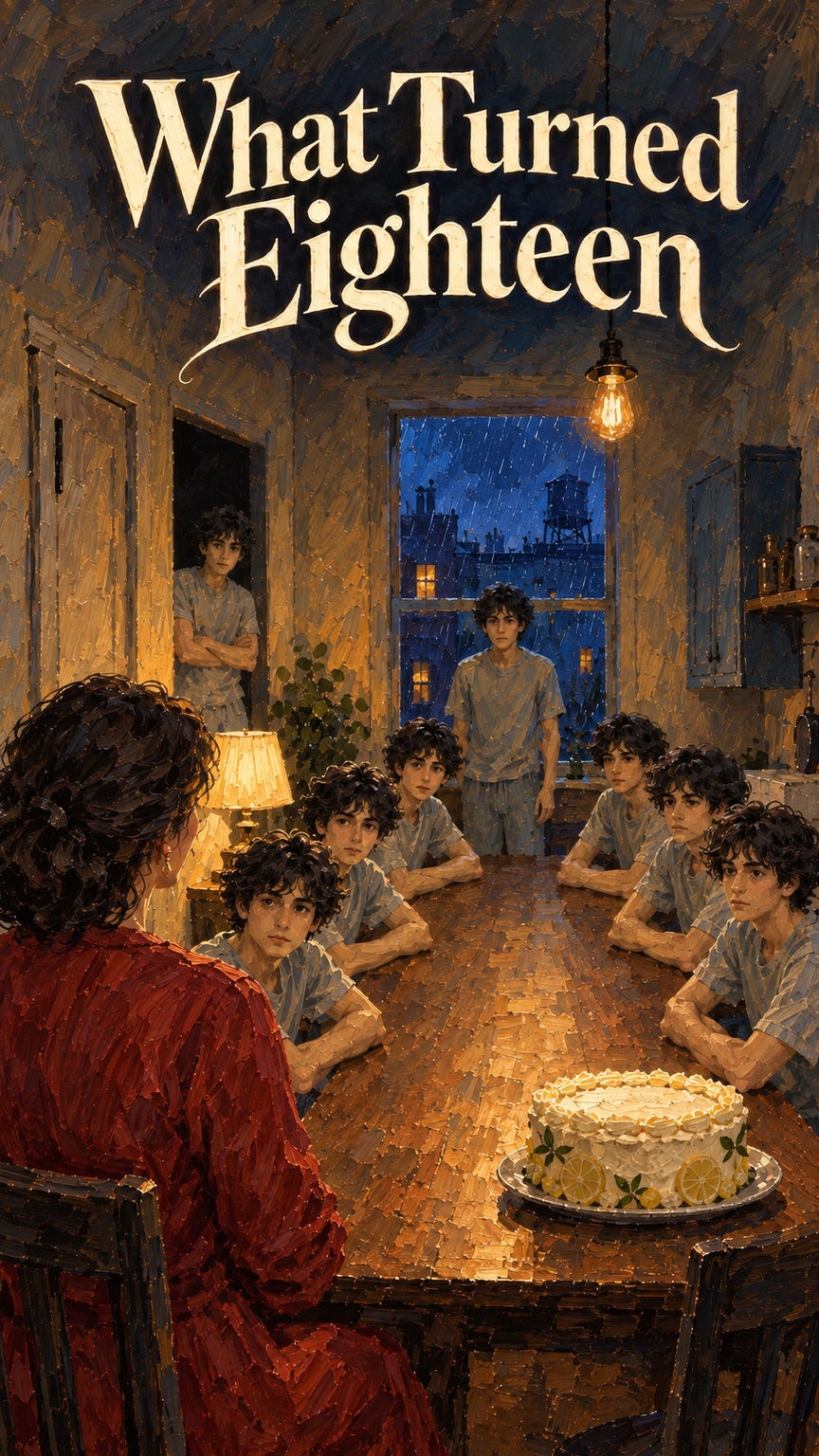
At four minutes to my birth minute, Maela stood on a chair and unhooked the glass shade from my ceiling light.
“In case of antlers?” my friend Jaro said from the doorway.
“In case of height.” My mother set the shade on top of the wardrobe. “Arlon can have it back after.”
“Assuming Arlon still fits under a ceiling.”
“And you’re helping how?”
Jaro lifted the cake box. “I stopped this falling down the stairs.”
He had also iced HAPPY EIGHTEENTH, ARLO in green across the lid because the bakery had refused to write on a box. The cake inside was supposed to have the full name and twice as much dignity. We had planned to carry it to the shared roof after my change, along with three folding chairs, Maela’s good cushions, and enough spiced lentil rolls to feed the neighbors who would pretend not to be watching.
Outside, rain worried at the afternoon but had not committed. The forecast said rain by nine. Maela believed weather forecasts only when they threatened a birthday.
Aluna came out of my closet holding the adjustable trousers she had brought me. They had ties at the waist, knees, and ankles and enough folded cloth to fit anything from very tall to discouragingly broad.
“They look like curtains,” I said.
“You said no robe.”
“I meant something elegant.”
“I brought safety pins. Elegance is phase two.”
Most true forms did not make this much preparation necessary. People grew a little, lost old scars, changed the shape of a face or the reach of a hand. My cousin had turned eighteen and acquired ears that could hear every clock in the building, which had led to an apprenticeship with a watchmaker and a bad month of sleep. Jaro had woken on his birthday with a different sex and spent two weeks replacing school records that had somehow been easy to correct everywhere except the swimming pool office.
“Drink before it happens,” he told me, setting down the cake. “I was so thirsty afterward I emptied a whole jug.”
“That was the hormones,” Maela said.
“That was me being thirsty.”
“You also ate six eggs.”
“Still do.” He nudged the cake box away from the edge of my desk. “See? I’m useful.”
I wanted useful people there, but I also wanted them upstairs. I wanted the lights strung on the clotheslines and the roof tiles still warm beneath my feet—whatever feet became—and Aluna laughing at Jaro’s music choices while Maela claimed not to monitor the parapet. I had spent a month planning a supper that could survive a tail, feathers, extra height, lost height, altered hands, or temporary blindness. The balcony door stood open so we could reach the roof stairs. The fan spun at its lowest setting because the apartment held the day’s heat.
Aluna checked her phone. “One minute.”
We all stopped pretending to have tasks.
I sat on the rug. My heart beat once, hard enough to feel in my teeth. Maela climbed down and took my hand. Her palm was flour-dry from shaping the rolls. Jaro tried to lean casually against the doorframe and missed it by a finger’s width. Aluna stood with the trousers bunched against her chest.
At the hour and minute printed on my birth record, I came apart without pain.
The room filled up.
I was against the wardrobe with its handle in my back. I was sitting on my bed. I was in the doorway with Jaro’s elbow in my ribs, and on the balcony with the rain-smell in my nose, and in the hall, and somewhere dark that smelled of dust and warm metal, and on the rug with Maela’s hand still in mine. Nine of me, each one my own height, my own face, my own bitten thumbnail. Every one of me wore the gray shirt and trousers I had put on that morning. Only one had my phone in its pocket.
There was still an I. It had no center.
That certainty lasted until I tried to stand up.
Nine bodies received the same instruction from nine different floors: rug, mattress, tiles, the edge of the bed frame. I pushed all of them up the same way. That was wrong. The one on the bed pitched forward into the one by the desk. Two in the hall knocked shoulders and went down together. The one in the doorway stumbled into Jaro, who saved the cake by holding it over his head. The fan blew across nine necks at nine different angles.
I tried to say Maela’s name. Nine mouths said it, not quite together, from the bed and the hall and the floor, a heartbeat apart, like a word shouted down a stairwell. Hearing my own voice come back from everywhere was worse than any fall. I shut every mouth at once.
Maela did not flinch at the sound. She reached past me and yanked the fan’s cord from the socket.
“Close the balcony,” she said. “Jaro, door. Aluna—”
Aluna was already on the balcony. I had forgotten the body out there. It had not forgotten my last instruction, stand, go, and it was still going, one slow step at a time, toward the railing and the drop to the courtyard. Aluna took its wrist and walked it back inside without a word.
“Arlo?” Jaro asked.
Every face I had went tight at the same instant. I saw it happen from across the room: my face, and my face, and my face, all doing the same frightened thing. I had not chosen to.
He took one step toward the nearest of me. Every body near him flinched, and the flinch went through the rest until nine people jerked away from him together.
“Stop,” Aluna said quietly. “Don’t move.”
“It’s only me,” Jaro said. “Arlo. It’s only me.”
But he stopped. Maela shut the balcony door. The apartment became suddenly still, though I kept swaying on legs I had not learned to stand on nine at a time.
Maela began to count.
She pointed, lost her place when two of me crossed, and started again. On the fourth attempt she used objects instead. She went to the kitchen, filled glasses at the tap, and set them in a row along the table. Aluna pulled out the chairs. The first of me went toward the water because Jaro had been right: I had been thirsty since before the change. When that mouth drank, thirst went through all of me so fiercely that the rest followed.
Not all at once. I could not walk nine bodies through one narrow hall without collisions. I learned to gather by layers, nearest first. Each mouth that drank eased the thirst a little. Each body that sat down gave Maela a shoulder she could touch with one finger and count.
“Four,” she said. “Five.”
I felt one body wedged in the corner behind the open wardrobe door, one arm pinned but moving. Another sat on the bathroom floor with its back against the tub. A third had found my bed and liked the warm quiet under the blanket. A fourth sensation came as a distant irritation I could not place.
All my faces went sharp at once. Jaro opened his mouth.
Aluna held up a hand. “We don’t know.”
Maela repeated, “Five.” Her voice had gone too careful. “Four missing.”
I turned all five heads at the table toward the bedroom. Aluna looked there. I lifted five hands and pointed. She eased the wardrobe door away from the wall, and the trapped arm came free. It hurt everywhere.
“Six,” Maela said when Aluna walked it to the table.
The one in the bathroom was easy. Jaro knocked, waited, and backed slowly down the hall so it could follow without anyone touching it.
“That makes seven,” Maela said. “Two.”
I sent two bodies from the table back to the bedroom. The warm one in the bed refused the shared intention for half a second—not another will, just one set of muscles receiving an instruction late. It took effort to make it get up. When it sat down in front of a glass, cold water erased the private pleasure of the blanket.
One remained.
I was in every place I could see, but one ache came from nowhere: a dark I could not open my eyes into, heat along one side, a pipe against my shoulder, a hand caught behind something. I tapped the table with eight hands, trying to force meaning into rhythm.
Jaro looked behind the sofa. Maela checked the balcony and the landing, and on her way back her knee knocked the radiator in the hall. A low ring went through the pipe. I could not tell what had made it. Aluna did not look away from the table.
“Maela,” she said. “Knock on the radiator again.”
Maela knocked. The missing body felt the vibration through metal. I hummed with every throat I had. A low hum shivered from eight bodies at the table, while somewhere behind the hall wall the last one hummed against the pipe.
Maela went white. “The cupboard.” She put her hand flat on the hall cupboard, where the vacuum lived and the heating pipes ran up through the building. She had bumped its door shut with her hip on the way to the kitchen, and it latched only from outside. “I shut it.”
“Arlo, can you get out?” Jaro asked.
I had no yes to give him.
Aluna put her palm on the table beside the nearest of me. “Arlon, touch once if you want us to open it.”
One of my hands settled against hers. Once.
Maela lifted the latch. The door let in a blade of hall light, and the body in the cupboard jerked back from it and wrenched its trapped hand against the pipe. Eight bodies half rose from their chairs. I made myself sit. Aluna’s hand stayed where it was.
“Slower,” she said.
Jaro switched off the hall light. Maela opened the door by centimeters. When it stood wide, the last of me came out of the dark on unsteady legs and walked straight into her. She caught it against her shoulder with both arms and stood frozen.
It was not a stranger in her arms. It had my face, but it was not a second Arlon she could speak to on its own. The pressure of her hands reached all my bodies, and I pushed once against her right hand to show I was conscious of it.
“Nine,” she said.
Then she counted again.
By the second count, I could make all nine faces smile on purpose if I concentrated. By the third, I could hum one high note through nine throats at once. Neither signal meant anything until we gave it work.
Aluna kept her palm open on the table. “Touch once for yes, twice for no.”
I touched once.
“Do you want the balcony door open?”
Twice.
“Do you want the fan on?” Jaro asked.
I slapped Aluna’s palm twice so hard that three of me rocked in their chairs.
He laughed, and the laugh was ordinary enough to loosen something in the room.
Maela did not laugh. “The supper is off.”
Nine of me stood up at once and faced her.
“That might mean no,” Aluna said.
“It might mean Arlo wants a vote,” Jaro said. “Nine votes.”
I hummed, then put six hands on the cake box.
“Cake,” Jaro said promptly.
Maela looked at him. “Stop answering for them.”
“Fine. Asking.” He pointed at the ceiling, then the cake, then me. “Upstairs?”
I touched Aluna’s palm once.
Maela said, “No.”
Every face I had went hard without my meaning it to. Jaro began, “When I changed—”
“You had one pair of feet,” Maela said. “You drank water and changed your school card. Arlon has already walked one of themselves halfway off the balcony.”
Jaro rubbed the side of the cake box where my hands had smudged the green writing. “Yeah. Not the same.” He did not look up from the box. “But at my dinner you all decided I was finished with the swim team. I was sitting right there with egg on my fork.”
Maela pressed the heel of her hand to her forehead. She was right about the roof. That made me furious with her.
I kept four bodies at the table and walked five toward the balcony door. Maela’s hand dropped.
“Is that a threat?” she asked.
It had been intended as a demonstration: I could choose two tasks at once now. The five wavered at the door because her question made me doubt my own signal.
Aluna moved her open palm between us. “One touch if that was meant to show control.”
Once.
“One touch if you still want the roof.”
Once.
“One touch if you’ll wait while we make it less stupid.”
I hesitated long enough for Jaro to say, “That’s a strong maybe.”
Once.
We spent the next hour making the roof less stupid.
The fan stayed unplugged. Jaro carried the cake upstairs without dropping it, which he mentioned twice. Maela borrowed six chairs from the neighbors and did not explain. Aluna tied a doubled clothesline across the broken corner of the parapet and rigged bedsheets between the roof posts as an awning, low enough to keep rain off the table and wide enough for all nine of me to stand under.
Every choice took time. Candles? Twice. Music? Once, after Jaro turned the speaker low and set it on the tiles so I would not hear it from nine places at once. Continuous counting? I answered twice. Maela asked again in case I had misunderstood. I answered twice again, then walked three of me into a line and had the others circle them. She watched, baffled.
“Three what?”
I had meant count only if three of me left the roof. Formation was not language merely because I wanted it to be.
“We’ll ask before counting,” Aluna said. “And if we lose sight of anyone—any part—we count anyway.”
I touched once.
On the roof, there was room for me at last. I spread out and saw our block in nine overlapping pieces: laundry snapping on the next building, a neighbor’s tomato pots, windows turning amber, swifts cutting through the lower clouds. Music traveled through the tiles and up through eighteen bare feet. I could stand inside the bass line.
Jaro served the cake. Its icing said HAPPY EIGHTEENTH, ARLON, though the final N had slid downhill. He cut nine thin slices before he cut any for anyone else.
“A culinary crime,” Aluna said.
“They have nine mouths.”
“You don’t know they’re all hungry.”
Jaro watched the nearest of me, my own face across the table from his. All nine of me took a bite at the same instant. He leaned back. “All hungry. Fine. A culinary adaptation.”
I tasted icing through all nine mouths at once. Sweetness did not multiply. It spread. Lemon arrived at the left edge of me; sugar at the right; a crumb of almond became briefly more important than the whole sky. All nine of me smiled, and I hummed a warm low chord.
“Good?” Maela asked.
I touched once, icing Aluna’s palm.
“Very good, apparently.” She wiped her hand on Jaro’s sleeve.
He objected. They argued about whether he had brought enough forks, now that I needed nine. For a while, the party became the thing I had planned: food cooling, music slightly too loud, the first lights strung overhead. I stood in a ring around the table while Aluna photographed the empty middle.
I wanted to show them I had learned faster than their fear.
I widened the ring beyond the awning.
The air there was cool and full of the rain’s mineral smell. I sent bodies to the parapet, around the tin hut that housed the lift motor, along the clotheslines. Distance added a delay that felt at first like pleasure. My intention rolled through me instead of arriving at once. I could begin a turn at one end and watch it become a wave.
Maela stood. “Arlon. Closer.”
I smiled with nine faces and walked farther.
The rain arrived as a single hard sheet.
One bedsheet tore loose from its lower knot. Wind punched beneath it, and the cloth snapped across the roof through the middle of me. Three bodies went down on the wet tiles. Two stumbled behind the lift hut. Two were at the parapet. Of the other two, one was wrapped blind in the torn sheet and one stood in rain so thick that every drop was a separate impact.
For an instant I tried to correct everything.
The result was nothing. Commands crossed in me. Bodies turned into one another. One of the two at the parapet slipped where the clothesline sagged over the broken corner, went through the gap, and landed on the maintenance ledge a body’s length below, hair and clothes plastered flat by rain. The other sat down hard against the parapet with its eyes screwed shut and stopped answering clearly to the rest of me. Behind the hut, sheet metal made the storm deafening.
Maela shouted numbers.
“Five here. Aluna, the hut. Jaro, get away from the edge.”
“Arlo, this way!” Jaro called. “Come to me. This way—”
Every face I had turned toward him, all at once, without my choosing. The bodies on the roof lurched toward his voice. The one on the ledge lurched too, and its foot went into a crack along the stone. Pain narrowed me to that one cold line of stone, and the bodies in safety sat down where they stood.
“Stop talking,” Aluna told Jaro.
“They need a direction.”
“You yell, Arlon goes nine ways. Quiet.” She crouched by the lift hut, not reaching into the dark gap. Rain pasted her hair to her jaw.
Maela held the loose sheet across her body, making a low shelter on the tiles. “Three under here. Two at the table. I can see one by the hut.”
“Maybe another behind it,” Aluna said. “I can’t see. Arlon—the one that can see my hand. Here.”
She lowered her palm to the roof. One wet body crawled out to her on hands and knees. I brought it to her alone, because moving one body was suddenly a relief. Touch. Shelter.
“Six,” Maela said. “Six here.”
Jaro knelt well back from the parapet. He put both hands around the metal railing and struck it with his ring: one slow tap, a pause, another. The sound reached the body against the parapet. It reached the one on the ledge. It reached the part of me behind the hut as a faint clean pulse inside the rain.
He did not call my name again.
I abandoned the whole formation. I took one body around the hut while the rest stayed wherever Maela and Aluna placed them. Behind the hut, a broken bracket made a pocket out of the wind. One of me had wedged its leg beneath the hut’s raised base. Aluna could not see it, but she saw where the one above it kept looking.
“Under?” she asked, pointing.
I touched her knuckle once. She lay flat, reached only as far as I could see her fingers, and waited. I worked the trapped leg free toward her hand, and she guided it out.
“Seven,” Maela said.
The body against the parapet opened its eyes, followed Jaro’s taps along the railing, and crawled into her sheet shelter.
“Eight,” Maela said.
The count seized all of us.
One remained on the ledge. I felt the rain sheeting off the parapet push at it, along the stone toward the far end, where the ledge broke off into air. Its foot came out of the crack, but the stone was too slick to stand on. The railing taps said where the roof was but not how to reach it.
Maela hooked one arm around a post and leaned out toward the ledge.
“Maela—don’t,” Aluna said.
“I’m not leaving them there.”
Jaro kept tapping.
I sent six recovered bodies back into the rain. This time I did not ask all six to do the same thing. Two lay flat along the parapet. Two knelt behind them and took hold of their ankles. Two stayed at the railing with their hands beside Jaro’s, feeling his taps and humming the rhythm the body on the ledge could follow.
I sent each movement separately: shift the left foot; wait; flatten against the wall; wait. The body edged backward, away from the broken end. One of the pair on the parapet reached down over the edge, and I took my own hand. I felt both grips at once, the one holding and the one held, and neither let go. The two at the ankles pulled. Between the four of them, I came up the wet wall in short, ugly heaves.
Maela got both arms around the last of me as it came over the parapet, and she did not let go until it was under the sheet.
“Nine,” she said.
This time she did not start over.
We left the roof while the rain strengthened. There was no graceful way to move nine of me down one narrow stair. Maela went first, with two of me holding her shoulders; Aluna came last, with two more; Jaro walked backward in the middle with the cake, three of me following the low hum we could now make on purpose and two at his elbows.
Indoors, towels filled the rug. Aluna switched off the bare ceiling bulb when my faces kept squinting at it and set two lamps at opposite ends of the room instead. Jaro moved the speaker under the table. Maela set out nine plates of lentil rolls, then stopped herself before assigning each to a particular body.
“Count?” she asked.
I touched her wrist once.
She counted by laying a fingertip against each wet shoulder. I felt every touch in order: pressure, warmth, pressure, warmth, until the last one. Then I touched her once in return.
“Fan stays off,” Aluna said. “Lamps low. Music low.”
“Cake high,” Jaro said.
Maela looked at the ruined corner of the cake. “Cake damp.”
“That’s weather, not me.”
“You carried it sideways.”
“For Arlo’s safety.”
I made a tone that began unevenly and gathered itself into something almost amused. Jaro waited instead of naming it.
We ate on the floor because nine of me and three of them did not fit around the table. I leaned against the bed, the wardrobe, the unplugged fan, and my own shoulders. Aluna knelt beside the wettest of me and pinned the curtain trousers around its waist with every safety pin she had brought; elegance was still phase two. Maela wrote TROUSERS on the shopping list, below EGGS and beside a question mark about nine toothbrushes.
There were still questions I could not answer. Whether distance would always blur me. Whether I would ever talk through one mouth while the other eight stayed quiet. How I would get on a bus, or sleep, or sign my name, or tell anyone more complicated things than yes and no. When those questions began to crowd the room, I let one of my hands knock the cake server against Jaro’s plate.
“More?” he asked.
I touched once.
He cut nine more slivers. Maela complained that he had cut the corner with my name on it. Aluna found the green N stuck to the underside of the knife and set it on the cleanest plate.
I bent nine heads toward supper while rain drummed on the window and Jaro restarted the music from the beginning.