When the Eagle Bowed
The last Eagle Queen was executed a century ago, yet when a wild eagle lands before an orphaned huntress and bows, ancient armor begins clawing its way out of the mountain—and every king in the valley orders her killed before she remembers who she was.
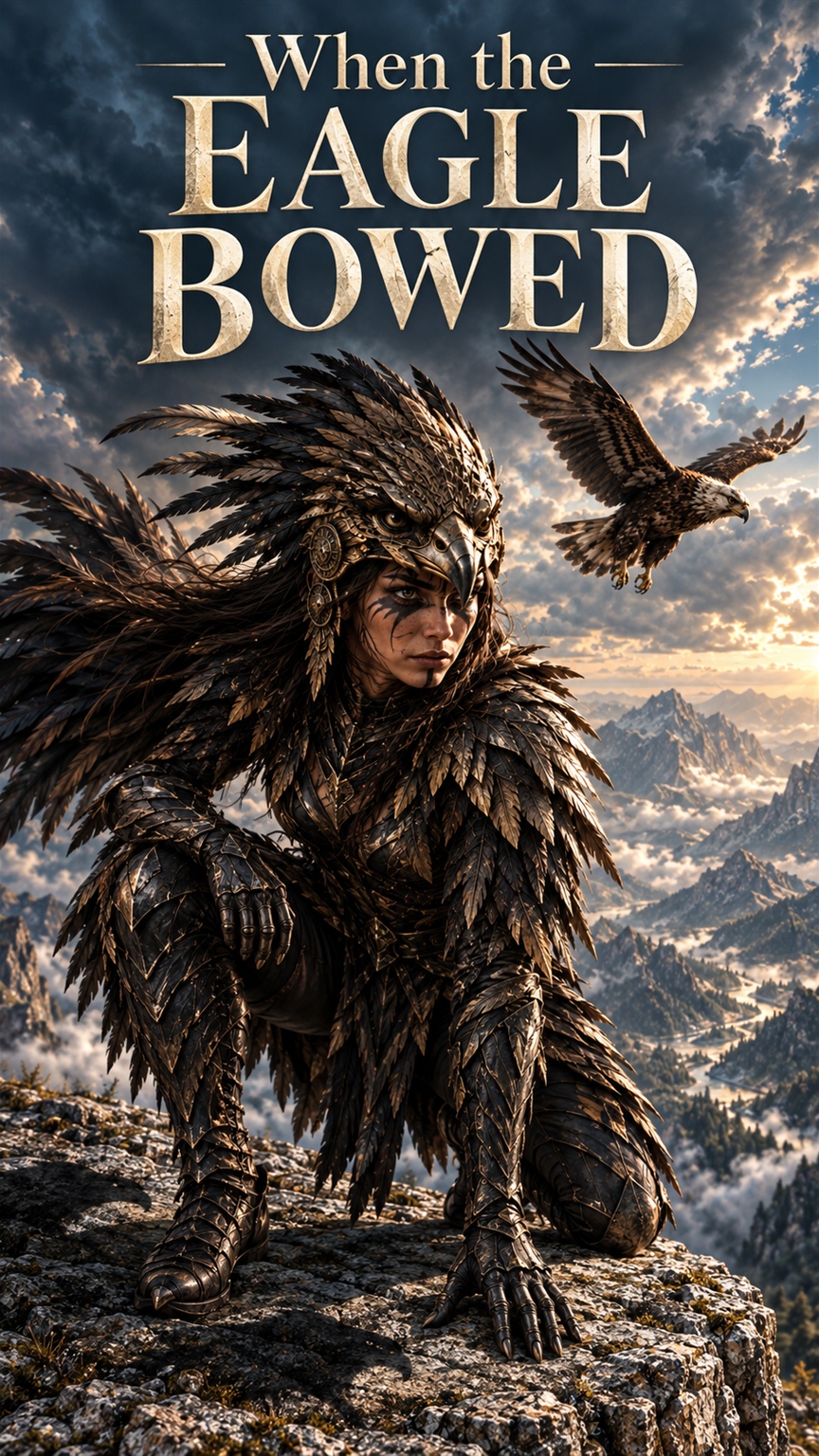
Yavren had the mountain goat open from breastbone to pelvis when the eagle dropped into the blood-wet grass.
It landed too close. A wild eagle did not give a hunter spear reach unless it meant to take her eyes. Yavren left one hand inside the carcass and closed the other around her knife. The bird’s wings folded without haste. Gold irises fixed on her face. No dragging pinion, no clouded eye, no thread around either foot. Its feathers lay clean except for limestone dust along the breast.
Then it bowed.
Not the quick head-dip of a bird gauging meat. It lowered its whole body until the hooked beak nearly touched the turf. Its wings opened a handspan and trembled there.
“Wrong woman,” Yavren told it.
The eagle remained bent.
Her right hand came out of the goat. Blood shone to her wrist. Before she knew what she meant to do, she turned that hand palm down and crooked two fingers toward the ground.
The mountain answered.
Scree jumped under her knees. Thirty paces uphill, a black point punched through the slope. Another hooked beside it, and another. They were not stones. Each flexed at its pale joint and clawed free, dragging a braid of dark filaments after it. Plates followed by the hundreds, mineral-bright backs overlapping, small as thumbnail scales at the edges and broad as shovel blades at the center. They worried limestone apart as roots worried a wall.
Yavren snatched up her bow. The living mass swung toward the heat of her body.
Far down the western ridge, a horn gave three blunt notes. From the ash woods to the south came a five-note answer. Last, beyond the switchback road, a brass call climbed bright and leisurely through the valley.
Three answers to one buried thing.
The eagle launched. It did not circle Yavren. It beat upslope toward a ledge where the rock had begun to shed gray dust.
“Pelka!” Yavren shouted.
The talonmail came faster.
Pelka, Yavren’s foster sister, emerged from the dwarf pines carrying six empty snares and half a grouse pie wrapped in cloth. She took in the opened goat, Yavren’s bow, and the black plates flowing downhill.
“Tell me that’s shale.”
“It has knees.”
“Leave the goat.”
“Already decided.”
They ran across the slope. Pelka caught Yavren’s pack strap and yanked her away from the usual descent.
“West horn,” she said. “Weir riders.”
“Three notes was rockfall.”
“When we were ten. They changed it after the spring flood. Three is royal danger now. Rockfall is two, wait, then one.”
Behind them, a plate reached the goat. It passed over hide and meat without pausing, but curled around the iron buckle on Yavren’s abandoned game strap. The buckle dulled, softened, and disappeared beneath rasping mouth-parts. The plate’s back thickened by a hair.
“It eats iron,” Pelka said.
“Only what we paid for. Good.”
“Yav.”
They had reached a rib of bare rock when one of the small plates sprang. Yavren knocked it aside with her bow, but its inner hooks caught her bracer. Cold bit through leather.
The mountain vanished.
Her wrists lay in bronze hollows. Smoke stung her eyes. Three men stood below a scaffold: one in water-blue, one with ash painted across his mouth, one wearing gold disks sewn down his sleeves. None yet wore a crown. They wanted the living mail taken through the valley and put on soldiers. She had refused them once at the eyries and once before their gathered companies.
The man in blue lifted a hand.
A blade fell.
Yavren came back on her knees with Pelka striking the hooked plate off her arm using a fist-sized stone.
“Look at me. Where are we?”
“The east gallery. The postern is below the rain cistern.”
Pelka gripped her jaw. “We’re above the goat meadow. There is no gallery.”
Yavren smelled smoke that was not there. She knew a passage behind the western face, narrow enough for one armored bearer, descending toward a river gate. She could feel its cool draft against a dead woman’s cheek.
“There’s a way through.” She pointed toward a cracked wall of stone. “Below that spur.”
“That spur fell before we were born.”
Hooves struck the lower track.
Pelka dropped the stone and unwound the short rope from her shoulder. “Fresh sign, then. Not memories. What crossed here today?”
Yavren made herself look down. Wind had combed the grass southward. Goat pellets, still wet. Two scuffed crescents where a hoof had tested shale. The herd had not used the old passage. It had crossed above them, through a slanting crease hidden by juniper.
“There.” Yavren took the rope. The familiar hemp roughness steadied her fingers. “Loose ledge halfway. Step where I step.”
“Better.”
They climbed as the first arrows arrived.
One struck sparks from the talonmail. The colony changed direction at once. Plates reared toward the bowman below, filaments tightening between them. The next arrowhead hit the mass and came out wood-bare. Black scales surged down the shaft.
The weir officer on the track swore and ordered every bow lowered.
“Clear the two houses under the shelf,” he called. “You, huntress—stand away from it. If it follows you, take it north.”
A gray-clad rider reined in beside him. Ash marked the rider’s veil from lip to chin. “The warrant says kill the returned bearer and anyone who heard her named.”
“The warrant doesn’t have three farms under a moving cliff.”
“It has a seal.”
From the road came the snap of weighted nets opening. Men in yellow leather spread below the traverse, iron sinkers glittering around each mesh.
Their captain pointed at Yavren. “Alive until we peel the shell off. Hands first. The warrant gets the rest.”
An opened ivory warrant tube hung at each officer’s belt, its present king’s seal cracked. Three kings, three versions of the same hundred-year order.
Pelka looked from one force to another. “They’ve thought about this.”
“For a hundred years.”
The sentence came out in a voice Yavren had never used: level, cold, accustomed to being heard across a chamber. All three detachments looked up.
So did Pelka.
Yavren crouched and studied the traverse. “Net line leaves a gap beside the split pine,” she said, forcing the words through the shape of her own mouth. “No. Too obvious. They’ll close it when we move. We need—”
The word for the low drainage channel would not come. In its place rose soldiers’ culvert, and with it a picture of stonework buried for a century.
“The wet cut,” Pelka said. “Say the thing you can see.”
“Wet cut. Rope around the juniper.”
They descended three body lengths, swung beneath the road men’s net, and landed hard in the channel. Pelka’s boot slipped. Yavren caught her forearm before her knee struck stone.
Above, the road captain shouted for the gap to close. The weir officer shouted back that iron would draw the creature across the shelf. The ash rider sent two hunters after Pelka instead.
The talonmail reached the first raised spear.
It did not strike the man holding it. It folded around the head, stripped iron from ashwood, and followed the weapon’s thrust toward his chest. The soldier dropped the shaft and rolled away. Plates cascaded over the place he had been, tearing a new seam in the rock.
Yavren’s left arm lifted. Her fingers shaped a cutting gesture she had made before three warlords and their banners. The living mass gathered itself.
Below lay men who had come to kill her. Behind them lay two roofs, a hay shed, and a woman dragging a child toward the stream.
Yavren seized her own wrist and forced the arm down.
The talonmail hesitated. Then it resumed climbing toward her heat, consuming every buckle and arrowhead in its path.
“What did you almost do?” Pelka asked.
“Don’t know the verb.”
“Did it end with us alive?”
“Maybe. Not them.”
“Then keep not knowing it. Up.”
They gained the narrow ground above the pines at dusk. The slope shuddered every few breaths. Dust lifted from three ledges where eagles nested; one slab had already tilted away from the mountain, leaving a wedge of dark air beneath it.
The wild eagle returned with a strip of wool snagged around one talon. It dropped the wool, landed on a boulder between Yavren and the eyries, and bowed again.
Yavren’s older memory reached first: banners lowering, petitioners prostrate, the ritual submission of lesser houses.
Another flash corrected it: a hen lowering itself before a broken nest ledge while a fledgling watched from the stone. The next spring, that grown bird had bowed at a new crack.
But the bird’s head stayed turned toward the cracking ledge. Its beak opened with exertion. Behind it, a half-grown eaglet flattened itself into the nest.
Not allegiance. Not recognition of a throne.
Distress.
“Its nest,” Yavren said. “The bow means the nest.”
Pelka was wrapping a strip torn from her undershirt around a slice on her calf. “Good. Ask it where to go.”
“It’s an eagle.”
“Then watch.”
The bird launched, banked past the eyries, and vanished behind a limestone fin. It returned along the same line, bowing on the boulder once more before repeating the flight.
Yavren followed the line with a hunter’s eye. The eagle was not pointing at the nest itself. Its wings changed pitch over a hollow behind the fin, where warm air lifted feathers along its belly.
“There’s a chimney.”
“Big enough?”
“For smoke. Maybe not us.”
“The gray cliff has a goat crawl on the far side.” Pelka tied off the bandage with her teeth. “We found droppings there last autumn. You said we’d check it when the snow went.”
Behind them, men shouted as the three detachments fought over the last safe approach. The weir force had begun cutting harness from pack animals before driving them downslope. The road men were replacing iron weights with stones. Ash hunters moved quietly along the upper timber, not toward Yavren now but toward the shepherds evacuating below.
“Can you climb?” Yavren asked.
Pelka tested her leg. “If you stop asking. What about your arm?”
Four black plates had fixed themselves beneath Yavren’s torn bracer. They pulsed with her heartbeat. On the stone beside her, the shadow of that arm ended in splayed feathers. She flexed her fingers; the feathers closed a moment later.
Every pulse brought another fragment: wind through a high audience slit; an eagle’s feet gripping her glove; a map incised into wet clay; a tunnel called the molting cleft, prepared where old talonmail could loosen its burden without breaking the outer mountain.
And beneath those fragments, waiting with terrible patience, a plan.
“We need the hollow,” she said. “It was built for this.”
“Built when?”
“Before they killed me.”
Pelka’s face tightened, but she did not argue about the pronoun. She shoved the grouse pie into Yavren’s pack. “Eat while we climb.”
“I’m not hungry.”
“Half now or all of it goes to the crows.”
Yavren took a bite. It tasted of onion, cold grease, and the morning they had expected to have.
They climbed.
The goat crawl narrowed behind the limestone fin until Pelka had to turn sideways. Yavren went first, testing each hold. The eagle passed overhead twice, never landing near them. It carried the wool to the nest on its second pass and did not look back.
At the end of the crawl, a vertical cleft opened into the mountain. Its walls were scored with thousands of parallel hooks. At the bottom, scarcely visible, a pale shelf curved around a black vent.
The talonmail poured around the fin.
There was no more room to outrun it. Plates climbed Yavren’s boots and calves. Their hooked edges did not cut at first; they fitted. Dark filaments wove behind her knees, across her hips, along her ribs. Their cold changed to feverish warmth as her body supplied what the colony lacked.
Pelka struck at a plate with the wooden handle of her knife.
“Stop,” Yavren said. “It takes raised weapons as threat. Put it down.”
“It’s closing over your neck.”
“Rope me. Under the arms.”
“Yavren—”
“Pelka. Rope. Then lower me to the shelf.”
Pelka laid the knife flat. Her first pass with the rope missed the buckle. The second went through. She dragged it beneath the advancing plates and cinched it twice.
When the talonmail closed over Yavren’s skull, memory ceased arriving in pieces.
She stood again in the cleft, a century younger and no younger at all, wearing the colony after its last clean molt. Below, three warlords waited with armies and bright new theories of peace. Give them a cohort of talonmail bearers, they had said, and the valley would never know invasion. They had already chosen whose valleys to invade.
The Eagle Queen was no blood sovereign. She settled grazing limits beneath the eyries, carried the living colony between molts, and made enemies wait where eagles could see them. She refused the warlords. When they bound her on the scaffold, she left a final movement impressed in the colony: wake when I return, open the old fault, travel beneath their keeps, and bring the mountain down through all three crowns.
It was not a command waiting in dead metal. It was an intention remembered by living bodies that had once lain against hers.
Now it lay against Yavren, intimate as rage.
The plates had not put a dead stranger inside her. Their impressions had struck against a life already hers and opened it. The scaffold belonged to her. So did Yavren’s childhood in the foster house, and every hungry winter Pelka had shared with her afterward.
She saw the route. Three deep roots of limestone. Three towns full of people who had never watched the blade fall. The old Queen had known there would be towns. She had planned the fall anyway.
The colony tightened. Yavren’s right hand had risen into the first familiar sign.
Beyond the face-plates, Pelka said, “Your feet are off the edge.”
Yavren caught a scored groove with one armored heel. Through the cleft’s mouth she saw an ash hunter lifting his bow toward Pelka’s back. The old gesture waited in her fingers. This time she completed it.
Plates leapt from her shoulder, stripped the arrow in flight, and struck the hunter against the rock. He fell out of sight. The ash rider shouted for another bow.
“Pull me up,” Yavren said.
“Can you get out of it?”
“Yes.”
Pelka hauled until Yavren’s hands reached the lip. “Then do it.”
Yavren looked down the slope where the hunters were still driving shepherds away from the safe path. They would burn the foster house next. Every winter after this would belong to whoever carried a king’s warrant.
“I’m going down to their keeps.”
Pelka stopped hauling. “With that?”
“It knows the rock beneath them. I can break their walls.”
“And the houses?”
The Queen’s old plan offered all three towns in one convulsion. Yavren could feel the fractures separately through the colony, as distinctly as she could feel her own fingers.
“You’ll have to get people clear. I’ll take one keep at a time.”
“You want me to help you become her?”
Yavren remembered the executioner’s hand pushing her head into place. She remembered Pelka at twelve, hiding their last flour when a tax rider came up the path. Neither memory loosened its hold.
“I want the kings dead,” she said. “And I want the valley.”
Pelka stared through the narrow eye gaps. Then she resumed pulling.
“If you bring a house down with someone in it, I stop helping.”
Yavren climbed out wearing the mountain.
The road men’s nets tightened around her and broke. She walked through three spear thrusts; iron crumbled against her ribs while the wooden shafts drove her half a step backward. She caught her balance, raised her hand, and the colony spread between the soldiers and their officers. The ash rider drew a sword. Black plates closed over him. When they parted, he did not rise.
The weir officer dropped his weapon and ordered his men to follow him off the ridge. Yavren let them go. The road captain ran after them without his nets.
Before descending, she turned the rest of the colony into the mountain’s opened seams. Broad plates braced the loosened eyries while the living braid withdrew through the deep roots. For the first time since afternoon, the ground held still. On the nest ledge, the wild eagle settled over its young.
By morning Yavren was on the western road. Behind her, a feathered shadow crossed the stones, though the rising sun should have thrown it ahead.
It kept pace with her for eight days.
At the first keep, Pelka brought the weir officer to the gate. He asked his king to dismiss the warrant and open the lower yard to those fleeing the walls. The king ordered his own archers to shoot him. Yavren caught the officer under one arm as talonmail surged through the arrowheads and into the gate hinges. She carried him clear; then she entered alone. The king died trying to drive an iron lance through her throat.
The road king offered the armor its weight in silver. When Yavren kept walking, he retreated behind a portcullis and dropped it on her. She stood beneath its grinding teeth until the colony had eaten a gap above her shoulders. His guards fled through it after she passed. She killed him in his counting room. By dusk his crown lay in her pack beside the first.
At night she could no longer sleep on her back. The colony strained against the ground beneath her. Pelka carried the lamp outside once, leaving only moonlight through the open flap, and the dark wings remained spread across the tent floor.
“Make it fold,” Pelka said.
Yavren lifted her hand. The wings folded. “It still follows.”
She left the lamp unlit and watched until morning.
The ash king waited in the chapel where his grandfather’s grandfather had knelt after the Queen’s execution. The old scaffold had stood outside its doors. Yavren recognized the lintel as she climbed over the gate she had broken.
Behind her, Pelka and the weir officer were bringing the last servants out through the kitchens. Ahead, the king’s remaining guards stood on a low timber gallery above the royal tombs. Their spears had stone heads. The chapel doors were bound with bronze, and the king wore no iron at all.
“You can have the other crowns,” he called. “Leave me this one and I’ll recognize your claim.”
Yavren stepped into the aisle. “You renewed the warrant.”
“I can revoke it.”
“Your hunters came for my sister.”
He glanced toward the kitchen passage, then signaled the gallery.
The guards drove down with their spears while men behind them heaved a stone coffin lid over the rail. Yavren flung herself sideways. It smashed through the paving where she had stood, opening a burial vault. Plates broke against the falling stone. She felt the living braid tear beneath her shoulder.
“Back!” she shouted to Pelka, who had appeared in the passage just behind her. “Get outside!”
The king was retreating toward a narrow stair behind the throne. A guard on the gallery turned his spear toward Pelka.
Yavren’s shadow lay across the aisle, its hooked beak touching the first stair. She knew the sign that bound it to her feet. She remembered making it each night before the old Queen slept. Holding the colony’s reach inside the bearer’s shape had once been as ordinary as tying back her hair.
She opened that hand.
The eagle shadow rose from the floor.
It passed through the gallery’s supports. Timber split without flame. Men dropped their spears and clung to the rail as the whole structure tipped inward. Yavren dragged Pelka into the shelter of a tomb; beams struck the aisle, and the king’s stair folded against the wall.
He tried to climb the wreckage. The shadow reached him first. Its beak closed around his shape on the plaster, and his body jerked backward from the steps. Yavren felt warmth rush into the torn colony beneath her shoulder. She shut her hand, but the beak held until the king stopped moving.
Then the shadow sank flat.
Yavren waited for it to fold against her heels. A wingtip remained on the far wall. When she moved her foot, it followed.
Pelka crawled out from beside the tomb. She checked the king, then looked up at Yavren.
“There are men alive under the gallery.”
Yavren bent and lifted the first beam. The plates obeyed her. Together they pulled out three guards, none carrying a weapon now. Outside, bells began to ring.
They crowned her before sunset beside the broken gallery.
The third king’s circlet was too wide. Pelka folded a strip of cloth inside it, hands shaking with fatigue, and fitted it above Yavren’s brow. Beyond the open doors stood soldiers from all three armies. Their surviving captains had surrendered their seals and gates. The two captured crowns lay at her feet.
When the weir officer knelt and called her Queen of the Valley, Yavren accepted. She made him rise, then ordered the century-old warrants brought into the square and burned. No king remained to renew them. The three houses that had killed her had lost their thrones, and she had taken their kingdom.
From the chapel step she could see the breach in the outer wall, smashed carts, people searching the road for someone who had not come back. There would be days enough to count what she had broken. She would be here for them.
Pelka touched her wrist. “Yav. Don’t move.”
The sun was behind the chapel. Yavren’s shadow lay forward across the square, an eagle with its wings shut. As she watched, its head turned toward a wounded standard-bearer resting beside the doors.
She made the binding sign.
The head kept turning.
The man saw it and tried to stand. His empty hand brushed the dark beak. Frost whitened his sleeve, and Yavren felt warmth enter her armor. Pelka caught his belt and hauled him backward. The shadow struck the place his head had been.
“He hasn’t got a weapon,” Pelka said.
“I know.”
Yavren pressed both hands against her breastplate and forced the closing movement again. Plates drew tight enough to stop her breath. Beneath them the living colony pulsed, pouring darkness across the stones. The eagle’s feet were still joined to her heels. Its head had reached the far side of the square.
She backed into the chapel, trying to drag it away from the people. The shadow lengthened.
Pelka stayed in the doorway with the wounded man behind her.
Across the square, the shadow began to lift one wing.