Where It Hurts
A knight became very famous among adventurers for wielding a sword that inflicts "emotional wounds." Today, you saw someone get struck by that sword.
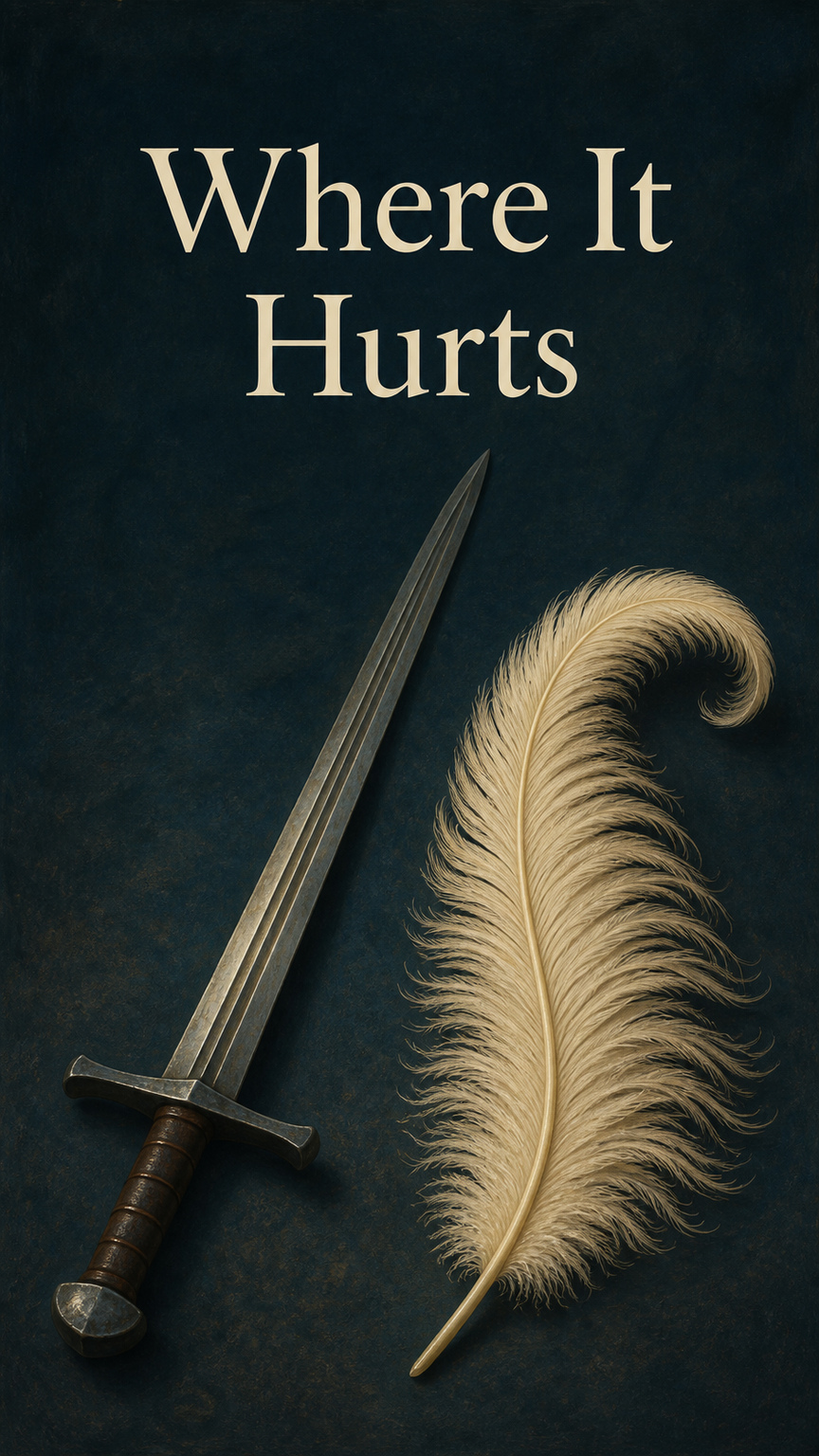
Dovran gave me his hat and asked whether, if the knight struck him, I would tell people he had been protecting me.
“From what?”
“Think of something. I’m about to be busy.”
He took the hat back, pulled out its feather, and gave it to me again. He had bought the feather that morning. Already its preservation required two people.
I laughed. In the inside pocket of my coat was a ticket for the evening coach, bought before he woke. My pack was waiting at the booking yard. I had paid for a winter room inland, with a window that shut and no gap between the bed and the wall, and I had not told him any of this. We had been travelling together for four years. I wanted one more pleasant afternoon with him.
At the hiring fair there were people who had survived things no sensible person would approach, and nearly all of them had come to watch Sir Frascot. His sword was famous wherever adventurers drank. I had heard of a captain who, struck by it, had wept into his own helmet; of a highway robber who had apologized to a horse; of a swordswoman who had carried on fighting and won. That last account was always disputed by somebody who hadn’t been there.
The wounds were emotional. Everyone knew that much. No severed fingers, no wound fever, no holding your insides in with your coat. We found this very funny at night, around fires, while picking ticks out of ourselves.
Frascot was taking challengers in a roped square between the horse pens and the tables where expedition leaders sat with their lists. First touch won. The fair paid a silver piece to anyone who touched him; so far its money was safe. An enterprising man outside the square sold wooden copies of the famous sword. Frascot’s actual weapon was rather plain, and the copies all had jewels.
Dovran had watched two bouts decided by surrender before a blow landed. He had disliked the second surrender in particular.
“At least let him try,” he’d whispered to me. “You’ve put on all those buckles.”
“You go, then.”
“Shall I?”
I had meant it. I liked watching him fight. He wasn’t elegant, but he was quick, and when frightened he made a furious little whistling sound through his teeth which he refused to believe in afterward. He’d be delighted if he won a silver. If he lost, I’d buy him a drink and we could add some outrageous circumstances to the account.
Now he ducked under the rope, tucked the feather inside his shirt, and drew his own sword.
Frascot looked tired and hot. He had removed his helmet, leaving a damp band across his brow. His padded sleeves were patched at both elbows.
“You understand what I’m using?” he asked.
“Unless you’ve brought the wrong one.”
Somebody laughed. Dovran glanced toward me, pleased.
“You may feel badly hurt without any cut,” Frascot said. “Bad enough to stop you. It can last for days. If you want an ordinary bout, I’ll use a practice blade.”
“No, this one.”
“You can withdraw at any time.”
Dovran saluted him. His face had settled into its fighting look, loose mouth and narrowed eyes. I knew that face better than the one he made when somebody drew his portrait on a tavern wall.
Frascot laid his bare thumb against the guard. A pale gleam passed from his hand into the narrow grooves along the steel. It brightened when he tightened his grip. Then he raised the blade and waited.
Dovran tried a cut toward the shoulder, drew it back, and came in low. Frascot stepped to his left. Their swords met near the guards with a clack; Frascot turned his wrist, let Dovran’s edge slide past, and tapped him under the ribs with the flat.
It was a small sound. I could hear the horse dealer behind me still counting out a price.
Dovran hopped backward, grinning. His coat was whole.
“Well,” he said. “That’s a—”
He looked at me. I was laughing because of the hop, which had been absurdly nimble for a man with his reach, and because we had all been holding our breath for nothing. A few others laughed too. One man clapped.
Dovran’s mouth stayed open. He drew a breath to finish whatever he’d been about to say, then turned his head toward the clapping man. His sword drooped until its point caught in the dirt.
“Dovran?” I said.
He tried to lift the point. It dragged a small furrow.
Frascot stepped back and took his thumb off the guard. The grooves went dull.
“Bout’s over.”
“I know,” Dovran said, too loudly. “I know it is.”
The laughter died unevenly. Those who couldn’t see over the people in front were asking what had happened. Dovran stood looking among us, from one face to another, and I ducked under the rope with his hat in my hand.
“Come on,” I said. “You nearly had him.”
“Don’t do that.”
His voice was ordinary enough to make me stop. Up close I could see that the muscles beside his mouth were trembling. He kept trying to press them still with his lips.
“What is it?” I asked Frascot.
“Let him tell you.”
Dovran swallowed. Somebody beyond the rope said they couldn’t see any blood.
“I feel,” he said, and stopped. He looked at the place where the sword had touched his coat. “As if you all want me to go away.”
“We don’t.”
“Yes, thank you, I gathered it was the sword.” He took his hat from me and pushed it onto his head without putting the feather back. “Can you stop it?”
Frascot shook his head.
“Hit the other side, perhaps?” Dovran said. He gave a short, ugly laugh. “No? Thought not.”
“It usually eases over a few days. Keep company tonight. Don’t travel alone.”
“How many days?” I asked.
“I can’t promise you a number.”
He wiped his palm on his breeches, then used that hand to steady the scabbard while he sheathed the sword. There was no glow now. He tied it down with a leather thong, and the next challenger, already loosening his cloak, protested.
“I’m done,” Frascot told him.
Dovran was trying to sheath his own sword and missing. I held the scabbard still for him. He let me, though he wouldn’t look at me.
“You call this better than cutting someone?” I said.
“Better than killing him.”
“Nobody needed killing.”
Frascot looked past me at the man selling the wooden swords. “No.”
I wanted more from him than that. Dovran caught my sleeve.
“Can we just get out?”
We went through the rope. People made room, which was what I wanted, until I saw Dovran’s face when they did it.
Beyond the horse pens I put an arm around his shoulders. We often walked that way after a good evening, mostly because one of us would be trying to steer the other toward another tavern. He hunched under my arm. I took it away.
“Sorry.”
“It’s hot.”
It was hot. His collar had left a red line across his neck. He pulled at it, found the feather, and looked surprised to be holding it.
“Worth keeping safe,” I said.
He didn’t answer. I wished I had let the feather go unnoticed.
At the edge of the fair, a woman frying cakes asked whether we wanted the last two. Dovran shook his head. She put them into a bag for somebody else, and he stopped walking.
“What?” I asked.
“Nothing.”
We stood while the woman took her money and started scraping the pan.
“I said no,” he told me, very quietly. “I know I said no. I’m not confused about it.”
“I can buy you something else.”
“I don’t want a cake.”
He walked on. I hurried after him, then slowed because I could hear myself hurrying. Everything I did seemed to come at the wrong speed.
“Do you want to lie down?”
“No.”
“A drink?”
“Not yet.”
“We could sit somewhere.”
“You could stop asking me things for a moment.”
So we walked without speaking. He kept the feather in his hand. In four years I’d seen him feverish, frightened, furious over a cheated purse, and so homesick that he’d tried to make his mother’s dumplings in a helmet. I’d eaten those dumplings. I had mentioned them at every opportunity afterward. I couldn’t think of a single thing to say about them now that wouldn’t be asking him to laugh for me.
We came to the street that led back to our lodging. Dovran turned into it. I went another three steps toward the coach yard before I stopped.
“This way,” he said.
“There’s a bench under the awning over there.”
“There’s a bed in the room.”
“You said you didn’t want to lie down.”
He stared at me. Then he looked at the yard, where a porter was rolling a barrel up a pair of planks. A coach stood in the shade with both doors open. It wasn’t mine; I had checked the painted destination without meaning to.
Dovran watched me check it.
“What are you doing?”
I put my hand inside my coat. It would have been easy to leave it there and tell him we should go back to the room. I could miss the coach. There was one every morning.
I brought out the ticket.
He leaned forward to read it, his face close enough that I saw the dust caught in the wet corner of one eye.
“When?”
“This evening.”
“That’s now.”
“Not quite.”
He stood back. I folded the ticket along its existing crease.
“I’m going inland for the winter,” I said. “I’ve found a room. Well, it’s been found for me. I’ve paid the first month. It’s not far from the coach stop.”
“You’ve paid?”
“Yes.”
“When did you do all this?”
“The room was arranged last week. The ticket this morning.”
He rubbed the feather between his hands. Small barbs broke loose and stuck to his damp palms.
“Your pack?”
“Here already.”
“Ah.”
There was a bench under the awning, as I had said, but he didn’t go to it. He leaned against a post in the yard entrance. I stood beside him, in everybody’s way, and waited for him to ask about the room. It had a stove. I’d spent a surprising amount of time thinking about the stove.
“This morning,” he said. “Before we went out?”
“Yes.”
“You sent me to buy the feather.”
“You wanted the feather.”
“You said the stall would close.”
I had. He’d been dithering over its price. I’d wanted ten minutes alone to take my pack down.
He pushed himself off the post, then leaned back again.
“I’d have bought it anyway,” he said. “You didn’t have to do that.”
A cart was coming through. We moved a few steps into the yard together, by habit, his hand going to my elbow before he pulled it back. The driver thanked us. Dovran studied the cart’s rear wheel until it had passed.
“I wanted to tell you properly,” I said.
“When?”
I had already answered that question, but not the one he meant. After lunch had become after the fair. I had imagined him helping to put my pack on the coach, grumbling about the fare, shouting something indecent after me to amuse the other passengers.
“Before I went.”
He nodded several times. I hated that more than if he’d shouted.
“You mustn’t think this is because—”
“I heard you. You bought it this morning.”
“I meant because of you.”
“Oh. Well. That’s a relief.”
“I’m trying to tell you. I can’t do another winter on the road.”
“Then you could have said.”
“I’ve been saying I’m tired for months.”
“So have I. It makes people offer you chairs.”
He was looking at me properly now. I could have laughed at that, on another afternoon. Even now, I wanted to.
“After the flooded mine,” I said, “I told you I wanted to stop.”
“We did stop.”
“For two days.”
“You wanted to leave that inn. You said you could hear things chewing inside the mattress.”
“There were things chewing inside the mattress.”
“I know. I heard them too.”
We looked at each other, and he laughed once. I started laughing as well. Then he put a hand over his eyes.
I couldn’t tell whether I’d made it worse. I waited until he took the hand away.
“I don’t want another inn,” I said. “I want that room. I want to take my boots off and know I won’t have to put them on in the dark because something’s coming. At the last job, when you woke me for the watch, I couldn’t get out of my blankets. I pretended I hadn’t heard you.”
“I thought you were ill.”
“I wasn’t ill.”
He looked down at my boots. They were the pair he’d helped me bargain for in the spring. One lace had a join in it where I’d broken it pulling too hard.
“All right,” he said.
“But I don’t know if it’s just the winter.”
He kept looking at the boots.
“I don’t want to promise I’ll come back in the spring,” I said. “I was going to tell you winter, but I don’t know.”
“I heard you.”
By the stable door, a boy was whistling. Dovran tried to brush the fragments of feather off his hands, then gave up and wiped them on his coat.
“I’d have tried to talk you out of it,” he said. “If you’d told me.”
“Yes.”
“I might still.”
“Please don’t.”
He breathed through his mouth for a while. When he spoke, his voice was thick.
“I bought that map yesterday. You looked at it with me.”
“I know.”
“You said the ferry would be cheaper downstream.”
“It would.”
He made an impatient movement, and I stopped.
We had sat with the map between us while he drew little boats in the margins. One of them had capsized under the weight of my luggage. I’d drawn him beneath it, being eaten by a fish. That was after I’d sent the money for the room.
“I liked sitting there,” I said. “With you.”
“So did I. I was planning a journey.”
I put the ticket away. It had begun to soften where I was holding it.
“Do you need some of the money back?” he asked.
“What?”
“For the map. Your half.”
“No. Of course not.”
“Good. Because I’ve drawn all over it.”
He tried to smile and couldn’t. I reached for his sleeve, then let my hand drop before touching him.
“This would be easier if he hadn’t hit you,” I said.
“Yes, probably. What do you want me to do about that?”
“Nothing. I didn’t mean—”
“I know there’s something wrong with me.” He stopped, rubbing his face. “Wrong happening. Whatever. I know that boy doesn’t hate me. He’s never seen me before. I know you don’t hate me either.”
The boy had stopped whistling. I wished he would start again.
“I don’t,” I said.
“I said I know.”
I let him stand without trying to touch him. After a while he took off the hat, looked inside it, and put it back on. The damaged feather was still in his other hand.
“I wouldn’t have done it,” he said. “The bout. If I’d known you were leaving today.”
“I’m sorry.”
“We could’ve gone somewhere. Not stood about watching other people fight.”
“There’s still time.”
He turned toward the yard. The porter had finished with the barrel and was carrying bags out of the booking office. My pack was among them, recognizable by the strip of red blanket Dovran had sewn around a failing strap. He’d charged me for the thread, then spent twice the amount buying me a drink to celebrate the repair.
“No,” he said. “I’m going back.”
“To the room?”
“Yes.”
“Frascot said you shouldn’t be alone.”
“I’ll sit downstairs. There are people there.”
I wanted to ask whether he’d tell them what had happened. I wanted him to tell it well, with the hop and the feather and his suggestion of a second blow, and leave my part in the afternoon out of it. I looked away from him.
“Could you stay until the coach comes?” I asked.
“No.”
He pushed the feather into the band of his hat. Half its barbs were missing. It leaned sideways, and for a moment I thought he’d make one last joke about it. He saw me looking and took the hat off again.
“Was it all right, though?” I said. “Us. Travelling.”
His face crumpled. He turned it away quickly, but I’d seen.
“Don’t ask me that now.”
“Sorry.”
He nodded without looking at me and walked out of the yard. I followed him as far as the entrance, then stopped. He was still carrying the hat when he reached the corner. He turned into the street toward our lodging without looking back.
The porter wanted to know which pack was mine. I showed him, and he set it on one end of the bench under the awning.
I sat down. There was dust on the knees of my trousers from ducking under the rope. I brushed one knee clean and left the other. Across the yard, the stable boy began whistling again, lost the tune halfway through, and started over.
I kept looking at the entrance. I wanted Dovran to come back, although I hadn’t found anything better to say to him. A driver came out of the office and I stood, but he was only fetching a coat he’d left on the bench. I moved my pack so he could reach it, then sat down again.