Where No Unicorn Stands
You are a unicorn and the only son of a newly crowned queen. Days after your mother's coronation, you are kidnapped by the Pegasi and taken to their kingdom in the clouds.
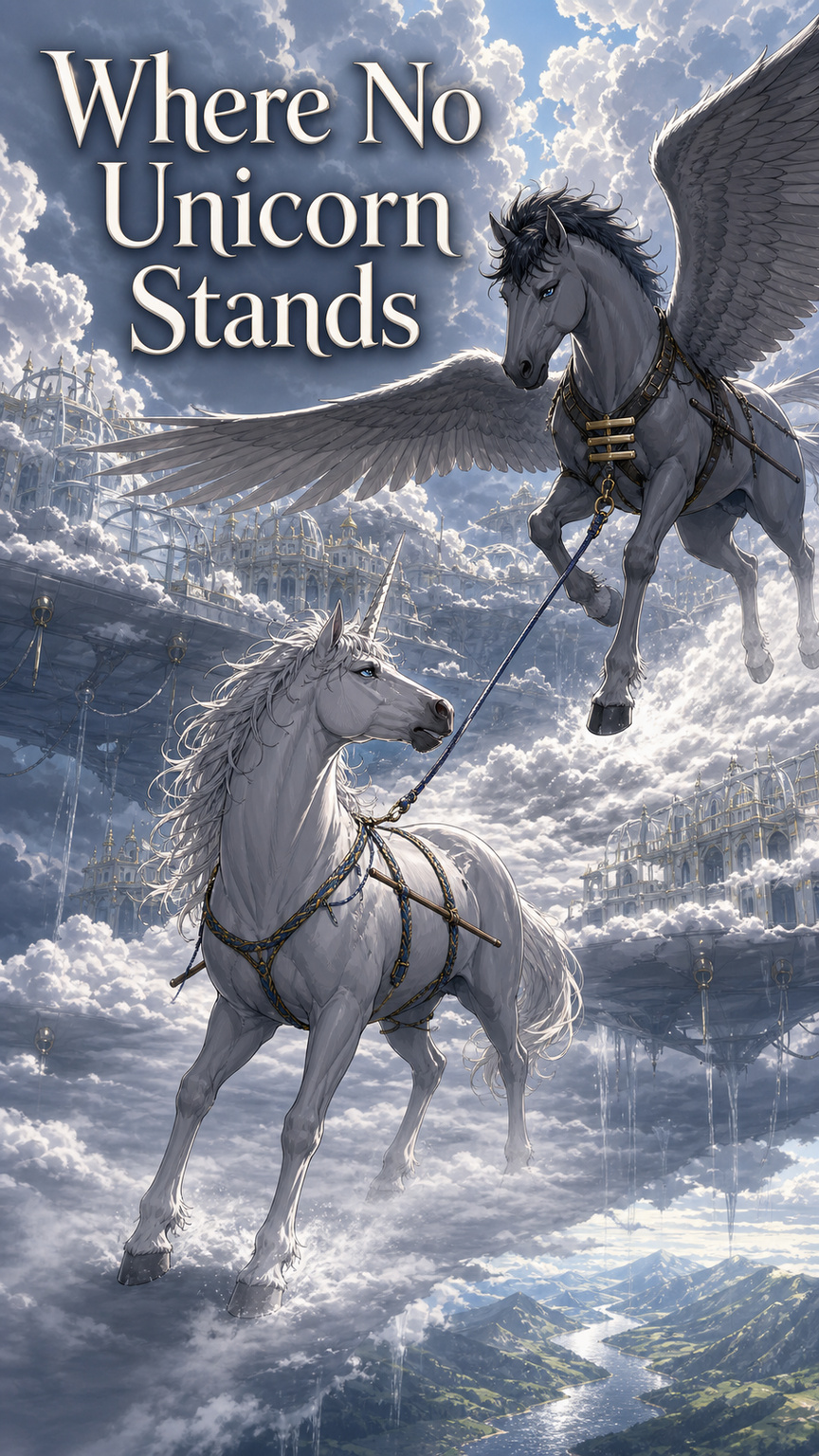
I woke because my foreleg dropped through the sky.
Cloud closed around it, cold and almost wet, then let it pass. The only thing that stopped the rest of me was a rope net drawn hard beneath my ribs. Its knots bit through my coronation blanket. Above me, wings struck the dark in staggered beats. Below me hung a country without a bottom: moonlit folds, black wells, and, very far down, a scatter of lamps along a river I knew.
I kicked for ground. The net swung. One of the wingbeats faltered.
“Stop.” The voice came from ahead and above. “Forelegs in. Horn to your right.”
I kicked again.
The net tipped far enough for my shoulder to slide against its rim. Cloud swallowed my dangling hoof to the knee. No bank of mist caught it. Nothing did.
“There is no footing here,” the voice said. “The cords hold you. Use them.”
That was harder to understand than being stolen. Four days earlier I had stood beside my mother while the crown settled between her ears, and every unicorn in the hall had lowered a horn to us. Since then I had slept badly under embroidered blankets, answered questions nobody had asked me the week before, and learned that even breakfast could become an occasion. None of it had prepared me for a world through which my body could fall.
I hooked both forelegs over the net rope.
“Banking left,” the voice said.
“Who are you?”
“Left now.”
The Pegasi tilted together. My stomach remained behind while the net swept sideways. I shut my eyes, which only made the wingbeats larger.
When we leveled, I tried the words that had opened doors since the coronation. “I am the queen’s only son and witnessed heir. By her crown, you will return me unharmed.”
The Pegasus ahead glanced back. Moonlight edged a leather flight hood and the rigid line of his jaw. He flew in the lead harness; the other ropes ran from his chest to the four bearers around me.
“Save your breath,” he said. “Climb coming.”
He had heard every word. That frightened me more than if he had not.
They carried me until the river lamps disappeared. Dawn found us inside the storm my mother had rooted over the valley. It should have been pouring there, making dark coins in the dust and filling the stone channels between the orchards. Instead its rain remained around us: gray chambers, sudden white corridors, blue-black bulges that shuddered when the Pegasi passed.
Shapes emerged from it. Towers coiled upward on braided cloud. Bridges, stretched thin as old wool, joined terraces crowded with wings. A whole kingdom had been made out of what would not hold one of my hooves.
The captain gave his first explanation when the nearest tower showed daylight through its lower wall.
“Your queen stopped our storm.”
“She called rain to dying fields.”
“She nailed our city over them.”
“Then speak to her.”
His wings shortened their stroke for the descent. “We tried.”
The landing platform looked solid until they lowered the net. White flagstones pressed against my hind hooves. I put weight on them, grateful enough to gasp.
The stones opened like breath.
I plunged chest-deep. Pegasi shouted. Ropes snapped taut beneath my forelegs, wrenching my shoulders, while my hindquarters sank into luminous cold. The captain seized the back of my blanket in his teeth. Three others hauled upward. For a moment the sky was inside my mouth and ears, tasting of metal.
“A sling,” a new voice ordered. “Not another net. Bring the audience sling.”
“The western seam is taking everyone,” somebody answered.
“Then strip the canopy poles. Move.”
The speaker was an older mare with narrow wings and a chain of plain iron links around one foreleg. She came close enough to see me but did not touch me. “Can you breathe?”
“Return me.”
“Can you breathe?”
I pulled air past the rope crushing my chest. “Yes.”
“Did you strike your head?”
“Under my mother’s—”
“Look at me.” Her eyes tracked mine. “Did you?”
“No.”
The captain landed beside her, sides heaving. “Regent, the lower quarter has hours. We need his horn at the binding.”
She did not look away from me. “Under whose order did you seize him?”
“I had twenty-seven crews lose their roosts last night.”
“That is not an order.”
“The council debated while the nursery floor thinned.”
“Did he consent to come?”
The captain folded his wings too sharply. “No.”
The regent looked then. “So you have brought me a crime and attached our survival to it.”
“I brought the one horn that can loosen a fresh royal claim.”
“You brought a prince who cannot stand in the room where you intend to bargain with him.” She turned to the Pegasi wrestling dismantled poles through a doorway. “Food too. Something he can eat, not cloudfruit.”
The audience sling hung from four poles laid across two facing galleries. It was wide enough for me to lie in, padded under the breast, and humiliating in ways the cargo net had been too frightening to achieve. Beneath its woven floor, the court chamber descended through layer after layer of translucent cloud. Pegasi moved below us as dim shadows. At the edge of sight, parts of the city sloughed away in silent white sheets.
The regent asked questions as workers tightened the sling: when my mother had taken the crown, where the storm had been when she claimed it, whether her horn still touched the coronation stone. She stopped each answer before I could dress it in ceremony.
“Four days,” she repeated. “Then the root is still dividing.”
“My mother did not know you lived here.”
“I asked what she knew, not what you hope.”
The captain scraped one hoof against the cloud floor. It held him as turf would hold me. “A direct descendant can slacken the claim until it travels again. He makes one cut. We send the storm home after.”
“Home where?” I asked. “Up? Down?”
He pointed with one wing toward the vanishing lower city. “Anywhere but fixed.”
The regent’s gaze followed his. “One cut drops the stored rain.”
“It also saves us.”
“And drowns the valley under us.” I had become very still in the sling. “You carried me here to choose which kingdom falls.”
The captain’s answer came after one wingbeat too many. “I carried you here because ours was already falling.”
The regent ordered him out before he could turn that into a defense. She ordered guards at the sling, then changed her mind and ordered no guards within horn reach. She sent another message toward the ground and made the messenger repeat the route back to her. None of this was freedom. A braided tether still ran from the sling to an iron ring in the gallery. But the cup put before me held oat mash, not a speech, and the worker who set it down only said, “Careful, the bowl isn’t as solid as it looks.”
I ate because terror had made me hungry.
By afternoon, the sling ropes had rubbed two raw tracks behind my forelegs. The harness-keeper found them without asking where it hurt. She was a broad Pegasus with one primary feather missing from her right wing and wax rubbed into the fur around both knees. She slid a flat measuring strip under each rope.
“Too tight,” she said.
“It kept him in,” the captain said from the gallery.
“A knot can keep a sack in. He has shoulders.” She bit through a lashing and retied it with two quick pulls. “Lift your chin.”
I did not.
“Or keep the throat rub. Your throat.”
I lifted it. She fitted a padded guard along my horn, leaving the point bare. Her talk stayed with buckles and skin. Two feathers’ room at the chest. A hoof’s width behind the foreleg. Never trust a wet strap merely because it had stopped squeaking. When she asked whether I needed water, it sounded like one more measurement.
“I need to know if my mother received your messages.”
“Then you need someone else.”
“Did they come back?”
She tested the new knot with her full weight. “Some.”
“Show me.”
The captain said, “No.”
The harness-keeper said, “He can look while I move him.”
“He is not leaving the court.”
“Then his skin comes off here.” She looked at the frayed sling, not at either of us. “Your choice.”
They moved me in a maintenance cradle hung beneath her body. My hooves rested in separate loops; her belly and the cradle’s webbing made a low ceiling over my head. It should have felt more degrading than the sling. Instead the heat of a living body steadied me. I could hear how her breath changed before every turn.
She took me through kitchen ways where steam condensed on the walls and cooks braced pots between their knees. Pegasi folded their wings to let us pass. One complained that somebody had used the salt scoop for resin. Another pushed a heel of brown bread into the cradle and told me to chew before the next climb. Nobody asked me to save them.
The returned messages filled a sorting rack beside an outer hatch. I knew our palace ribbon: green, with a narrow gold edge. Six bundles wore it. Their wax seals were unbroken. Across each had been brushed the same gray mark.
“What does that mean?” I asked.
“No descent,” the harness-keeper said. “The rooted edge threw them back.”
“So she never saw them.”
“It means they did not reach your border riders. Keep your right hoof inside.”
“You said—”
“I said what the mark means.” She ducked under a beam. “Right hoof.”
I pulled it in just before the cradle scraped the wall.
Beyond the message hatch, a pale vertical crease ran through the storm. Rain glittered inside it, close enough that I smelled wet stone from the country below. My horn prickled. The sensation was familiar: the soft resistance of my mother’s magic when she set a ward over a door and let me open it from the other side.
There. A way out that did not require a Pegasus.
I waited until the harness-keeper turned to receive a replacement buckle. Then I drove my horn through the crease.
The storm tore.
Not widely. The opening was no longer than my neck. It was enough. The passage wall peeled outward, taking a section of terrace with it. A cook vanished in the white collapse. Wings hammered. A pot spun past, shedding broth in round drops.
“Horn out!” the harness-keeper shouted.
I froze.
“Out. Now, not down.”
I jerked backward. The captain plunged through the tear and came up beneath the cook, taking the cook’s weight across his back. Two workers caught the terrace edge with their wing-wakes. The harness-keeper slammed her shoulder into my cradle to keep it from turning.
“Close your eyes,” she said.
“I can help.”
“You are twisting the chest strap. Eyes closed. Breathe while I fix it.”
Her directions gave me three small things to do. I did them. When I opened my eyes, the cook was clinging to the passage, the captain’s left wing shook with strain, and the pale crease had become a dark wet scar. Far below, a sudden hammer of rain struck one bare patch of valley and ran brown over its banks.
My one hard cut had done that.
The captain landed and shoved the rescued cook toward the doorway. He looked at me, mouth open, but whatever accusation came first did not survive his need for air.
“I thought it was a passage,” I said.
“It is,” the harness-keeper said. “For water.”
The captain folded his trembling wing. “Back to court. Short route.”
He did not tell me I had proved him right. For that much, at least, I was grateful.
The storm began to shear after sunset. I knew it first through the cradle: every third wingbeat landed at a different angle. The harness-keeper stopped twice to shorten lines. By the time we reached the court, one gallery had been evacuated, and the audience sling swung empty over a widening shaft.
The regent stood beside its tether ring. “How much time?” she asked.
“To save the city?” said the captain. “Less than an hour.”
“To carry him to ground.”
His ears tipped back. “With which crews?”
“Yours.”
“If we turn from the upper seam, it parts.”
“Will your route reach the mountain?”
“Yes, but—”
“Then prepare it.”
The captain stared at her. Around us the court filled with clipped reports: east bridge empty, nursery moved, two bearers missing, rain load rising. The regent took the knife from the harness-keeper’s tool belt.
“Regent,” the captain said, “that tether is our claim.”
“It is evidence.” She cut the braided rope tying my cradle to the court. The loose end whipped through the iron ring and vanished into whiteness. “Carry him home.”
No bargain. No promise extracted. The lower quarter could dissolve, and she had given away the only body they believed might prevent it.
The harness-keeper began changing my cradle into a riding harness. I watched the cut end of the tether swing beneath me.
“Wait,” I said.
Nobody did; the floor lurched, and waiting had become dangerous.
“There are three moving seams,” I said louder. Fear made each word a separate object. “I can loosen them. Lightly. Not the root. Three releases, while we descend.”
The captain stopped fastening his breastplate. “You tried lightly once.”
“I tried to escape.”
The regent asked, “What changes now?”
“You released me.” The old ceremonial cadence pressed up when I needed plain speech, each clause wanting witnesses. “I offer aid bounded by my consent: three seams, on a homeward course, if my mother breaks contact with the coronation stone before the last. If you turn me back toward the city or fasten another tether, my offer ends.”
The captain glanced toward the upper towers, then toward the dark gap where the mountain lay beyond the storm. He could not make himself look at me.
“Homeward course,” he said. “Rig him to me.”
The harness-keeper put me on the captain’s back. Leather crossed my chest and belly; loops took my legs without binding them. He was smaller under me than he had looked beside the net. Every breath widened his ribs against mine.
“If he slips?” one bearer asked.
“He will not,” the harness-keeper said.
“That was not my question.”
She passed the bearer an emergency line. “Then keep this out of his horn.”
We flew.
The first seam raced down the storm’s outer face, a silver wrinkle in black vapor. The captain called distances, never looking back. “Twenty lengths. Ten. Brace.” The regent’s fliers beat above and below us, their wakes pulling the cloud skin tight. Rain bulged behind it.
“Now,” said the captain.
I touched the seam with my horn and drew a line no longer than my ear.
Cold seized my teeth. The root fought to remain one thing. Then it yielded by a fraction. Rain streamed out behind us in a narrow curtain, not down upon one field but slanting across miles of thirsty dark. The city lifted. I felt the change through the captain’s spine.
“One,” he said. “Turning.”
No praise. The route was already beneath his next instruction.
The second seam moved faster and lower. Wind flattened his mane into my eyes. The harness-keeper flew at our left, watching the straps rather than the rain.
“Chest is walking,” she called.
“Hold,” the captain shouted.
I held my horn away from the seam. He had meant my body.
The loose strap slid across his wing root. His left wing lost half a stroke. We dropped. The mountain lamps leapt upward, then disappeared behind cloud. Somebody screamed “Line,” and the bearer cast the emergency rope. It struck my horn guard and snagged.
“Don’t cut!” the captain barked.
I went rigid. Cut nothing. Move nothing. Be literal or kill a kingdom.
The harness-keeper slammed into our side and bit through the rope above the snag. “Your right knee,” she shouted at me. “Press down.”
“He said don’t—”
“Knee. Down.”
I pressed. My weight shifted off the captain’s damaged wing. His next stroke caught air; the following one caught more. We skimmed the seam so close that rain needled my face.
The captain did not have breath for a full command. “Horn. Two.”
I scored the second release.
Rain burst outward. The fliers below us vanished behind silver. The captain’s left wing shuddered but kept its rhythm, and the harness-keeper wedged the wandering chest strap beneath my knee where I could pin it.
“Keep that,” she said.
“I am.”
“You weren’t.”
We descended around the storm’s edge toward the mountain. With two seams open, the cloud city no longer sagged in one direction. Its lowest terraces remained ragged, some gone entirely, but the towers drew upward on the Pegasi wakes. Below, rain spread through two long bands. The river swelled within its banks.
At the exchange ridge, a line of unicorns stood with lowered horns. Their armor flashed whenever lightning moved inside the cloud. My mother waited ahead of them beside the coronation stone, her horn touching the wet white surface. The root ran from it into the storm as a green-gold cord only our kind could see.
She saw the captain carrying me. She saw the trailing strap, his failing wing, the Pegasi around us.
“Bows down,” she called.
Nobody moved.
My mother stepped between the armed line and the cliff. “All of them. Down.”
Horn tips rose from their aim. Bowstrings slackened. Only then did she turn away from me. She put one forehoof against the coronation stone and wrenched her horn free.
The green-gold cord snapped back into the storm.
The captain stumbled in the air as the released root changed the wind. The final seam opened beneath us, broad and pulsing.
“Three?” he managed.
It was not a command anymore. It was all the question he could carry.
I lowered my horn. This time the magic gave under its own weight. I guided the opening along the seam while the captain flew the curve, and the stored storm descended in a wide gray veil. Rain reached the valley, the ridges, and the cloud kingdom’s tattered underside. The city drifted free, turning slowly toward the dark country beyond the mountains.
The captain reached turf before his left wing failed.
Mountain grass struck my hooves through the harness loops. Real weight rose into my bones. I had imagined the relief so often that the truth of it surprised me: mud between my toes, stones pressing one heel, the slope refusing to let me through. The captain folded under us. I tore at the buckles with my teeth until the harness-keeper landed and pushed me aside.
“Third pin,” she said. “Not the shiny one. Third.”
My mother arrived first and found it before I did. She pulled the pin, rolled the captain onto his sound side, then worked the chest leather away from my raw skin. The armed line kept its distance because she had told it to. The regent landed farther upslope with three fliers and no court behind her.
Nobody discussed peace in the rain.
We took shelter in a shepherd’s hut just below the ridge. It smelled of damp wool and last winter’s ashes. My mother cleaned the rope burns with boiled water while the harness-keeper wrapped the captain’s wing around a split of roof lath. The regent counted who had returned. A valley guard set down bread, hard cheese, and a pot of beans, then left when the queen looked at the weapons still on his back.
The captain woke once while his wing was being bound.
“City?” he asked.
“Moving east,” the regent said. Her voice had shortened to exhaustion. “Lower homes lost. No count yet.”
He swallowed. “Route held?”
“Eat later,” the harness-keeper told him. “Talk less now.” She pulled the bandage firm. He obeyed.
My mother removed the last strap from behind my foreleg. Fur and a little skin came with it. Her mouth tightened, but she did not ask me to comfort her. She did not ask whether the Pegasi had hurt me, as if one answer could hold the net, the sling, the bread, the cut tether, and the captain’s back.
“The stone?” I asked.
“Cold,” she said. “I released it before I knew you would reach us.”
Across the hut, the captain watched the rain tick from the roof. “I took you,” he said. The rest failed somewhere between his ribs and his teeth.
“Yes,” I said.
The harness-keeper shoved a folded blanket under his bandaged wing. “Don’t roll onto that.”
The regent broke the bread into uneven pieces. My mother passed the largest to me.
“When you can,” she said.
She meant the whole account. The six sealed bundles. The torn terrace. The cut tether and everything after. My mouth tasted of rain and old rope. I could not begin while the captain’s bandage was still being tied.
“Not yet,” I said.
My mother nodded and pushed the beans closer. The harness-keeper ate standing up. The regent counted the bread again and gave the captain her piece when she thought nobody watched.
I put all four hooves on the packed earth floor. Then I ate.