Where the White Elk Went
The giant white elk has carried the same elven guardian through the forest for longer than any kingdom can remember—so when it suddenly walks beyond the ancient boundary for the first time, something has changed in the world outside.
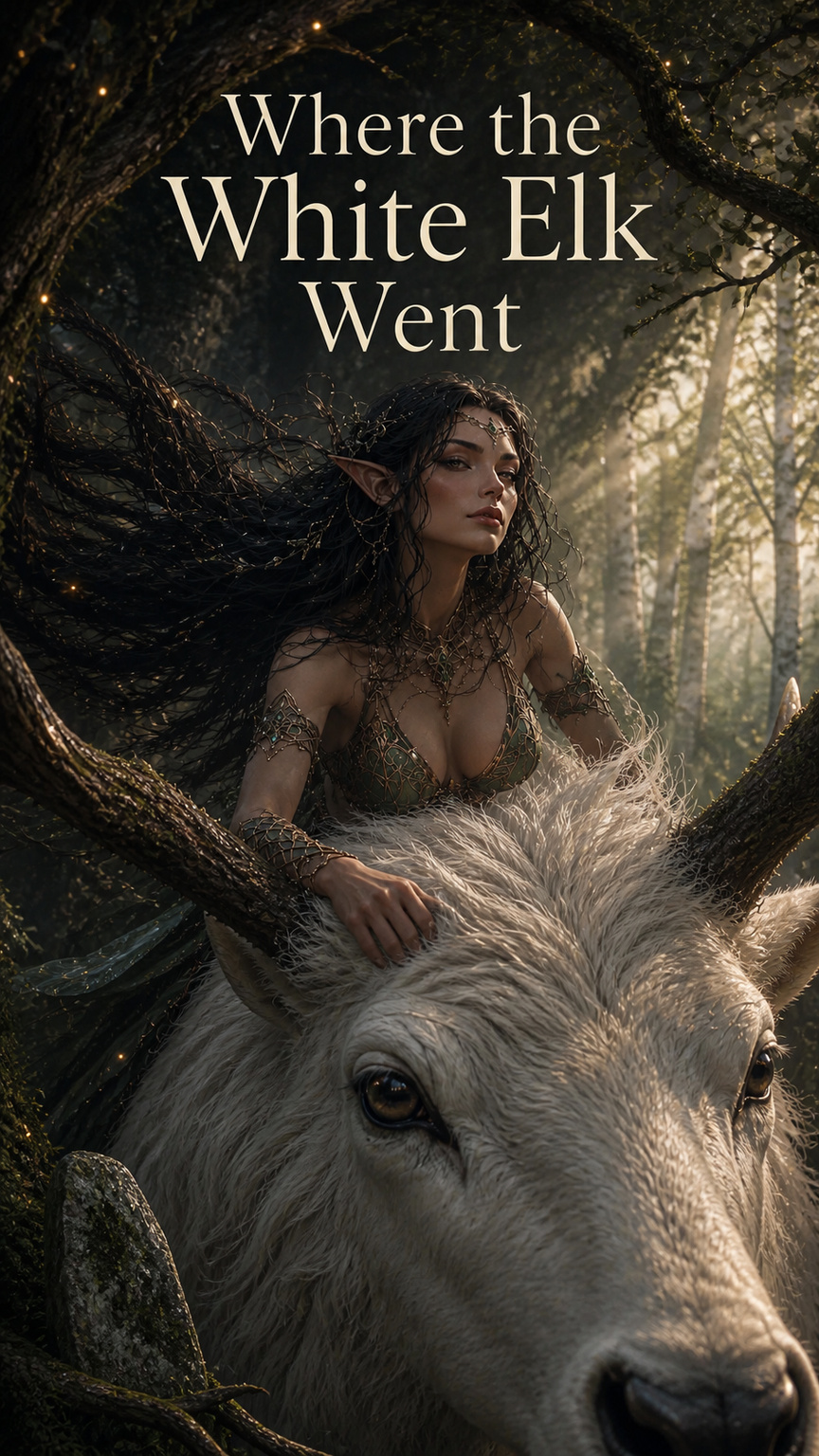
At the western stone, Winterbough did not turn.
The white elk had made the turn every ninth morning of autumn for longer than Avarra could measure without borrowing the names of dead kings. He would pass close enough for the lichen to brush his left shoulder, lower his antlers beneath a crooked yew, and begin the northward part of their circuit. Avarra usually leaned with him before he moved. That morning she leaned, and Winterbough went straight.
A yew branch caught her across the chest and tugged the chain woven behind one pointed ear.
“Ow. Very dignified,” she said, freeing a strand of black hair from the bark. “Now turn.”
His ears tilted back. He had heard her. Then his right forehoof came down on the strip of brown grass beyond the stones.
Avarra’s hand closed in the dense fur at the base of his neck. There was no bridle to take up, no rein hidden under the long pale shag. There had never been one. His shoulder stood half again as high as hers when she was on the ground; from his back she usually needed only the weight of a knee, the angle of her body, and a word spoken more from courtesy than need.
“Winterbough.”
He crossed the boundary.
The stones were no wall, only a procession of waist-high slabs sunk among the roots. Their faces bore no threats or blessings. Moss had eaten whatever marks had once been cut into them. Still, they described the edge of Elderweald as faithfully as shore stones described a lake. Inside: beech, oak, yew, silver fir, and the deep-linked roots that carried the forest’s slow rhythm. Outside: kingdoms, roads, fires, fields. Change.
Winterbough had walked beside those stones in thaw and drought, beneath banners whose colors Avarra had forgotten and beneath skies empty of any smoke at all. He had never put a hoof past them.
Now three of his hooves stood outside.
“There may be a ditch,” she told him. “Or hunters. You dislike hunters.”
His hide shifted under her bare calf. He took another step.
“That was not an argument in favor.”
She twisted to look behind. Elderweald waited in its familiar dimness. From this side, the boundary seemed absurdly small: a few stones vanishing between trunks. Avarra could slide from Winterbough’s back, walk home, and let his sudden foolishness be his own. The thought lasted until he stopped.
He turned his head as far as his antlers allowed. One dark eye found her through the pale tines. Then he bent his forelegs.
Avarra knew that motion. He had lowered himself for her on mornings when ice stiffened her knees, after the summer lightning split the hill oak, once when a boar’s tusk opened her calf. This time he was offering her the ground.
Not carrying her away, then. Not refusing to release her. Asking something, perhaps, though asking was her word for it.
“You could have done that before the branch.”
Winterbough waited.
Fear made her want to list duties. The southern springs needed checking. A dead fir leaned above the red-deer track. The circuit did not keep itself, although this was plainly untrue: for three thousand autumns and perhaps many more, Winterbough’s feet had chosen the path while Avarra named the work.
She shifted her weight forward. “Go on.”
He rose, and the stones slipped between the trees behind them.
Beyond Elderweald lay no field.
Young birches crowded a shallow slope, their white trunks thin as unlit candles. Hazel whipped at Winterbough’s chest. Thorn caught in his shag and tugged loose in showers of yellow leaves. Avarra watched for a roofline, a woodcutter’s blaze, the straight black wound of a recent road. She smelled damp bark and mushrooms. Somewhere ahead, water moved over stone.
“This was pasture,” she said. “The boar-crowned kings pastured black cattle here.”
Winterbough stepped over a fallen birch.
“Unless it was the kings with the bronze mouths. They pastured something. Horses, possibly.”
His ear turned toward her.
“They were kingdoms, Winterbough. They cannot all be expected to remain distinct.”
A mile beyond the boundary, a road surfaced under the thicket. Two parallel banks ran between the trees, but their paving had heaved into humps and cups. Ferns grew in the joints. Winterbough took it west, though west had never been part of their circuit.
Avarra pressed one palm to his neck. Beneath his heat and muscle came the familiar interval: a gathering too slow to be called a beat, then release. Elderweald’s living rhythm passed through root into hoof, through Winterbough into her. In spring it quickened. In winter it sank so deep that she sometimes woke afraid it had ended. It carried no message. It did not speak of distant trees or remember the dead. It was only life answering life, and while Avarra remained within it, the years could find no clean place to take hold.
Here the pulse was faint, but it was not gone.
She sat straighter. Winterbough halted at once.
“You feel that.”
He lowered his nose toward the road. Between two slabs, a hazel root as thick as Avarra’s finger had buckled the paving upward.
“That proves a hazel is tenacious.”
Winterbough touched his nose to the lifted stone.
“Yes. Remarkably tenacious.”
He moved on.
By afternoon, the road had become a channel for rain. Alder filled its ruts. Beyond it, a wall rose under green mounds, shoulder-high in places and vanished in others. Winterbough passed through a breach too narrow for a gate. A pear tree leaned within, its fruit small, hard, and furred with brown scab.
Avarra picked one as they passed. It tasted sour enough to draw her mouth tight.
“A surviving achievement of the outer world.” She offered Winterbough the bitten pear.
He smelled it and turned away.
“Coward.”
She ate the rest because he had refused it.
Near dusk he left the drowned road and climbed onto a shelf of dry ground. He scuffed leaves away until dark soil showed, then folded his long legs and settled. Avarra dismounted stiffly. Her soles, accustomed to Elderweald’s moss and packed paths, objected to every hidden pebble.
The old forest lay less than a day behind them. She could still feel its direction without looking, a gentle inward weight in her bones. If she left now, she would reach the boundary before midnight. Winterbough could follow when his mood improved.
She laid both hands against the earth.
Nothing at first. Then the slow gathering came through a mesh of fine roots: weak, broken by spaces, yet unmistakable.
Winterbough watched her from beneath the branches.
“You might have shown me this at the stones.”
One ear flicked at a gnat.
“Or any time in the last century.”
He put his head down.
Avarra gathered deadwood. The fire smoked, the ground sloped, and a root placed itself precisely under her hip no matter where she lay. Winterbough slept with no visible regret. Sometime before dawn, rain tapped its way through the leaves and extinguished the fire.
“I hope,” Avarra told his broad white back, “that you are having an instructive night.”
His breathing did not change.
She moved closer for warmth and slept with one hand buried in his fur.
In the morning Winterbough faced west, away from home.
Avarra stood beside him with wet hair, smoked clothes, and the remains of the pear arguing in her stomach. “We could go back.”
He did nothing.
“That is an observation, not a command.”
Still nothing.
When she placed a hand between his eyes, he leaned into it hard enough to make her take a step. Then he lowered himself for her to mount.
Affection, apparently, and no concession at all.
“One more day,” she said.
Winterbough rose before she had settled properly, and she grabbed his fur with both hands.
The road gave them ruins in pieces. A line of dressed stone appeared beneath ivy, disappeared into a hill, then emerged as the foundation of a shepherd’s hut built with poorer mortar. Beyond that, a broad stair descended into a pond. Minnows wavered above the fifth step. Someone had cut drainage grooves across carvings already worn too shallow to read.
Avarra had expected devastation. She knew devastation: charcoal in the soil, lime-split stones, arrowheads under bracken. Here no single wound explained the emptiness. A hall had been dismantled to make farm walls. The farm walls had sunk beneath an orchard. Oaks grew through the orchard, some old enough that four of Avarra with linked arms could not have circled them. A later road had bent around those oaks before vanishing under beech.
“This could be the river court,” she said at midday, though the roof tiles in the stream were the wrong blue. “Or the eastern end of the horse-banner kingdom. They had lions on their mileposts.”
Winterbough stopped beside a broken pillar lying on its side. The relief on it might once have been a lion. It might also have been a basket of reeds.
“Do not encourage me.”
He rubbed an antler against the pillar. Stone flakes pattered into the moss.
The ridiculousness of scolding an elk older than the language she used struck her all at once. Avarra laughed. Winterbough lifted his head sharply; a torn streamer of ivy hung from his third tine.
“Oh, no. Keep it. You have improved the monument.”
He shook himself. Ivy whipped Avarra across the cheek.
Her laughter followed them down the slope, less dignified than the yew branch had been.
It ended when the pulse vanished.
Winterbough had entered a broad paved court. Moss silvered the flagstones, but no root had yet pried them apart. At his first step onto it, the slow rhythm under Avarra’s hand ceased. The absence was so clean that her breath caught.
“Back.”
Winterbough kept walking.
“Back, Winterbough.” She drove her knee against his shoulder, an old signal for a close turn. He stopped but did not turn. “The roots end here.”
Ahead, the court stretched between roofless walls. Its far side lay in shadow. Thirty paces, perhaps forty. Nothing moved there but rainwater under a skin of leaves.
Avarra slid down. The silence inside her bones widened. Without Winterbough’s warmth under her, the day felt suddenly cold.
“We go around.”
She took hold of the fur beneath his jaw and pulled to the right. He could have dragged her without effort. Instead he lowered his head until his nose nearly touched the stone, then looked across the court.
Not looked, she corrected herself. Faced. Or happened to face. She had made a life from differences she believed she understood: the impatient stamp, the warning stillness, the shoulder lowered in invitation. Perhaps she knew those. Perhaps she had merely been lucky for a long time.
“I cannot tell what you mean.”
Winterbough waited.
Rainwater slid off the ivy and ticked onto stone. Avarra loosened her hand.
“I cannot.”
He stepped forward. She did not.
After three paces he stopped and looked back. The distance between them was small, but it contained the boundary, the wasted commands, and every morning she had leaned before he turned.
Avarra put one foot on the paving. No rhythm rose to meet it. She crossed to him anyway.
They walked the court together, Avarra’s hand against his shoulder. Halfway across, Winterbough shortened his stride to hers. He had to; his legs were absurd. She nearly told him so, then kept the thought.
At the far wall, a fig tree had opened a crack wide enough for them to pass. The pulse returned under the first mat of roots, faint but steady. Avarra let out a breath she had not meant to hold.
Winterbough lowered his head. She pressed her forehead to the warm hollow above his eye.
“One more day,” she whispered, changing the promise after she had already broken it.
They slept that night in the shell of a room where swallows had plastered nests beneath an arch. Avarra dreamed no visions. She woke twice with cold feet and once because Winterbough was chewing beside her ear.
The third morning brought thicker woodland. Sapling stands gave way to young oaks, then to trunks scarred by fires that had burned and healed before any living kingdom had named the land. Winterbough no longer followed a road. He threaded westward through hollows where stonework showed only when a root lifted it.
Avarra walked for a while to spare her bruised legs. When she drifted toward easy ground, Winterbough angled across her path. When she tried the north side of a bramble brake, he stopped on the south and waited. His choices irritated her most when they proved better. Beyond the brambles lay a dry streambed whose loose stones would have turned her ankle. Southward, the ground held firm.
“You might enjoy being right less visibly,” she said.
He tore a mouthful of leaves from a branch.
By noon they reached a ridge made too straight to be natural. Earth covered it, and trees covered the earth, but beneath both ran a foundation broader than a city wall. Its stones had kept the oldest roots to either side. Along its crown, the woodland changed: behind them stood oak and beech; ahead, pale birch spread across the lower country in waves.
Winterbough climbed the ridge and turned along it. His hooves struck buried stone with a muffled note. Avarra felt the pulse falter, recover, falter again.
Then he stopped at a raw break.
One of the young birches had fallen in a recent storm, wrenching up a plate of soil. Beneath its lifted roots, frost and weight had split the ancient foundation. The opening was narrow and full of fresh earth. From the wooded ground behind them, dark roots entered the gap, thick, many-branched, old. From the birches ahead came a lace of white tips no wider than threads. They met inside the broken stone.
No light shone. No voice moved through the ground. A beetle crawled over one root and under another.
Winterbough placed his forehooves on either side of the break.
Avarra put her palm to his shoulder.
The rhythm rose through him with a strength she had not felt since the boundary. It gathered. Released. Beneath it came smaller variations, not messages but resistance and return: the young roots holding water, the old roots giving under stone, all of it joined closely enough for life to answer life. The pulse ran east toward Elderweald and west beneath the birches. Not two rhythms. One.
The change had not happened that morning. It had taken abandoned fields, fallen roofs, seed carried in the bellies of birds. It had taken orchards growing wild, roads becoming streams, halls becoming quarries and then soil. The growth nearest Elderweald had joined its roots a little at a time, but this buried foundation had kept the vast young woodland to the west apart. It had taken fires, rain, and generations of trees whose whole lives would have seemed brief to Avarra.
But sometime after their last circuit—perhaps in the storm that toppled the birch, perhaps with one pale root’s blind growth through the crack—the forest had joined across the thing that had divided it.
Winterbough had put his foot beyond the stones because, to his feet, there was no beyond anymore.
The certainty came so neatly that Avarra distrusted it. She looked at the elk: his head raised into the wind, ivy long gone from his antler, his eye reflecting a small dark shape that was her.
“Is this what you brought me to see?”
His ear turned toward the birches below.
It could mean yes. It could mean wind.
Avarra left her hand on him until the need to choose between those answers eased.
They climbed above the broken foundation. From higher ground, she could see what the old roads and walls had hidden. Woodland rolled westward across the former kingdoms, youngest and brightest near the ridge, deepening to green in the distance. Here and there a tower or chimney stood above the canopy with no roof to serve. Farther still, sunlight caught a river. No banners marked its banks.
She had guarded Elderweald by walking its edge. She had watched the outer world alter beyond that edge and called the line constant because the stones stayed where they had been put. All those years, Winterbough had carried her circuit without once mistaking it for the forest.
He bent his forelegs.
The offered place between his shoulders waited, warm and familiar. From there Avarra could see farther. From there she could pretend, if she wished, that the choice of direction belonged to the rider.
She laid a hand in his fur but did not climb.
“I don’t know where we’re going.”
Winterbough rose. He waited until she stood beside him, then took one step toward the young trees.
Avarra looked back. The boundary stones lay three days away, out of sight within the old dark woods. They were still true, in the way a scar was true. They marked where something had once ended.
“Go on,” she said.
Winterbough walked downhill. This time Avarra did not lean before he moved. She matched her shorter stride to his, her hand resting lightly against his shoulder, and went with him into the forest outside.