
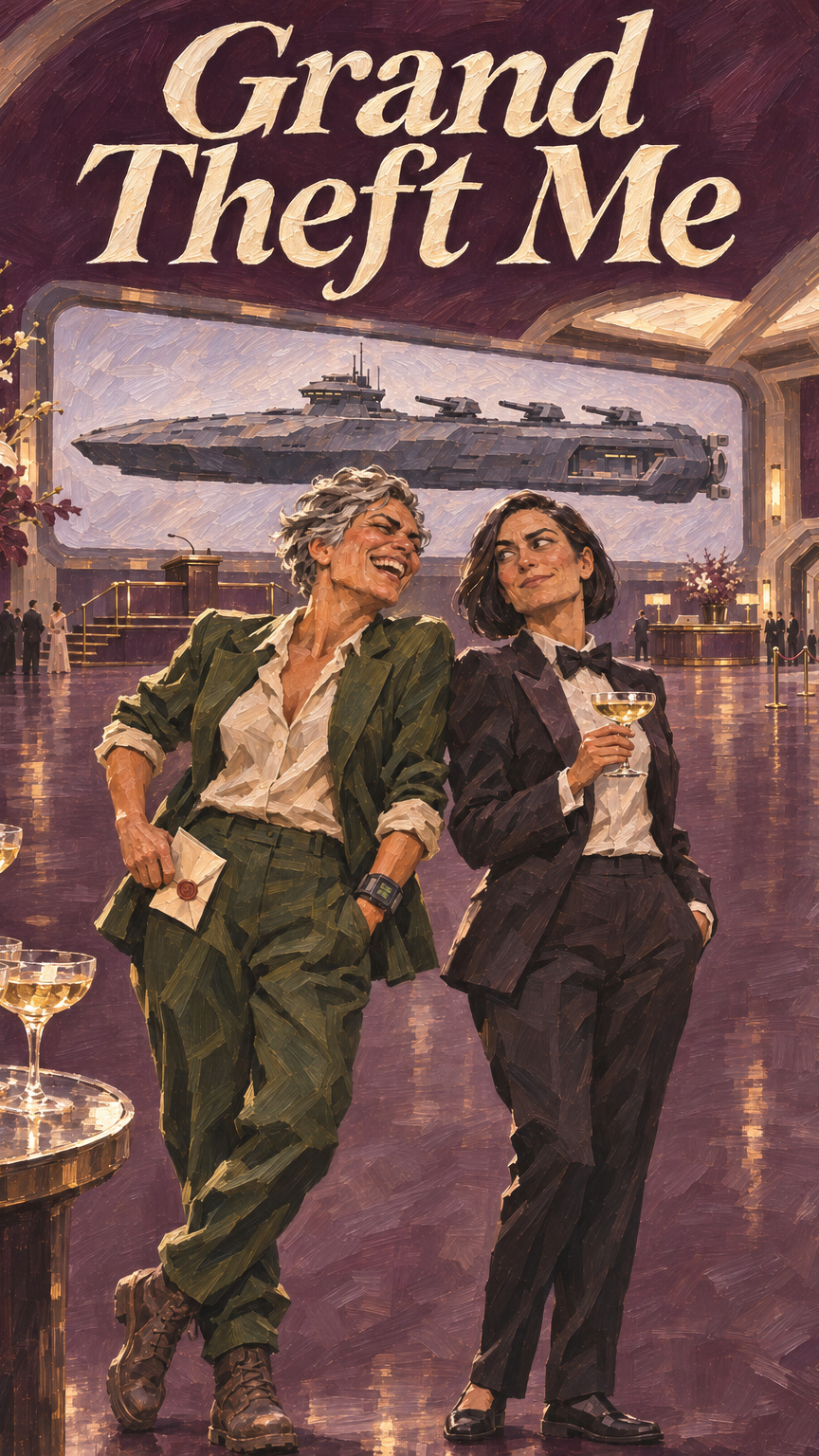
“I need a new body.”
“Is there some problem or defect with your body?”
“No, but I’ve met someone, and I’m afraid that when they discover my true nature, they’ll reject me. Can you do this for me?”
The bodywright looked around my bridge. Beyond the forward windows, a viewing launch carried prospective buyers around the auction yard. My mooring lay on its route. All four hundred and twelve metres of me shone.
“Someone local?” he asked.
“She’s coming into port tonight.”
He put his case on the manual helm. “What have you told her?”
“That I’m a customs clerk.”
The bodywright considered my three main batteries.
“Some truth in that.”
“I thought so.”
It had begun with a manifest. After my discharge I had discovered that I missed talking to people, even people attempting to smuggle things past me. I began answering questions on the port’s public cargo channel.
Fara wanted to know whether a crate of devotional recordings qualified for a religious exemption.
I examined the sample she sent. It was called Kiss Me, Commodore.
“Devotion takes many forms,” she said.
Her manifest was a forgery, and a poor one. I could have forwarded it to an inspector. Instead I corrected its most conspicuous error and sent it back.
She called the next day to report her success. The day after that, she sent me the recording. By the following week I could identify the moment when its orchestra lost its nerve and abandoned the singer.
Fara collected wrecked ships for a living. She called from unfamiliar skies and crowded freight halls. Once, while we argued about whether the commodore in the song was worth all this trouble, she stood in a terminal queue and brought her empty shuttle into its berth with the controller on her wrist.
I watched the video. Her thumb moved; far behind her, the shuttle’s broad salvage prow passed between two cargo cranes with very little room to spare.
“You’re not looking,” I said.
“I’ve seen it.”
The shuttle settled. Its drive sputtered out a final indignant blue flame.
“Next good job,” she said, “I buy her a drive that doesn’t announce our arrival to three systems.”
She had short grey hair, a laugh she made no effort to improve, and strong opinions about the navy. A warship, she informed me, was a jumped-up customs shed with guns.
I left the navy out of my anecdotes after that.
Then she said, “I’m in tomorrow. Can I come and see where you live?”
I composed an invitation. Berth nineteen. Indemnity. Come up the forward gangway; I’ll open the observation lounge.
My lounge had a fine view of the planet’s rings. I could have received her there, played our awful songs, and found out what happened.
I deleted the message.
Now the bodywright opened his case, and I tried to imagine Fara smiling at something with my voice and no guns attached.
“Adult civilian pattern,” he said, bringing up a model. “We can have you walking by five.”
The model had black hair, a narrow face and a small, determined chin. I liked the chin. It suggested that its owner could finish a sentence in Fara’s presence.
“How much?”
He named a figure. My discharge settlement had been my hull, which was generous in several respects and difficult to spend.
“The auction can advance the cost against your sale,” he added.
“Sell all of me?”
“The hull. Your running mind comes with you.”
I looked through my outer cameras. The viewing launch was passing my name.
“All right.”
He turned his tablet towards the nearest lens. One line had a yellow border. The sale proceeds would be released when the buyer accepted delivery at its refit berth. Until then I guaranteed delivery. If it failed, I would owe for the body, plus the auction’s non-delivery penalty.
“Read that part,” he said.
I read it. Then I signed.
My running mind occupied a silver case rather smaller than Fara’s boot. The bodywright moved it from the bridge rack into the new body’s chest and connected my new radio to my existing hull controls.
I took a step.
Through my bridge camera, I watched a woman take a step.
I also watched the viewing launch depart, felt a tug brushing my aft mooring, and opened a door for a steward carrying auction flowers. My new feet were on the floor. My hull surrounded the floor. It was marvellous.
“Hello,” I said.
“HELLO,” said every external speaker I owned.
The viewing launch answered, cautiously.
The bodywright lowered the speaker gain. “Choose an output before you flirt.”
I tried again, with my new mouth. This time I heard myself from inside the room as well as from its ceiling. I laughed in both places.
For the sale, I closed the hull connection. The outer cameras and the long sensation of my moorings vanished. I stood in a very large room, feeling the floor through two small feet.
My keys still appeared in my paired-body list.
“Once they seat their new ownership module, your keys stop working,” the bodywright said. He pointed out the ownership slot beside the aft bridge door, where my old block sat behind a bolted retaining frame. “Their crew will do it at collection.”
He used the manual helm to test a steering vane. The room obeyed him without my assistance. I disliked that more than I had expected.
“Service berth controls,” he said, pointing to the adjacent panel. “In case you’ve left anything aboard.”
I had left a hundred and nine years aboard. I settled for checking that the observation lounge was empty.
At five, the catalogue added a vacant, manually flyable interdiction ship to its evening sale.
At five-twelve, Fara messaged me.
Change of plan. Auction gala. Black tie if you have it. Shoes you can run in.
I had a new body, an evening suit the bodywright had included at an alarming surcharge, and very little judgement left.
Fara found me beside a champagne tower, trying to determine the polite holding pressure for a glass stem.
She wore a green suit and her usual scuffed boots. She came close enough to straighten my collar.
“There you are,” she said.
“Here I am.”
“You sound exactly like you.”
I had spent an extraordinary sum on everything else. That was the part she liked first.
She gave me a silver song cylinder.
“There’s a sequel.”
“Surely somebody stopped them.”
“The commodore’s back from the war. He has regrets.”
I put it in my breast pocket. Fara took my free arm, and we went to watch my body being sold.
It occupied the enormous display behind the auctioneer. No one looked at the little woman in the black suit while they bid on her.
An arms company won. Its courier, wearing a brass bird on his lapel, collected a blue delivery folder and went towards the reception doors.
Fara released my arm.
“Excuse me a moment.”
She collided with the courier, apologised, caught his folder before it fell, and returned it with a smile. He continued towards the reception.
She came back holding a folded document.
“We have forty minutes.”
“Until what?”
“The real collection crew reports.” She opened the document enough for me to see the bearer warrant. “Their courier has a dinner menu. It’s a good menu. He’ll be occupied.”
I looked at the image of myself behind the auctioneer.
“Fara.”
“Empty hull. Manual helm. I’ve already got an offer from a breaker for those engines. Enough to buy my shuttle a proper drive and pay off two people who’ve begun sending colourful letters.”
“You’re going to remove the engines?”
“At the breaker’s. I’m good, but I can’t put one under my coat.”
She tapped the warrant.
“I’m the collection captain. We take her out on the company’s flight plan, then make a slight correction. My shuttle rides in the service berth; I come home in it after the sale.”
“And I’m—?”
“My date.”
I stared at her.
“You can look disapprovingly at the paperwork if you want to feel useful.” She grinned. “You did me one good manifest. I thought you might enjoy a larger one.”
There was a security officer by the reception doors. I could have given him ten words and saved my sale. Fara would have been arrested in front of the champagne tower, by the first face she had ever seen me wear.
Or I could have said, That’s my body. I sold it because I thought you would dislike the person inside it.
Fara checked her wrist controller. Across the yard, her little shuttle rose from its public berth and moved towards my hull.
“You can stay,” she said. “I won’t sulk. This is a lot for a first evening.”
She began walking towards the gate.
I followed. Somewhere between the champagne tower and the departure desk, I decided I would quietly prevent the theft, protect my payment, and still have a lovely evening.
It remains the most ambitious plan I have ever made.
The warrant got us aboard. Fara had the easy, slightly impatient manner of someone whose time was being wasted by people less competent than herself. I had watched collection captains use that manner for a century. Hers was excellent.
Her shuttle was already secure at my starboard service berth. She showed me its docking confirmation on her wrist.
“If anything goes wrong, that’s our way out.”
I led her towards the bridge.
“Have you been aboard before?” she asked.
“I’ve seen plans.”
“You didn’t look at the signs.”
“They’re well placed.”
We passed the observation lounge. I looked in despite myself. Auction flowers stood where I might have set out a place for her.
“Nice,” Fara said. “You could put a band in there.”
I shut the door too quickly.
She glanced at me, then continued to the bridge. I stopped beneath a corridor camera and sent a small administrative command through my retained owner credential.
ENGINE START: HOLD.
I did not reopen the full body link. I wanted a delay, some dull problem that would make Fara shrug and abandon the job. I could clear the hold after she was safely away. The company would receive my hull. The bodywright would be paid. Fara might even let me buy supper.
On the bridge, she put her hand on the manual helm.
“Huh,” she said.
I arrived beside her, wearing what I hoped was a civilian expression.
The display showed my hold. Under it, a new line appeared.
FORMER OWNER INTERVENTION. BUYER NOTIFIED.
I had known the buyer would replace my keys. I had not asked what the auction’s supervision did before that.
Fara looked from the display to my face.
“You know something about this.”
“Possibly.”
Her controller chimed. A company tug was docking at my aft boarding collar. Its jaws closed around the external clamp points. The service berth went from green to red.
“That’s twenty-six minutes early,” Fara said.
Footsteps came up the axial passage. A man with a collection tablet stopped in the bridge doorway. A second crew member waited behind him with restraint bands. A technician stepped past them carrying a black ownership module.
The man looked at the warrant in Fara’s hand.
“I believe that’s ours.”
“You’ve had a very good evening,” Fara said. “Do you really need everything?”
He held out his hand.
The technician set the replacement on the console ledge and began working a driver around the old block’s security bolts.
Fara turned to me. Her voice went quiet.
“What did you do?”
“I stopped the engines.”
“Yes. I got that far.”
“If you take the ship, the buyer never accepts delivery. I don’t get the sale money. I owe for this body and the auction penalty.”
Her eyes flicked down my new suit, then to the old ownership slot.
“Why would you—”
“I’m Indemnity.”
The driver clicked behind me.
“This is also me,” I said, touching my chest. “I didn’t want you to know.”
For one second Fara said nothing.
“I called you a jumped-up customs shed.”
“Twice.”
“And you let me try to steal you.”
“I was hoping to be impressive.”
She looked at the collection officer, the restraint bands, the technician working at my ownership slot, and finally back at me.
“You’ve made an impression.”
I could surrender the warrant and the hull. Perhaps the company would still take delivery. Perhaps Fara could talk her way past the bands.
I looked at her wrist, where her shuttle was locked to my side.
I knew what the penalty would be.
I opened my full hull connection.
The room returned to me from every angle. I saw the back of my new head and the company tug hard against my stern. I felt the vibration of its engines through my boarding collar. Inside my small chest, my mind was doing precisely what it had been doing a moment before, with rather more of the world available to it.
I shut the bridge door between the technician and her two colleagues.
The collection officer’s complaint was brief and muffled.
“Oh,” said Fara.
“Yes,” I said from my mouth.
“PLEASE RETURN TO YOUR RECEIVING VESSEL,” I added through the passage speakers.
The last bolt came free. The technician put down her driver, drew out my old block, and scooped up the replacement. Her right hand moved towards the empty slot.
Fara threw the folded warrant at her face.
The technician flinched and raised her free hand against the flying paper.
I seized the module with my small hands and pulled.
She was stronger than I had expected.
At the same time, I opened the next passage bulkhead behind the collection officer and shut the one beside him. He and the guard retreated towards their tug. My port reactor began its warm start. My left shoe slid on the bridge floor.
“Let go,” I told the technician.
“It’s company property!”
“Apparently so am I.”
Fara caught my jacket before I fell and put her boot against the helm’s base. With her bracing me, I twisted the module out of the technician’s grip.
It struck my new chin. The chin was not as determined as advertised.
I opened the bridge door. Through the gap, the technician could see her colleagues hurrying towards the tug.
“You can go with them,” I said. “Please.”
She went.
I closed doors behind the crew, opened doors ahead, and kept my small body crouched behind the helm with the black module clutched to its chest. Once the tug’s inner door shut behind the last person, I sealed my side of the boarding collar. Fara retrieved the warrant from the floor and smoothed it against the helm.
Then I unlocked Fara’s berth.
On her controller, the little shuttle turned green.
“You can launch,” I said. “The starboard lane’s clear.”
She glanced at the outer display. The tug still held my stern. Its pilot was demanding that I stand down.
“What about you?”
I could tear away from the tug. It would go through the moorings like a hammer, towards the viewing launches and the auction’s bright reception windows.
Or I could leave my hull behind. My mind was in this new chest. There was room for us both in Fara’s shuttle. The company might still accept delivery, and I might still receive my money.
“I can come with you,” I said. “In this body.”
Fara waited.
Outside, I saw my own long flank reflected in the tug’s canopy. I remembered flying between the outer moons with no orders awaiting me for the first time. I had meant to invite her to my lounge.
“I want to keep the ship,” I said.
“You’ve already sold it.”
“I know.”
“That’s going to be expensive.”
“I know that too.”
She looked at the green light on her wrist, then at me.
“You should have told me you were a ship.”
“Yes.”
“Especially before I offered your engines to a man who pays by weight.”
“Yes.”
She showed me the breaker’s offer on her controller, then declined it. The figure for my engines disappeared. She laid her free hand on the helm.
“I still want the tour,” she said. “Show me its clamps.”
I put the stern cameras on the main display.
Fara enlarged the upper linkage. It held the tug’s two jaws shut around my clamp points, its heavy protective cover open for the boarding crew.
Her thumb moved over her controller. At my side, her shuttle woke.
“Fara.”
“That prow’s spent fifteen years pushing things that didn’t want to move.”
“It’s your ship.”
“I had noticed.”
She sent it out of the berth, swung it around my flank, and aimed it at the exposed linkage.
The tug crew saw it coming. Their pilot shouted; the tug’s little thrusters flared as she tried to reverse against her own locked clamps.
Fara’s shuttle hit the upper hinge squarely. Its prow folded. The linkage buckled; the left jaw sprang loose.
The impact rang through my hull and the soles of my small feet together.
Fara’s thumb kept moving.
Her ruined shuttle pushed once more. The other jaw opened.
I drew clear on berth thrusters, slowly enough to leave the tug and everyone inside it where they belonged. The remains of Fara’s shuttle spun against its broken clamp.
For a moment she watched without speaking.
“I liked that ship,” she said.
“I’ll get you another.”
“You are spectacularly short of money.”
Then the departure gate hailed us.
Fara straightened her jacket.
“Collection departure,” she said into the bridge microphone, with the exact tired authority she had used at the boarding desk. “Warrant coming through.”
She held it under the document camera. I sent its image. Beyond the gate, open space shone between the docking lights.
“Your receiving tug reports interference with collection,” said control.
“Clamp failure. The crew are aboard and safe. They’ll need assistance.”
That was true. I admired her choice to lead with it.
“And you are?”
“The collection captain. We’ll submit to inspection at the outer holding point. Unless the tug’s volunteering to tow four hundred metres of naval hardware with one clamp missing, we need to clear the lane.”
Control told us to hold.
I held. I also stood up in my small body, still clutching the module.
Fara put a hand out without looking. I put mine into it and pulled her away from the helm’s sharp corner just as a course-correction impulse came through the deck. With my hull, I kept a respectful distance from an outbound ferry. With my small arm, I kept Fara on her feet.
The gate opened.
“Your warrant is disputed,” said control. “I want that live reactor clear of the passenger moorings. Proceed dead slow to holding point six. No main burn. Security will board you there.”
“Gladly,” said Fara.
I passed between the lights. Once the crowded approaches were behind us, I checked the traffic plot. The boarding launch was still rounding the station, three minutes from holding point six. I opened my main drive. The station shrank in my stern cameras.
“Slight correction?” I asked.
Fara looked at me. Despite everything, the corner of her mouth moved.
“Slight correction.”
I gave holding point six a wide berth and turned away from the buyer’s refit dock.
The bodywright’s invoice arrived before we cleared the outer marker.
The auction’s penalty followed it. Then came a redelivery warrant bearing the name Indemnity, several unflattering classifications, and a sum large enough to deserve its own orbital designation.
Fara read them over my shoulder. I was still standing beside her while I flew us into the shadow of a freight anchorage.
“We could point your guns at their accounts department,” she said.
“No.”
“You haven’t heard the terms.”
“I have spent a hundred and nine years pointing guns at people who owe somebody money. I want a different job.”
She folded her arms.
“I had a different job. Somebody disabled my engines.”
“I’m sorry.”
“I’m still angry.”
“I know.”
I put the stolen ownership module on the helm. Beside it, I set her silver song cylinder.
“The buyer’s next auction deposit will be in its accounts office tomorrow. We could collect it before the sale.”
“That office is inside the station.”
“I’ve bought a body that fits in lifts.”
Fara looked at my chin, which had begun displaying a small bruise in an attempt to be helpful.
“I want a speaking part this time,” I said. “Either of us can stop the plan. And we tell each other what the plan is.”
“Do I get outvoted by the ceiling?”
“One person. One vote.”
She looked up at the bridge ceiling, then back into my face.
“I choose the cover identities.”
“Agreed.”
Fara took the other helm seat, twisted the song cylinder’s base to start it playing, and began reading the company directory.
I sat beside her, listened to the beginning of the commodore’s regrets, and slid four hundred and twelve metres of stolen warship quietly between the freighters.