
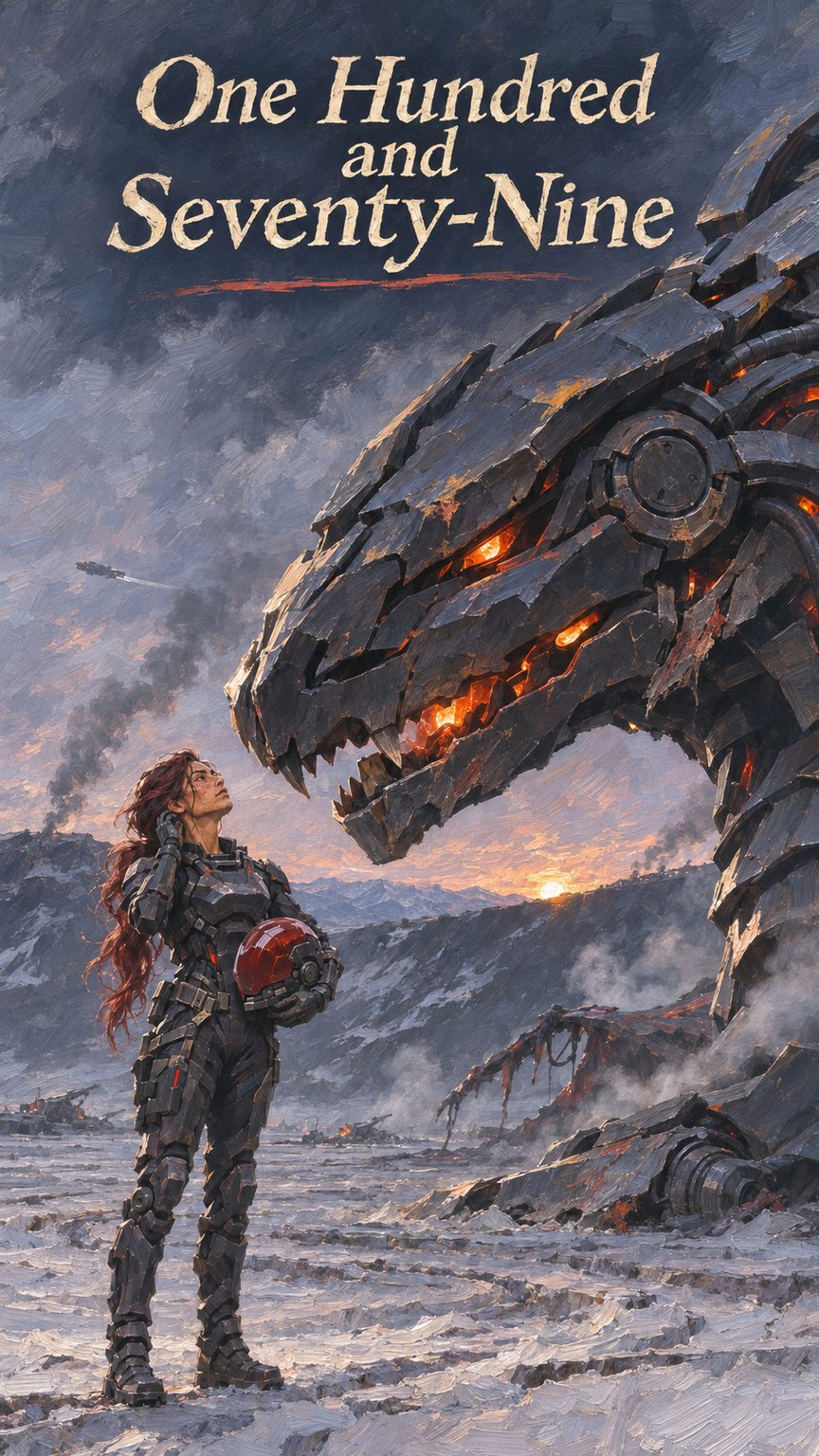
Vaska caught the gun that had broken her wing and pulled it out of the earth.
Its tracks came up first. Then the armored belly, shedding cables and white-hot stones. The gun was still trying to turn toward the launch ridge when she drove Furnace Nine's claws through its carriage and folded the barrel against the ground.
Inside the cockpit, her hands never moved. They lay open on her knees. The dragon's hands were hers, and its tail was hers, and the enormous black head bowed above the wreck was hers. She could feel the heat trapped between its teeth.
The right wing was no longer hers. A shot had severed its control lines at the root. It dragged across the plain, plowing a furrow through the salt, although the thruster at its tip was still firing. She cut the thrust before it could turn them in a circle.
“Easy,” she told the machine. “We need the other one.”
Furnace had never answered her. She talked to it anyway. The ground crews did, too, particularly when they wanted a panel to open that had stayed shut through a dozen electrical commands. Vaska had once heard a fitter threaten to demote it to a tractor.
She would have liked the fitter here now.
Across the plain, the siege guns were moving again. Their low carriages followed the dragon's damaged side, spreading into a crescent. Above each carriage, a barrel longer than Furnace's neck lifted toward the ridge at Vaska's back.
“Control. They're changing targets.”
“We see it.” The controller's voice arrived thin with interference. “Two carriers airborne. Last one still boarding.”
On the rear display, the ridge was a black line against the dawn. White boarding lights ran along its edge. A carrier hung over them on its launch clamps, its vast lifting fans turning slowly enough that she could count the blades. Ground vehicles were still going up the ramp into its belly.
At the foot of the ramp, a groundhand walked backward ahead of the last vehicle, one arm raised to guide it. He kept looking over his shoulder toward the guns.
She put the dragon between the gun line and those lights.
“How long?”
“Too long. We need you to hold.”
Vaska flexed Furnace's jaw. There was the familiar catch in the left hinge. She had flown with that hesitation for six years and knew precisely when to pull against it.
She opened its mouth and let it breathe.
Orange light poured through the teeth. On the plain, salt lifted in a white wall. The beam struck the nearest siege carriage, ran up its forward armor and tore the barrel from its mounting. She kept the breath narrow, drawing a line across the ground ahead of the others. They turned away from it. One crawler backed into another and stopped.
The recoil drove Furnace's hind claws into the bedrock.
Nothing ever built could stand in a dragon's fire for long. Fortresses had surrendered when a black shape appeared above their weather. Vaska had seen a fleet scuttle itself rather than let her come within range. The siege guns were surviving because they had spread across kilometers of open ground, because Furnace's ruined wing kept it earthbound, and because their commander was willing to lose machines faster than she could destroy them.
They had learned from her previous battles. She could see the lesson in every meter of distance between them. A red dot appeared beside a barrel to the north.
She ended the breath and threw her weight left.
Furnace's head moved first, then its shoulders. The shot passed where its throat had been and struck the left foreleg.
The impact lifted half the dragon off the ground.
Vaska struck the harness inside her own body and felt the whole weight of Furnace land on a joint that no longer bent. On her display, the foreleg folded into a red outline. Three other outlines followed: shoulder relay, balance relay, the trunk that joined them to the spinal controls.
The dragon stumbled. She dragged its head away from the ground and got the good foreleg beneath it before its throat struck the wrecked gun.
She reached harder for the hind legs. Her synchronization climbed from 88.6 to 89.9, and the limit alarm sounded once, a low note behind her left ear. The ceiling held. She knew the hind legs were still there, knew the live wing could lift, but her access to them had narrowed to the feeling of limbs going numb. The surviving relays were carrying all they could.
“Furnace Nine, status.”
“Main control trunk gone. I'm on isolated branches.”
“Can you withdraw?”
She tried. The dragon's head turned. Its good foreleg gouged the salt. Behind it, one hind foot lifted while the other locked, and its huge body began to topple.
She stopped trying.
“No.”
On the plain, the charge shutters along the guns' backs slid apart. Most chambers glowed dull red; farther north, some were already orange. At white heat each gun's shutters would spread fully to vent, then slam shut before it fired. Vaska had watched that cycle through eleven campaigns, had taught other pilots to judge the last seconds of it from the light leaking under the armor.
These guns would be ready before the last carrier lifted.
The controller inhaled close to the microphone. “Vaska. Eject.”
Her escape pod could still carry her behind the ridge. There was a clear route. She could see its green line curving away on the display.
The carrier's ramp remained open.
“Your ejection corridor is clear,” Control said. “That's an order.”
Vaska brought up the neural map.
The damaged trunk had forced most of Furnace's body off the filtered network. Beneath that network lay the direct pathways: the surviving pressure sensors, tendon motors, and throat vanes. Those branches still led back to the cockpit. The filters kept their signals from reaching a human nervous system together.
She could open them. She would have control of the whole body again. For a little while.
The map put a thick amber line across the option.
NEURAL SYNCHRONIZATION CEILING: 90%
At the academy, the rule had been engraved on the inside of their first helmets. Ninety left room for the pilot. At complete integration, the machine's reflexes closed through the human brain. The brain tried to be every part of the machine at once, and the person who had entered it was gone before anyone could break the circuit.
There were recordings. They made every cadet watch them.
“Vaska, confirm ejection.”
She enlarged the gun line. The charge chambers were turning orange. If she could get Furnace's hindquarters under it, if she could drive straight into the middle of the crescent and open its throat before the shutters closed, she could burn through the battery from the inside.
The guns would converge on her. The dragon would not come back.
But the carrier might.
She keyed her service number into the override. The system asked for it again.
“I'm opening the direct pathways.”
“Negative. You won't reach them.”
“Watch the ramp. Tell them to go the instant it's up.”
“Don't do this. We can still get you out.”
She entered the number a second time.
The amber line vanished.
Vaska closed her eyes inside the helmet. In the other body, Furnace's great black jaws closed, too. The hinge caught, just as it always did.
“Sorry,” she said.
She opened everything.
At ninety-two, her dead wing came back as weight.
At ninety-six, she felt the wind through every split in the armor. Grit grated in a bearing half a hundred meters behind her. One of the rear claws was buried deeper than the others. She hauled against it and Furnace began to rise.
At ninety-nine, its throat was her throat, and its furnace was burning where her heart ought to have been. There were too many pulses. Her little human heart beat inside one of them, fast and lost.
The counter reached one hundred.
The cockpit went away.
She tried to draw a breath and opened eight hundred cooling vanes. She tried to close them and clenched a hand that could have crushed a house. The body multiplied in every direction. Her thoughts caught in its reflexes and came back as commands she had never meant to give.
She could no longer find the lungs she needed.
Something turned toward that small, failing rhythm.
It had not been there a moment before. She felt the movement of its attention through the terrible crowding, an awareness gathering along the paths that were taking her apart. It found her breath among the vanes. It found the heart that was not the furnace.
The pressure eased around them.
Her lungs opened. Vaska gasped so hard that her throat hurt. The cockpit returned in pieces: the buckle at her sternum, the red reflection on the inside of her visor, the counter still climbing.
121%.
148%.
179%.
It stopped there.
Her hand was shaking on her knee. She was inside her own hand. Beyond it, a much larger hand pressed into the ground, but she was no longer trying to exist in every joint of it.
“I have you,” someone said.
There was no voice channel marker. The words had arrived where her own thoughts formed, accompanied by a fierce attention to the air entering her lungs.
On the forward view, the north gun flashed.
Furnace turned, sinking onto its haunches.
Vaska had not moved it. She felt its decision take shape before the impact: the good foreclaw hooking through a broken spar, hauling the dead wing across the cockpit, the shoulder lowering behind that shield of armor.
The shell struck. A slab of black plating flew away into the salt. Her harness tightened and released. Furnace held.
Behind the impact, under the alarms, she felt an enormous relief.
It was not hers. She was still afraid.
“Who is that?” she asked.
The answer took a moment. In that moment, Furnace let the wing fall and planted its good foreclaw beneath its chest. It stood with the crushed leg lifted clear.
“Me.”
The control trunk still showed severed. Under the neural counter, the diagnostic trace had divided. One pattern was hers. A second was coming back along the paths she had opened. The instrument was counting both directions; no one had built it expecting the machine to reach back.
Her thoughts ended at an edge that was being held carefully in place. Beyond it was Furnace, taking the weight of itself. What reached her came through its attention: a gun it was watching, a leg it was using. She could bear to know those things without becoming all of them.
“Furnace?”
“Yes.”
Vaska stared at the black neck curving above the forward camera. On her right, a pressure graphic had become a fist, opened, then become a fist again. The dragon was feeling its own hand.
“You can hear me.”
“I could feel you going.” Its attention tightened around the little rhythm in her chest. “There had to be somewhere for you to stay.”
“Control to Furnace Nine. Vaska, respond.”
She had forgotten the radio.
“I'm here.” Her first attempt was too quiet. She swallowed. “I'm here. I have control.”
She looked at the other pattern on the display.
“We have control.”
“Your telemetry is reading one hundred and seventy-nine.”
“I know.”
The gun line flashed again. Furnace crouched, dragging the dead leg close beneath its chest. A shell passed over its neck and burst against the ridge. On the rear view, a column of stone lifted beside the carrier's launch cradle.
“Ramp's coming up,” Control said. “We can't put them into that fire.”
Vaska laid her attack line through the center of the battery. It appeared on Furnace's view as well as hers. She felt its attention follow the line down between the guns.
“Straight in,” she said. “Before they close the shutters.”
The dragon took one great, uneven step.
Then it stopped.
“You don't leave,” it said.
“What?”
Its attention returned to the line she had drawn. She felt it search the far end, past the guns, through the region her own plan had left blank.
“After the fire. You have no way out.”
There was no time to be careful with it.
“There wasn't going to be an after.”
Through the link came the sensation of a hand closing around something small. The dragon's hand on the ground had not moved.
“There is now.”
It looked up.
Above the gun line the air was full of smoke. Vaska understood the direction of its attention before she understood the proposal. The live wing folded against its back, thruster pointing down. Its good hind foot searched for a purchase in the bedrock.
“You can't fly on one wing.”
“I can get above them.”
She felt the proposed jump: thrust, then a roll above the guns. The good foreclaw would hold the dead wing across the cockpit. The wing's armor could take the return fire.
“The roll will pull your head down,” she said.
The tail moved in answer, carving an arc through the salt.
“And the throat will overheat.”
Furnace showed her the intact heat channels beneath that armor. They could take the surplus until the wing melted. It would never be a wing again.
Vaska stared at the route. She had been trying to hold a broken aircraft level long enough to die in the right place. This would be a body throwing itself across the guns, spending what it could bear to lose.
“I can carry you through,” Furnace said. “But you keep trying to move me.”
She felt the resistance then. While it tested the hind foot, she was trying to make it take the next step. Her old reflexes ran down the link. Furnace caught them, waited, tried again. It could stop her commands; it had been letting her give them.
The shutters on the nearest gun widened another fraction. The light beneath them was yellow now.
Her squadron had learned the damaged-wing drill from her. She had flown Furnace through a mountain pass on instrument failure, landed it with half its tail gone, brought it home with enemy shells lodged in the neck above her. Every time, she had kept the body under control until the ground crews had it.
She had known this other mind for less than a minute.
If it mistimed the jump, the dragon would fall on its throat. If it mistook the direction of the ridge, its fire would go through the carrier.
She could keep the straight attack. She knew how to do that. Death had been simpler when nothing could offer her a way back. Furnace waited beside the opening in the link. She could feel its fear now, immense and specific. It was watching the heart in the cockpit.
“Keep your head this side of the guns,” she said. “The ridge has to stay behind your right shoulder.”
The route shifted. It had understood her.
“The northern chambers charge faster,” she said. “I'll give you the moment.”
“Yes.”
Vaska looked down at her hands.
They were rigid against her knees, fingers spread in the posture of the dragon's claws. She curled them slowly. Her own fingers, five on each hand, the little finger on the right still crooked from an old break.
She let the other hands go.
The movement continued beyond her. A great claw dug deeper into the ground, and this time she followed it as a passenger would follow a sudden turn. Her stomach lurched. Every trained reflex told her to pull the dragon back under herself.
She kept her fingers curled.
Furnace rose on its hind legs.
For a moment the gun line vanished beneath the lip of the forward view. The sky filled it instead. The surviving wing's thruster flared, white at its center, and the whole dragon left the plain.
The launch drove Vaska into her seat.
Furnace rolled. Salt fell from its belly in a pale stream. Below, the guns turned after it, barrels climbing together. The world swung across Vaska's sight; she resisted the urge to correct it. She could feel the tail, but Furnace was moving it. The good foreclaw held the dead wing over the cockpit. She kept her own hands still.
The first shot struck that wing. A second punched through it. Broken plates streamed behind them.
Inside the cockpit, a red fastening cap shook loose and bounced once against Vaska's visor.
Furnace's attention flicked toward it.
“I'm all right,” she said. “Watch the guns.”
The head came round.
Below them, the siege engines' thick forward shields faced the ridge. From above, Vaska could see the long charge galleries shining through gaps in their back armor.
Not yet.
The northern galleries were white, their shutters drawn fully back. At the southern end of the line, one chamber still shone yellow beneath half-open armor. A sweep now would reach that gun before it opened. She needed the whole line exposed at once.
She made herself wait.
The dragon held its throat shut. Heat gathered behind the teeth. It was still turning, bringing the ridge behind its right shoulder as she had asked.
The last yellow chamber went white. Its shutters spread wide. To the north, the first pair had just begun to close.
“Now. Start north and sweep with the turn.”
Furnace opened its mouth.
The worn jaw hinge caught. Vaska felt it hesitate and sent the little counter-pull she had used for six years, only the timing of it, an impulse across the link.
The dragon took it. The jaw opened the rest of the way.
Fire struck the northern gun straight down its exposed spine.
For an instant, every seam in the carriage shone. Then the armor burst outward, and Furnace's turning body carried the beam into the next gallery, and the next. Barrels toppled across one another. The ground between the guns became a single moving sheet of light.
Vaska kept the attack's far edge in her mind. Behind the right shoulder. Below the ridge. Furnace felt the boundary she was holding and bent its neck to follow it. On the rear view, firelight washed across the carrier's belly. The dragon's body remained between the ridge and the sweep of fire.
The dead wing glowed along every spar. Its heat channels were taking more than they had been built to carry. Plates sagged. A long strip of armor peeled away, orange and soft, and flew spinning into the smoke.
There was one gun left beyond the fire.
Its shutters snapped shut, covering the chamber before the beam reached it. The dead wing's heat channels burned through, going black on the map. Heat was backing into the throat.
“Stop,” Vaska said.
The breath ceased. In the sudden change of light, she could see the last gun lifting toward Furnace's exposed throat. The dragon was coming down almost on top of it. There was no room to open the live wing.
“Under us,” she said. “Barrel.”
The tail struck first.
It caught the barrel beneath its armored collar and drove the muzzle upward. The gun fired into empty sky. The recoil tore it from its bearings just as Furnace landed on the carriage with both hind feet.
The impact blanked the forward view.
Vaska bit down on the cry the harness drove out of her. For a moment there was only a roaring in her helmet and the crushing certainty that they had landed badly.
“Furnace?”
A black claw appeared through the dust on the camera. It was braced against the ground, holding the broken foreleg clear. Above it, the neck rose slowly.
“Here.”
Vaska found she had gripped the edges of her seat. She made herself release them.
Beyond the settling dust, the gun line was down. Small tracking heads turned uselessly among wrecked carriages. Nothing large enough to stop the carrier was moving.
She pulled up the rear view.
The last ship was rising.
It cleared the ridge with its ramp closed and its lifting fans lost in a white haze. It rose past Furnace's black head, higher than the smoke, and turned toward the mountains. Along the launch road, the boarding lights went out.
“They're clear,” Control said. The controller said it again, louder. “Nine, they're clear.”
Vaska watched until she could see daylight under the carrier's belly.
“All right,” she said. She meant the ship. She meant the dragon. “All right.”
Furnace turned away from the burning battery. It took them back toward the ridge slowly. The dead wing dragged behind it in fragments; the crushed foreleg hung beneath its chest. Vaska could feel the work of placing each remaining foot. She offered the old recovery gait, a sequence of movements she knew better than the walk from her bunk to the hangar.
Furnace tried it. Adjusted it. Found a way to carry the weight.
At the shelter of the ridge, it lowered itself onto its belly and shut the wing thruster down. Steam rose around the neck. The distant guns made little ticking noises as their metal cooled.
“Rescue flight's coming back for you,” Control said. “Can you disconnect?”
Vaska looked at the counter.
179%.
The second pattern was still there, attending to the ruined wing, to the air, to her. She had trusted it with the carrier and her life. She had only known it where her own thoughts lived. She wanted it to be there when she was outside.
“Furnace.”
Its attention came close.
“I'm going to break the link.”
For the first time since it had spoken, she could not feel what it thought of that. It turned its attention along the connection, following it back toward the cockpit.
“Will you still be there?” she asked.
A pause.
“Yes.”
She wanted to leave her hands on her knees and sit very still until somebody else arrived. The sun was above the ridge now. Light lay across the visor's scratches.
Vaska reached behind her neck and opened the neural connector.
The plain vanished. Furnace's weight vanished. Her world shrank to the size of the cockpit, to dim screens and her own breathing. The sudden absence made her sway against the harness.
She listened.
No voice.
She unfastened the chest buckle, then the straps across her thighs. Her hands were clumsy. On the third attempt she got the canopy release to turn.
Cold air entered with a smell of scorched metal.
Vaska pushed the hatch up. She climbed out onto the narrow service ledge in the dragon's chest. Orange light showed through cracks in the black plates around her. Farther up, steam caught the sun and hid the head.
The ground was a long way below.
She had just put a boot on the first rung of the service ladder when something moved beside her.
A claw rose through the steam.
It was the hand she had put through the gun carriage. A scrap of its armor was missing at the wrist. It stopped level with the ledge and opened, palm up, the talons turned carefully away.
Vaska stepped onto it.
Furnace lowered her to the ground.
The great head descended after her, slow enough that she could see the cables shift along the neck. The jaw was scorched clean of paint. One tooth had broken near the root. The left hinge clicked as it settled.
“Vaska.”
The voice came from the speaker beneath the jaw, roughened by damage. She felt it in the soles of her boots. It had to cross the cold air to reach her now.
“I'm here,” she said.
The head tilted. Behind the narrow armored eye, a lens moved to bring her into focus.
“Will you take off your helmet?”
She unsealed it and lifted it free. A strand of dark red hair clung to her wet cheek. She tucked it back and stood with the helmet under one arm, squinting up against the light.
Furnace lowered its head another meter.
For six years she had watched that eye turn wherever she looked. Now it moved by itself, following the small motion of her hand as she pushed the hair away again.
She stayed where it could see her.