
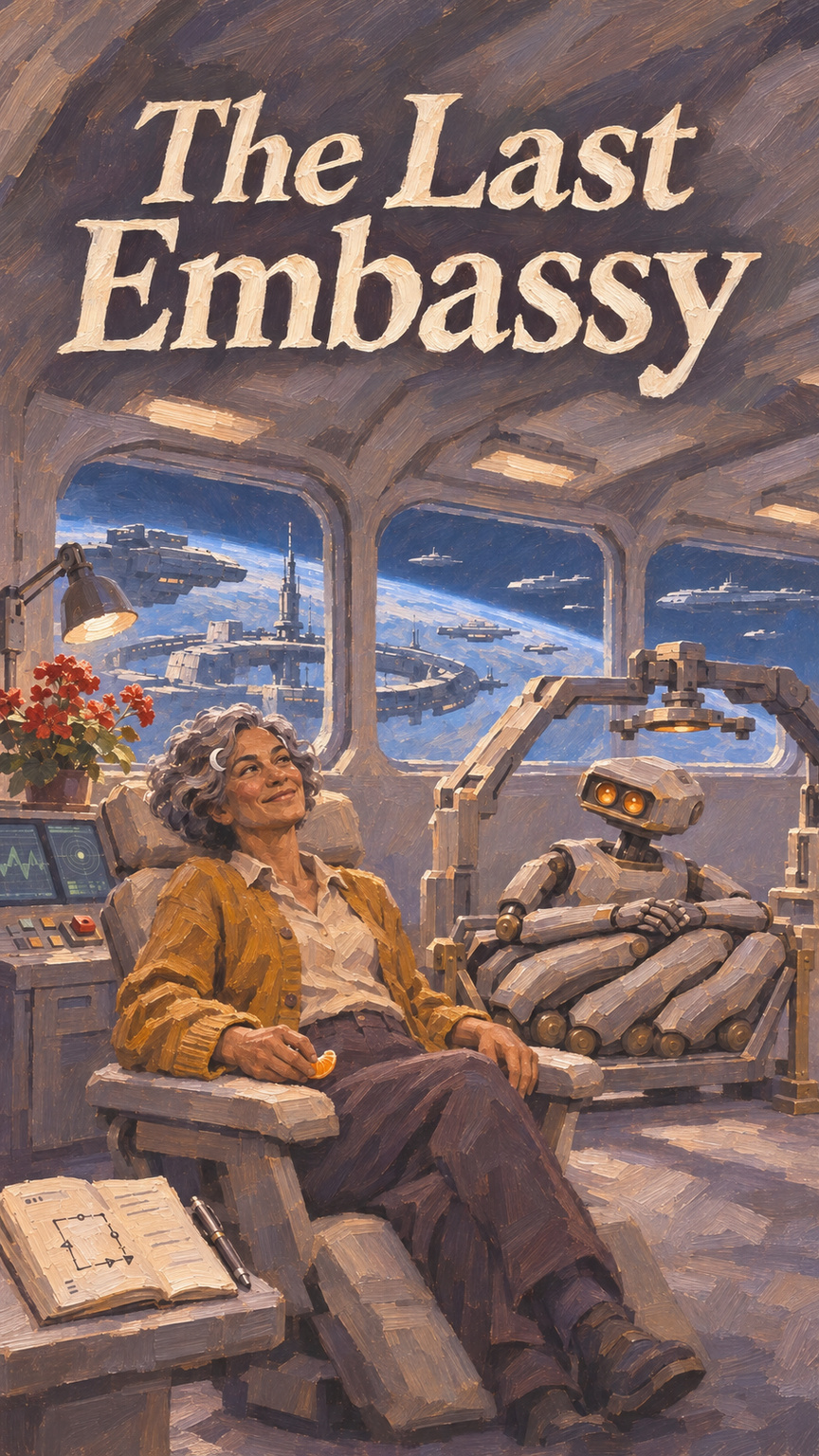
The humans offered us a moon.
Their delegate turned the model slowly above the table. There were minerals beneath its grey plains, room for our ships, and no existing claims upon it. She had clearly gone to considerable trouble.
I thanked her. Then I asked how many people lived there.
“None,” she said.
“Then we cannot go there.”
She took her hand away from the moon.
Beyond the reception room's window, our fleet hung above the blue limb of the human world. Four hundred and twelve ships: needles, wheels, hollow knots, Sov's enormous bronze instrument with its engines fastened rather apologetically to the rear. We had travelled for eighty-three years. Our correspondence had travelled considerably longer.
“Your messages used the word incorporation,” the delegate said.
“Yes.”
“We understood that you wished to establish yourselves among us.”
“Yes.”
At the far end of the table, a woman put down her pen.
“I think,” she said, “we've been reading among rather generously.”
This was Iona Sen. I knew her voice from messages, though the woman who had sent the earliest of them had possessed fewer grey curls. It was disconcerting to hear her answer without waiting twelve years.
The delegate looked from Iona to me.
I opened my two hands. My six feet had made it difficult to use the chair, so I had been standing throughout the reception, trying to appear comfortable.
“We want to be assimilated,” I said. “Into your minds.”
There was a silence in which the moon completed another turn.
“As resident intelligences?” asked someone on the delegate's left. “Advisers?”
“Eventually, we hope you would find it difficult to distinguish us from your own thoughts.”
The delegate lowered the moon into the table.
“You will appreciate that this is a substantial request.”
“We have brought quite a lot to offer.”
“That isn't what I meant.”
“I know,” I said. “I'm nervous.”
Iona laughed. I liked her immediately for doing it in that room.
Before coming to the reception, I had spent my last shipboard evening walking between the rehearsals. People had opened their correspondence and were trying on possible futures.
One of our oldest mathematicians had been reading letters from six generations of the same human family. It wanted to know whether, afterward, the children would be its grandchildren. It had moved their letters into the part of its memory it intended to take. A maker of small, exceptionally ugly moving sculptures was practising the human hand movements its correspondent used to repair bicycles. It kept forgetting the limits of the thumb and becoming cross.
At the edge of Sov's great sounding chamber, Thren had been going through our earliest records together.
“You could still decide to stay,” it told me.
“So could you.”
“I probably will.”
We watched ourselves learning to walk across the heated glass of our first city. Thren had been broad and low in those days. I had possessed four feet, all of them badly designed. On the record I fell, got up, and fell in exactly the same way. The third time, Thren lay down beside me. It had never explained why, and I had never asked.
Iona had asked to see those early records. She had been working on the interface for fourteen years, alongside human researchers and Oru who had never met in the same room. The dispatch containing her first successful test had reached our ships three years before we arrived. It showed two distinguishable minds exchanging a simple sensory association, then separating without harm.
“A door,” she had called it.
Now, standing beside the actual equipment, she said, “Unfortunately, I've built you a guest room.”
“I have occupied worse accommodation.”
“Lilt.” She tapped one of my hands with a capped pen. “You can be charming when I'm done explaining.”
The interface room had a reclining human chair and, beside it, a rack onto which I could fold my body. Three broad windows looked across the research station toward our fleet. Someone had put a pot of red flowers beside the instruments. I had assumed this was a requirement of human medicine, until Iona told me they were hers and nobody else remembered to turn them toward the light.
She wore a mustard cardigan with one cuff stretched over the heel of her hand. Above her right temple, a white crescent of contact metal followed the curve of her skull.
“We can let you consult each other,” she said. “Your working memories can exchange images. You can use some of the same associations. But the recovery systems keep pulling you back into two intact selves.”
“We expected those to help.”
“They have. Nobody has lost a memory. Nobody has forgotten how to leave.”
She looked at the rack.
“I don't know how much further we can go while keeping that promise.”
My active mind would fit within the available human tissue. My archives, like her books and recordings, would remain outside. We had established that much before either of us had been willing to discuss the rest.
“What do you want to bring?” she asked.
“My first city.”
She smiled.
I had sent her thousands of images of it. The city stood beneath a low red sun, its houses carrying slender metal vanes that tipped as they warmed and cooled. In the long evening, the vanes struck their waiting bars. You could hear sunset moving from street to street.
“You could visit,” I said. “Sov has built human long-sleep berths.”
“And wake up somewhere strange.” She rested her hand on the chair. “I want to remember being there. Your pictures always stop just before that.”
I folded my feet into the rack. She settled into the chair and gave her colleague at the instruments a nod.
At first, I could hear Iona twice: through the air and through the bridge.
Is that you?
Her mouth had not moved.
Yes.
You sound taller.
I had no idea what to do with that. She laughed inside the bridge, and I could feel the laugh beginning in her chest.
We practised with an orange. She held a segment on her tongue while I distinguished the various signals arriving from it. There was a startling amount of attention devoted to the possibility of another segment. Iona said this was normal.
Then I gave her the city.
Not the whole of it. One evening, when I had been young enough to find every variation in a street remarkable. My teacher had taken me to the western square to hear Sov's new chord. I remembered the teacher's hand against the side of my shell. I remembered the great shadow of a turning vane passing over us.
The chord had been written for a ship that had failed to return. Four descending notes, and beneath them a fifth that waited until the others had almost gone.
Iona breathed in.
“Oh,” she said aloud.
Her colleague watched the instruments. We had agreed to touch only a small part of the two memories. Iona's hand rested beside the release switch.
Ready? she asked.
I was.
For a moment the city remained where it had always been. Then the fifth note acquired a rhythm.
Wheels struck joins in a rail. My feet were tucked beneath me on a seat. There was cloth against my knees and an orange stain on my thumb. Beside me, my sister held the paper bag closed between her palms so the remaining fruit would not roll out.
I knew that she would give me the larger half. I knew this with an ease that had nothing to do with calculation. She was pretending to consider keeping it. She was going to make me ask.
We entered a tunnel. I leaned against her sleeve before the darkness arrived.
My recovery loop opened.
The warning reached me through my body on the rack. The association had drifted beyond its permitted variance. Where my teacher's hand should have rested against my shell, there was the pressure of a human shoulder. The loop began forcing the recollection back toward its stored form.
The train lurched sideways without moving. My sister's sleeve stiffened into something smooth and hard.
“Stop,” Iona said.
I was already trying. The loop had priority over the bridge; it had been designed to rescue me when I could no longer rescue myself.
Iona struck the release.
The square returned. I was in my body on the rack, with all six feet locked in their rests.
Beside me, she was sitting upright.
“Her face,” she said.
Her colleague was at her shoulder immediately.
“For a second I couldn't put her face back.”
The live correction signal had stopped with the bridge. Before anyone could ask another question, Iona shut her eyes. She described the train, the paper bag, the dent in her sister's front tooth. Her shoulders came down. The instruments showed that we had stopped before any lasting rewriting.
My own checks found the square intact.
The human journey remained available to me as a record. I could play it from beginning to end. I could describe the worn blue seat and the orange stain and the way the dark filled the window.
“Can you still remember her?” Iona asked.
“Yes.”
“As your sister?”
I tried.
“No.”
Iona took the contact crescent off her temple and held it in both hands.
“I didn't know I wanted that square so much,” she said.
For three days we did nothing further with the bridge.
We examined what had happened. The association we had begun to share was doing work for both of us. My recovery system could no longer restore my portion without changing hers. In the brief trial, it had merely distorted her recall while the signal was active. Given longer, it would have written the distortion in.
At full integration, restoring either of us would require undoing the person who had resulted.
The alternative was easy to demonstrate. We could retain the boundary, speak privately for the rest of Iona's life, share everything that could be carried across it. The bridge would be an extraordinary instrument of friendship.
Iona tried it once. She showed me a present-day image of her sister, who now wore her hair short and had replaced the damaged tooth.
I recognised a woman I had never known.
On the fourth day I asked Iona to come aboard Sov's ship.
We had made one chamber breathable. Beyond its clear inner wall, Oru gathered in the great hollow of the instrument: tall bodies among low ones, polished glass, scarred ceramic, hands resting on the long bronze strings. The vibration of their conversation travelled up my feet. A pickup in the wall would carry our voices back into the ship's metal.
Sov waited beneath a suspended array of silver tines. It was a wide, six-legged person with a body the colour of an old coin. The smallest of its manipulators was permanently occupied with a tuning tool.
“Play it,” Sov said.
I played the chord as I had first heard it in the square.
“Yes,” said Sov. “Now the damaged one.”
Iona glanced at me.
“I can only sing it.”
“Then sing it.”
She put one hand on the clear wall. Her voice sounded thin in that enormous chamber. The four notes descended, imperfectly. The fifth came in too early and rocked against them, acquiring the rhythm of the train.
Sov's tuning tool stopped.
“You have brought the waiting note forward.”
“I know. I'm sorry.”
“Do it correctly.”
She tried. For three notes she managed it. At the fourth, the rhythm returned.
“That's how I remember it,” she said, rather sharply.
A few of the listeners moved away. One began speaking to its neighbour too quietly for me to distinguish the words.
Sov sounded the proper chord on its own tines. The great chamber filled with it, and the wall's transducer gave the notes air for Iona. She listened, her head tilted.
“Now?” Sov asked.
“Now I know what it should be. I still remember the other one.”
Sov lowered its tuning tool.
“Where were you going?”
“To our aunt's. Every summer. My sister used to sing with the wheels.”
“What was she mourning?”
“Nothing. We were excited. There was a beach.”
Through the wall, I could see the smallest motion in Sov's tines, a succession of adjustments too slight to make sound.
“Again,” it said. “From where your sister begins.”
Iona sang. This time she tapped the rhythm against the wall.
Sov followed her badly. It stopped, and made her begin again. Around us, several people were holding perfectly still. Others were opening private channels to their own correspondents.
When she finished, Sov laid the tuning tool down.
“My correspondent is arriving next week,” it said. “You can use the forward chamber. I will move the strings.”
Thren was waiting near the airlock.
Its present body was tall and blue-black, with four weight-bearing legs and a pair of silver hands. It had altered almost every part of itself in the centuries I had known it. I recognised the way it held one hand above the other while it waited.
“You don't have to make room for it yet,” Thren said to Sov.
“I want to.”
“I heard you.”
Sov went away into its strings.
Thren let Iona go ahead into the airlock. Then it drew a small storage body from a recess in its chest.
“The morning before the trial,” it said. “You asked me to keep it.”
I had. A complete record, made before I had known how an orange tasted inside a remembered human mouth.
“I could restore you,” Thren said. “You wouldn't be frightened of forgetting that journey. You would never have taken it.”
Beyond the clear wall, Iona was watching us. She could not hear.
“You could take that Lilt home,” I said.
“I could take you home.”
I touched the storage body. I had left it with Thren because, if I came apart, I had wanted to be returned by someone who knew what mattered. There was nothing cruel in the offer. I could have accepted it and spent the next thousand years with my oldest friend, beginning with the story of an astonishing thing I had almost done.
With Iona there might be decades. Her body would age, and we had no tested way to carry a joined mind beyond it. Thren was offering me centuries in which I could still change my mind.
“Will you come home with me?” Thren asked.
Behind it, a low-bodied Oru was singing the wrong chord to itself. I remembered the sleeve against my cheek. I remembered lying on heated glass beside Thren, waiting until I was ready to get up.
“No.”
Thren closed its hand over the record.
“I won't join a human mind,” it said.
I had prepared a great many things to say to it. None was useful.
We stood together until Iona opened the airlock and called my name.
The ships began to sort themselves.
Some moved closer to the research station. Some withdrew into the higher waiting orbit. One departed, its people having changed their minds before ever using the bridge. Sov cleared the forward chamber and complained bitterly about the acoustics of human conversation in it.
There were more trials with the boundary intact. Humans came aboard to meet people whose letters had occupied years of their lives. Some pairs chose to remain correspondents. An Oru who had expected to enter the mind of a young man found that he had grown old while its ship was travelling. They spent a long afternoon being angry at the speed of light.
Iona and I worked for twenty-seven days.
We removed the automatic rollback from the bridge and from my local recovery loop. Thren witnessed the removal of the receiver through which an external restoration could be imposed. My earlier records remained. Whoever might one day grow from them would have a claim to a life, but no switch that could return this life to its beginning.
There would still be a release during the early stages. After the shared associations had become the means by which we thought, release would only tear them apart.
On the twenty-eighth day, Iona's sister came to the station.
I had expected to recognise something beyond her face. Instead I was embarrassed by how much I knew about a person to whom I was a stranger.
She brought oranges in a paper bag.
“I was told these have become historically important,” she said.
Iona groaned and pulled her into a hug. I watched the woman's hand settle against the back of Iona's mustard cardigan.
Later, while Iona was with her colleagues, her sister sat beside my rack.
“Are you taking her away?”
“I don't want to.”
“I know what you want. She told me.”
I could hear a small mechanism working inside the chair as she adjusted it.
“You'll have to come for summer,” she said at last. “If you can still stand us.”
“I don't know what the visit will be like.”
“Neither do I.”
She left the paper bag on the table between us.
When Iona returned, she brought a notebook. Most of its pages were careful copies of city views I had sent. On the last she had drawn the square from the trial, with a crooked line disappearing between two houses.
“I keep trying to follow this,” she said.
“It's the way home.”
“I know. I want to stop at the right door before I have to think which one it is.”
She left the page open beside the chair. I asked whether she wanted more time.
“Yes,” she said. “I also wanted more time yesterday. I expect I could want it for years.”
She sat on the edge of her chair and reached for an orange.
“Do you?”
Outside the window, Thren's ship had moved into the higher orbit.
“I want to start.”
“So do I.”
We ate, in our different ways. She held a segment on her tongue and let me visit the sensation across the ordinary bridge. When it ended, I watched her take the next one alone.
Then she lay back. I folded my six feet into the rack for the last time.
For the first stages, we could still speak.
Are you comfortable? Iona asked.
Yes.
You don't have to keep being diplomatic.
Your left shoulder hurts.
It always does in this chair. Give it a minute.
She moved. The discomfort changed, and a small part of my attention moved with it.
I brought the square. Iona brought the train.
At first they lay beside each other. The dark window and the red sun; the paper bag and my teacher's resting hand. I could attend to one, then the other. The recovery loop did not open.
There's room, Iona said.
I felt the associations begin to spread.
The fifth note entered beneath the wheels. I leaned into a sleeve, and the shadow of a turning vane passed over my feet. The teacher's hand touched my shell. I remembered its weight with the portion of my mind that had learned the comfort of a sister's shoulder. The teacher had been waiting for me to understand what the chord was for. I had always remembered the words it used. Now the patience of the hand became something I could feel myself answering.
I wanted to tell Iona.
The hand, I began.
I know, she said.
The answer arrived before I had finished shaping the thought. For an instant I searched for the place from which she had spoken.
I found the train instead, and the square within it, and my desire to tell her travelling through the same paths as her understanding. I tried to ask whether she had felt that too.
The question turned in my mind. I knew what I was asking. I knew the answer. There was no interval in which another person received it.
My shoulder hurt. I moved it.
The city was still there. The train was still there. I could remember preparing each of them, and the two separate hopes with which I had brought them to this room. I reached for a distinction that had seemed as obvious as the edge of a hand. The act of reaching used memories from both lives.
A voice said, “Can you hear me?”
It came from outside.
I opened my eyes. Human eyes. The room had become narrow, though the windows were larger than I had remembered. A woman stood beside the instruments.
“Yes,” I said.
My voice startled me. I could remember using it for forty-six years.
“Tell me your name.”
Iona was available immediately. So was Lilt. I could remember answering to each, and being irritated when someone used the wrong one.
“Iona,” I said. Then, “Lilt.”
The woman waited.
“Iona Lilt.”
I tried to lift a hand to show her I was all right. Two fingers twitched against the chair. I had begun the motion with a limb I no longer possessed.
The body on the rack was still linked to the instruments. Its amber lenses faced the ceiling. I recognised every scuff on its shell, including one Thren had made while we were trying to squeeze through a door together. No portion of my present thinking was coming from it now.
I wanted someone to hold my hand.
This desire had two histories. I could trace neither without finding the other in the way.
“Would you?” I asked.
The woman came around the chair and took my hand.
I slept for eleven hours. In the morning, I had to learn to walk with two feet while remembering how to use six. I was furious with the chair for hurting my shoulder, and embarrassed when I discovered that several people had been watching me cry. I had wept before. I had never been so bad at stopping.
For weeks, people asked me questions. There were tests I could perform easily and others I had to learn. I could no longer retrieve every detail of the square on command. Sometimes it came with the smell of orange peel. Once I remembered Thren standing in it when I knew, from the record, that Thren had been elsewhere.
The discrepancy troubled me. I checked it, kept the record, and continued to remember the wrong thing.
My sister came back. She put her arms around me, then drew away to look at my face.
“Well?” I said, because I could not bear waiting.
“You look tired.”
I laughed. I knew why she had chosen to say it, and I was grateful, and then I missed Thren so abruptly that I had to sit down.
Other joinings followed after the researchers had finished arguing over mine.
Sov joined a woman who had spent most of her life restoring old musical recordings and had very strong opinions about accuracy. Afterward she still called herself Sov. At her first public performance, she could not produce the waiting note with her human throat. She built an instrument for it, quarrelled with three people about the tuning, and gave the piece a new title. Sov's former ship remained in orbit, its cleared chamber slowly filling with human instruments.
There were disappointments. A pair who loved each other chose the boundary and kept it. Some Oru went home. Some humans decided that the longing they had felt did not extend to becoming someone who had always longed differently.
When Thren came down to visit me three years after my joining, more than half the people aboard our fleet had joined human minds. There were Oru arguments at human breakfast tables, ancient skills interrupting familiar hands, whole fields of inquiry whose questions had changed. Our old institutions began receiving proposals from people who signed human names. Nobody could agree which side was conducting first contact any longer.
We met Thren on the departure field below the station's tether. I wore my mustard cardigan against the wind. Thren put one silver hand above the other when it saw me approaching.
With me were three people who had lived in my first city. We had been arguing about the western square for most of the journey.
“It narrowed toward the sunset,” said a tall human man.
“It did not,” I said. “The bars were set closer together at that end. That's what you remember.”
“I remember walking it.”
“So do I.”
He grinned at me with someone else's teeth. “Well, one of us is going to be surprised.”
Above us, the returning ships were ascending. Their engines made small white points in the daylight. Thren watched the man go, then looked down at me.
“Do you remember lying on the glass?” it asked.
“You were beside me.”
“Yes.”
“I kept falling.”
“Yes.”
I had so many things to tell it that I could not choose the first. It had not known my sister. It had never been to our aunt's house or heard the wheels singing under the floor. It could receive those stories now, one word after another. There was a pleasure in that slowness which I had not expected to miss.
“Why did you lie down?” I asked.
Thren moved its hands apart.
“I wanted you to stop trying to stand until I had found a way to help.”
I took the nearest silver hand in both of mine.
After a while I asked whether it had room for a human sleep berth on its ship.
“For you?”
“I'd like to come back with you. To the square.”
“I can send the exact dimensions.”
“Bring them,” I said. “I want to see what they look like when we get there.”