
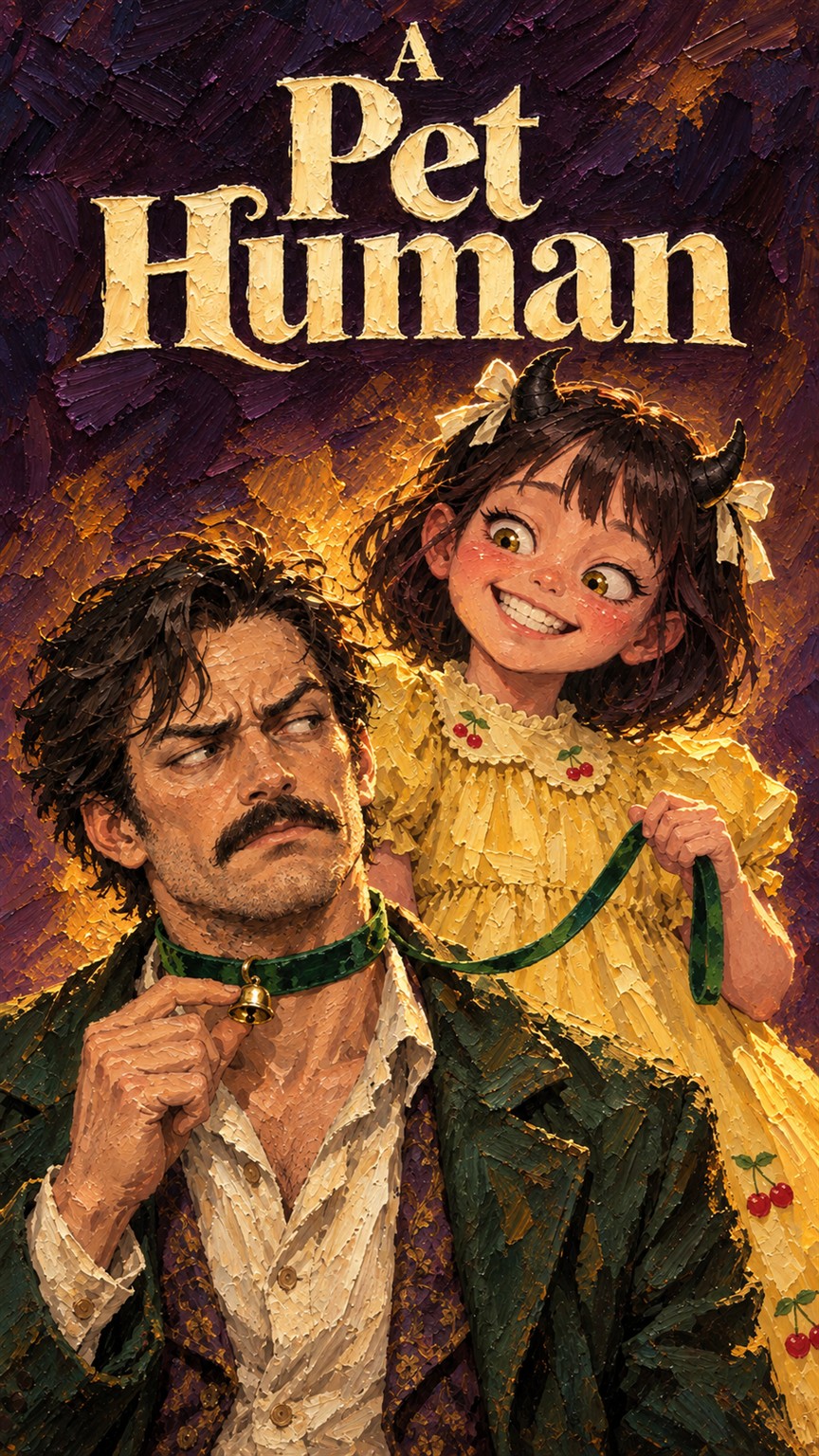
The priest put on my boots before he picked up the knife.
They were good boots. I had spent three wet fairs earning them, and he was stretching the left one with his bunion. I watched him wriggle his foot beneath his robe while two assistants bound me to the altar.
“Those won't fit you,” I said.
“Be still.”
“The heel will rub.”
He raised the knife. Beyond his elbow I could see the temple doors, barred from within. Nobody was coming. My mouth kept moving, but I had run out of things to put in it.
Then the stone wall behind the altar split open.
A blue hand came through, caught the front of my green coat, and dragged me backwards off the stone. Rope snapped. My chin struck my chest. I passed through something cold and tight and landed face-first on a carpet that smelled of singed sugar.
Above me, a child's voice squealed. “A pet human! Thanks Mother!”
I stayed facedown for a moment. After what had just happened, I felt entitled to receive my next piece of information slowly.
“He's rather grubby,” said another voice.
“He's perfect.”
I lifted my head. The child was seven feet tall, pink, and wearing a yellow party dress with cherries embroidered around the hem. Ivory ribbons hung from her two small black horns. Her mother stood behind her in a blue silk gown; the tips of her own horns almost brushed a chandelier full of smouldering cones. One long hand still gripped the edges of a dark opening in the hearth. Through it, sideways, I saw my altar and the priest peering into the crack.
“Did it take?” he whispered.
The mother blew into the opening. Its edges folded together beneath her claws, and the priest vanished.
“You didn't tell me,” the child said, jumping hard enough to make the chandelier shed ash. “You said no more things with teeth!”
“There was nothing to tell. It was offered.”
“I have teeth,” I said. “I also have an engagement tomorrow at the fair.”
The child sank to her knees and bent over me. Her golden eyes filled my view.
“Mother. He talks.”
“So I hear.”
“Do it again.”
“Send me home.”
“Oh, he's cross.” She reached for me. “Are you cross?”
“Yes.”
She lifted me beneath the arms. My coat rode up; my trousers followed to a lesser and less welcome extent.
“Put me down. You're hurting me.”
She dropped me.
“Less quickly,” I said from the carpet.
“Nimmet,” said her mother, “gently.”
Nimmet lay flat on her stomach beside me, her tail whipping behind her like an angry coachman's lash. “I'm being gentle now.”
“Madam,” I said, sitting up and addressing the mother, “I was seized in my lodging, tied to a stone, and very nearly opened. I don't belong here.”
She looked from me to the hearth.
“He called you a willing offering.”
“Did you hear me willing?”
“There was a great deal of noise.”
“That was me.”
Her lips thinned. She picked a broken strand of rope from my sleeve, examined its knot, and let it fall.
“Very well. I shall return you when he calls again.”
“When?”
“Dusk. He expects a boon.” She regarded the closed hearth with renewed interest. “He shall have my attention.”
Nimmet sat up so fast one ribbon slipped off her horn.
“But he's my birthday human.”
“He says he isn't.”
“He doesn't know it's my birthday.” She turned to me. “It's my birthday.”
I was thirty-seven, shoeless, and still shaking. I congratulated her because my mother had brought me up properly, and because Nimmet's mother had just shown me a mouthful of teeth as long as my thumbs.
“I'm Mavrix,” the mother said. “You may wait in here. Keep away from the east balcony. The moths there take bites.”
“Can't you open that again now?”
She scraped a claw across the hearth. Blue sparks followed its point, but the stone remained stone.
“He must call from his end. Then I can reach through.”
I went over and put my hand against it. Warm, solid, unhelpful. When I turned back, Nimmet had produced a woven basket large enough to sleep a pony.
“You can wait in this.”
I am Caff. You may have heard me inviting you to view a serpent with two heads, or a woman who could swallow a sword, or a serpent with one head on days when we had suffered a disappointment. I possess a carrying voice, a serviceable moustache, and enough judgment to know when a paying customer needs encouragement.
Nimmet was not paying. This became my chief difficulty.
“Sit,” she said.
“I am sitting.”
“Good human!”
She dropped a sweet into my lap. It was the size of a fist, glazed white, with a sugared violet on top. I had eaten nothing since the previous night. I took a cautious bite.
Almonds. Real almonds, and soft pear inside.
Nimmet leaned close. “Do you like it?”
I nodded around a second bite.
“Mother! He likes his biscuit!”
Mavrix, seated by the tall window with a dish of black cherries, made an acknowledging motion. I discovered another sugared violet underneath the sweet and ate that too.
“What's your name?” Nimmet asked.
“Caff.”
She considered this. “That's a funny noise.”
“It will do.”
“I was going to call you Buttonkin.”
“Caff.”
“All right.” She opened a box and drew out a green velvet collar with a brass bell. “I can still put buttons on this.”
I had worn a false beard made of combings from a horse. I had stood in a barrel while a supposedly trained goose selected a card from my mouth. My professional dignity was flexible. Nevertheless, I set down the sweet.
“Absolutely not.”
Nimmet put the collar away. “Brush, then.”
The brush had curved iron prongs. Beside it lay a pair of shears. She spread a cloth beneath me and made a small, pleased noise at the sight of my moustache.
I got up. “I bite.”
Her face brightened. “How hard?”
“Extremely hard.”
“Mother, he bites!”
“Then keep your fingers clear.”
Nimmet held out the brush handle. I stared at it. She stared at me. Across the room, Mavrix selected another cherry.
“I'm not going to bite a brush,” I said eventually.
“It won't bite you back.”
I went to the far end of the room. Nimmet followed on hands and knees, which made the pursuit considerably worse. I climbed onto a cushioned chair. She settled beneath it with her chin on her hands.
“I shall require wine,” I announced, “and roast fowl. A whole one. Also new stockings.”
Surely there was some limit to the inconvenience a mother would endure before ordering her child to leave the human alone.
Mavrix put down the cherries.
“Fetch the little cupboard from the dining room, Nimmet.”
Nimmet returned carrying a cupboard taller than I was. She planted it before my chair, opened it, and revealed cold birds, glazed buns, white cheeses, and bottles wrapped in straw. At the bottom stood a pair of boots with curled silver toes.
“Those are decorations,” Mavrix said before I could ask.
The wine tasted of plums. I ate a leg, then the other leg. Nimmet watched every mouthful. When I looked about for something to wipe my fingers on, she handed me the cloth she had spread for the shears.
There is a point at which a gentleman must acknowledge that his strategy is failing.
“Fetch,” Nimmet said, and threw a little red ball across the room.
“No.”
She threw it again after retrieving it herself. “Fetch?”
I took another sip of wine.
“He isn't very clever,” Mavrix observed.
This was unnecessary. I had successfully supported myself by speaking outdoors over bad weather and sometimes over bears. I placed my cup on the cupboard.
“Nimmet. Ball.” I held out my palm.
She brought it over.
“Excellent. Now, stand there.”
I pointed. She went. I raised my hand, palm down, and slowly lowered it. She sat.
“Splendid.” I tossed her a bun.
She caught it in her mouth. The whole bun disappeared with a soft pock.
“Again!” she said.
I glanced at Mavrix. The cherry had stopped halfway to her mouth.
“He appears to be teaching you,” she said.
“We're doing tricks together.” Nimmet bounced on the carpet. “Watch.”
She got to her feet before I asked, then sat before I lowered my hand.
“You must wait for the signal,” I told her. “Otherwise it spoils the effect.”
“I knew what you wanted.”
“Yes, but your mother didn't.”
Mavrix ate the cherry very slowly.
For a child who could lift furniture, Nimmet was easily distracted. During our first bow she noticed a moth behind the glass and ran to pull faces at it. The moth spread wings like a butcher's apron and pressed its teeth to the pane. I decided I would not attempt a window.
For our second bow, I took away the buns. Our third was excellent.
“What else can we do?” she asked.
“Can you roar?”
“I'm not supposed to in here.”
I looked towards the adjoining room, where Mavrix had gone to change for the evening. The open door showed her blue sleeve and the edge of a mirror.
“A small one.”
Nimmet drew a breath. Her dress puffed out. The sound that followed lifted the hair from my forehead and knocked three cherries from their dish.
“Nimmet,” said the voice beside the mirror.
“That was little!”
“I heard it.”
Nimmet clamped both hands over her mouth. I was on the floor, clutching the foot of the cupboard. We stayed where we were until Mavrix's sleeve withdrew from the doorway.
“Quite sufficient,” I whispered.
“You fell over.”
“Part of the act.”
“Do that again.”
“Later.” I got up, rubbing my hip. We agreed that opening my fist would mean roar, and practised the signal without the noise. Nimmet mimed a splendid catastrophe. I declined to fall over again.
By then the red light beyond the windows had begun to drain upward, leaving the garden below in darkness. I could see rows of pale flowers shutting themselves inside hard, spiked buds. Somewhere out there, something heavy was ringing a chain against a tree.
My hands began to shake again. I put them in my pockets. The priest had searched these too. He had kept my little purse, my lodging key, and the folded bill announcing tomorrow's entertainment. He'd left the landlady's brass-tagged spare in my bedroom door when they carried me out. The knife had had a nick near its point. I remembered that with extraordinary clarity.
Nimmet nudged my elbow with the collar box.
“You could wear it for the tricks.”
“He'll be there,” I said.
She waited.
“The man who gave me to your mother. When she sends me back, he'll still be there.”
“The offering man?”
I nodded.
“Did he brush you too hard?”
“He was going to kill me.”
She lowered the box.
“Why?”
“He wants something from your mother. And he thought nobody would miss me before he'd finished.”
“I would.”
“You hadn't met me.”
“Well, I would now.”
She said it crossly, as though I had been difficult over something obvious. Then she went to the doorway and called for her mother.
Mavrix emerged wearing a black gown. Nimmet immediately clung to its skirt.
“We have to take Caff home properly. The man there kills humans.”
“I heard the human, Nimmet.”
“Then don't put him back in the man's hands.”
“I wasn't proposing to.”
“We can take him. And he can show you our tricks.”
Mavrix looked at me. I thought of asking her to terrify the priest on my behalf. I could have described the knife again. Instead I found myself picturing him in my boots, waiting to be rewarded.
“I would like to recover my property,” I said. “With an escort.”
Nimmet swelled with importance. “Me.”
“You will remain where I can see you,” Mavrix told her. “I must hold the opening. No running.”
“Can we roar?”
“You may ask the human.”
I reached for the collar box.
The evening call sounded like someone praying inside a saucepan. Mavrix knelt at the hearth, set her claws against the stone, and breathed out. This time they sank in. She pulled the opening wide, dragging its edges upward until the temple appeared beyond her arms.
The altar stood three paces past the threshold. Behind it waited the priest in a gilt headdress, holding the knife. His two assistants carried empty bowls. A dozen people crowded near the now unbarred doors; I recognized my landlady and the man who sold hot chestnuts by the temple steps.
“Great receiver of our gift,” the priest intoned, “we beseech—”
“Nimmet,” Mavrix said. “Slowly.”
I walked through first. The bell at my neck gave a small, disgraceful jingle. Nimmet followed, holding the far end of its loose green ribbon. The priest's mouth fell open.
I stopped beyond the altar, well to one side of his knife. Nimmet stopped behind me. I could hear Mavrix breathing in the opening.
“Evening,” I said.
The priest looked at the collar, the ribbon, and Nimmet. His shoulders relaxed a little.
“The offering has pleased you?” he asked her.
“Yes. He's called Caff. Watch what he can do.”
This was her cue to hand me the ribbon. She forgot. I held out my hand twice before she noticed, then she put the red ball in it.
I shut my eyes briefly, then gave her back the ball. “The other thing.”
“Oh!”
She passed me the ribbon. I unbuckled the collar and put it in my pocket, then faced my audience. I had addressed bigger crowds, although rarely with such excellent support.
“Ladies and gentlemen, you have been promised a manifestation. Kindly remain for the complete performance.”
The priest stepped towards me. “You will be silent.”
The knife moved. My next words caught somewhere beneath my ribs. I lifted my hand as we had practised, curled the fingers, and opened them sharply.
Nimmet roared.
The priest sat down on the altar steps. One assistant put a bowl over his head. The other held his out in front of him, which seemed optimistic.
I drew a breath. My voice came back cracked, but usable.
“That's the little one.”
Nimmet bent close to my ear. “Was I good?”
“Wonderful. Stay there.”
The priest looked towards the doorway. Mavrix's face filled its upper half.
“You described him as willing,” she said.
“The sacrifice was undertaken with the fullest—”
“Put that down.”
He followed her gaze to the knife and set it carefully on the stone. I stepped forward and slid it out of his reach. My landlady made a small, sharp sound at the back of the crowd.
“He took me out of your upstairs room,” I called to her. “After you gave him the spare key.”
“He said you were ill!”
“I did become unwell.”
The priest tried to stand. Nimmet sat beside him, delighted to be at eye level. He stayed on the step.
“Now,” I said, “my purse, my key, and my boots.”
His hand went inside his robe. “There is no need for threats.”
I hadn't made one. I was prepared to start, but Nimmet had become interested in his headdress. Gold leaves trembled on fine wires around its rim.
“Caff. Look. It wobbles.”
The priest handed over my purse and key. I pointed at his feet. He pulled off the boots; the left resisted. I had warned him.
“Can I have the hat?” Nimmet whispered.
Everyone heard her.
“It is a consecrated vessel of divine—”
“Ask your mother,” I said.
Mavrix glanced at the hat.
“You were expecting a boon,” she told the priest. “You may give my daughter a birthday present and then I shall leave.”
He took it off.
Nimmet carefully lowered it between her horns. The gold leaves quivered. She made them wobble again, giggled, and nearly knocked me over with her tail.
I put my boots on sitting beside the altar. It took longer than I would have liked because my fingers would not quite obey me. My landlady came forward and held one steady. Neither of us said anything until I had fastened the buckle.
“Your room's still yours,” she said.
“It had better be.”
Behind us, the chestnut seller began asking the assistants whose money had paid for the hat.
“Come on,” Nimmet said, reaching for my hand.
I pulled it back before she could close her fingers.
“This is where I stay.”
Her mouth turned down. I could have refused a demand. This was harder.
“We didn't do the bow.”
“Nimmet,” Mavrix said from the hearth. “My arms.”
“We practised.”
So we bowed. Nimmet went too low and the headdress tipped over her eyes. I caught it, set it straight, and tightened its band. There was some applause, principally from the chestnut seller, who was enjoying himself.
She caught my sleeve before I stepped away. “I want to see you again.”
“Next birthday,” I said, before I could be sensible.
“That's ages.”
“I'm a busy man.”
“I could come to your fair.”
The priest made a strangled noise. I ignored it.
“If your mother brings you. As a visitor. You mustn't carry me about.”
“What if I ask?”
“You may ask.”
Mavrix shifted her grip. Her claws grated against the edges of the opening.
“Nimmet. Now.”
Nimmet thrust the red ball into my hand and stepped back through. She turned at once, holding her skirt away from her feet.
“Don't lose that. It's my best one.”
“I won't.”
Mavrix drew the opening shut. I caught one last glimpse of the gold leaves nodding between the little black horns. Then there was only an ordinary wall behind an ordinary altar, with a priest sitting rather heavily on its steps.
I walked out past him.
Halfway to my lodging, reaching into my pocket for the key, I discovered that the velvet collar was missing. I stood in the street considering the inconvenience of going back for it. My bed was waiting. My boots fitted. Behind me, from the temple, came an increasingly lively argument about sacred expenses.
I went back.
The priest had picked up the collar and was staring at its brass bell. I took it out of his hands.
“Mine,” I said.