
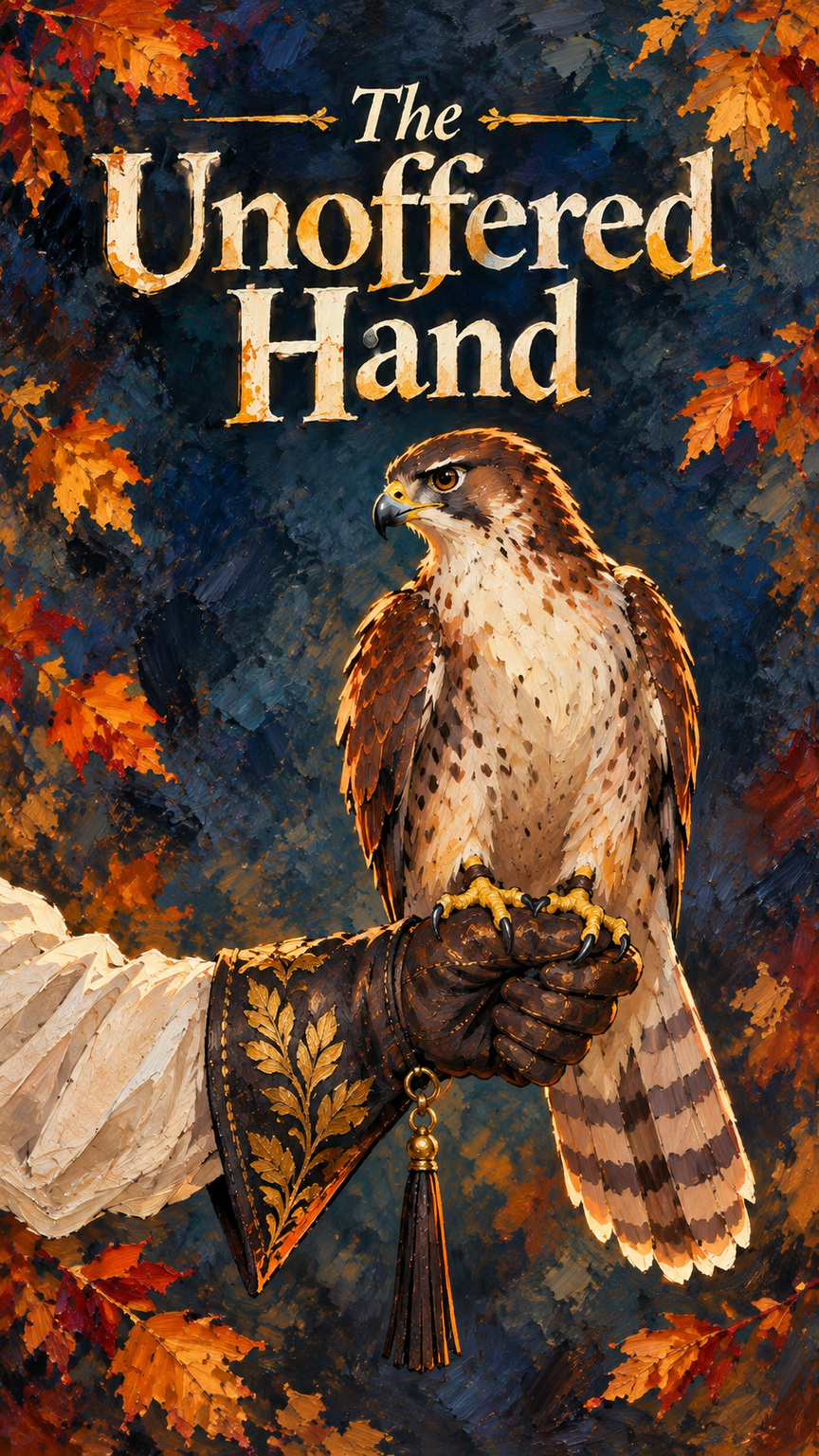
Sovelda had her hand inside the princess's spare glove when the falcon came down.
She was supposed to be polishing it. The leather had gold leaves worked into its cuff, and she could get the blacking out of their edges more easily with her fingers filling the glove. That was true. It was also true that she had been holding her arm sideways to see how the long tassel swung.
Across the court, the princess stood beneath the autumn garlands with her other glove raised. Cresset had turned his back on her. He had done the same to three generals, who now stood together pretending to discuss a horse, and to every master falconer in the royal mews. One of the masters had tried crouching. Cresset had watched him get down, then watched him get up again.
Now the bird was on Sovelda's fist.
His weight struck through her elbow. She staggered against the table, knocking over the blacking, and held her arm out because there was nowhere else to put it. A barred tail spread across her apron. Above it rose a spotted white breast, a brown head, two bright eyes which, from this close, seemed impossibly large.
Sovelda had never touched a hawk. She had not wanted to. The mews boys carried scars on their knuckles and ate with the cheerfulness of people who had forgotten how they got them.
“Don't move,” somebody said.
She could not tell whether it was meant for her or the bird.
The princess lowered her arm.
Every autumn, from the first yellow leaf until the last, the kingdom's unbound falcons chose the one person they would obey for the rest of their lives. Most chose in their first autumn. Cresset had been brought out for four autumns. In that time he had opened a general's cheek, killed a kennel rat through the bars of his weathering cage, and driven every other bird away from the highest perch. Sovelda knew these things because the glove-room windows faced the mews, not because anyone had expected her to need them.
“Take him,” she said as the princess approached.
The princess offered her fist beside Sovelda's. Cresset leaned away. When she brought it closer, he opened his beak.
“Cresset.” The princess's voice was low and familiar. “Come along.”
His attention remained on Sovelda. She wished it wouldn't.
Master Tirren came behind the princess with a short block perch. He was a broad man whose leather apron had gone almost black at the waist. He set the block down, moved the spilled polish away from Cresset's tail, and looked at Sovelda's elbow.
“Straighten your wrist. No, leave the elbow bent. That's it.”
“I haven't fed him anything.”
“I can see that. Ask him to step down.”
“Will he?”
“We shall find out.”
She lowered her fist toward the block. “Down.”
The falcon stepped onto it. Tirren put out a hand to draw a strip of leather clear of the bird's foot. Cresset struck at him so quickly that Sovelda heard the beak close after Tirren's hand was already gone.
“Up again,” Tirren told her.
She offered the glove. Cresset climbed onto it, carefully placing one foot and then the other.
Behind Tirren, someone laughed once in astonishment. People began coming away from the garlands. The generals stopped talking about their horse. Sovelda could see the woman in charge of the glove room hurrying toward them, and opened her mouth to explain the blacking.
“Not now,” the princess said, stepping between them.
For the first time since she had entered service, Sovelda watched someone else be sent away from her.
By evening she had a room beside the mews, two clean aprons, and permission to eat before the kitchen servants finished serving the upper hall. She was twenty and had never had a room to herself. There was a peg on the back of the door. She hung her second apron on it, took it down, and hung it up again.
Cresset occupied a perch in the adjoining chamber. She could hear him moving. They had left the door between them open because she had asked whether he might forget her in the night.
Tirren had looked briefly at the ceiling.
“He won't forget you. He may forget where he put a piece of meat. That's different.”
The princess arrived while Sovelda was trying the latch on her window.
She still wore her choosing clothes: cream sleeves embroidered with rust-colored flowers, a dark fitted bodice, an orange sash that had acquired a smear of dirt near the knot. A little spray of purple flowers leaned crookedly out of her brown hair. Sovelda had seen that sash brought down for pressing three times before the ceremony.
“You've got my glove,” the princess said.
It lay on the bed. Sovelda picked it up with both hands.
“I'll finish the cuff. I was going to—”
“Keep it for tonight. They'll have to fit one for you.”
The princess went through to Cresset. Sovelda followed. The bird watched the newcomer with his feathers held close. When the princess stopped an arm's length away, he turned his head and began drawing his beak along a wing feather.
“He's tired,” she said.
Sovelda looked at the handsome curved beak. “How do you know?”
“He always does that after the choosing.”
The princess reached toward him, stopped, and pulled a loose thread from her sleeve instead.
“Did you come every year?” Sovelda asked.
“I live here.”
“I meant to see him.”
“Yes.” She rubbed the thread between her fingers. “I came most mornings.”
Sovelda looked away. She had imagined the princess arriving once each autumn, lifting a magnificent arm, expecting the best bird because she had always had the best things. Most mornings was harder to picture.
“Perhaps he thought I was you. Because of the glove.”
“He didn't.”
The answer came so quickly that Sovelda's face warmed.
Outside, a cart rattled across the stones. Cresset stopped working on his feather and watched the open window until it had passed.
“Tirren has twelve new pairs to settle,” the princess said. “I'll come after breakfast.”
“To take him?”
“To show you what to do.”
Sovelda nodded. She wished the princess would leave before she said something else foolish. At the door, however, the princess paused.
“Does that glove fit?”
“Yes, Highness.”
“It came halfway off when he landed.”
Sovelda's bare fingers closed against her skirt.
“It's too big.”
“Then say so when they measure you.”
In the following days Sovelda learned that a falcon could make a room smell quite unlike any room she had cleaned before. She learned where to cut his food, how to weigh it, and how much of a morning could be spent waiting for him to finish something unpleasant. Her left arm ached down to the fingertips. Cresset liked to look out while she walked; when she turned toward a wall, he leaned around her to keep the court in view.
The princess showed her how to hold him clear of her body. She demonstrated with the spare glove on her own wrist, moving slowly enough for Sovelda to copy. Without a bird, her arm looked oddly incomplete.
Tirren fitted Sovelda's new glove himself. It was plain brown leather with a cuff as long as her forearm. She thanked him, then caught herself looking at the gold leaves on the other one.
“You can keep that for ceremonies,” the princess said.
“I wasn't—”
“You were. It's all right.”
It might have been kindness. Sovelda could not decide.
The choosing had not given her the bird's thoughts. When she spoke about tomorrow, he watched her mouth. When she asked whether he wanted more food, he searched her bare hand. But a simple instruction addressed to him reached him even before she had learned the proper call. He would come, step down, wait. Once, frightened when he spread his wings beside her face, she cried for him to stop. He folded them at once and almost lost his balance.
The princess caught Sovelda's wrist before she lowered it.
“Let him settle.”
“He startled me.”
“He was balancing.”
Sovelda tried to hold still. The bird's feet tightened and loosened through the glove.
“He'll do what you ask,” the princess said. “He won't know you asked badly.”
It was useful information. It was also the fourth correction since breakfast.
By the fifth morning, Sovelda could call him from one end of the enclosed exercise hall to the other. He came low over the sand, wings beating hard enough to stir her skirt. At the last moment his feet reached forward and the rest of him rose behind them. She learned to let her arm give a little under the landing. Once she did it without thinking, and laughed aloud.
Cresset tilted his head. The princess stood by the far door with the empty traveling perch.
“I want to see him outside,” Sovelda said.
“Tirren will take you to the high field when he has time.”
“He's been in here all week.”
“So have you.”
Sovelda rubbed a mark on her new cuff. Through the mesh above the doors she could see leaves traveling past, yellow against a clear sky. People had begun to greet her in the passages. The mews boys moved their things off the best bench when she brought Cresset out. Yet every day still seemed to end with somebody explaining how far she was from being able to do anything.
“You could take me,” she said.
“I could.”
“Then why won't you?”
The princess set down the perch. “Because when you want him back, you call before you look where he is.”
“He comes.”
“Yes. He does.”
Sovelda could hear agreement being used to make her stupid. She held out her arm, and Cresset shifted his feet.
“You don't have to keep coming.”
The princess went very still. Sovelda had never told anyone of her rank to go away. For a moment she enjoyed the silence so much that she wished there were someone else in the hall to hear it.
Then the princess picked up the perch.
“Take him into the south orchard after dinner. There's room for a short flight. I'll show you.”
She left before Sovelda could decide whether to thank her.
The orchard sloped away from the palace wall. Its lower trees had been cut back years ago, leaving a broad grassy strip between the trunks and the boundary fence. Here the wind moved steadily uphill. Fallen apples lay in the grass, some split open, their flesh already browning.
The princess walked Sovelda to the middle of the clear strip.
“Wait here. Let him get above the trees. When you call, give him room to come in from this side.” She swept her empty glove through the air above the grass. “Stay where he can see you.”
Sovelda unfastened the traveling leash as she had been taught. Cresset leaned forward. His whole body seemed to narrow toward the open sky.
She raised her arm.
He left it with a thrust that lifted her onto her toes.
For a second she saw every barred feather separately. Then he was beyond the apple trees, climbing, turning on one extended wing. The light caught his pale breast. She had carried that weight for five days; she had not understood what it could do without her.
“Look at him,” she said.
The princess was already looking. Her mouth had softened. She backed three quick steps down the slope to keep him in sight above the trees, and for the first time Sovelda saw her without any wish to have her clothes.
Cresset passed over the wall. The palace hid him.
Sovelda lifted her glove.
“Wait,” the princess said. “He'll circle.”
There was nothing above the wall. Sovelda went uphill to see past it. She passed beneath the outer branch of an apple tree; leaves brushed her hair.
“Come back to the grass.”
“I can't see him.”
“Sovelda, come down here.”
She heard her name in the voice that had spent the week telling her what she had done wrong. Behind the wall a brown shape rose, banked, and came over the orchard.
“Cresset! Here!”
He turned toward her.
The princess shouted. Sovelda saw the branch between them and pulled her arm down. Cresset followed the movement, folding himself through the narrowing space. One wing struck wood with a sound she felt in her teeth. He fell into the leaves at her feet.
She crouched, reaching with both hands. His beak snapped at her bare fingers.
“Don't grab him.”
The princess knelt on the other side. Cresset stood low in the grass, one wing hanging. He opened it halfway, closed it, and tried again. A dark drop fell onto an apple leaf.
“Is it broken?” Sovelda asked.
“Get your glove under his feet.”
“Is it?”
“I can't tell yet.”
Sovelda pushed the glove through the grass. Her whole arm shook. Cresset placed one foot on it and stopped. She had to hold the position, bent double, while he gathered himself for the second step.
“Up,” she whispered, then wished she hadn't.
He climbed.
Tirren examined the wing while Sovelda held the bird. The princess stood beside them with a lamp, although it was still afternoon. Twice Tirren asked her to move it closer.
The bone was sound. A growing feather had broken near its base; the skin beside it was torn. There would be no flying until the wound had closed and Tirren was satisfied with the wing.
“What did he hit?”
“An apple branch,” Sovelda said.
“Calling him in?”
She nodded.
“Where were you standing?”
“Under it.”
Tirren looked at the princess. She stared at the lamp.
“I told her to move,” she said.
“You took her out.”
“Yes.”
He returned to the wing. Sovelda watched the slow movement of his hands. She had wanted the princess to see Cresset come to her in the open air. The wanting had been so large and pleasant that she had barely noticed the tree.
When Tirren finished, the princess carried the lamp away. Sovelda heard it set down in the next room. Then nothing.
“He didn't fly badly,” Sovelda called.
The princess appeared in the doorway.
“I know.”
“In case anybody asks.”
“I'll tell them.”
Sovelda lowered Cresset to his perch. He stepped down more slowly than usual and turned his injured side toward the wall. She kept her glove beside him until he had settled, then sat on the floor because the stool seemed too far away.
“You were right,” she said.
The princess leaned against the doorframe. “Which part?”
Sovelda looked up sharply. The princess rubbed her forehead with the heel of her hand.
“I'm sorry. I heard how that sounded.”
“About me calling him.”
“Yes.”
There was no relief in saying it. Cresset still held his wing oddly. Sovelda could see the place where his breast feathers moved with each breath.
“I liked making you leave,” she said. “This morning.”
The princess looked toward the empty stool, then sat on it.
“I nearly didn't come back.”
“Why did you?”
“I wanted to see him fly.” She watched the bird. “And I was tired of you looking at me as if I'd been keeping something of yours.”
Sovelda pressed the glove flat between her knees. A spot of blood had dried on the thumb.
“I thought you'd hate me.”
“For this?”
“For him choosing me.”
The princess breathed out through her nose. “I did. For most of that first day.”
Sovelda had been expecting a denial. She studied the princess's slippers, which were muddy around the toes.
“I hadn't done anything.”
“I know. That made it worse.”
The princess bent to work a burr out of her hem. It resisted. She picked at it until one of its hooks broke, then laid the pieces on her palm.
“I used to bring my breakfast down here. He'd watch me eat. If I was late, he'd be at the window.”
“He does that when the meat cart comes.”
The princess looked at her.
“I didn't mean—”
“No. You're probably right.”
For a while neither spoke. From the court came the noise of the other newly chosen birds, their handlers calling, Tirren asking someone to stop waving both arms.
Sovelda turned the glove over. “You can still come.”
“I know I can.”
“I mean I'd like you to.”
The princess let the broken burr fall into the bowl beside the stool. She stayed until the daylight faded from the high window. Cresset put his head beneath his good wing and slept through their silence.
The orchard lost its leaves. Sovelda learned the sounds Cresset made while asleep, and which piece of the mews roof he preferred to watch after rain. She stopped offering him the glove every time he looked in her direction. Some afternoons he ignored her for hours. Being chosen did not make this less insulting.
Tirren cleared him for exercise, then for flight. Sovelda went to the high field under the master's eye. She stayed in the open. She waited for the wide approach. When Cresset landed she nearly cried, which would have been difficult to explain to the boys carrying the scales.
The princess came on the third outing, riding a mare with a mane the color of chestnuts. She dismounted and handed her reins to a groom. Sovelda had the gold-leaf glove on; it had been taken in to fit her hand. She had done the stitching herself.
“Ceremonial?” the princess asked.
“I like it.”
The princess bent to inspect the cuff. “You've matched the thread.”
“Of course.”
Below them the bare orchard shone silver in the morning light. Beyond it lay stubble fields, a dark fold of woods, distant hills Sovelda had never had a reason to visit. Cresset stretched one wing, then the other. Both opened fully.
“Where will he go?” she asked.
“Let him show you.”
She sent him up. He climbed above the field, circled once, and struck out toward the ridge. Sovelda turned with him until she was facing into the wind. Her eyes watered. She wiped them on the sleeve of her ungloved arm.
“He's going a long way.”
“He can.”
At the ridge, Cresset tipped. His body became a dark mark descending so quickly that Sovelda lost it against the grass. A moment later he rose again, empty-footed, and she heard herself make a disappointed sound.
Beside her, the princess laughed.
“You wanted him to catch it.”
“I didn't even see what it was.”
“It's gone to ground, whatever it was. He'll try again.”
Cresset turned beyond the ridge. Sovelda walked after him, keeping to the open crest. The princess followed for a little way, then went back for her mare.
Hooves thudded past. The princess leaned forward in the saddle, her orange sash lifting behind her. Sovelda broke into a run. She was too far behind almost immediately; she had known she would be, and ran anyway, the tassel striking her wrist, the bird's shadow crossing the grass ahead of both of them.
The princess reined in at the next rise and twisted round.
“Sovelda!”
She was pointing beyond the hill. Sovelda couldn't see from where she was. She hitched up her skirts and kept coming.