
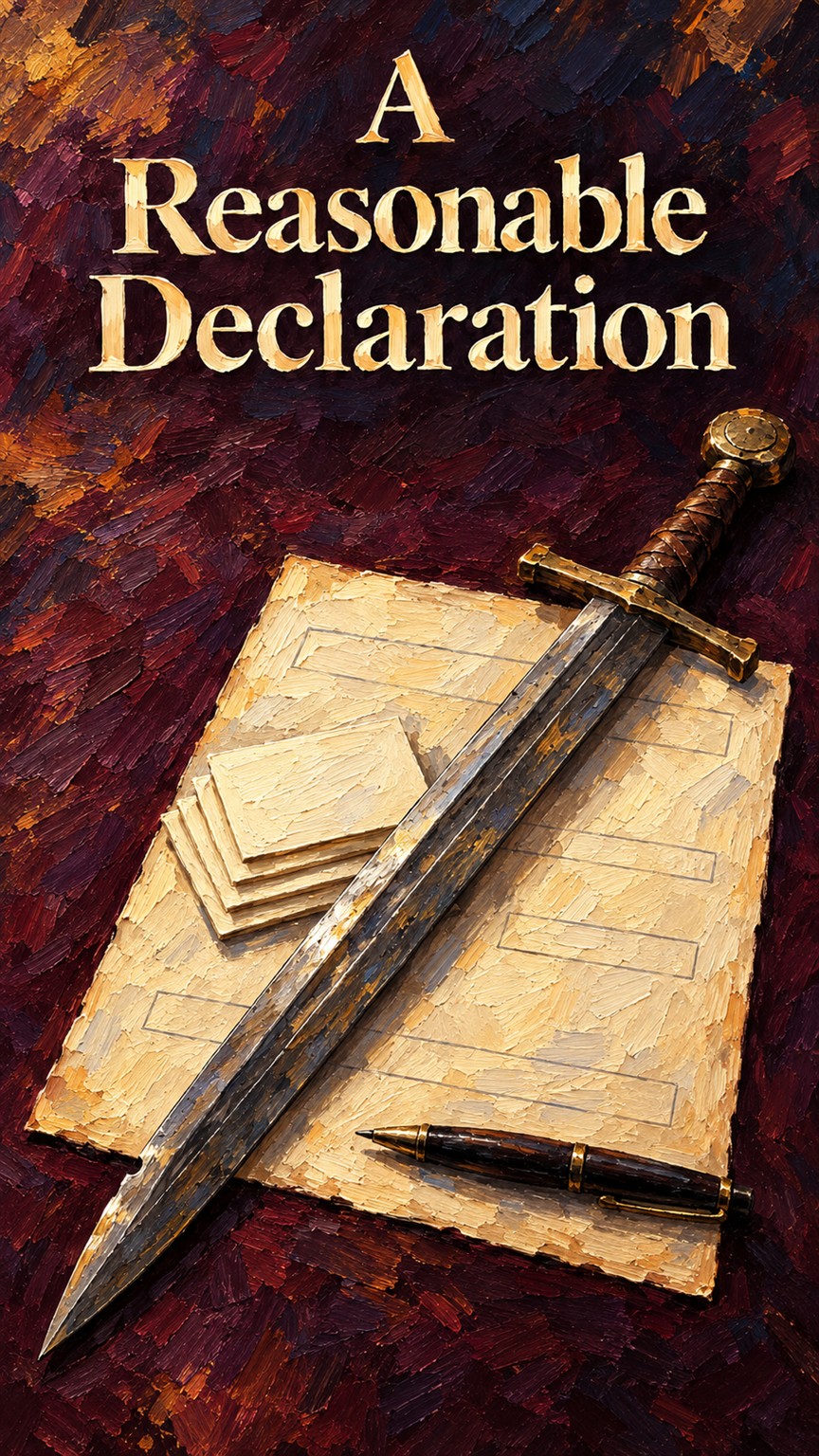
Barnaby Greave could have carried the sword upstairs. What he could not do was carry the sword, pull the trolley, and prevent the warming cup from knocking against the spectacles, all while holding his appointment slip where somebody might see he was expected.
He put the slip between his teeth.
At the second-floor landing, a woman behind a low partition looked up. Barnaby straightened, removed the paper from his mouth, and waited for her to finish recognizing him.
"You've come," she said.
"I gave my word."
She looked at the damp slip. "This is your third appointment."
He set the sword beside the trolley with some care. His shoulder had begun to complain halfway up; his knee had been complaining since breakfast. There had been an excellent reclining chair in a shop window that morning, upholstered in plum velvet, with a handle that brought one's feet up. He had tested it. The proprietor had eventually come to check whether he was asleep.
"Fulvia," said the woman, indicating the little nameplate on her desk. "I wrote to you. Several times. Where's the rest?"
"Of me?"
"Your collection. I arranged for the long table."
The table ran almost to the window. On it lay nineteen numbered cards.
Barnaby opened the trolley's battered lid. "This is the collection."
Fulvia stood. She looked inside, then at the corridor. The trolley contained a folded cloak and a biscuit tin. It had originally been built for groceries, a purpose to which he looked forward to returning it.
"I expected crates," she said.
He had expected to be offered a chair. After a moment he pulled one out himself.
Fulvia sat too. Barnaby handed her his preliminary assessment. The total had been underlined twice. He had underlined it himself a third time before coming, so there could be no doubt about which part he objected to.
"A hundred and forty-eight crowns," he said. "For things already mine. I didn't have them off the district. I carried every one of them through places the district has never heard of, generally at a run, and I have carried them up and down stairs ever since without anybody once offering to help."
"You can correct the inventory today. Tomorrow there's a late charge."
"I'm retired."
Fulvia wrote the date at the top of a fresh inventory sheet.
He took the chair envelope from his inside pocket and set it under his hand. Ninety crowns. The plain wool version cost sixty; the plum velvet cost ninety, and he had decided, after everything, that he deserved the plum.
Fulvia leaned down to a shelf. When she rose she was holding both volumes of his memoirs, their spines creased almost white.
"The preliminary office used your books," she said. "I brought my own copies. They have the illustrations."
She opened the first volume without consulting its contents. A pressed flower lay beside a picture of Barnaby standing on a precipice, his cloak lifting in a wind that had been much less accommodating at the time.
"I read this part to my sister," she said. "She doesn't usually like adventure."
Barnaby took his hand off the envelope.
"The ascent?" He sat forward. "People generally like the ascent. Eleven days on the face, and a night on a ledge no wider than this table, with the wind trying to have my boots off. The illustrator never did get the ledge. He drew a sort of balcony —"
"The fight afterwards. Where you turn back."
"Ah. Yes."
She set the book beside the first card. "The Red Verdict. May I see it?"
He drew the sword. There was very little space between the table and the partition, and he had to draw it upwards, which spoiled the gesture. Fulvia moved her books before he could lay the blade across them.
For a while things improved. She inspected the dark groove along the blade and the crescent nick near the tip. She turned a page and compared the sword with its picture, then glanced at Barnaby as if he had stepped out of it carrying the right property.
"What is the grip wrapped in?"
"Bootlace. The leather rotted."
Her finger stopped over the drawing. "The Emperor's Ruin has that same wrapping."
"It would."
"And the nick."
"That too."
She opened the other volume. Barnaby could tell from the ribbon that she had prepared this question.
"Is this also the Last Argument?"
"In the context of that expedition. The Red Verdict had been in the first book, and one can't very well have the same sword turn up in the second without some sign of growth."
Fulvia looked from the blade to three of her cards. "You've given one sword three names?"
"Four. Mercy of the Pass, near the end of the first book. Circumstances changed."
"But the sword didn't."
"It was sharpened."
She brought the fourth card over. For the first time since the notices began, Barnaby saw something promising in the arrangement of government property.
"You aren't proposing to charge me four times?"
"I need to identify which entries are the same object."
He drew the cards into a neat stack. "These are. Indisputably. You have noticed the nick yourself."
Fulvia's disappointment was visible enough to be disagreeable. She turned back to the precipice.
"You say the Red Verdict was torn from your hand."
"It was. I caught the lace."
"I always wondered how you caught it. With the other hand?"
"The same one."
He spread his fingers. She studied the pale bands across their bases, then the bootlace spiraling around the grip. The illustrator had given him a clenched fist and a clean cuff. In fact the lace had unwrapped under his weight, one turn at a time, until he thought it would peel the skin off his fingers. Above him, the blade had jammed between two stones. Below him something moved through the white air, slow enough to wait.
For three days afterwards he had eaten with his left hand, spilling soup down his shirt. He had been furious about the soup.
"Was it a very long fall?" Fulvia asked.
"I didn't go and measure it."
She closed the book halfway. He had answered too sharply. He pulled the sword nearer, fed a small thread of his own power into its grip, and watched a line of amber run along the edge.
"Still takes a charge from the wielder," he said. "Not much of one now. Keep your fingers clear."
The line died when he released it. Fulvia entered the surviving function and counted four aliases against one blade. Barnaby sat back.
The cloak occupied three further cards: the Veil of Night, the Mantle of Unseen Steps, and the Widow's Shadow. Fulvia accepted the darn on its shoulder as evidence, though she spent some time looking for the widow in the index.
"There wasn't one," he admitted. "I thought there ought to have been. It's a very good name for a cloak."
She wrote something in the margin of her book.
"You aren't correcting your copy?"
"I'll forget otherwise."
The cloak had once bent the visible outline of a person wearing it, provided that person supplied the power. Now the lining had split at the hips. Barnaby explained this twice, because the preliminary valuation assumed complete concealment, and then stood to demonstrate.
He fastened the clasp, pulled the hood over his head, and let power work out through the worn threads. His hands blurred. The chair behind his chest became visible in a patchwork of pale streaks. He took three steps along the table.
Fulvia leaned to her left.
"I can see your knees."
"The lining. As I said."
"In the picture you reach the throne without anyone seeing you."
"I was younger. I could crouch."
He attempted to show her. His knee made a sound, and he abandoned the demonstration, gripping the table while his head became solid again. Fulvia brought his chair round without comment, which he preferred to sympathy.
When he had sat and unfastened the clasp, she showed him the illustration. "They drew the cloak down to the floor."
"They also gave me longer legs."
She looked at the picture for another moment, then at the two crowns she had written in the assessment column. "It was my favorite picture."
"It can remain so."
Fulvia didn't answer. She folded the cloak with its damaged lining outwards. Barnaby opened the biscuit tin and took out the circlet.
This was copper, much polished on the inside and green at the joints. Barnaby wore it on the cover of the second volume, although in the pictured incident he had been keeping it in a pocket because of the cold.
"The Crown of Command." Fulvia turned the second volume round so that he could see his own cover, as though he might have forgotten it. "This is the one my sister wanted framed. She never read past the cover till I made her, and then she read it twice and wouldn't give it back, and I had to go round on a Sunday and —" She stopped, looked down at her cards, and uncapped her pen.
Barnaby waited until she had found the right card. "Also the Voice of the Mountain, for the second half of the book, where it matters. And the Siege Chorus, for the chapter at the fort. That one was mine."
"That makes ten entries accounted for." She copied the names. "What does it do, precisely?"
"Carries your voice. You feed it a little power and it carries whatever you say. Through stone, if necessary." He leaned back. "At the fort I needed the besiegers to think the pass was held. So I held it. I called the watches from the east wall and answered them from the west. I had a sergeant with a cough. I had a boy who kept asking when supper was. By the second night they were sending out to parley with a company of fifty."
"How many were there?"
"Me. I stood in different places."
She turned the circlet over. "May I try it?"
He ought to have said he would demonstrate it himself. But she was holding it above her hair, and he had spent enough time disappointing her.
"Touch the inner rim with your fingertips. The smallest thread of power. You'll feel it warm."
Fulvia set the circlet on her head, holding it by the outside.
"Will I sound like you?"
"You'll sound like yourself. Speak softly."
She touched the inner rim, and the copper brightened beneath her fingers. Drawing herself up, she glanced at the open book and whispered, "Lay down your spears."
Her whisper came out of the ceiling, the wall behind Barnaby, and the stairs. In the corridor somebody dropped a box of paper clips.
"Take it off," Barnaby said.
"Oh, I'm sorry!"
The apology filled the office. Beyond the partition a chair scraped violently backwards. Fulvia snatched off the circlet, cutting her supply of power, and silence returned with a small metallic ringing in Barnaby's ears.
She held the copper band in both hands. Her hair stood up through the middle.
The person gathering paper clips said, quite clearly, "Again?"
Barnaby looked at her.
"The man who assesses musical instruments works here on Tuesdays," she said. She set the circlet down and brushed at her hair. "You did say softly."
"I did. It's louder since I cracked that joint."
"You could have mentioned that."
He could. He had forgotten the crack, and now hoped she would discover some useful depreciation in it. Instead she wrote six crowns beside the circlet.
"For that?"
"It works through walls."
"It has lost all delicacy. It used to put a whisper in one ear on the far side of a courtyard. You heard it just now. It's a town crier."
"You called it the Siege Chorus."
There was no beneficial reply to this. He pushed the circlet across the table and reached into the tin.
The warming cup came wrapped in a pair of his socks. He hadn't polished it: he used it every morning, and it was already annoying enough to have his morning cup detained in a tax office. The Grail of Embers, Winter's Defeat, and the Beggar's Comfort proved to be one squat vessel with a chipped yellow rim.
Fulvia's books showed it in gold.
"It is yellow," Barnaby said, before she could speak.
She put a fingertip against the side. "Cold."
"Empty. Give me a moment."
He fetched tea from the office urn, returned with the cup, and warmed it with his hands around the base, pressing his own power into the clay. It would retain that small charge for half an hour. It couldn't replenish itself; when he forgot, he drank cold tea like anybody else.
Fulvia tested it again. "Three crowns."
"Three? It's a cup. It's clay with a chip in it. Whatever your illustrator thinks, there isn't a scrap of gold anywhere on it."
She wrote the three down.
"I do the work," he said.
She waited with her pen above the paper. Barnaby took a sip. He had warmed it more than he intended, and could not pursue his objection until his tongue recovered.
The lifting buckle was the Titan's Favor and the Giant's Hand. Together with its original braided strap, it had once enabled him to carry two injured people in succession up a broken stair. He put the cloak and circlet back in the trolley to give it some weight, then hooked the strap around the handle and supplied the buckle with power through his palm. The trolley became easy to lift but retained all its bulk. Bringing it round, he knocked a corner against the table and scattered the cards.
Fulvia retrieved them while he lowered it, and wrote four crowns.
"It does nothing about the size," he said. "You saw."
She squared the cards against the edge of the table and set them back in their places.
The spectacles had three names too: Eyes of the Deep, Lanternless Sight, and Scholar's Salvation. One lens was held in with wire, the other with a dreadful hard paste he had never managed to remove. By feeding the frames a little of his power he could read in the dark, although he had to tilt his head to keep the two halves of each line aligned. Fulvia tested them under her desk, directing her own power through the frames, and emerged with a gray smudge on her sleeve.
"I can only read one side clearly."
"Tilt your head."
She went back under. He heard a soft bump. This time she emerged rubbing her scalp, with the spectacles in her other hand.
Two crowns. He felt rather protective of them at that price. They had helped him read a warning scratched inside a door he had been about to shut. For years afterwards he had kept a wooden wedge in his boot, ordinary wood, replaced whenever it broke. He was relieved he hadn't put that in a book.
The last thing in the tin was a metal disk in a paper sleeve. Fulvia read the nineteenth card: Key of Return.
"That was your publisher's title," she said. "You call it an exit token in the chapter."
"The publisher owned the headings."
He slid it onto the table. There was no route left in it, only marks and a closing stamp. He had turned it over often enough to make its edges smooth.
"Queen Street," he said, before she asked.
It came back to him with unnecessary sharpness: the white seam in the abandoned tunnel, black rain falling upwards around it, his own breath catching because he was safely through and could at last afford to be frightened. The Exit Witness had taken the disk from his hand and closed the returned token. Barnaby had watched until it was done. Whatever the place beyond that crossing was, he had wanted no unfinished way back to it.
Fulvia tilted the disk toward the window. "Can it open anything now?"
"No. The Witness closed it."
She put it back in its sleeve. "No precious metal. No remaining function. Nil."
He reached for it, then stopped to let her attach its numbered label. It was faintly insulting to have the thing appraised as worthless, but he was not about to appeal.
By then the light had moved off the long table. Fulvia had seven cards in front of her and a chain of pencil marks running through both books. Barnaby's tea had gone cold. Somewhere in the corridor a clock began to strike, and he looked up so quickly she said, "Four. We close at five."
"Have we finished?"
"The inventory isn't signed. I need the places of acquisition."
He looked at the form. Each object had a space about the length of his thumb.
"How much detail?"
"Enough to identify the place, if you know it."
"We called them the Realms. That didn't mean we knew where we were."
"Then write what you do know. There's an additional sheet."
He had spent two books making the doors he had entered sound like destinations. Now he had to distinguish what he remembered from what the chapter headings implied. A copper circlet bought from a woman beside a stair. The stair had been black; the sky above it had moved in strips. Was that enough? Fulvia said to put it down. The cup acquired in exchange for a blanket. The sword bought before his first crossing. The cloak taken as his agreed share of an expedition's finds, from a place he knew only as the third door; maker unknown. The buckle and spectacles purchased from other Runners who had not told him where they'd got them. Queen Street for the token. Dates approximate, where he could remember any.
"The cup wasn't a gift from a king?" Fulvia asked.
"He said he was a king. He wanted my blanket."
She checked the passage, lips moving. "You gave him your last protection against the killing frost."
"Yes."
"But you had the cloak."
"It let the wind through. I'd torn it."
He waited for another annotation. She made none. Instead she turned forward to a small drawing of the cup beside his boots.
"I don't think it's yellow in this one either," she said.
He bent over the additional sheet. At least she was pursuing the illustrator now.
It took most of the hour to fit nineteen names onto seven descriptions. Fulvia rejected his first signature because it crossed the box reserved for her stamp. He used the ordinary small one that he signed letters with. He declared that he had listed all retained artifacts, including those of no assessable value, and she passed the whole inventory back for him to check.
The sword was nine crowns. Cloak two, circlet six, cup three, buckle four, spectacles two, token nothing. Twenty-six in total. Fulvia canceled the preliminary bill, entered the corrected assessment, and turned it so he could see both figures.
Barnaby opened the chair envelope.
Sixty-four would remain. The wool chair had the same reclining mechanism; he had checked, before the velvet had distracted him. Four crowns for delivery, the man had said. He could have the chair tomorrow if he went straight to the shop.
He counted out twenty-six. Fulvia counted it again, stamped the bill PAID, and gave him his receipt with the inventory. He looked at the stamp, let out a breath through his nose, and folded the papers into his pocket. While she entered the payment in her ledger, he drank his cold tea and packed everything away. The sword went back into its sheath; he would carry it under his arm.
Only then did she push the first volume toward him.
"Would you sign it?"
He took up the pen with considerable relief. There was generous blank space on the flyleaf, untroubled by boxes. "To Fulvia?"
"Yes, please."
He began, To Fulvia, who knows the cost of adventure.
She read it upside down. "I don't want the tax in it."
His pen hung over the paper. He had meant it generously. It was a perfectly good inscription.
"What would you like?"
"The date. And your name. I like the book as it is."
He put a neat line through the dedication, added the date and a handsome signature, and handed it back. Fulvia examined the page, then shut the book over her thumb, smiling. He suspected she preferred having the crossed-out sentence there.
At the door he paused. "On my copy of the inventory, under occupation. You've written retired."
"That's what you told me."
"Retired adventurer. There's room."
She took the paper, added the word, and returned it. Barnaby checked the addition before lowering the trolley carefully over the first stair. He had a chair to buy, and the shops would soon be closing.