
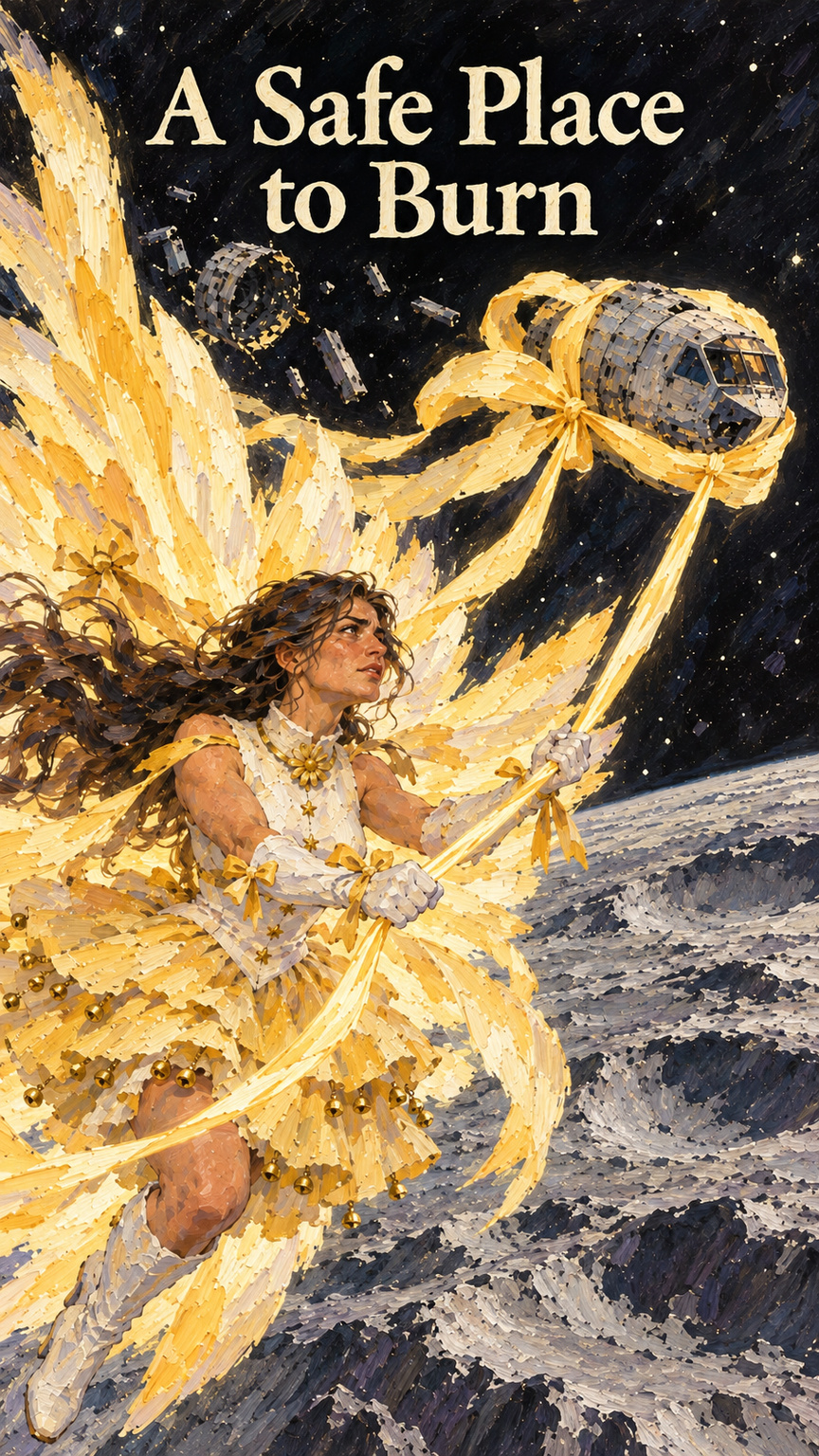
At eighteen percent, Hedra could hold our ship in one hand.
It was a hand made of light, six hundred metres long, with a white glove and a yellow bow at the wrist. Its fingers closed gently around the Kitewake while a boulder tumbled past our bow. Hedra herself floated outside the bridge window, looking pleased with her catch.
“You could have moved the rock,” I told her.
“You could have said thank you.”
“Thank you. Put my ship down.”
She opened the enormous fingers. Then she pressed her own, very small hand against the glass beside my head.
I put mine against it from inside.
My wife was thirty-six. The title on her license was still magical girl, and the bows she had chosen when she qualified still appeared whenever she transformed. Once, after a difficult negotiation over hazard pay, she had threatened to replace them with little skulls. She hadn't. Children drew pictures of her with the bows.
“Captain,” Kivik said from the drive station. “If you've finished conducting the hull inspection.”
Hedra showed him a gloved middle finger. Only the small one.
We had been surveying the little moon for nineteen days. Nothing lived there; nothing had ever been built there. Grey craters, a glassy plain, the sharp black shadows of mountains. We had found a chain of caves, and Hedra had spent her off-watch hours arguing that one of them looked like a rabbit. Sella had begun putting long ears on the survey maps.
I was watching Hedra laugh at something I couldn't hear over the crew channel when the drive struck us from behind.
The bridge snapped sideways. My harness caught me. The window filled with grey chips and spinning stars.
“Impact,” Kivik said. “Drive housing. Shutoff isn't taking.”
On the stern camera, a blue-white seam opened along the drive. There was no sound from outside, only the warning tone in the cabin, so small and polite that I hated it.
Hedra looked toward the stern.
I saw her put both hands around the daisy brooch at her throat. Her right wrist turned hard. The little gold ring around the petals broke.
“Hedra!”
The drive opened.
For a moment the whole ship was inside a yellow flower.
Its petals caught the expanding fire and folded over it. The bridge went dark. Something huge struck the underside of the hull, and every loose thing in the cabin rose together: a pencil, Kivik's spectacles, the biscuit I had been saving.
The lights returned. A ribbon lay across the broken window frame, holding the air in.
On the stern camera, the engine was gone. So was the aft third of my ship. The remaining decks hung inside a net of yellow ribbons. Where their ends met, a woman in white boots held a burning flower between her hands.
My display acquired a new window. HEDRA: CHANNEL LOAD. Eighty-four percent.
“All stations,” I said. “Answer.”
Kivik beside me. Sella in the galley. The other four, one after another, from the survey deck. Seven voices, including mine. I counted again without meaning to.
“Hedra?”
“Here.” She sounded winded. “I caught it.”
“You caught it. Let it go.”
On the camera she opened her hands. The flower split, and a spear of light crossed the darkness, scattering the broken drive into sparks. Beyond it, a mountain on the moon lit from the side.
The number climbed to ninety-one.
“Hedra, close up.”
“Trying.”
We were dropping. The drive had been firing when the rock struck, and its last impulse had shoved us out of orbit. The surface grew beneath us. I called up the impact estimate, looked at it, and put it in the corner where I could still see it without staring.
Nine minutes.
I sent the distress call.
“Everyone forward,” I said. “Pressure cabin. Sella, count them through the bulkhead. Kivik, emergency panel.”
Hedra stayed between our wreck and the moon, the ribbons taut around her. They were slowing the fall. I could see her fingers working at her brooch.
One hundred and six percent.
Kivik brought up the medical channel. A matching daisy glowed on his panel, each petal an indicator. He selected shutdown. The petals blinked shut.
Outside, Hedra made a strangled noise. For an instant her ribbons thinned enough for me to see the stars through them. Then the light came back brighter.
One hundred and twenty-eight.
“Stop,” she said. “Don't do that again.”
Kivik took his hands off the panel.
“What happened?” I asked.
Hedra looked directly into the stern camera. “It won't close.”
“Can you untransform?”
She tried. Her yellow skirt flickered. Beneath it I glimpsed the blue flight suit she'd been wearing at breakfast. Then the skirt returned in three tiers instead of two, each edged with tiny bright bells.
None of us heard them. There was no air outside.
“Hedra.”
“It's opening farther when I try.”
Her license was in a frame over our bed. I'd read the limits printed along the bottom, most recently while looking for a moth. A hundred was the full width of the channel a body could safely hold. The brooch limited her to a small fraction of that. The brooch did not make the magic.
“Put it into something,” Kivik said. “All of it. The rock, the ship, anything.”
“I'm already putting it into the ship.”
She spread her arms. Wings unfolded behind her, yellow feathers longer than our remaining hull. The wreck rose. The impact estimate blinked out, then returned with another three minutes added.
One hundred and sixty-three.
“There isn't less of it afterward,” she said.
Sella came through the bridge hatch with the last of the survey crew. One had a hand wrapped in a towel. Another was holding somebody else's boot. Sella put a palm on each shoulder as they passed her, moving them toward their crash seats. She looked at the number on Kivik's panel and stopped.
“No,” she said.
Hedra's face disappeared behind the wing for a moment. When she came back into view she was shaking her head, hard, like someone trying to wake up.
“We can get you inside,” I said. “Get everyone here, cut the cabin free. You won't have to hold the whole ship.”
“Romy.”
“We've got the jets. We can help.”
“I know.”
I had kept my voice level through the count and the broken hull and the failed shutdown. I lost it then.
“What's it going to do to you?”
Hedra swallowed. Her hands were still at her throat. She looked away from the camera.
“Magical girls normally only use small amounts of their magic. 10, 20%. I'm at 195% and rising. Once I get you and the crew to safety, I'm going to find a safe place to burn up. Good bye. I love you so much.”
For a moment I thought she had changed to a private channel. She hadn't. Behind me, someone began to cry.
“No,” I said. “You don't get to say it like you're hanging up.”
Her mouth crumpled.
“I don't know how to say it.”
“I love you,” I said. “I love you. Now come to the window.”
She looked at the camera for a long moment. Then the wings swept, and the Kitewake rose under us. She came around its side in a trail of little yellow stars.
I unbuckled. Kivik caught my arm, but I shook him off and crossed the bridge. The old window was gone; a sheet of her light held the air in its frame. I stopped just short of it.
She was there. Her hair had come out of its plait. It floated around her face, bright at the ends. There were new bows at her shoulders, and the light at her throat was too strong to look at.
I lifted my hand.
She reached toward it. Before she touched the shining barrier, the metal beside my face ticked sharply. The paint blistered along the frame.
Hedra snatched her hand away.
On the wall above me, the cabin temperature began to climb.
“Back,” she said.
“Hedra—”
“Romy, get back.”
I stepped away. She went with me in the other direction, away from the ship, her open hand still raised. The ribbons stretched between us.
“I wanted to come in,” she said.
Behind her, one of the wings came apart. Its feathers scattered in a whirl, then joined again farther out, each feather now a curved white shield with a yellow bow at its base. They circled her in a widening skirt. The light from them swept across the cabin, across Sella holding the injured surveyor, across Kivik's bare face.
Two hundred and twenty-one percent.
Hedra looked down at herself. “Oh, that's ridiculous.”
It was the voice she used when her transformation caught a sleeve in a door. I sat down before my legs could fail me.
She took a breath I could hear over the radio.
“Cut the cabin loose. I can't keep all this.”
Kivik put his hands back on the controls. Sella tightened the last harness and dropped into her own seat. I buckled in, armed the separation bolts, and brought the cabin's maneuvering jets online. Four green indicators. A flight plan that ended in the moon.
“Hedra, we haven't got thrust to clear the surface.”
“I have.”
“You'll have to push us along the horizon. Up won't do it.”
“Then steer me.”
I fired the bolts.
The deck jumped. Our nose cabin broke free. For a moment the rest of the Kitewake hung beside us: the bunks, the galley, the tiny room I shared with Hedra. A yellow ribbon slipped through the broken decks and unwound. The wreck fell away.
The cabin tilted, and the moon filled the window.
I fired the port jets. Hedra's ribbons gathered beneath us into an enormous bow. Two long tails streamed back to her hands. The white shields turned edge-on and swept around her, clearing a path through the wreckage falling with us.
“That's it,” I said. “Hold that line.”
We began to move sideways across the moon.
At first I could make out individual stones below us. Then the grey ground blurred. A ridge came up ahead, jagged black across the stars, and I pulled the nose toward its lowest saddle. Hedra followed my turn. The bow beneath us tightened. All seven of us sank into our seats.
We cleared the ridge with the lower tail of the ribbon brushing its peaks. A bright seam ran along the stone where it touched.
The pressure cabin shuddered. Something in the wall gave a loud crack.
“Too much,” I said.
“I know.”
Two hundred and sixty-eight. Her voice was tight now. The star-shaped buttons on her bodice had multiplied until a whole constellation shone around her waist. One by one they lifted away and wheeled around the cabin, taking the heat of the ribbons on their little golden points. She had put herself farther behind us. I switched from the window to the cabin's rear camera, afraid to lose sight of her.
The curve on my flight display bent away from the surface.
Not enough.
I feathered the jets, keeping the cabin square against her pull. One of the surveyors was praying. Kivik called out our speed. Sella told him to keep doing it.
Hedra's wings opened again, beyond the ring of shields. There was no longer room for them on the camera. Their light raced across the plain below us, overtook the mountains, threw shadows out behind craters I had spent nineteen days measuring.
The curve lifted clear of the moon.
I checked it against our speed. Checked it against our height. Behind us, Hedra was a small dark figure at the centre of a flower the size of a city.
“We've got it,” I said. “We're clear.”
“Check.”
“I have.”
“Again.”
Kivik read the figures back to me. I ran the plot once more. The line went out into darkness, well above the mountains, toward the traffic orbit. There was a rescue beacon on it, coming our way.
“You can let go,” I said.
The bow untied beneath us.
Our little cabin sailed on. Hedra fell behind, trailing ribbons. The numbers on my display stopped changing so quickly: distance, speed, predicted intercept. Small ordinary numbers I knew what to do with.
Hers was three hundred and four.
“Everybody?” she asked.
Sella unmuted the crew channel. They answered her themselves, all seven of us. The surveyor who had been praying tried to thank her and couldn't finish. She pressed her lips together and nodded. Then she looked away from the camera, toward the moon.
“I have to go now.”
Below her was the long, flat basin where we had landed on our first survey day. I could still see the little dark mark our launch had made.
“There's the basin,” I said. “Nothing down there. I'll warn the traffic.”
I was already bringing up the emergency broadcast. If the other ships turned now, if we cut our own path behind the nearest ridge, if the release stayed inside any estimate I could invent, she wouldn't have to fly farther.
She could stay where I could see her.
“The far side,” she said.
“You don't have to go that far.”
“The crater with the rabbit caves. It's deep.”
“We can clear the near side.”
She looked toward the lights on the traffic display I had shared with her. One was the rescue tender, burning toward us.
“I don't know how big it's going to be.”
I stared at the little tender. It had turned out of its safe orbit because I had called for help.
“Neither do I,” I said.
“Put the moon between me and them.”
I brought up our survey. The crater lay just beyond the far limb. There was no shallow way down to it from where she was; she would have to skirt the high ground, then drop behind it. Another minute of flight. At the rate her number was climbing, I didn't know if she had a minute.
“We'll lose radio,” I said.
“I know.”
“When you go behind it, I won't be able to hear you.”
“Romy. I know.”
I laid in the route. My hands kept moving the last point back to the near side. I made myself stop. Sent it.
Hedra turned.
The huge wings swept together behind her, folding their bright surfaces into a cup. Its open mouth faced the moon. All the streaming ribbons ran toward it. She couldn't close the channel, but I had watched her turn its light away from us once already.
“That way,” she said, almost to herself. “Keep it going that way.”
She flew.
The rear camera followed her across the mountains. Her skirts streamed behind her in enormous yellow tiers. The bows were still there. I could pick them out, absurdly neat, at the roots of the vast white wings.
I magnified the image. Through the wash of light I could see a little of her face.
“I'm frightened,” she said.
I put my hand over my mouth. Sella leaned forward in her harness, trying to reach me, but the next seat was too far away.
“I'm here,” I managed.
“I don't want to stop talking.”
“Then don't.”
She made a small sound. Her lips moved, but nothing came out.
“You were right about the caves,” I said.
It was all I could find. The silly argument in the galley, her insisting on two long ears, Sella turning the map around, me saying rabbits didn't have mouths like that. I had been there. We had all been there.
“Definitely a rabbit,” I said.
Her mouth twitched. “Awful rabbit.”
“Terrible.”
Three hundred and eighty-nine.
Her face washed out. I pulled the image back until I could see her descending toward the horizon. The shields had begun to break. They tumbled away from her and vanished, each one leaving a streak across the dark.
“How far?” she asked.
“Past the next ridge. Then down.”
“All right.”
“I'm with you.”
The curve of the moon rose across her wings. For an instant the whole black ridge was edged in yellow. Then her figure dropped out of sight, and her voice broke into a burst of static.
I said her name.
The load window went grey.
I kept the channel open. On the camera there was only a mountain range and the black space above it. The cabin drifted; I corrected it automatically. Kivik asked me something, very softly, and Sella answered for me.
I waited for light on the near side, for some terrible sign she hadn't made it. The plain stayed dark.
Then, beyond the far limb, a plume of dust rose, lit white from below.
It climbed slowly at first. The crater's rim held the base of it out of sight. Its top spread above the mountains, brighter and brighter, until the cabin windows dimmed themselves and I could see my own face reflected over it.
The moon stood between us and the fire.
Behind me, harnesses creaked as people turned to look. I counted them again.
I left the radio open as the rescue tender came alongside. Sella undid my straps. Someone put a warm hand around mine, and I held it so tightly that they had to ask me to loosen my fingers.