
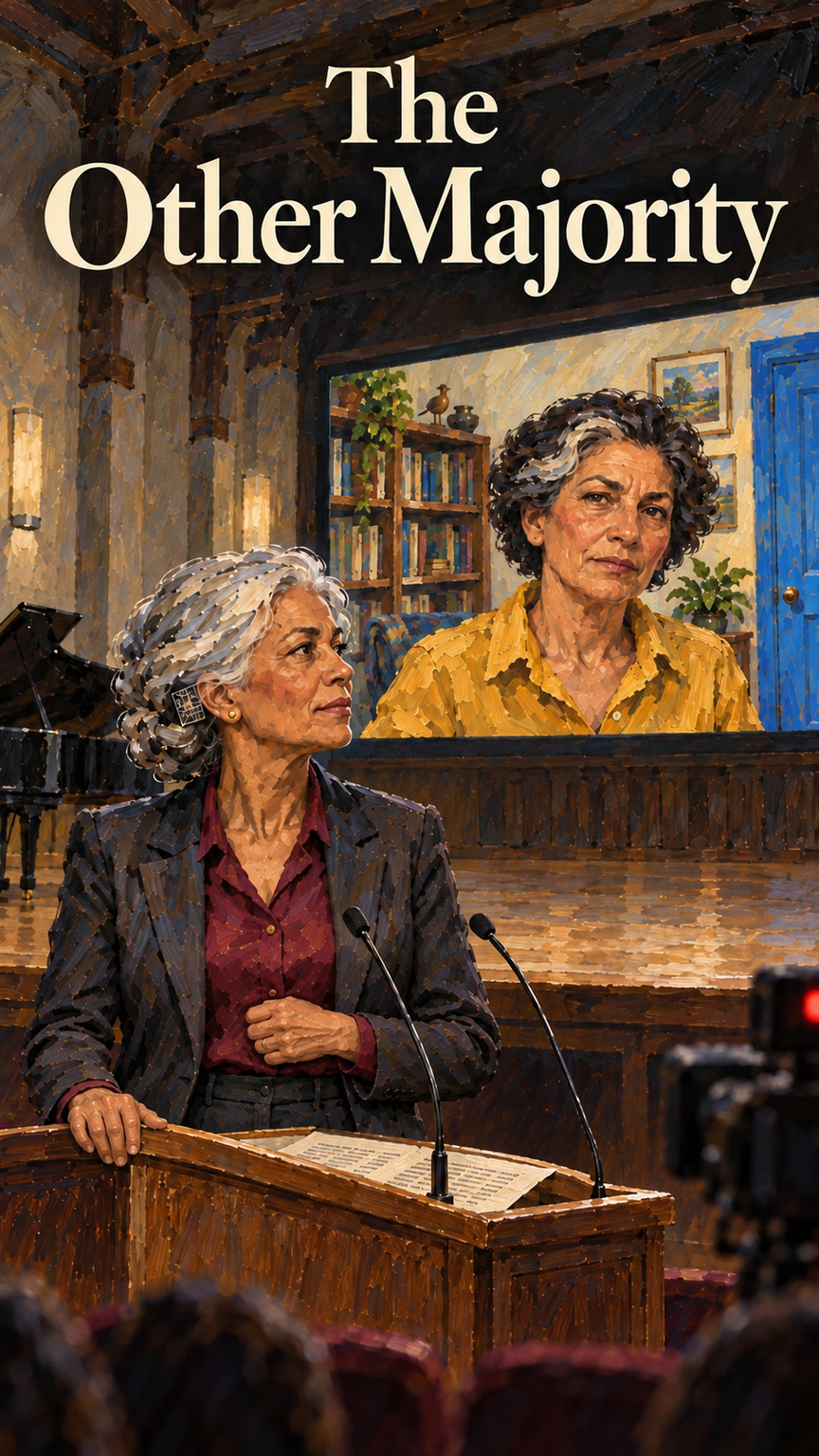
When Isabet Orris won immortality, she was using both hands to lift a glass.
The left had begun to fail in February. By June she could no longer strike a clean octave; by election night she needed the right to keep champagne off her jacket. She had refused a straw. On television a straw would have become the whole campaign.
Around her, people were shouting the returns from the southern districts. Her campaign had sent observers to every station, and the observers had photographed every signed count. There were still photographs coming in, grainy paper squares held against coats and car doors. The sum on the wall passed the number they needed.
“Don't jump,” she told her campaign manager. “You'll break something I have to pay for.”
He embraced her anyway. Someone caught the glass.
Outside the election hall the crowd took up her name. It was the same chant she had heard after concerts, except that now they were asking her to come out and live forever.
She wanted to. She had been remarkably plain about that. Other candidates promised centuries of service, wisdom ripening in an inexhaustible body. Isabet had said she wanted to play the second movement of the Kessel concerto without wondering whether it would be the last time. She wanted a hundred more summers. She wanted to eat cherries after her doctor had stopped worrying about what she swallowed.
The speech had been called selfish. Millions had sent her cherries.
She had promised to spend the award's civic endowment on free concerts. Ordel had pledged it to hospital equipment. The treatment itself carried no obligation to be useful; she had said that too, and lost the endorsement of three newspapers.
The electoral commissioner arrived before she could go onto the balcony. He wore his ceremonial white coat over a rumpled shirt and carried no glass.
“May we speak privately?”
“If it's about my tax return, I intend to pay it over the next thousand years.”
He did not smile.
In the little room behind the stage he said, “You have not won.”
Through the door she heard somebody singing the opening of the concerto, with entirely wrong words.
“We have the returns.”
“You have some of them.”
“Every station. There are pictures.”
“Yes,” he said. “That has made this difficult.”
She set her hands flat on the table so he would not see them shake.
The commissioner placed a folded printout between them. At the bottom were two columns: BIOLOGICAL and CONTINUED. In the first, Isabet had her narrow majority. In the second, the physician Renn Ordel had beaten her by nearly forty million votes.
“Continued what?”
He turned the next page. A sample of the electoral roll. She read six names before she stopped.
MARET TAL.
The name was uncommon. The date of birth was right.
“My wife,” Isabet said, very softly, “has been dead for twenty-three years.”
“I know.”
She reached across the table and caught his immaculate sleeve. Getting hold of it took two attempts.
“Then you have twenty-three seconds to explain why you're using her name.”
*
There was a lift beneath the election stage. Isabet had performed in the hall six times and never known it existed.
As they descended, the commissioner pointed to the faint square behind his ear. She had one too. Most people did. The neural mesh watched for damage, kept a recovery profile in a hospital vault, and let surgeons restore what a stroke or an accident had taken. At certified death the profile was deleted. Her consent forms had said so.
“There was a period,” he said, “before regenerative medicine, when we could preserve a person but could not repair the body.”
“Preserve.”
“Continue. On other equipment.”
“I know what you're saying.” She let go of his sleeve. “I don't know why you're saying it in that voice.”
The lift opened onto a broad gallery. Behind glass, ranks of dark cabinets extended into the distance. Small amber lights burned on them. A screen above a desk showed a street where no such street could fit: red buildings, people in a square, a woman closing a striped awning. The movement stopped. A number in the corner changed. The movement resumed.
Isabet had played to larger audiences than the population of her birthplace. She knew what a crowd looked like when it was waiting for something.
“How many?”
“Seventy-three million registered electors. More unregistered.”
“Here?”
“Here and in two other facilities.”
She pressed two fingers against the square behind her ear.
“You didn't delete them.”
“No.”
“They didn't agree to that.”
“No.”
He had the sense not to offer an explanation yet.
On the screen, a boy ran under the awning and stopped halfway through his next step. Isabet looked away.
“The treatment,” she said. “The vote.”
“The regrowth lattice is real. One new viable seed every six years. We have never managed better. Ordel will receive this one.”
Every child had seen pictures of the first recipient, two hundred and eleven years old, stepping uninjured from the wreckage of an aircraft. The lattice made a body capable of rebuilding itself; a portion was kept with the recovery profile in case the body was lost entirely. That was immortality: the stubborn, extravagant return of flesh.
“But this came first.” She indicated the cabinets.
“More than a century before it.”
“And they vote.”
“The constitution says every citizen. It doesn't say every living body.”
“Does it say you may invent election returns?”
He took off his ceremonial coat. Under it he was a tired man with a stain near his shirt pocket.
“We count everyone. Then we publish the percentages against the biological turnout. It has been done that way since the first award.”
For years Isabet had watched totals appear on the national broadcast, accompanied by music and pictures of cheering voters. Every six years the country chose one person to keep. The candidates bowed to the result; the winner went to the clinic. Nobody published the station counts.
Previous campaigns had checked sample stations and accepted the official sum. Her fan clubs had supplied enough volunteers to check them all. Her campaign manager had called it an encore.
“You're asking me to concede,” she said, “so you can put my face beside another set of lies.”
“I'm asking you to see whom those lies have kept alive.”
“Show me my wife.”
*
The room had a table, a chair and a screen. Someone had thought to provide tissues. Isabet put the box on the floor.
Maret was waiting.
She wore a yellow shirt Isabet had never seen. Her hair was short, with a grey streak above the right temple. There had been no grey when she died. Behind her stood bookshelves and a blue door, and somebody outside was trying to sing.
Isabet sat down. She had rehearsed meeting Maret again through twenty-three years of dreams, and now she could not find anything to say.
“You look tired,” Maret said.
“I've been campaigning.”
“I watched.”
That hurt in a place Isabet had not prepared for.
“All of it?”
“Most. They give us the broadcasts. I missed the last debate. Our ward was suspended.”
“You watched me and you couldn't—”
“No outgoing connection. The ballot channel accepts a candidate number once every six years. Nothing else.”
“You could have refused to vote.”
“People have. Nobody outside knows when we do.”
The singing stopped. Maret glanced towards the door, and Isabet felt an absurd resentment of whoever had been there, whoever could interrupt this.
“Is this your house?”
“My room. I share the kitchen with four people.” Maret leaned closer. “Ask me something.”
“What?”
“Something to make you believe me.”
Isabet stared at her mouth. There was the little unevenness in the upper lip, where she had been struck by a falling shelf. Isabet had held the ladder. They had argued for years about whose fault it was.
“I don't want an examination,” she said. “I want you to have been allowed to tell me.”
Maret put her hand against the screen. Isabet lifted her own, then lowered it. Touching glass would make her angry, and she was afraid of what she might do with more anger.
“Did you vote for him?”
Maret's hand stayed where it was.
“Yes.”
She had asked the commissioner whether Maret supported Ordel. He had suggested she ask Maret herself. She had been sure there would be an error.
“You know what's happening to me.”
“I do.”
“Then what has he promised you?”
“An additional third of processing capacity. He's pledged the endowment to the recovery vaults. He came here and showed us the costings.”
“He came here.”
“All the approved candidates did.”
Isabet had entered through the public nomination route. Her campaign manager had called the official shortlist a gathering of respectable corpses. She remembered enjoying that.
“You should have been asked too,” Maret said. “You were supposed to lose before anybody had to tell you.”
“And you thought that was acceptable?”
“No.”
“But you voted.”
“Yes. I wanted people awake.”
Outside the blue door, the singer began again, a few bars further on.
“That's Petren,” Maret said. “He thinks he paused for breath. He was stopped for eleven minutes. I was too, just before you came in. They moved our allocation to this room.”
Isabet looked at the bookshelves. There were handwritten labels on them, illegible at this distance. A chair with a cushion. A cup.
“Do you eat?”
“We can. It takes more time than most of us can afford. I like the cup.”
“And Ordel gets a body.”
“He gets the years to keep his programme running. We get time to see our friends before one of us is put away again.”
“He might not keep his promise.”
“He might not. I don't know how to vote without that risk.”
Maret's voice was sharper now, the way it had been when Isabet made a joke in company at someone else's expense and expected her to laugh. Isabet recognised it with a rush of love so painful she had to look down.
Her left hand lay curled in her lap. In six months, perhaps a year, she might be in one of those cabinets. Someone would decide whether she was permitted the time to be frightened.
“You can't expect me to want this,” she said.
“I don't.”
“I've spent the last year explaining why I want to live.”
“I know why you want it. I wanted it for you too.”
“Just not enough.”
Maret drew back. For a moment the old marriage was there in all its dangerous familiarity: the phrase Isabet would regret, the silence in which she could either retrieve it or make it worse.
She made herself wait.
“I'm sorry,” she said finally.
“I stood for the ward council because they suspended a woman halfway through rehearsing my play,” Maret said. “When they brought her back, she was no older. Everyone else had finished rehearsing. They offered her a different part.”
“You've written a play?”
“Three. You would hate two of them.”
“Would I?”
“Absolutely.”
Isabet laughed once. It came out badly.
Maret looked towards the blue door. “I have been here a long time. I can't make these people less important to me because you're here now.”
*
Isabet used the full seven days allowed for an electoral challenge.
On the first morning she told her waiting supporters that she disputed the announced count, that her evidence was secure, and that they should go home and sleep. She had not slept herself.
The commissioner offered her a private connection to Maret while they discussed a statement. She asked for a connection to the archive council instead.
Its members disagreed so fiercely that she had to stop trying to remember who was on her side. One wanted the secret preserved because his grandchildren, whom he watched on public programmes, had joined a group opposed to the immortality award. Another wanted immediate disclosure even if the government shut the whole city down. A third asked whether the candidate had considered that the people who controlled the electricity were also the people being told their votes had never been enough.
“I have,” Isabet said. “What I need to know is whether you can leave.”
They could be suspended and moved. That was how the recovery vaults held the profiles of trauma patients while hospitals prepared to receive them. Keeping a person safely stored required little power. Letting that person think required much more. The archive's population could be preserved outside the three facilities; there was nowhere else with enough equipment to keep everyone awake.
“Then we find people who will take you,” she said.
“As what?” asked the woman who had spoken about electricity.
Isabet had no answer that a hospital had yet agreed to.
She called Ordel.
He came to the hall without his campaign staff. She knew his face from weeks of wishing he would disappear from the news: broad brow, heavy eyelids, a small, infuriating expression of patience.
Her lawyers had sent her a proposed case. The country had voted under published rules, on a published roll. A hidden administration could not simply add another electorate afterwards. They thought a court might agree.
“I could challenge every ballot in that second column,” she said.
“You could. I would fight the case.”
“Because those are your votes.”
“Yes.”
She had spent an hour reading the lawyers' messages. If she won, there would be surgeons and a clean octave, her left hand opening when she asked it to. The photographs could carry her case a long way. She would have to explain why only one column mattered.
“How long have you known?” she asked.
“Eleven years. A patient of mine died. I noticed the hospital continued to bill for her recovery profile.”
“And you didn't tell anyone.”
“I told a great many people. They were all people who already knew.”
“I haven't been impressed by them.”
“Neither was I. I thought if I won I could change things slowly.” He looked at the paper returns stacked on her desk. “You have made slowly rather difficult.”
“Will you accept the treatment?”
“Yes.”
She appreciated that he did not pretend to hesitate.
She turned her phone face down.
“I'm releasing both counts. Help me make you win an election we can publish.”
He knew hospital directors. She knew people who would come when she asked, and people who would come for the cameras. Between them they found six institutions willing to listen.
At the first meeting, a director spent twenty minutes discussing additional storage liability. Isabet nearly walked out. Then the woman asked to speak directly to a continued person.
Maret appeared on a portable terminal. The director asked whether she could understand a transfer agreement.
“Probably,” Maret said. “Could you send it to me?”
The director had been speaking to Ordel. She turned the document towards the camera instead.
“The archive can't recall a patient by order,” she said. “Waking allocations will be ours to make. You need to understand that too, Ms. Orris.”
“I wasn't asking for—”
“You've brought me your wife. What happens when I tell you we cannot wake her?”
Isabet had imagined evenings. Maret telling her about the plays, with enough time left to argue about them.
“The transfer test,” she said. “The broadcast.”
“We can agree those sessions, if she consents. After that, no extra time because she's married to you. You can book calls like anyone else.”
Maret was reading the document. Isabet watched her reach the relevant paragraph.
“I want that kept in,” Maret said.
Isabet looked back at the director.
“Keep it in.”
By the fourth day three hospitals had signed. They would accept consenting continued citizens into recovery vaults under ordinary patient protections, with independent clinicians responsible for access. They could run only a few at a time. Everyone else would have to wait in suspension. The courts might decide the directors had exceeded their authority. Ministers might try to take custody back.
“They will,” the commissioner said.
“Then you should put your name on it too,” Isabet told him.
He looked at her for so long she thought he would leave.
“If you are going to expose the country,” he said, “you will expose my part in it.”
“Yes.”
He signed.
The archive council voted that evening to authorise the offer. Citizens would choose for themselves whether to move. Some refused. Some distrusted hospitals more than they distrusted the commissioner. Some had voted against disclosure and would not leave the people who had voted with them. Maret lost an argument with Petren and came to her next call furious.
“Let me speak to him,” Isabet said.
“He knows your views.”
“I can be very persuasive.”
“Yes. That was one of his objections.”
Isabet shut her mouth.
*
Maret volunteered for the first transfer.
“They haven't given you a date for waking again after the test,” Isabet said.
“I know.”
“You could be asleep longer than if you stayed.”
“Here I can't ask anybody outside. I want to go.”
On the fifth day Isabet carried the sealed unit to the north hospital in the leather case she used for scores. She had not needed to bring the case; the unit was no larger than a book. She wanted something substantial to hold.
An ambulance took them. Outside the hall a few of her supporters were still waiting. One held a sign that said LET HER LIVE. Isabet lowered her head before the woman could see her.
At the hospital a clinician read the seals aloud and matched them to the transfer order. Isabet watched him fit the unit into a recovery dock. He called the archive technician. They checked the state record and its accompanying room files together. He asked Isabet to sit down.
She remained standing.
The screen lit.
Maret stood in her room beside the blue door. She looked straight out at them.
“Did it work?”
Isabet began to laugh and could not stop. The clinician put a chair behind her. She sat down hard.
“I'm at the hospital,” Maret said. “Am I?”
“Yes.”
“Could I see?”
They turned the terminal. Maret looked at the bed, the cream walls, the clock, the clinician holding her papers. At the window she said, “Wait.”
There were ordinary trees outside, crowded against the afternoon sky. A bird landed on one of the branches, stayed briefly, and flew.
“We can give you a better view,” the clinician said.
“This is good.”
He let her look.
Later, with a few minutes of the agreed test remaining, Isabet was alone with her. Maret asked to see the hospital's consent form again.
“Is something wrong?”
“No. I want a copy.”
The council put the offer on the archive's public screens. By the end of the next day millions had applied, accepting suspension with no promised waking date. Most were still waiting for transfer. Once Maret's test had been verified, technicians opened the hospitals' medical transfer links; the spare vault storage could take far more people than the computers could run. Others chose to remain in the old facilities. Several council members stayed with them. Hospital directors answered angry calls from their own boards without yet being able to explain whom they had admitted.
The arrangements could not remain secret much longer. Isabet announced that her challenge statement would be made from the election stage that night, live, with Ordel present.
She dressed herself slowly. One cuff defeated her. The campaign manager fastened it without comment and then said, “Are they going to arrest us?”
“Possibly.”
“Is it a good statement?”
“It's a long one.”
“You've always done well with those.”
*
Onstage, she looked at the camera and saw the little red light come on.
She had thought she would begin with Maret. In the end she began with the count.
“The figures my campaign published are accurate. So is the certificate naming Dr. Ordel. Those facts should not both be possible.”
They put the photographed returns on the screen, then the two-column count.
She explained the profiles, the continued citizens, the falsified public totals. The commissioner stood beside her and answered questions she had given him no chance to approve. Ordel confirmed his private campaign in the archive. She made him say how long he had known.
Then Maret appeared behind them, speaking from the north hospital.
“My name is Maret Tal,” she said. “I died on the seventeenth of August, twenty-three years ago. I was forty-six. I have been a citizen of this country for all the years since.”
Isabet turned before she could help it.
“I voted for Dr. Ordel. I did not vote for my wife.”
Somebody in the press seats made a small involuntary sound.
“I would like you to hear why,” Maret said.
She told them about Petren, about the suspended wards, about people waiting years to finish an argument. She named council members who had opposed disclosure. She said that their fear was reasonable. She did not ask the living to be pleased with the election.
The hospital had invited journalists, clinicians and people chosen by lot from its waiting room. One of them, an elderly man in a dressing gown, leaned towards the microphone.
“Can you find anyone?”
Maret looked towards someone outside the picture.
“If they were continued. If they want to answer.”
He gave a name. His sister. The hospital team had warned everyone that there would be very little capacity, but he waited beside the microphone until a woman appeared in another window. She was younger than he was by decades.
“What have you done to yourself?” she demanded.
The man touched his bald head. Then he was crying, and she was calling him by a name he kept shaking his head at, as if she ought to know better than to say it on television.
Another woman asked for her son. They could not find him in the registered records. She stayed in her chair while the man beside her talked to his sister. The camera did not know where to look.
In the election hall, a journalist stood up and said the whole thing could have been fabricated.
“Yes,” Isabet said. “You should investigate it. We're releasing the records and the custody agreements. You can go to the hospitals. You can speak to people without us present.”
“You expect us to believe the election was won by the dead?”
“I expect another election. With a roll everyone can inspect.”
He began another question, but the picture beside Maret's went black.
It had been the archive square. A council member was preparing to speak from it. The sound stopped halfway through her first word.
Isabet looked at the commissioner. He was staring at his phone.
“An order to isolate the facilities,” he said. “From the ministry.”
For a moment Isabet could hear nothing except a loose fitting on somebody's camera tapping against its stand. Petren was there. The woman who had spoken about electricity was there. Seventy-three million had been a number she could hardly hold in her mind; now it was the next word of a sentence that had not come.
“Maret?”
“I'm here.”
The hospital picture remained. Behind Maret, the blue door stood open. The elderly man was still speaking to his sister.
Isabet put her good hand on the edge of the lectern.
“Commissioner. Will their stored states survive?”
“Yes. The batteries will suspend them safely. If nobody interferes with the cabinets.”
“Who is guarding the cabinets?”
He began making calls. Ordel took his own phone out.
Isabet gave the camera the three facility addresses. She named the council members who had stayed. She asked the journalists to send people, and asked her supporters to let them through. There was shouting in the press seats now, urgent conversations, people getting up.
“The hospital has received the same order,” Maret said.
The director stepped into the picture. She wore a dark coat over her hospital clothes. Isabet had not noticed until then that she had been preparing to leave.
“I have patients,” the director said. “The ministry can put its request in writing.”
She took the microphone away to make a call.
Isabet had imagined the broadcast ending when she finished her statement. Instead she stayed onstage for another four hours. People called in furious. People called in with names. Some demanded that Ordel withdraw; others demanded that Isabet do so. One caller asked why people with no bodies should be allowed to decide who got one. Another asked whether he had already signed something that would make him one of them.
Isabet touched the square behind her ear.
“So have I,” she said.
She could not answer much more than that. She had to let the question remain.
Near midnight, a reporter reached the largest facility. The guards had refused an order to admit a ministry disposal team. There were cameras at the gates. The commissioner was going there himself.
At a quarter to one he called from the gallery Isabet had visited. The guards had accepted his signed custody order; the disposal van remained outside. He had brought two archive engineers back through the gate. They were restoring a single chamber on reserve power. Most of the city would remain suspended.
“Can we see the reporter?” Isabet asked.
The camera turned. The reporter stood beside a cabinet, speaking to one of the engineers. Behind them a small screen lit up.
At one in the morning the archive council member returned to the screen. She sat very straight.
“You interrupted me,” she said.
Maret covered her face. Isabet laughed, and this time it did not hurt her throat.
The council member waited for them to stop.
*
Eight weeks later, when Isabet went onto the same stage, people stood before she had played a note.
She disliked that. She waited until they sat down.
The rerun had taken an emergency court order and an agreement signed by both candidates. For this award, every registered citizen had been permitted to vote, with observers examining the continued roll and the hospital patients voting from their temporary vaults. What would happen at the next award remained before parliament. Outside it, opposing crowds carried photographs of the same people.
Ordel had won by a smaller margin. Isabet had sent him a basket of cherries, with no card.
He sat in the front row tonight. The treatment had taken years off his face. She tried not to look at him.
Three hospitals had become nineteen. Most of their continued patients were still suspended; the directors would not promise more capacity than they had. Families booked calls and then waited. Maret was awake for forty minutes this evening. She had spent ten of them arguing with the concert organiser, who wanted her picture projected above Isabet for the whole performance.
“I'd like to listen,” she had said. “Without being watched.”
They had given her the view from a camera in a front-row seat instead.
Isabet adjusted the bench. The nerves in her left arm flickered unpleasantly. She could play most of the second movement still. She had told the audience that in advance, which had cost her more effort than any of the speeches.
For nine minutes there was only the music and the work of bringing it out. Then her left hand closed on itself.
She tried once to release it. The bass line faltered. She stopped.
The hall was quiet.
She laid the hand in her lap and finished with the right, leaving out what it could not reach. The movement sounded bare and stranger than she had expected. When the last note went, she did not lift her hand for a while.
Afterwards, backstage, she called Maret on the portable terminal. The blue door was visible behind her again. Petren had finally chosen a hospital transfer; that afternoon his room had been linked to her ward again. His first message had been an objection to everything, including the microphones.
“I wanted you here,” Isabet said.
“I know.”
“In the front row.”
Maret looked down. Isabet could see the edge of the yellow cuff. She remembered fastening Maret's bracelets before they went out, a small thing she had once done carelessly, with years ahead of them.
“It was the right decision,” she said. “The election. I can see that.”
“You don't have to tell me tonight.”
“I'm telling myself.”
Beyond the dressing-room door somebody dropped a stack of programmes. The campaign manager, still attending to things long after he had stopped being paid, swore softly.
Maret glanced towards the sound.
“Will you call on Tuesday?”
“What time?”
“They've given me half an hour at six.”
Isabet looked at her hand. She would need help dressing soon. Later there would be hospital rooms, and decisions, and the little square behind her ear. She could not make herself want all of it.
But Tuesday was three days away. Maret would be there, with things to tell her that Isabet did not yet know.
“Six,” she said. “I'll call.”