
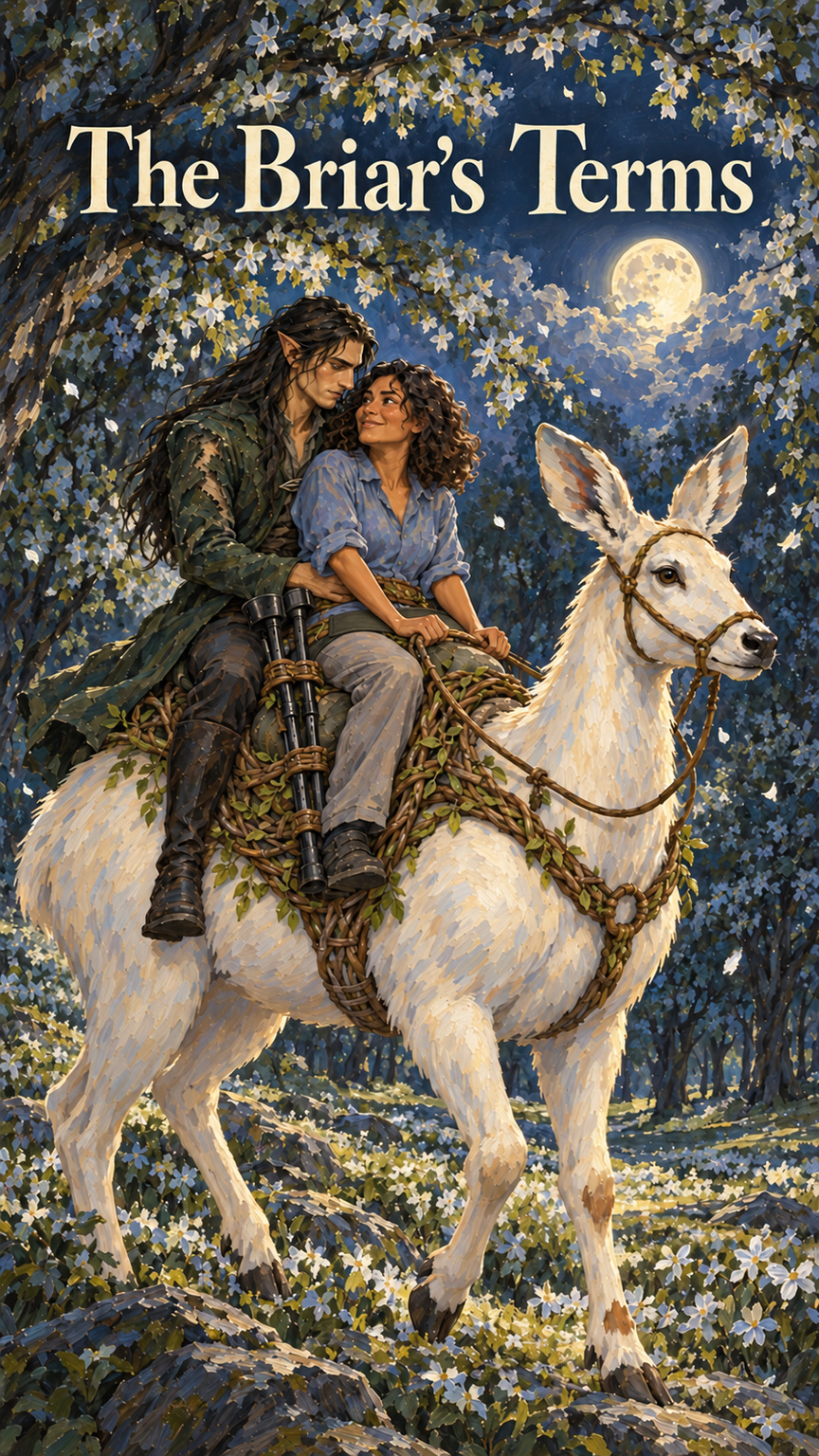
The first thing I did was look for my crutches.
The second was recognize the bed.
White branches held up its canopy, still alive, with tiny leaves furled along the wood. Beyond the open windows, the towers of the Briar Court stood among trees that had been old when the moon was young. I knew the window on the left would stick if you tried to close it. I remembered the crack in the green glass pitcher beside the bed.
I had never felt the weight of its blankets before.
“Dulcie.”
Rhaedren stood in the doorway. His black hair was loose over his dark green coat, and one of his pointed ears showed through it. He had a cup in each hand. Neither cup moved, though the tea spilled over his fingers.
He looked at me as though I had done something appalling and wonderful.
“I appear to be here,” I said.
He put down the cups. Then he was beside the bed, holding my face between his hands.
“Stay.”
For seven years, every morning had taken me from him. Sometimes we had parted gently. Sometimes I had vanished halfway through a quarrel, which was an excellent way to spend the following day unable to think about anything else.
“I’m trying.”
He kissed me once, hard, then drew back to look at me again. His thumb moved over my cheek. I could feel its small callus.
I had been dreaming my way into this country since I was twenty-seven. At thirty-four, I knew his face better than I knew the view from my office window. But dreams had never given me the cold air on my teeth, or the smell of his wet coat, or the uncomfortable way I had slept on my right shoulder.
My left leg jerked beneath the blankets.
His gaze dropped.
“It’s all right,” I said. “That happens.”
I pushed the blankets away. My faded blue sleep shirt had come with me, and my soft grey trousers. So had my crutches: they lay across the foot of the bed, black cuffs neatly nested together.
Rhaedren reached for them before I could.
“Those are mine.”
“I know. You told me.” He gave them to me, watching my face. “Did the crossing hurt you?”
“No. I don’t think so.”
I sat on the edge of the mattress and waited for my legs to settle. Rhaedren crouched in front of me. He had once made a visiting ambassador finish his threats from that position. Seeing him there now did something peculiar to my stomach.
“Then who has done this?”
“Do you remember the car accident?”
“Nine years ago.”
“Yes.”
He went very still.
I had told him about the accident. I had told him about the hospital, the wheelchair I used for distances, the crutches. But here I had crossed streams on stepping stones and run down corridors to meet him. Here, my dreaming body did whatever I expected of it.
He looked at my legs, then back at my face.
“They never healed you.”
There it was. I had heard that tone before, just before he declared war on the winter.
“They did what they could.”
“Bring me one of these healers.”
“You’d have to make an appointment.”
“Dulcie.”
“I’m serious. They’re busy.”
He took a breath. Outside the window, something long and thorned scraped the stone, then withdrew.
“Let me see.”
He held out his hand. Silver light gathered along his fingers: the mending I had seen close a split lip, a knife wound, the torn wing of a furious little bird.
“No,” I said.
The light went out.
His hand stayed where it was for a moment, empty. Then he rested it on his knee.
“Explain it to me.”
I rubbed at the mark my crutch cuff had left on my arm the night before. It was absurdly comforting to find it there.
“The nerves in my back were damaged. Some messages get through. Some don’t. I spent a long time learning what I could do afterward.”
“But the wound—”
“Is closed.”
He looked at me.
“Years ago,” I said. “You’re looking for something fresh to mend.”
His thumb moved across his own palm. A pale line ran through it, crooked at the base of his smallest finger.
I took his hand and turned it upward.
“You can still feel this when it’s cold.”
“It was old before I learned.”
“And your mending can’t reach it now.”
“No.”
For a while neither of us spoke. His palm was warm. He had that same hand in the first story I had written about him, though I hadn’t known about the scar then.
I had drawn his country at sixteen and written him into it at twenty-two. When I began to dream my way here, I had assumed that made me an authority. Rhaedren, who disliked half his dialogue and all the honey I had tried to feed him, had corrected that impression very quickly.
He believed I had glimpsed his world before I knew how to visit it. I still had a notebook full of crossed-out place names to offer in evidence. Neither of us had won the argument.
“There must be another working,” he said at last.
“There might be. If someone knows how to do it, I’d like to hear about it. Properly. What it does, what could go wrong.”
“I could seek—”
“Yes. We can ask.” I squeezed his hand. “But the spell you were about to use can’t do this.”
He looked at his extinguished fingers.
“No,” he said.
I leaned forward until my forehead touched his.
“And I would like some breakfast.”
His eyes closed. He made a sound that might, in a less alarming man, have been a laugh.
“Anything else?”
“The starflowers. They open tonight, don’t they?”
He opened his eyes.
“At moonrise.”
“I want to see them.”
“You have described them to me a hundred times.”
“I’ve imagined them a hundred times. That’s different.”
The starflowers bloomed once in a century, and were gone by dawn. I had filled three pages with them at sixteen: blossoms that opened with cold light, whole constellations growing on the branches. In the margin I had drawn a girl kissing an elf beneath them. I had given her flowing hair and a dress that would have been an absolute nuisance to get around in.
Rhaedren looked toward the window. Beyond the towers, the Briarwood rose in a dark ring against the afternoon sky.
“My parents took the lovers’ path on a flowering night,” he said. “My mother kept the shoes she left at the gate. I have them still.”
I remembered the shoes: green silk, embroidered with little gold birds, preserved in a glass case. He had shown them to me with a tenderness I had wanted for myself.
“Then let’s go,” I said.
He looked down at my crutches.
“You don’t expect me to walk there.”
“No.” He said it at once. “Certainly not.”
The moon-hind was broad-backed and taller than a horse. She bent her knees until the saddle was level with the mounting bench.
I had written that she was as white as snow. In person she was white with a brown patch above one hoof and a strong conviction that the last apple belonged to her.
“You missed a spot,” Rhaedren said.
“Artistic license.”
“On her part?”
I gave her the apple.
He had shaped a saddle from living willow, with deep cushions and a broad strap. He listened while I told him where I needed the support, then changed it twice. When I was settled, he fastened my crutches beside my knee, where I could reach them, and swung up behind me.
“Too close?”
“No.”
His arm rested around my waist.
“Now?”
“You know perfectly well what you’re doing.”
“I should hope so.”
I took the reins from his hand.
We rode through the orchard, where the apples turned their red cheeks after us, and out beneath the first great trees. His breath touched my hair. The hind’s gait was smoother than a horse’s; even so, by the time the towers disappeared, I was glad of the cushions.
At the heart of the Briarwood, the thorns grew so thickly that they shut out the sky. Roots crossed and recrossed the ground. The hind stopped before a narrow arch woven from branches, each thorn as long as my hand.
Beyond it lay a path barely wide enough for two people to walk abreast. Its stones shone pale in the dark.
The arch stirred. A branch reached toward the hind’s bridle, then curled back on itself. White flowers closed all along its length.
“It won’t admit the hind,” Rhaedren said.
I looked up at the living arch.
“Barefoot and unaided, let those who love come through,” I said.
The words were mine. I could see them on the page, in purple ink, beneath a drawing of two clasped hands.
At sixteen, I had thought they were beautiful.
“Is there another way?” I asked.
“The ring brings every road to this gate. Fly over the trees, and you find yourself here again.”
Of course it did. I had been very thorough about keeping unworthy lovers out of my grove.
Rhaedren dismounted and walked to the arch. The branches inclined toward him. For a moment I thought they would open at once; he was their lord, after all. Then a thorn settled against the silver clasp of his coat, and he stopped.
He had dressed for this. I saw it suddenly. There was no sword at his hip, no ring of office on his hand.
He had expected to leave his shoes here with me.
“We can go back,” he said.
“And miss the flowering.”
“The grove will still be here.”
“The flowers won’t.”
He turned. He did not smile.
“I won’t have you hurt yourself for this.”
“Neither will I.”
The hind shifted beneath me. I steadied myself against the saddle and waited for the little tightening in my left leg to pass.
Rhaedren watched, his hands empty at his sides.
“Then we cannot cross tonight.”
The arch creaked softly. It sounded pleased.
I looked beyond him, at the pale path, and tried to remember the girl who had written it. She had wanted love to matter more than crowns or swords or money. She had stripped everything else away and called what remained enough.
There were things she had not thought to include.
“Can you open it?” I asked.
Rhaedren looked back at the gate.
“I swore to keep this path as it was.”
“To whom?”
“My mother. When I took the wood.”
That stopped me.
The little green shoes were older than the stories in my notebook. She had been a real woman, with a son who remembered her. I had never written her a single line.
“I’m sorry,” I said.
He rested his hand against the arch. A twig curled around his wrist.
“She walked it with my father on the night they made their vows. She said that here, at least, the wood knew true love when it saw it.”
I could have let him take me back. He would have been gentle. We could have sat at the window and watched whatever light escaped the trees.
I wanted the grove.
I wanted to smell the flowers I had given no scent to. I wanted to kiss him beneath something neither of us had seen before. I wanted to get there in this body, with the crutches knocking against the saddle and his arm warm behind my back.
“It’s looking at us now,” I said.
He turned his head.
“I love you. You love me. What is it waiting to see?”
The twig tightened around his wrist.
He looked at it for a long time. Then his gaze travelled up through the thorned arch, toward the black roof of the wood.
“I have kept her shoes,” he said quietly. “I needn’t keep this.”
He closed his hand around the branch.
“Hold the hind.”
“Rhaedren. I want the trees left alive.”
He looked back at me, and there was the man I had fallen in love with: furious, certain, much too beautiful when he had decided on something.
“You do make demands.”
“Several. I’ve been very patient about the kiss.”
The corner of his mouth lifted.
Then he pulled.
The arch struck at him. Thorns caught his sleeve and tore it from shoulder to wrist. The roots under the hind’s hooves heaved. She tossed her head, and I shortened the reins, speaking to her over the growing noise.
Rhaedren did not let go.
Silver light ran beneath the bark. It passed from his hand into the arch and down through every root crossing the path. The branches bent toward him, then away, then toward him again, fighting an order he had never given them before.
His boots slid in the earth.
“You kept what I asked you to keep,” he said to the wood. “Now release it.”
Something snapped high above us. A great thorned limb swung down, and he caught it with his free hand. For an instant he stood holding the whole arch apart. A closed blossom slid down his torn sleeve and dropped between his boots.
The hind backed a step. I kept my voice low and my hands steady. Beyond Rhaedren, the narrow path was coming apart: roots unthreaded themselves from the stones, lifting in long, straining curves. Trunks leaned away from one another. The dark roof split.
Moonlight fell through.
“No one,” Rhaedren said, “will have to satisfy this gate again.”
The root beneath his feet broke loose from its knot. It rose, carrying the arch with it, and the branches swept overhead in a single enormous motion.
I ducked. Leaves brushed my hair.
When I looked up, the path was wide enough for a carriage. Living boughs held themselves high on either side, still bristling, still covered in flowers. Far away, through the parted trees, a pale light was gathering.
Rhaedren stood in the middle of the ride with his ruined sleeve hanging from his arm.
I let the hind walk forward.
He watched us pass beneath the arch. Then he looked back once at the place where he would have left his shoes. I let the hind stand until he turned back to me.
“Come on,” I said, reaching down for him. “You’re the one who knows the way.”
We reached the grove just as the first flower opened.
It was small enough to sit in my palm. At first I could see only a narrow blue seam in its white petals. Then they drew apart, and light spilled across the branch.
Another opened. Then twenty. Then the trees all around us were flowering, their branches lifting into constellations. Pale sparks came loose and drifted through the grove, turning slowly as they fell.
They smelled of pears.
I began to laugh.
I drew the hind to a halt beneath the largest tree, and Rhaedren slid down. I had planned to sit with him on the grass. Now my back ached and my left calf was stubbornly tight, and the saddle was a very good saddle.
“I think I’m staying here,” I said.
“Then I shall have to come up.”
He climbed onto the hind behind me again. I leaned back against him, with my crutches beside me and a thousand impossible flowers overhead.
“What do you need?” he asked.
“Some warmth. On this leg, if you can.”
He laid his palm over the tight muscle. Heat spread slowly through the cloth.
“Like that?”
“A little more. There.”
He kept his hand still. After a while the spasm began to ease. I loosened my grip on the reins.
“Did it hurt,” he asked, “when you went back? All those mornings?”
I watched a flower turn above his wrist.
“Some of them.”
His other arm tightened around me.
“I should have understood.”
“I liked leaving it behind.” I rubbed my thumb along his torn cuff. “The appointments. All the explaining. Here I could just turn up and be late for something.”
“You are remarkably good at that.”
“Seven years of practice.”
He lowered his face into my hair.
“Tell me about one of the mornings.”
I thought about it.
“Last Thursday I had coffee with my sister. We argued about whether she should marry her boyfriend.”
“Should she?”
“Absolutely not. He calls every woman he meets ‘young lady.’ He’s twenty-six.”
Rhaedren made a sound of disgust.
“You see? You understand the important things.”
“And afterward?”
“I went home. Did some work. Had a bad afternoon with my back. Ate the cherries I’d bought for a cake.” I tilted my head against his. “Thought about you.”
He was quiet for a little while.
“I sealed the green pitcher with resin yesterday morning,” he said.
I looked up at him.
“It will no longer spill on you. Then I waited for night.”
“Will you still be here at dawn?” he asked.
“I don’t know.”
I took his free hand and kissed the crooked scar in his palm.
Above us, a cluster of blossoms opened at once. Light moved across his cheek, the sharp line of his ear, the mouth I had spent an unreasonable portion of my adult life thinking about.
“Come here,” I said.
He did.
When I finally let him go, a little fallen star was caught in his black hair. I reached up and took it out.
It opened in my hand.