
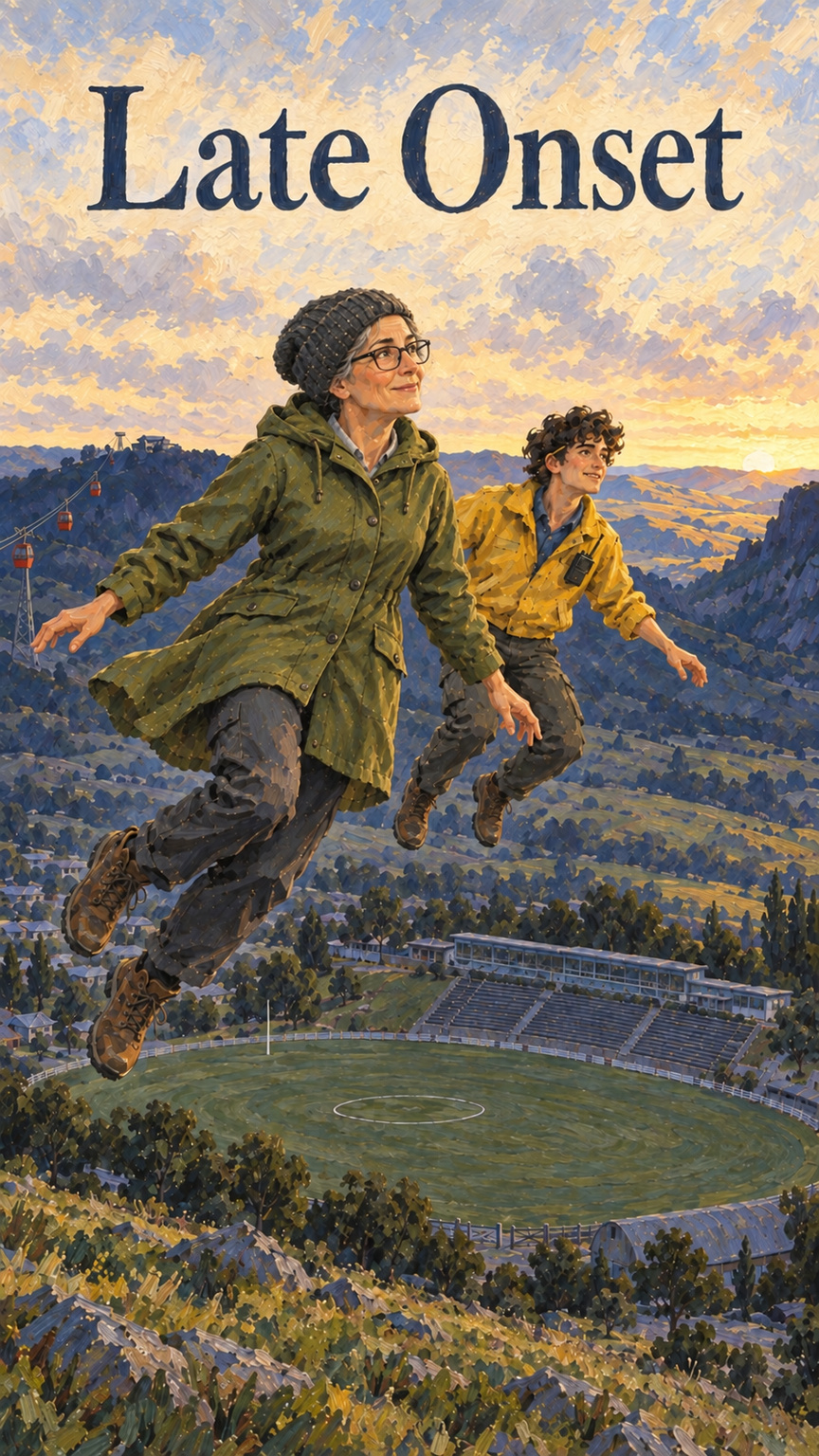
The first thing I levitated was a Number Six bus. This was inconsiderate of me. It was already running late.
I had just come from the doctor's, where we had discussed my sleep, my periods, and the sudden conviction, several times a day, that someone had installed a furnace behind my breastbone. Menopause, she said. We made a plan. I put the leaflet in my handbag beside the train tickets for my walking holiday and went out into the afternoon.
At the bus stop the heat came again. I pulled off my green raincoat and put one hand against the bus while I untangled the sleeve from my watch.
Its tyres left the road.
For a moment I thought I was fainting. The whole bus seemed to move strangely against the stationary shelter. A man inside rose out of his seat, still holding his newspaper open. The driver's cap hovered above his head.
My hand slid up the warm metal. I snatched it away. The bus bobbed a little higher, then came down hard enough to make the shelter rattle.
The driver opened his window.
I said, "I'm terribly sorry."
He looked at me. He looked at the tyres.
"Was that you?"
I was fifty-three. I had owned a bookshop for twenty-seven years. I had brought up a daughter, learned to dance reasonably well, and finally sold my share of the shop to a partner who enjoyed ordering calendars. I had never, before that afternoon, been a plausible answer to this question.
"I don't think so," I said.
Then my watch rose away from my wrist, taking my hand with it.
*
I had tested positive for the mutation at thirteen. My parents had bought fire blankets and taken the glass out of my bedroom door. At school I wore a yellow wristband for three years, so a teacher would know to press the red button if I became unusual during a lesson.
Nothing happened. The glass went back. By twenty, when even the slow starters had started, I was delighted to be ordinary. The girl who sat behind me in chemistry had spent her sixteenth birthday giving an interview about the ethics of lightning. I had spent mine failing to kiss a boy behind the bowling alley. Nobody had asked me to defend this publicly.
Thirty-three years later, the agency physician turned my old screening record toward me on her desk.
"Same marker," she said. "It's active now."
"Bit late."
"Yes."
"The other doctor said menopause."
"Another major transition. It may be relevant. We don't know enough yet."
She did not sound pleased to be handed an interesting case. She sounded annoyed that the screening system had no box for it, which I appreciated.
My daughter rang while I was waiting for the induction officer.
"Are you hurt?" she asked.
"No. Neither is anybody on the bus. They've checked."
"Good. I've watched it eleven times."
There was a pause.
"You're not cancelling your trip, are you?"
I looked down at my handbag. Six weeks until the sleeper train, then eleven days crossing the ridge country on foot. I had chosen the route myself. I had paid extra for a room with a bath at the far end. Nobody was coming with me.
"I don't know," I said.
That was the first part of the afternoon I truly resented.
*
Joss Bell came into the waiting room with a tablet and a pencil behind his ear. He had short black curls, a yellow flight jacket, and the narrow, unfinished look of someone who might yet grow into his own elbows.
"Delia Moss? I'm your instructor."
"How old are you?"
"Nineteen."
I managed to stop before asking whether his mother knew where he was.
"How long have you been flying?"
"Four years. Professionally, two."
He handed me the tablet. The first field asked for my parent or guardian.
"Sorry," he said, reaching for it. "Wrong form."
"I think it may be the right form with the wrong question."
He considered that, then sat beside me and opened a blank page.
The agency used an old airship hangar at the exhibition grounds. Beyond its great doors lay an oval arena, empty for the season. Along the north side, a grandstand climbed the steep bank in tiers, topped by glass-fronted rooms. The public cable cars crossed high above the arena's western end on their way from the lower town to the ridge station. I had sold postcards of the view for years.
Inside, the hangar smelled of rubber mats and cold metal. Joss brought out a trolley, put a padded training dummy and a crate on it, and asked me to hold the handle.
"What did you do to the bus?"
"I wanted some air."
"Did you imagine it moving?"
"I wasn't thinking about it at all."
He tapped his pencil against his teeth.
"Try wanting it to go up. A little."
The hangar was cool. I had no furnace in my chest, no particular emotion beyond doubt. I put my hand on the trolley and thought about its wheels leaving the floor.
It rose. The dummy and the crate rose with it. A loose strap floated above the crate, neither falling away nor dangling down.
"Keep touching it," Joss said quickly.
I did. He drew the whole assembly toward him with two fingers.
"And stop it."
I stopped wanting it to rise. It kept coming. Joss caught the handle before the frame struck his shins.
We spent most of that first lesson establishing that removing gravity did not remove the motion something already had. By the end I had driven the trolley into a crash mat twice and learned to pull it the opposite way before it reached what I wanted to avoid. The dummy looked reproachful. Joss kept moving the mat back into position.
The power took the whole trolley and everything on it. It did the same with a closed equipment box and the things inside. It could also take just me, although we discovered that rather abruptly when I made the wrong choice while sitting on the trolley.
Joss caught my ankle before my head reached a light fitting.
For a few seconds I floated above him. My cardigan had migrated over my face.
"Take your time," he said. "Normal down when you're ready. I'll lower you."
I had to trust that he could. I pulled the cardigan away from my eyes and looked at him, his hand secure around my ankle, his boots clear of the floor.
"Ready," I said.
He brought me down without a jolt.
Afterward, sitting on a mat, I had a thoroughly ordinary hot flush. Joss offered me water. The trolley stayed where we had left it.
"I can get you an interview slot," he said. "They're very interested."
"I don't want an interview slot."
"Okay."
"Just like that?"
"It's optional. They don't make that clear."
I fanned my face with my appointment card. He lay back on his elbows, considering the lights I had nearly hit.
"They asked me to do an advert for trainers last month," he said. "I don't run."
I laughed. He looked pleased.
Before I left, I asked whether I could safely walk alone in the mountains in six weeks.
He sat up again.
"I don't know yet," he said. "You need to be able to choose nothing even when you're frightened. And choose normal without dropping yourself."
I wanted a reassuring answer. That one was more useful.
*
On the third afternoon I managed to float myself from one end of a low practice lane to the other. I spent most of the journey facing backward. Joss flew beside me and called corrections while I discovered how little my ears cared for a floor that had become a wall.
Rain swept across the hangar doors. The ridge had vanished into a low bank of cloud. We were putting the trolley away when a sound came from outside, a great metallic crack that brought every conversation in the hangar to a stop.
Joss was in the air before his radio spoke.
Through the open doors I saw one of the red cable cars hanging at an angle above the arena. The others had stopped along the line. This one dangled below it, suspended from a thin emergency sling, its broken hanger swinging against the cabin roof.
Joss went straight up. I heard his breathing on the hangar radio.
"Eight inside. Ninety metres above the field. No injuries I can see. Sling's separating."
The duty officer asked how many he could take.
"One a trip. I don't think I've got that long."
A strand flashed loose above the car.
I went to the duty officer's desk.
"Tell him I can take the weight off it."
She looked from me to the open doors. She had seen my lessons.
"You'd have to get inside."
"Yes."
She pressed her transmitter.
Joss came down so fast he bent his knees on landing, though his boots never touched the concrete.
"If I get you there, can you keep a hand on it?"
"I can. Can you carry me?"
"Yes."
He put a harness over my shoulders and drew the straps snug. His fingers moved quickly; mine kept trying to help with the wrong buckle.
"You've lifted a bus," he said. "This is lighter."
We went out into the rain.
He carried me facing outward, one arm through my harness. The arena opened beneath my shoes. My body wanted to clutch him and climb over his head. I kept my hands where he had put them.
Above us, faces filled the cable car's windows.
Joss brought me up beside the open service hatch in its roof. The torn hanger struck the metal a few feet from his head. He caught the edge, lowered my legs through, and put me inside.
I dropped onto a bench beside a woman holding a little boy. Across from us, a man in a grey suit was gripping his briefcase with both hands.
"She's with me," Joss said through the hatch.
I got my palm flat against the vertical rail beside the door. He passed down a rescue strop, looped it around my wrist and the rail, and pulled it tight enough to keep my hand in place.
Then the last sling broke.
The car fell out from under my feet.
I had been going to take its weight away. That thought vanished. There was only the field below, sickeningly far away, and the sudden certainty that it was coming to meet us.
Up.
The loose end of the strop rose beside my face. The woman's boy came off her lap, still in her arms. My own legs drifted away from the bench.
I had selected all of us, car and contents. For an instant the stillness inside was so complete that I almost let it go.
"Keep up," Joss said. He had caught a rail inside the hatch. "We're still falling."
"I can't feel it—"
"Look at the station. Red roof."
Beyond the window, the roof of the lower station was climbing toward us.
I kept wanting up. The roof rose more slowly. The duty officer's voice came over the radio, a string of numbers I could not make into anything useful.
The red roof stopped.
"None," Joss said.
I took the pull away.
We were hanging above the western end of the arena. We had lost much of our height. The grandstand roof was no longer something to look down on.
Rain hissed against the glass. A blue scarf drifted from one end of the cabin to the other. The man in the suit let go of his briefcase, then tried to retrieve it by swimming.
"There's a restraint under each seat," Joss told the passengers. "Pull the red tab. Pair up. Keep hold of each other."
He moved down the cabin, giving people something solid to catch and guiding them toward the seats. Nobody cheered. The woman had both arms around her boy and was whispering into his hair. A teenager near the far door kept saying, very quietly, "Oh, no. Oh, no."
I wanted to tell them I knew what I was doing. Instead I checked that my palm was still against the rail.
The wind pushed us toward the grandstand.
At first I noticed only that the grandstand's windows were growing larger. Then the roof began to fill the view.
"The field," I said. "We need to get over the field."
"White flagpole," Joss said. "Pull toward that."
I found it at the far edge of the grass, leaning in the wind. I chose that way, and the grandstand slowed its approach.
A gust caught the side of the cabin. The whole view swung, and my mouth filled with the sour taste of the practice lane. I kept the flagpole in sight and pulled until Joss said, "Now none."
The car drifted away from the grandstand. Below us, people in orange jackets were shutting the arena gates. There was room to land. There was an enormous amount of room, if I could stop thinking about the places we must not go.
"Back toward the stand now," Joss said.
"We're not over the middle."
"We will be by the time you stop."
I remembered the trolley and its reproachful passenger embedded in the mat.
I pulled back. The far side of the field kept coming, but more slowly, until Joss told me to stop.
Another gust sent the painted centre circle sliding sideways beneath us. I pulled against it while the circle was still under the car. It slid a little farther, then stopped.
The wind did not pause to let us be clever. I kept correcting against the circle while he watched our height. My forearms ached from clenching the rail. The strap would have held my right hand in place if I relaxed. I could not persuade either hand of this.
Heat ran up my chest and into my face. Of all the possible times. Sweat slipped down behind my glasses. I could not make myself let go to wipe it.
"My glasses," I said.
Joss took them off, dried them on the inside of his jacket, and put them back on my nose.
The field was still beneath us.
"I'm bringing us down," I said. "Tell me how far to the grass."
Joss leaned through the open door. "Twenty metres."
I wanted earth to be down again, wanted it with an intensity that frightened me. I let it pull for a moment, then sent us up to brake. We sank in a series of ugly little stages, down, up, then no pull while I listened for his next distance.
"Five metres. Two."
The man in the suit had recovered his briefcase. He hugged it against his chest. The boy's mother had her eyes shut.
The car's lower skirt brushed the grass. We slid a foot to the side, caught, and settled.
I restored ordinary gravity.
Everyone came down into their seats. The scarf dropped onto the boy's head.
Outside, someone knocked on the glass. Two responders had hold of the door. One was laughing, though she seemed to be trying to stop.
I undid the strop. My fingers stayed curled for a moment after I took them off the rail.
Joss sat on the floor.
"You all right?" I asked.
He nodded, then shook his head, then put his forehead against his knees.
I sat beside him while the passengers got out.
*
There were interviews afterward, most of which I declined. There were examinations and questions I could not answer. Somebody asked if the car had been difficult because it was heavy. I said it had been difficult because it was moving, which seemed to disappoint him.
My daughter sent me a photograph of the red car sitting in the middle of the arena. Under it she wrote: Still going?
I sent back a photograph of my train tickets.
Joss and I kept our lessons. He stopped telling me where I was going before asking where I wanted to go. I stopped pretending I could judge a landing by how brave I felt.
Four weeks after the bus, we met on the practice field before sunrise. My walking boots were broken in, the bags were nearly packed, and I had been awake since three. The early waking was still a nuisance. That morning, at least, I had somewhere to take it.
Joss wore his yellow jacket. I had my green coat buttoned and my hair tucked into a wool hat. He checked my radio and stood back.
"A lap of the field?" he asked.
Beyond the grandstand, the ridge lay black against a pale strip of sky. There was a notch near its eastern end that I knew from the walking map. My train would pass beneath it in a fortnight, through a long tunnel. I had been looking forward to coming out the other side.
"That gap," I said. "Can we get high enough to see through it?"
He looked up at the clouds, then toward the ridge.
"Yes. We'll want to stay south of the cable line."
I put my handbag on the bench. The hat itched against my forehead. My heart was going much too fast for a woman standing perfectly still on grass.
I chose myself, and up.
The ground loosened its hold. At the height of Joss's shoulder I let the pull go, then corrected while there was still time, and came gently to a stop.
Joss lifted his own feet off the grass. I chose up again, and we rose side by side. Neither of us spoke until the grandstand lay below our feet.
Through the notch in the ridge, the first sunlight reached the far slopes. There were whole folds of country beyond them that my map had flattened into a page.
I turned toward the gap and began to fall that way.