
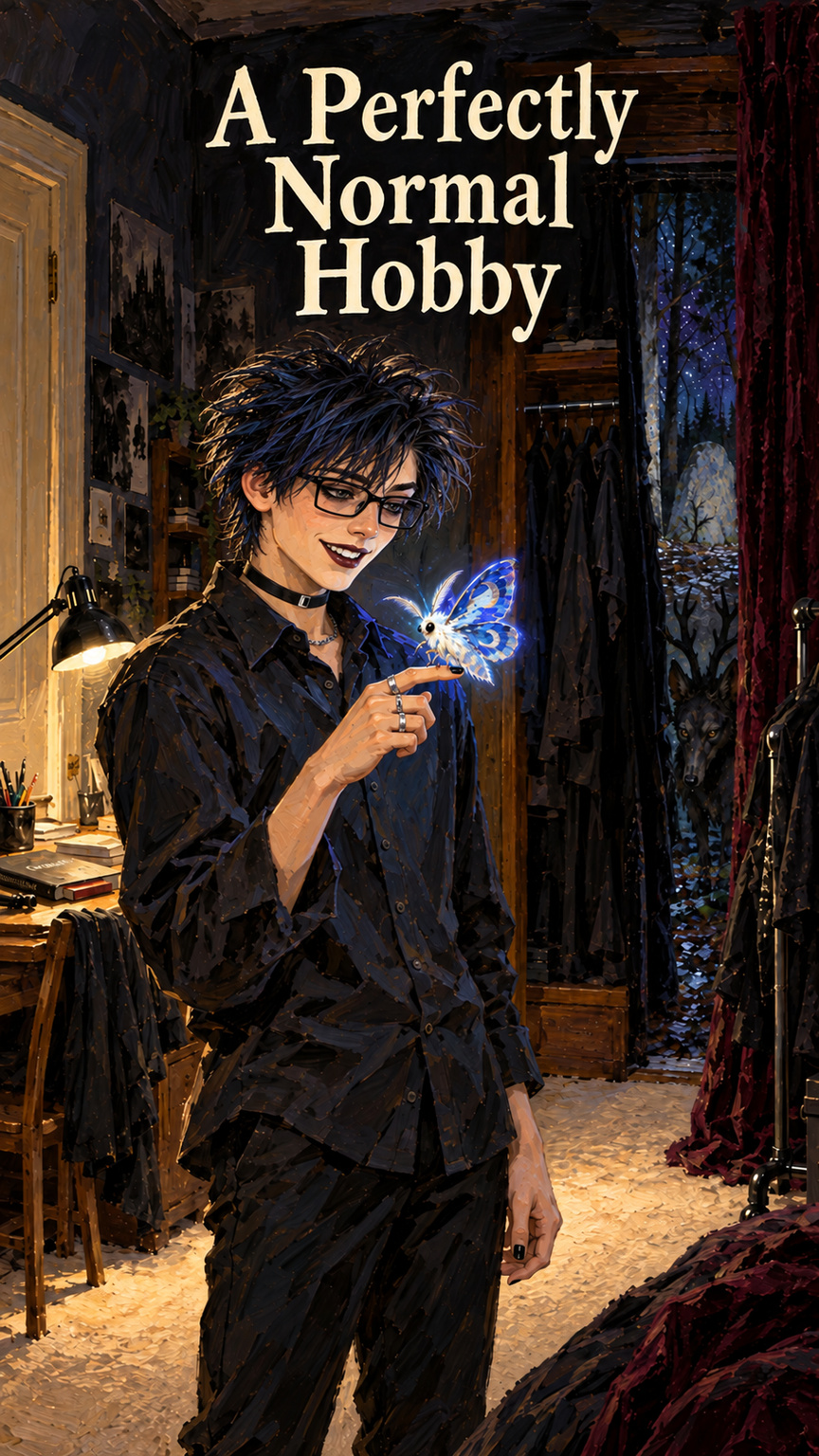
The first thing Orson Dacre learned about witchcraft was that he needed a better lamp.
The little print kept disappearing into the crease of the book. He had spent eleven months making his bedroom suitably gloomy, and now, when the gloom might finally be of some use, he had to turn the desk lamp up and put his glasses on. He angled the light across the carpet toward the old cupboard. His bed and the freestanding clothes rail beside it could stay in the dark.
Elementary Witchcraft lay inside his chemistry revision guide. The covers were approximately the same size. To make room, he had removed the section on acids, which he understood, and kept the section on chemical bonding, which he did not.
Downstairs, his parents were arguing pleasantly about whether a film they'd seen contained a second dog. There had been one dog. Orson had counted. He had been waiting six days for them to find something else to discuss.
He bent over the page.
Keep an ordinary light at your back. Make a seam in your own shadow. Invite one witchlight. Close the seam before attending to your guest.
Below this was a small illustration of a moth, and below that a pronunciation guide considerably longer than the invitation.
Orson had bought the book from a box marked HOME AND GARDEN. Its previous owner had underlined things in brown pencil. One sentence in the introduction had been underlined twice: Admiration is not instruction.
He had admired the book for a week. At sixteen, he already knew how long he could admire something before his mother offered to laminate it.
He'd met his closest friends at an all-ages goth night, under a speaker that made his boots hum with bass. They sent one another songs long after midnight and never asked who he was dressed as.
His parents liked the goth thing. They liked it so much that his father had made a family-chat album called Our Little Prince of Darkness. It contained Orson in his secondhand velvet coat, Orson learning eyeliner, and Orson standing beside a cake whose black icing had turned everybody's teeth green. His mother had once asked whether he wanted to bring a friend to the cemetery, then suggested making it a picnic.
They meant well. That was the difficulty.
If they found the book, there would be themed bookmarks. There would be a photograph. His father would use the word warlock in front of a cashier.
Orson wanted time to be terrible at this in private.
He stood with the lamp behind him, facing the old cupboard he'd turned into a clothes alcove. His shadow fell across a row of black shirts, the velvet coat, and a pair of boots still being paid for in birthday money. He pressed his thumb into the shadow's middle and pulled sideways.
Nothing happened.
He tried the invitation. The last sound caught somewhere behind his teeth. He started again, followed the pronunciation guide, and kept pulling.
A white line opened between the shirts.
Orson stopped breathing. The line widened. Behind it stood pale tree trunks, wet black leaves, and stars that were not on his ceiling.
Something small came fluttering through.
The moth settled on his raised hand. It had a white furry body and broad blue wings marked with silver crescents. Light sifted from it onto his black nail varnish. He could feel its six tiny feet.
He had wanted something strange enough to deserve the room he'd made for it. Now that it was here, he couldn't think of anything suitably solemn to say.
“Hello,” he whispered.
The moth cleaned one antenna.
Orson held out his other hand. The book had said to offer a direction with one finger and a slow breath. He did, and the moth floated across to it. His shadow swelled and swept along the shirts.
He tried again. The moth followed. There was no wire, no battery, no sensible place for the light to come from. He was grinning so hard that his eyeliner felt tight.
“Orson?” Dad called from the stairs. “Found you something.”
He clapped the book shut.
The moth startled upward. Orson pointed frantically behind the velvet curtain beside the alcove, and it went there. Blue light showed through the gap. He pulled the curtain across it, shoved the chemistry guide onto his desk, and turned to the door.
A hanger clicked behind him.
The thing emerging from the seam in the alcove was too large to have been concealed by the curtain.
Its head came first: a narrow hound's head, carried low, with branching black antlers above the ears. Then a long back, then forelegs so thin they seemed drawn in ink. One paw touched the carpet. The room smelled suddenly of leaves left in a closed bag.
Orson snatched a shirt from the bed and threw it at the animal's head.
The hound ducked. Orson made a small, entirely unsolemn sound. The shirt caught on the corner of the desk. In the lamplight its falling sleeve swung an enormous arm over the bright carpet and up the wall.
The hound sprang sideways.
Its whole body flattened against the moving shadow, black muzzle snapping at the sleeve's outline. Cloth slithered off the desk. The shadow vanished. The animal spilled back down the wall and gathered itself in the darkness beneath the clothes rail.
There was a knock.
Orson stood between the door and the rest of the room, opened it a hand's width, and said, “Thanks, you can leave it there.”
Dad, in his mustard jumper, held up a folded phone tripod.
“For your outfit pictures. Found it at the back of the cupboard. You'll get the whole boots in.”
“Great. Thanks.”
“Here, I'll just—”
Dad nudged the door wider with his elbow. Orson moved with it. Beyond his father's shoulder the landing was bright and empty.
The hound waited beneath the clothes. Only the tips of its antlers showed, among buckles and hangers. Behind the curtain, the moth's light was hidden in thick black folds.
“No room on this desk,” Dad said affectionately.
He reached past Orson, turned the lamp aside, and put the tripod down.
The bright strip of carpet between the clothes rail and the desk disappeared. Their shadows joined, a dark road running to the open door.
The hound poured onto it.
Orson caught the lamp by its hot metal shade and swung it back.
Light struck the carpet. The animal recoiled into the rail's shadow. A cold black nose had been less than a foot from Dad's slipper.
“Careful,” Dad said. “That's hot.”
“Yes. Thanks. Please don't come in. I've got something balanced.”
“What sort of something?”
“Something I really need you not to knock over.”
Dad withdrew his hand.
“Fair enough. Dinner in five.”
Orson shut the door and pressed his back against it. On the other side, his father began whistling as he went downstairs.
The hound lifted its head.
Orson held still. It lowered its head again, staring at the thin, bright strip it hadn't crossed.
He couldn't leave it here. He couldn't let Mum come in. If it got onto the landing, he would have to shout for them to get out of the house, and hope they did that before asking what he meant.
He edged along the lit side of the room and retrieved the primer.
The sentence about closing the seam had a small brown arrow beside it. He followed the arrow down to a footnote.
The light attracts other inhabitants. Shadehounds move wherever shadows meet. Keep your own shadow small, and do not run.
“That,” Orson whispered, “should be at the top.”
The book explained closing on the next page. Hold both edges of the seam and smooth them together, from top to bottom, without stopping. He could do that. The hound, however, was on this side of it. He would be shutting a large hungry animal in his bedroom.
Across the room the sleeve of his fallen shirt stirred in the breeze from the alcove.
The hound's ears turned toward it.
Orson looked from the sleeve to the lamp. Then he looked at his velvet coat.
“Dinner!” Mum called.
“One minute!”
“You said that yesterday, and we found you asleep.”
“I'm awake!”
“Then come and eat while it's hot.”
He put the book open on the bed. He read the closing instructions again, slowly, while the coat hangers ticked together in the wind.
“I'm in the middle of something.”
“Bring it down.”
Orson looked at the hound.
“Can't.”
There was a pause.
“All right,” Mum said. “I'll bring yours up in a minute. You needn't stop, but you do need to eat.”
He had perhaps sixty seconds.
He eased the curtain aside and offered the moth his finger. It came down, brushing his cheek with light. The hound pressed itself lower beneath the rail.
The coat was the first thing he'd owned that made him look exactly as he meant to look. Orson took it off the hanger anyway. His throat felt small and dry. He stood close to the alcove so his shadow fell into it, rather than toward the door, and made himself look past the shirts.
The seam had spread to the width of the cupboard. One edge ran down its wooden side. Beyond the threshold, a short stretch of open ground led between the trees. A broad pale stone stood upright at the far side, with black branches tossing above it.
He held his coat up by the shoulders. It cast a long, empty-headed figure onto the leaves beyond the opening.
The hound rose.
Orson pointed above his shoulder, his breath trembling. The moth hovered behind him. Its blue light caught the coat's spread sleeves and made the figure on the leaves darker still.
The hound watched it.
The bright strip barred the hound from the alcove as well as the bedroom door. He would have to let it across.
He backed toward the desk and switched off the lamp. The barrier vanished. Before the hound could turn toward the bedroom door, Orson jerked the coat up. Its blue-lit shadow slid ahead into the wood. He sidestepped back to the alcove and across the threshold.
Cold struck through his socks. His bedroom carpet ended in a sharp line against damp earth. He could still see the corner of his bed, the chemistry guide, the stupid helpful tripod.
The hound came after him.
It flowed through the opening, a long dark body passing without a sound over the wooden sill. Orson retreated sideways, keeping the moth behind his shoulder and the coat's shadow sliding ahead of him over the leaves.
The hound followed the moving outline.
Seven steps took him to the stone. It was taller than Dad, smooth and white on one face. He hung the coat from two low twigs in front of it and brought the moth down until its light cast the coat's outline onto the stone. Wind flapped the empty sleeves. On the white surface, a huge stooping figure beckoned.
The hound crouched.
The wind dropped.
So did the coat's empty sleeves.
For a moment everything was still except Orson's breath. The animal turned its head. It looked at him.
From the square of his bedroom, he heard a plate clink.
“Orson?”
He didn't answer. He crouched close beside the stone, keeping his shadow small against its base.
Mum knocked.
Any moment she'd shift the plate to one hand and try the handle.
The hound's hindquarters bunched.
Orson caught an empty cuff and whipped it upward.
A giant arm lashed across the stone.
The hound sprang. Orson let go and ducked. An antler ripped through the coat as the animal leapt past him. It struck the coat's moving shadow on the stone and spread flat across it.
“Just a second!” he shouted.
He ran for his bedroom.
The moth streaked after his pointing hand. Behind him the coat fell from the twigs. Its shadow shrank and folded. He heard leaves shift as the hound peeled itself away from the stone.
Orson crossed the sill, caught both edges of the opening, and pulled them together.
They dragged at his palms like heavy curtains. He smoothed down from above his head, stumbling onto his knees as the seam narrowed. Through the remaining gap he saw the hound racing toward him along the shadow of a tree.
He pressed his hands to the floor. A dark muzzle struck at the last inch of opening with a dull thump.
The wood disappeared.
He was kneeling among his boots. A hanger rocked against his ear.
“What was that?” Mum asked.
“Coat fell.”
He looked up. The moth hovered over his shoulder.
He clicked the desk lamp on, slid the primer back into its chemistry cover, and offered the moth his wrist. He held very still until it settled. Then he folded the loose black cuff of his shirt over it. The blue light vanished beneath two layers. Tiny feet tickled his skin.
He opened the door.
Mum stood on the landing with a covered plate. She had her green cardigan buttoned wrong, and a tea towel over one shoulder. Beyond her, the ordinary house smelled of roast potatoes.
“You all right?”
“Yes.”
She looked at the tripod, the fallen shirt, the hangers on the carpet, and his socks, which were muddy.
“Are you doing one of those little films?”
Orson swallowed. “Trying something.”
“Well, don't rush on our account. It's nice to see you getting interested in the technical side.”
He took the plate in his free hand.
“Please don't put it in the chat.”
Mum glanced at the folded tripod. “You haven't even made your film yet, have you?”
“No. Not yet.”
She reached up and straightened his glasses.
“Eat first. And open the window if you're getting that hot.”
He waited until she had gone downstairs before letting his breath out. Then he shut the door, set the plate on the desk, and unfolded his cuff.
The moth emerged, shook out its wings, and settled on the edge of the chemistry guide.
“Sorry,” Orson whispered.
It cleaned its antenna again.
He ate three potatoes with his fingers before he remembered the fork.
Later, after carrying his plate down and answering several questions about frame rates with noncommittal noises, Orson returned to the alcove. A ragged piece of velvet lay caught on the sill. The rest of his coat was still in the wood. He drew the scrap free and rubbed his thumb over it before laying it beside the book.
He moved the desk lamp until its bright strip lay across the carpet. He checked the page on closing. Then he checked it again.
This time he made the seam no wider than his thumb.
Stars shone between the shirts. Beyond the pale trunks, high above the clearing, something vast and blue moved slowly across the sky. It had too many wings to be a bird.
The moth left the book and settled on his shoulder.
Orson watched until the blue shape passed behind a cloud. Then he pinched the top of the seam and smoothed it shut, all the way to the bottom.
Dad's voice came through the door.
“Your mum says you're making films. We've got that little microphone somewhere, if you want it.”
Orson looked at the moth. Silver crescents opened and closed against his black sleeve.
“I've got everything I need, thanks.”
“All right. Don't stay up all night.”
Dad went away. Orson took Elementary Witchcraft out of the chemistry guide and opened the next chapter.
It was called Finding Your Way Back.