
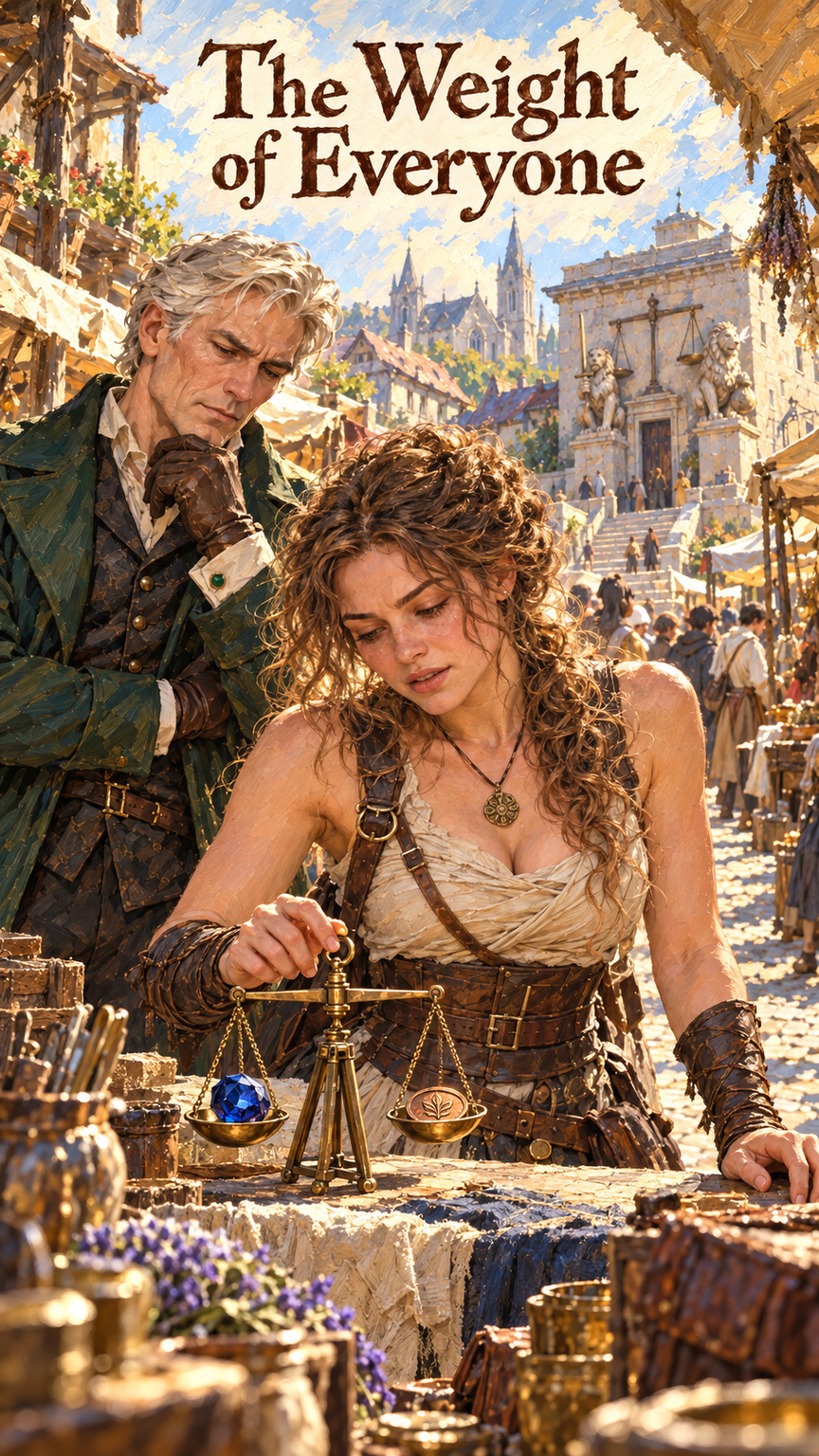
The blessing was genuine. Merryn had to disappoint the woman about that first.
“Seven grains of love,” she said. “A very good weight.”
The woman shifted the baby against her shoulder. He wore a yellow cap, much too large, with the front rolled back three times.
“Then why hasn't it worked?”
“What did you want it to do?”
“Let him sleep.”
Merryn glanced at the child. He was asleep now, his mouth open against his mother's collar.
“When I sleep,” the woman added.
Behind them, the seller of blessings made a sympathetic noise. He had been making sympathetic noises since Merryn unfolded her scales.
They stood at the corner of his stall, between strings of painted saints and a little shrine whose candles were priced according to the sincerity of the prayer. Merryn's own pitch was across the lane: two trays of rings, knives with soundness certificates, a box of winter courage bought cheaply in a very brave village. All of it was already paid for. So were the mule, the cart, and her room above the best pastry shop in town. At twenty-three she had discovered that people would pay generously to be told a bargain was dishonest, provided she could tell them before they signed it.
She lifted the charm from the left pan. It was a silver bell with no clapper, suspended from a blue thread.
“May I undo this?”
“You break it, you buy it,” said the seller.
“We can certainly weigh your loss afterward.”
He subsided. Merryn worried the tight knot with a fingernail, then caught the end between her teeth and pulled. The bell came free. She set it in one brass pan and the thread in the other, breathed along the beam, and asked for the love in each.
The bell rose. The thread sank.
“He tied this on while you were holding the baby?”
The woman nodded.
“It's yours,” Merryn said. “He caught a little of what was already coming from you. A proper blessing adds something. This one sold you a window and charged for the view.”
“There was workmanship,” the seller said.
“Three coppers' worth. Shall we measure?”
He reached beneath the counter for his cashbox.
The woman caught Merryn's sleeve. “Wait. I paid for the whole thing. His receipt says the whole thing.”
Merryn liked her better at once.
She flattened the receipt. Beneath the seller's crooked signature was the ordinary title warranty, printed on almost every market bill: the lot entire, the goods my own. A buyer could reject a whole lot when one part belonged to somebody else. Even a king's horse came home if it proved to be a stolen horse.
“Quite right,” she said. “And did you ever give him your love?”
“Certainly not.”
Merryn set the thread in one pan and brought the seller's signature against the other.
“His title to it,” she asked the beam.
The love weighed seven grains. His ownership weighed nothing.
“Twenty-six coppers back, then.”
The seller counted them out.
The woman took off the bell herself and returned it. She kept the thread.
“Lenet,” she said to Merryn. “I work at the royal weigh-house. Come to the side door if anyone gives you trouble over your traveling weights.”
“I usually am the trouble.”
“Then you'll know the way.”
She bought a paper bag of hot chestnuts from the next stall and put half into Merryn's hand before she could refuse.
The baby opened his eyes as they left. His mother sighed at him without conviction.
Merryn ate a chestnut, burned her tongue, and went back to selling things she actually owned.
By noon she had sold three rings, weighed a cook's loyalty to the tavern that had just cut his wages, and recovered a handsome fee from a dealer whose six bottles of bravery contained five bottles of drunkenness. She was choosing between a custard tart and a plum tart when a man in a dark green coat laid a blue gemstone on her counter.
It was the size of a walnut. Light seemed to enter it by several different doors and meet in a blue so deep that Merryn leaned forward before she remembered herself.
“For those,” he said.
His finger pointed past her merchandise to the little brass scales at her hip.
She touched their leather case.
“You haven't asked their price.”
“You haven't weighed my offer.”
He had silver hair, neatly cut, and a green stone in one cuff. The other cuff was plain. His gloves were very soft and worn through at the right thumb.
“Merryn, isn't it? Halden.”
“Do we know one another?”
“I know your work.”
She looked again at the gem. No flaws, no milky patches, no anxious little imitation glimmer where the color ought to be. Her hand wanted it with an uncomplicated greed she usually reserved for ripe peaches.
“I won't buy anything I haven't tested.”
“I should be disappointed if you did.”
She set up the scales on their folding stand. Each pan would have held half a plum. At her request the gemstone settled comfortably into one of them.
Its ordinary weight was two ounces.
Its workmanship was excellent. Its color was natural. Its age made the beam tremble, as old things often did, but age alone commanded no particular price. Merryn had sold a very old turnip the week before at a considerable discount.
Then she asked what claim the gemstone carried.
The blue pan fell to the stop.
Halden smiled.
She turned the counting screw. A hundred. A thousand. Ten thousand. The empty pan stayed high.
There was no strain in the brass. Weight of this kind lived between the thing and the questioner; the stand did not have to bear it. But her breath shortened as she fed the question through the beam. Usually a merchant could discover the upper limit of an offer without undoing the counting screw completely.
This time she had to use the extension.
Four hundred and eighteen thousand, six hundred and seventy-three soulweights.
She took her hands away. The magic ceased. The gem was two ounces again.
The ordinary market went on around them. A man was arguing over the tenderness of a goose. The plum-tart boy had begun packing his tray.
“What is it?” she asked.
Halden laid a copper disk beside the stone. The royal census seal was impressed on it, and beneath the seal a small dial showed the number of living people within the kingdom's borders. Clerks kept the great count alive in the weigh-house; their daily impressions served for tax estimates, army provisions, the sale of grain.
The disk showed 418,673.
Merryn put it into the empty pan.
“The living souls of this kingdom,” she said, and gave the balance her breath.
The beam stood level.
She waited. Halden waited with her. A breeze lifted a curl from her cheek and blew the scent of lavender across the counter.
The copper dial clicked.
418,674.
The beam quivered, then leveled again. The blue stone had gained precisely one soulweight.
Somewhere beyond the roofs and fields, a child had arrived.
Merryn felt her own mouth opening in the foolish smile she had worn when she first discovered the scales could weigh a kiss left on a letter.
Then she looked at Halden.
“What claim?”
“The Crown's pledge to me.”
“Of what?”
“It's there on your scales.”
She brought out her traveling token. It bore her name, the mark of her birth town, and the royal stamp certifying that her road dues were paid. She laid it beside the census disk.
“The people of this kingdom, except Merryn.”
The blue pan sank.
By exactly one soulweight.
Her own.
She put a hand flat on the counter. Beneath it were the fine scratches left by years of weighing, counting, wrapping. A little crust of old sealing wax caught her palm.
Merryn looked toward the street where Lenet had disappeared with the baby. When she turned back, Halden was holding the blue stone up to the sun.
She kept her hand flat until she could trust it to move.
“And the whole claim would be mine?” she asked.
“An indivisible claim, transferable before collection. The most valuable object you will ever hold.”
“In exchange for my scales.”
“There are other kingdoms. With those, I can test what the next king offers before I lend to him. I would rather travel with a tool than an estate.”
She could see it then: herself accepting the stone, him walking out through the city gate with her scales in his pocket. Wherever he went next, he would be able to test every lie he told and every lie he bought. Behind him would remain a king's seal and a beautiful blue claim no ordinary assayer could look inside.
“When is collection?”
“I've booked the evening bell. Until delivery, the original pledge may be challenged. Afterward, disputes go to court.”
“Delivered where?”
“The stone can contain what it measures.”
“Me included?”
“You'd take my place as creditor. You decide when to collect, and you hold the receiver's anchor while it happens. Your own soul stays outside.”
She had been resting her fingers against it. She withdrew them.
Halden watched the movement.
“You could hold it for income,” he said. “Think what they'd pay to be released.”
The attraction had not gone out of the jewel. That was unpleasant. It remained the loveliest thing on her counter.
She picked it up again, turning it toward the light.
“At whatever price I chose?”
His shoulders eased.
“Of course.”
“I'll see the deed,” she said.
He took a folded bill from his coat.
“The original. I buy no title from a copy.”
His eyes moved from her face to the scales. She made herself pick a chestnut skin out of a seam in the counter and flick it away.
“You'll be taking them to another kingdom,” she added. “You ought to see them used properly first.”
He tucked the bill back into his coat.
“Very well.”
Merryn paid a neighbor to watch her trays. She took her scales, her purse, and the chestnuts she had not finished.
At the palace end of the market stood the royal weigh-house, a square building with white steps and two carved lions supporting an enormous balance over the door. The left lion held a sword. The right held a purse. Somebody had stuck a feather into the purse lion's nose.
Halden went in through the front.
Merryn followed him.
Inside, people waited on benches with sacks, documents, a caged red bird, a wedding veil. Bells rang at different counters. Everything had a value; nothing obliged two people to agree what ought to be paid for it. Most of the kingdom's arguments eventually came through these doors.
Halden led her past the public hall to a chamber where a wide copper frame hung over a stone table. Thin metal links spread from it across a map of the kingdom, joining cities, villages, and the little brass circles that stood for lonely farms. Beneath the map, a larger census dial turned in the hands of a clerk seated with his fingertips against its rim.
Lenet stood at the table with her baby asleep in a quilted box beside her. She had put on a plain dark gown and a chain of office. A yellow cap lay on the floor.
“Trouble already?” she said.
Halden glanced at Merryn.
“We met this morning,” Merryn said.
Lenet's smile diminished when she saw what Halden carried.
“You're early.”
“My business has gone well.”
He set the blue stone into an empty socket beneath the copper frame.
For an instant all the little links stood out from the map. Merryn felt a pinch behind her breastbone, as if she had swallowed a hook no larger than an eyelash.
Lenet took one hand off the frame. The links relaxed.
“Don't do that again until we're ready,” she told him. She bent to the baby, who had begun to stir.
“What was that?” Merryn asked.
“The pledge finding its goods.” Lenet lifted the boy against her.
“It found me,” Merryn said.
Lenet stared at her.
“It shouldn't have found you. My docket says mines and Crown revenues.”
Halden said, “The royal security extends very widely.”
“Let me see the deed,” Merryn said.
Lenet laid it out on the stone table. It was three sheets long, held together by a broad red ribbon. The king had signed each sheet. At the bottom hung his heavy seal, enclosed in a brass cage attached to the frame.
Halden unbuttoned his cuffs. With his gloves off, the fingertips of his right hand were dark blue.
“A quarter of a million gold crowns,” he said. “To settle the army's arrears. You'll find the acknowledgment on the second sheet.”
Merryn read the first sheet, then the second. The king had pledged the gold mines, hunting lands, palaces, and all else that he owned within the boundaries of the kingdom. Halden's appended schedule named the goods to be delivered: all living human souls within those same boundaries.
She looked up.
“I haven't sold you my soul.”
“No,” Halden said. “His Majesty has.”
“These people aren't an estate.”
“You'd be surprised what appears in an estate.”
Merryn looked down at the last sheet.
The title warranty was at the end, above the king's seal. The lot entire, the goods my own. While settlement remained pending, a proven owner could reclaim any falsely included part and void the whole levy. Merryn had read that language on bills for sheep.
“How does a challenge stop delivery?” she asked.
Lenet pointed to the cage. “Withdraw the original seal. That releases every link made under it. After delivery, my key won't open it.”
Halden rested a hand on the empty creditor's grip projecting from the frame.
The receiver's anchor. He had made provision for himself.
“His Majesty's assayers examined this.”
Merryn was still reading. “Did they?”
“For six days.”
“I should have charged more.”
She had seen a Crown beam. It could measure the extent of an obligation to a hair; it could not tell whether the obligation had ever been given. The royal seal was supposed to settle that.
She moved her folding stand onto the table, close to the caged seal. Halden followed her hands.
“What are you testing now?”
“One part of your lot.”
He looked at the blue stone.
She put her traveling token into the left pan.
“My soul.”
Lenet set the baby down in his box. Carefully, she drew the edges of his quilt away from his face.
“You belong to the king?” Merryn asked her.
Lenet looked at Halden's schedule again.
“I serve him.”
“So do I. Mine's a yearly license. His are the road dues. I never transferred the rest.”
“You were born here,” Halden said.
“Yes. That's why I know whose taxes to pay.”
She could feel the hook in her chest again, a faint coldness from the dormant stone. Four hundred and eighteen thousand people. Almost certainly more, now. Whatever Halden expected her scales to find, he had put that number in her hands because he thought it would be more than she could refuse.
She took the scales off their stand.
To weigh another person's soul, the person could touch the pan. To weigh her own, Merryn had to keep the balance suspended from one hand and touch her token with the other. There must be a living bridge from question to weight. She had done it often enough to calibrate the scales and disliked it every time: the peculiar double feeling of being herself and being something she could drop.
She let the weight settle. The left pan sank.
The cold hook behind her breastbone slackened, as though it could no longer find her.
“One soulweight,” she said.
“We can see that,” said Halden.
“Now the Crown's ownership of that soul.”
Lenet guided the right pan against an edge of the gold seal exposed between the cage's bars.
The pan remained high.
Merryn held her breath, released it, and made the question again. Exact subject. Exact claimant. The transfer that would make this soul the Crown's to pledge.
Nothing.
Halden did not look at the empty pan. He watched Lenet's face. He had never needed Merryn to believe the title, only to want its power.
On one side of the beam, her whole soul. On the other, a seal whose gold content alone would keep her in tarts for a year. Between them, no transfer at all.
“I am claiming this part,” she said. “It is mine. You can have the whole pledge weighed if you disagree.”
Halden reached across the table.
Lenet caught his wrist before his fingers reached the beam.
“There's an ownership challenge.”
“The Crown has sold its subjects before.”
“Then it can show how it acquired this one.”
He pulled his hand away. “Ask the king.”
“He's had six days,” Merryn said. “I'm here now.”
Lenet took a key from her chain. She put it into the lock on the brass cage.
“Put them down first,” she told Merryn. “You're shaking.”
Merryn tried to smile. “This one's expensive.”
The lock clicked.
Halden drove his blue-stained hand into the creditor's grip.
The stone flashed.
Every link rose from the map.
Merryn's soul pulled sharply toward the blue socket. Her left arm jerked; the empty pan struck the seal with a tiny ringing noise. She kept her right fingertip pressed against her token, but the skin beneath it seemed very far away.
Across the room, the census clerk cried out. His chair hit the wall. He had taken his hands from the dial, but Halden was supplying the working now, his bare wrist buried in the grip.
Lenet shoved at his arm.
“Let go!”
“After delivery,” he said through his teeth. “Challenge it after delivery.”
The blue was climbing his fingers. He had been inside this working before. He knew what it cost him to hold it open; he had decided it was affordable.
Merryn backed a step away from the socket. For now her scales were doing what Halden's grip did: anchoring her soul outside the collection. Her left hand held the suspension ring steady. Her right fingertip kept her soul's weight in the pan. Both contacts had to hold; let either go and her soul would fall back into her body, where the stone could take it. The open cage was beyond her reach.
The baby began to cry.
Lenet looked toward the box. The copper circle nearest the capital was filling with blue, spreading outward through the map. Beyond the chamber, a bell rang once and stopped halfway through its next note.
“The seal,” Merryn said.
Halden lunged at the scales with his free hand.
Lenet threw herself between them. She caught his sleeve against the table edge and twisted the cloth around her forearm. He struck her shoulder with his elbow. She held on.
“I have him,” she said, though she plainly had only half of him. “Do it.”
Merryn moved toward the cage.
The nearer she came to the socket, the more her soul pulled. It was no longer merely weight. There was a thin clear gleam above the left pan, and within it she could feel the unchosen continuance of her own life: tomorrow's appetite, the shape of a road she hadn't taken, all the years in which she might become someone she could not yet imagine. None of it had been promised to a king.
She could let go of the suspension ring with one hand. The scales would fall and the gleam would go with them.
She could lift the other fingertip. She felt the stone waiting for it.
The caged seal swung six inches beyond her knuckles. The red ribbon lay over the cage's open door.
Merryn bent her head and caught the ribbon between her teeth.
Halden saw. He pulled against Lenet so hard the table scraped the floor.
“That's the king's seal!”
The ribbon tasted of dust and bitter wax.
Merryn pulled.
For a moment nothing moved. Her arms shook hard enough to set the chains ringing. The gleam in her pan thinned to a thread.
Lenet braced one foot against the table leg.
Merryn pulled again.
The seal struck the brass door and cleared the cage.
All the raised links fell flat.
Halden's hand came out of the grip. He staggered into Lenet, who let go of his coat and pushed him away from the table with both hands.
Merryn lifted her fingertip from the token.
Her soul's weight returned so abruptly that she sat down on the floor.
For several breaths she could only be pleased by the floor. It was cool. It was solid. She was a woman sitting on it, and likely to remain so.
Above her, Lenet was saying, “Stay where you are.”
Halden said something Merryn did not hear. Lenet repeated herself, with less courtesy. Two door guards came in. The census clerk pointed a shaking finger at Halden's blue hand.
Merryn still had the scales. She checked. A chain had twisted round the beam, but nothing was broken.
Then she heard the baby.
Lenet had him against her, capless and furious. She was crying too, with her mouth pressed into the fine hair on his head. A warm spark showed beneath his breastbone, then sank out of sight.
On the map, little flashes traveled along the fallen links. A spark at a farm in the north. A scatter of them at the coastal towns. A whole shining handful where the capital lay beneath their feet. They were traveling out from the broken pledge, returning what had begun to be drawn in.
The census clerk put his hands back on the dial.
418,679.
He made a sound between a laugh and a sob, and checked it again.
The number held.
Merryn let her head rest against the table leg.
One of the guards had taken Halden's wrist. He was watching the fallen links.
Lenet knelt beside her, holding out the baby with an uncertainty Merryn had never seen in a person offering something to her.
Merryn set the scales down and took him.
He was heavier than any love she had weighed that morning. His cheek was damp and hot. He seized one of her loose curls, wound it into his fist, and ceased crying.
“Oh,” said Lenet. “So that's the blessing we needed.”
Merryn laughed, and it hurt, and she laughed again.
They kept her at the weigh-house until after the evening bell. There were statements to take and a messenger to send to the palace. The king's six assayers were summoned. Halden demanded to know who would repay his quarter of a million crowns.
Lenet turned the first sheet of the deed toward him.
“It has the king's name on it,” she said.
Merryn refused three requests to make the same demonstration again. Her hands were still trembling. She ate the remaining chestnuts, cold, and let Lenet bring her a cup of wine whose honesty nobody tested.
When she was finally allowed to stand, she found the blue gemstone lying in a shallow evidence tray beside the withdrawn royal seal.
“What does it weigh now?” Lenet asked.
It seemed possible that she would dislike the stone now. She did not.
She unfolded the stand. Two ounces of stone. No souls, no claim on anybody, and a blue that had lost none of its depth.
“Two ounces,” she said. “A very good color.”
“They'll sell his property if the fraud is upheld. You could bid.”
Merryn touched her sore jaw. She looked at the jewel for a long time, then tucked the scales into their leather case.
“I will.”
Outside, the market was closing. Her neighbor had packed her trays and bought the last plum tart on her behalf. It had survived the afternoon under an upturned bowl.
Merryn sat on the edge of her cart to eat it. All down the street people were holding each other, or arguing, or peering into one another's faces. A man stood beneath the lion with the feather in its nose, taking his hat off and putting it on again. He kept saying that he had felt himself go, and that he was here.
Lenet came down the steps with her son asleep against her shoulder. When she saw Merryn, she crossed the cobbles and sat beside her without asking.
Merryn broke the tart in half.
The baby's yellow cap slipped. Lenet caught it, then took the pastry.
Above the rooftops, the palace bell struck another hour. The boy slept through it.