
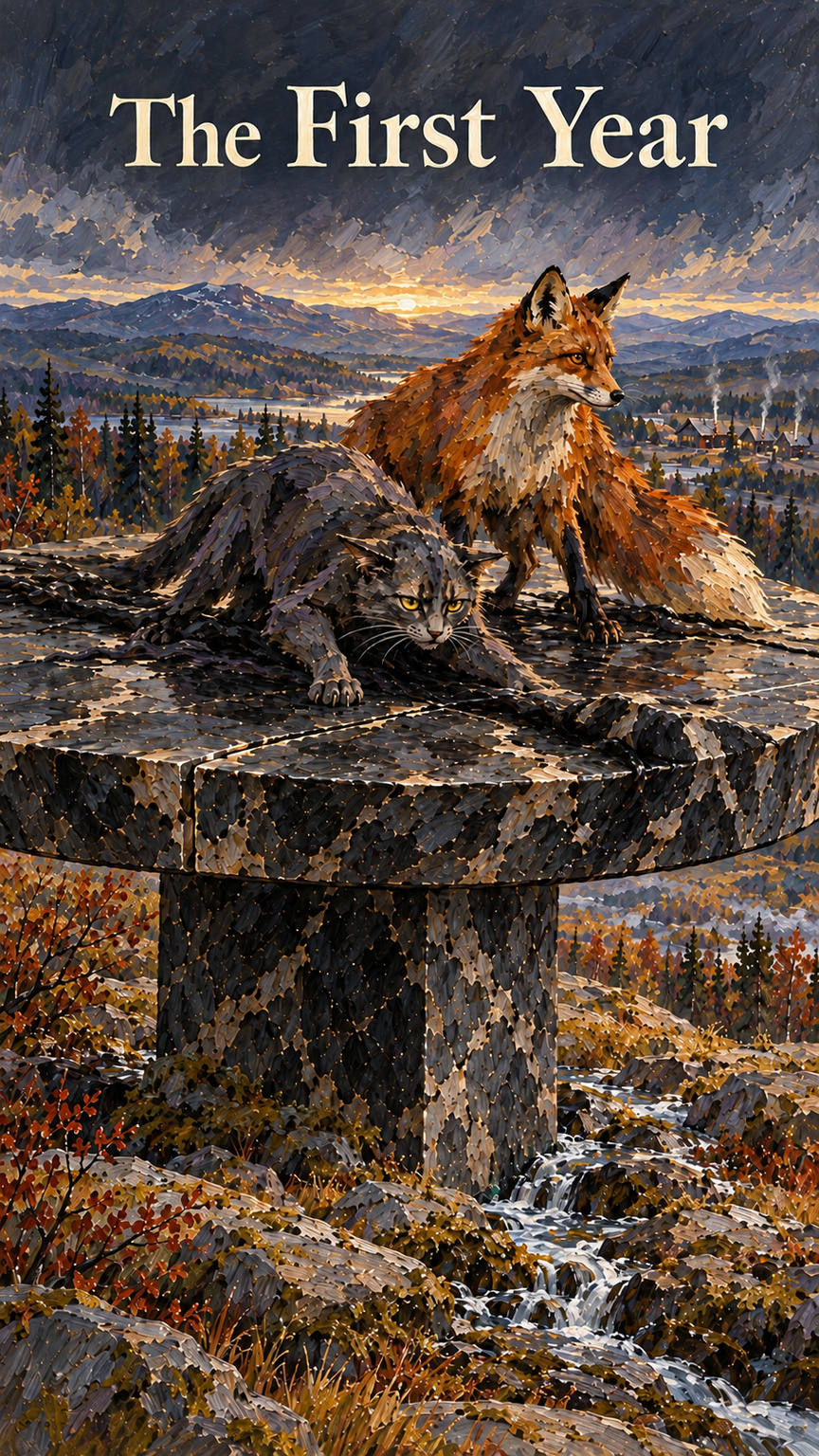
Before there were months, the Cat could walk from winter into summer in an evening, provided she did not let the Bear see her.
The Bear hated the Cat's footsteps in her strawberries. The Cat hated the Bear's noon. Between their countries the Serpent kept a slope of warm stone, and anyone crossing it paid her in secrets. The Fox usually paid with somebody else's.
Elsewhere the Boar broke the earth and the Frog filled the hollows. The Wren made flowers grow wherever she sang. The Salmon's rivers ran toward the sea and, beneath the sea, found their way home. The Spider caught dew, the Wolf hunted beneath a frost that never melted, the Hawk owned the height from which everything could be seen, and the Stag stood among bare trees with the cold caught in his antlers.
They were living spirits. Their shadows went deeper than the shadows of other creatures. The black shape beneath the Wren's feet reached through every flowering branch in her country; the Salmon's shadow lay along the beds of his rivers. A spirit could withdraw into that darkness and come out a hundred hills away. It was how each knew its own land, and how the land knew its sovereign.
Their borders were bitter places. Rain trespassed on ripe fruit. Frost stopped a river. The Hawk stripped the Wren's blossoms from their stems, then said she should have grown them lower. Each wanted the others' countries. None would yield its own.
At the meeting of their twelve borders grew a stone table.
Its round top stood level on a single massive central leg. It had no tool marks. A pale vein crept across its surface as the twelve watched, dividing and joining again beneath the polish. The stone was alive, and warm even on the side that lay in shadow.
“Who owns this place?” it asked.
All twelve answered.
The table listened. Each sovereign saw a different country reflected in its black surface. The Bear saw her berries growing beneath every mountain. The Wolf saw frost on the sea. The Wren saw a forest flowering from horizon to horizon, with no Hawk above it.
The Fox saw himself running through all eleven kingdoms without once being caught.
“I can settle this,” the table said.
“And afterward?” asked the Wren.
“Each shall have what it sees.”
“With what?” asked the Boar.
“I have no country. I have no quarrel. Lay your shadows on me, and let each show the others how far its kingdom ought to reach.”
The Stag stood at the northern edge. The Salmon came up through a spring. The Spider lowered herself from a thorn. Each let its shadow reach across the stone toward the country it had been shown.
The Fox watched the pale vein.
It was growing over the shadows.
He sprang, but the stone caught him by the dark shape of his hind feet. The table widened beneath the twelve, lifting them from the ground. Its central leg thickened and drove deep into the meeting of the borders.
The Stag thrust his antlers beneath the rising edge. For a moment it could not move. Then the stone bore down. The sound carried into every country, and the Stag fell without his crown.
The others struck, sang, spat, leaped. Their shadows sank through the polish.
The table drew the Wren out of her blossoms and the Salmon out of his rivers. Each found itself bound at a place around the edge. The part of its shadow held inside the stone became a black root, running inward toward the center. It could stretch, but it could not be pulled free.
The table had grown broad enough for all twelve. The border thorn scraped along its new edge. Its surface held the reflection of the whole country.
“Everything,” it said. “As promised.”
A ridge of stone grew across the Cat's root.
The Cat had never been made to do anything.
She clawed the ridge until splinters of black stone fell between her feet. It thickened. Pain ran out through her shadow into every roof and branch she had once crossed, and she put her darkness over them to stop it.
Night went across the country.
The Bear's strawberries disappeared beneath stars. In the Frog's country, people carrying baskets home stopped on paths they had walked in daylight a thousand times. The Wren's flowers closed. The Cat could feel all of it, but she could not set one paw upon the ground.
“There,” said the table. “Your kingdom.”
She called her darkness back. The ridge pressed harder. It held her until she put the night out again.
At dawn the pressure eased. At dusk it returned. The moon grew round above the hills and dwindled to a horn. People burned the wood they had saved for crossing the Wolf's country. Children who had never seen frost began to dream of it.
The Cat made her nights as short as she could. The table made them longer.
When the moon vanished, it let her root lie slack and pressed upon the Serpent's.
Warmth entered the ground. Ice slid from roofs in great sheets. People came out to find the whole country smelling of stone in sunlight, and they said that the season had changed.
The Serpent looked at her hills in the polished surface. She could have reached them in a breath if the shadow rooted in her belly had stretched one inch farther.
She went still. She loosened her scales. Slowly, with the patience that had made the stones warm before anything else awakened, she slipped out of her skin.
The empty skin lay on the table.
The Serpent rose new and bright. Her root rose with her, still fixed in the stone.
The table laughed until pebbles fell from distant hills.
It let the empty skin blow from its edge, spreading it wider and wider over the fields. The people found it stretched across three of them and built their first shrine beneath its glittering scales.
The moon waxed and waned over the warm country. Seeds woke in the earth. The shed skin whitened where people touched it for good fortune.
“They think you gave it to them,” the Fox said.
The Serpent turned her new head toward him.
“I know.”
The Fox walked backward to his place when his root began to tighten.
“You could have asked,” he told the table.
“You could have refused.”
“I still can.”
Stone closed across his shadow.
Outside, dusk spread through the country. The Fox drew one last brightness along the western hills, made the path beside a village seem to fork where it did not, sent warm weather over a frozen field and a sharp shower across the Bear's former country. The people learned to hesitate before believing an evening sky.
While the table watched his work in its surface, the Fox left an afterimage beside his root and slipped behind it.
He tried the edge first. He got his head and forelegs over it. Grass brushed his nose. A woman on the path saw a red creature straining down from the stone and dropped her firewood.
The Fox stretched toward the earth. His root drew tight. The table pulled him backward, through his own afterimage, and struck him against the ridge.
For three dawns he could not stand. On the fourth he crawled beneath the overhanging edge.
There he found a crack in the underside, cold and dry. A seam in the old stone curved beneath the rim toward the Cat's place; here it widened enough for him to curl up inside. The table had grown around that stone without bringing it to life. Its dark surface could reflect what happened above, but no warmth entered that blind place beneath it.
The Fox pushed himself inside. He tucked his tail over his injured legs.
The table called him.
He said nothing.
Stone rose around his abandoned place and crushed the afterimage flat.
For the first time since his shadow had been taken, the Fox slept.
He could still be dragged out by his root when the table wanted dusk. Between those hours, he had somewhere to go.
When the next moon began, the Boar's root was pressed. The ground of the country split beneath his power. Hard fields turned over. Shoots thrust up beside roads, through floors, between the white scales of the Serpent's shrine.
The Boar saw them and charged.
He drove his tusks beneath the ridge that held his shadow. Stone split from his feet toward the center of the table. In the fissure lay his root, a black curve embedded in the pale grain.
“At last,” he said, and bit it.
His right foreleg thinned. Through it the Fox could see the sky. Outside, shoots blackened from their tips downward. A woman knelt in a field with both hands full of dead leaves.
The Boar let go.
His leg grew solid again. The dead shoots did not rise.
New stone crept into the fissure, then stopped short of the root. The table had felt the thinning too. It had almost lost something it meant to keep.
The Boar lay with his snout against the crack.
“That was me,” he said.
No one answered him.
The rain began when the Frog's turn came. It struck dust from the leaves and filled the Boar's furrows. For days people stood in doorways, listening to water that no longer stopped at a border. Wells rose. The spring on the north side of the pedestal ran again, though the Salmon did not come out of it.
Rain gathered in the Boar's crack. The Frog put her head into it and listened.
She leaped toward the dripping sound beneath the slab. The table pulled her root, and she landed hard at her place.
She leaped again. Again she came down where she had begun.
But the rain went on through the stone. A drop touched the Fox's nose inside his refuge.
“Do that again,” he called.
“I have done it twice.”
“The rain.”
She sent a little more along the crack. The Fox followed it beneath the edge, where a narrow seam ran around the underside of the table. He could hear the Serpent breathing above him and the Boar worrying the stone with his tusks.
There was a path between their places. It led nowhere off the table, but it was a path their captor had not given them.
The Fox said nothing about the cold crack in which he slept.
The Wren's moon began with flowers.
They came out on bare wood, over the Boar's dead field, in the wet straw of roofs. People woke to petals on their blankets. Orchards blossomed before anyone had known the trees were orchards. The Wren had never sung to so much country.
“Again,” said the table, whenever her song faltered.
The Boar had kept his snout against the fissure all through the rain. He was trying to work his root free without biting it, and sometimes he forgot and put his teeth down.
“Stop that,” the Wren told him.
“Sing something else.”
She put her feet beside his exposed root and sang the hard little song she had once used to split the shells of seeds.
The stone hummed.
The ridge over her own root lifted a hair's breadth. For one beat she was silent and no pain followed. Outside, flowers stood half open, waiting.
Then the ridge came down.
The Wren fell against the stone. The table kept pressing until she sang, and the flowers opened too far, tearing themselves from their stems. Petals covered the paths so deeply that people could not find their way home.
Later the Fox came up from beneath the edge.
“Do it again,” he whispered.
The Wren's breast moved fast.
“Not while it is listening.”
At the end of her moon, the Stag's new antlers scraped the stone beside his place.
The Bear followed the flowers with fruit.
Heat thickened over the country. Berries bent branches to the ground. Plums split their skins. Children came home with purple hands and no hunger. The Bear smelled all of it on the wind, and the table let her smell it.
It would not let her eat.
“You have fat enough,” it said.
She watched a boy reflected in the stone climb a tree that had once grown in her country. He filled his shirt with little yellow pears.
That night, instead of sending another wave of heat across the hills, the Bear put her head upon her paws. She remembered her deepest cave. She remembered the weight of snow above it and the sound of her own breathing beneath the earth.
Sleep went down her root.
The pale veins in the stone slowed. Its warmth ebbed. The pressure on the Bear's root slackened, and she slept more heavily.
“Wake,” said the table.
She let a long breath out through her nose.
The table seized the Wolf's shadow beside hers. His frost tore across the Bear's hot country. Pears froze in the boy's shirt. Branches broke under fruit suddenly hard as stones. The boy got down from the tree and could not feel his hands.
The Bear woke.
“Lie down again,” said the table.
She stood until her moon was done.
From her place the Cat said, “One at a time.”
The black surface cleared around her reflection.
“You will take one of us at a time,” she said. “And when the moon is gone, you will let the next one begin.”
“Will I?” said the table.
It let the Bear look at the frozen pears.
The Salmon came to rivers filmed with frost that should never have been there. Beneath it, the fish of the country were gathering to return. Their bodies shone red and silver in the dark water. They struck the ice from below.
Water filled the hollow that had formed about his place. The table pressed his root, making the current run out through the country. He faced it, as he had always faced the current, and drove upstream.
Outside, fish broke through the ice. They climbed falls that had never before known their return. Along the banks, people ran beside them shouting.
Inside the stone, the black flow in the Salmon's root began to run backward.
The Boar's fissure opened again. The roots rose in it, twelve living shadows sunk into a single bed of stone. The ridge above the Salmon shivered. Water rose between it and his root.
The table pulled him out of his pool and held him above his own water until he could no longer struggle.
It put him back before he died.
The ridge settled. A little black water remained in the fissure.
That night the Spider came down into it.
The Spider's moon left dew on everything.
At dawn every field carried a thousand small reflections of the sky. Mist lay between houses. Travelers stopped at familiar turnings and saw white roads where there had been no roads before. Webs stretched between the tines of the Stag's growing antlers.
On the table, beads of water settled along the roots the Salmon had exposed. The Spider followed them into the fissure.
“There are twelve,” she told the Fox.
“I had counted.”
“You counted prisoners.”
She laid a foot against his root.
The Fox felt the foot inside his own chest.
He drew back.
“Be still.”
She fastened a thread. Then she went to the next root, letting the mist conceal the silver line behind her.
The Fox waited until she had gone and crept back to his refuge. Through the thread he felt the Spider pause at the Serpent. He felt the Wren's quick heart. When the Boar shifted in his sleep, the Fox's foreleg ached.
He lay very still in the only place where the stone was cold.
When the Wolf's proper moon came, frost silvered the fields each morning and hardened the paths beneath people's feet. The fruit the table had frozen in the Bear's reign still hung on the boughs. Deer came down from the high country to find what they could beneath it.
The Wolf smelled them.
The table pressed his root and made him call. Packs answered from every part of the country. Their howls went through doors and into the sleep of children.
Then it stopped him and let him listen to the hunt.
The Spider was halfway around the roots when the fissure began to close. The Wolf came to it along the underside seam and thrust his jaws beneath the descending stone.
The table stopped calling for him. It pressed.
The thread trembled in the Fox's chest. He felt the pressure on the Wolf's teeth, felt the animal hold, and then the Spider went on.
For the rest of that moon the Wolf could not howl. Frost came in silence. Outside, the packs hunted without him.
By the Hawk's moon the Spider had passed every root but the Cat's. Here the fissure ended. Between the last two roots stood a thickness of stone she could not enter.
The Hawk spread her wings.
Wind stripped the trees. It tore the last fruit down and drove it against walls. People bound their doors shut. Up on the hills, the shrines built under the Serpent's skin came apart and went flapping across the country in pale pieces.
The Hawk flew over the rim and down beneath the slab. Her root stretched behind her, and the table pulled. She flew farther along the underside, while the whole country bent beneath her wind.
She saw the seam in the dead stone, and where it ran up toward the Cat's root.
The Fox looked out from his refuge.
The Hawk looked in at him.
“There,” she said.
Above them, the Spider waited with the loose end between her feet.
The Fox shook his head once.
The Hawk's root jerked her inward. She struck the pedestal, caught herself, and flew back beneath the edge. Roofs lifted outside. Somewhere above, the Wolf's teeth scraped against the stone.
The Fox came out.
He took the thread in his mouth. It tasted of dew and the other prisoners. He carried it through the cold crack where his body had fitted, and up through a narrow break beside the Cat's root.
Warmth followed him.
The living thread had crossed the dead place. A pale vein reached into it, following the warmth of the twelve. The table found the little hollow in which the Fox had slept and filled it with new stone.
The Fox kept going. He laid the thread against the Cat's root.
For the first time all twelve felt the slow pulse beneath the surface on which they stood.
The Stag's moon came with bare boughs and deep cold.
Across the country, people cut branches to burn. They had learned that a season would end, but they did not know what would follow this one. They stacked wood against the houses and took the old and the small into the warmest rooms.
The table pressed the Stag's root and watched winter spread through its reflection.
His antlers had regrown during confinement. He had turned his head a little each day to keep them from the stone. Now their branches lay back along his shoulders, pale and crowded, ending in points his captor had not yet felt.
The moon grew round and thinned. Each dawn the Stag gave the country his cold. Each night he brought his crown a little farther into the fissure the Wolf was holding open. Through the thread they could all feel where the table's weight lay, and the thin place beneath the ridge that pressed his root.
Beyond the edge, people counted the wood left in their houses. Above the stone, the Wren counted the days.
The next dawn came without a moon. The Cat waited for her root to tighten. Instead the pressure on the Stag grew heavier, driving cold deeper into the country. Frost stopped the smoke in chimneys. People brought their last wood in from the stacks.
“My moon is done,” the Stag said.
“This one pleases me,” said the table.
He lowered his head.
The Wren gave one small note. The stone hummed. The Bear sent sleep along her root, and the pale veins slowed.
As the ridge loosened, the Salmon drove against the pull. For a moment the pressure that had forced winter into the country ran backward into the stone.
The Stag sent his cold after it.
The Serpent put her warmth into the same grain from the other side. A sharp report rang through the table. The Boar's old fissure ran to the center, beneath the Stag's ridge.
A shard bit into the Boar's root. He cried out; his foreleg began to thin.
With his own root stretched tight, the Fox crossed from the Cat's place to the fissure. He eased his shoulder beneath the exposed black curve and lifted it clear of the shard. The Boar's foreleg grew solid again; through the thread the Fox felt the foot meet stone.
The Boar drove his tusks beneath the breaking edge. The Stag thrust his crown beside them. Together they caught it before it crushed the exposed shadows.
The table bore down.
The Stag's hind feet slid. The Frog wedged herself behind them, her wet feet spread against the stone. The Serpent held the other roots clear of the broken edge while the others pushed their power inward. Through the taut thread the Fox felt their weight settle across the Stag's neck.
The ridge lifted from his root.
Outside, winter stopped deepening. Frost ceased its climb over a child's blanket. The smoke caught in a chimney broke loose and rose.
The Stag's root still lay embedded in the table. He could feel his cold country through it. He could not go there.
The table tried to press him again. The Wren's note sharpened; heat and cold met inside the stone. It stopped before the new crack cut through what it had taken such care to own.
“Let go,” it said.
No one did.
From her bound place the Cat sent night across the country.
Stars came out above the bare trees. In a thousand houses people saw the frost loosen at their windows and carried their lamps to the doors.
The table gave one great shudder. The stone above the Stag's root shifted aside. He drew his head back from beneath the broken edge and left a tine behind.
For a while there was no sound among the prisoners but the Wolf's breathing.
The Cat's nights had returned.
People recognized them. In the country that had once been twelve countries, they counted back through the changing moons. They named each for the creature whose work they had seen, and called the completed round a year.
The table had not moved from the meeting of the borders. Yet twelve reigns had passed around it and come back to the first.
People marked twelve places around the rims of their bowls. They called the twelve reigns months, and the thing that held them the Wheel of Ages.
New stone crept across the Cat's root.
She watched the pale vein reach the new crack. It divided, skirted the break, and rose on the other side. Her shadow tightened beneath it.
Night deepened. Frost took the edges of the lamps. At the hour when dawn ought to have come, a child went to a door and found the stars still there.
“A little longer,” the Wheel told the Cat.
She felt its pulse through the thread. She felt the Wren begin to count the beat, and the Bear stir at her place. The Salmon faced the current. The Fox, with nowhere left to hide, stood beside her.
The Cat took the darkness from the sky and laid it across the polished stone.
The ridge pressed harder, trying to drive the night out again. Beneath the cover of her darkness, the Wren's note made the pale vein falter. Sleep entered the stone; the current pulled backward. The pressure slackened, and the Cat kept her darkness on the table.
Dawn reached the hills.
The Wheel clamped her root. The Fox felt her bones bend. It held her while, outside, people opened their doors and saw the light. Then it eased its grip just enough to keep her alive.
The lamps went out, one by one. Children were lifted to windows. In the orchards, the fruit killed in the Bear's moon lay frozen beneath the trees, and beyond them smoke rose straight from a thousand roofs.
The Cat did not cry out. She could feel all eleven bearing the pressure with her through the stone.
At dusk her root tightened.
Her darkness still covered the table, but its voice came through it.
“Again,” it said.