
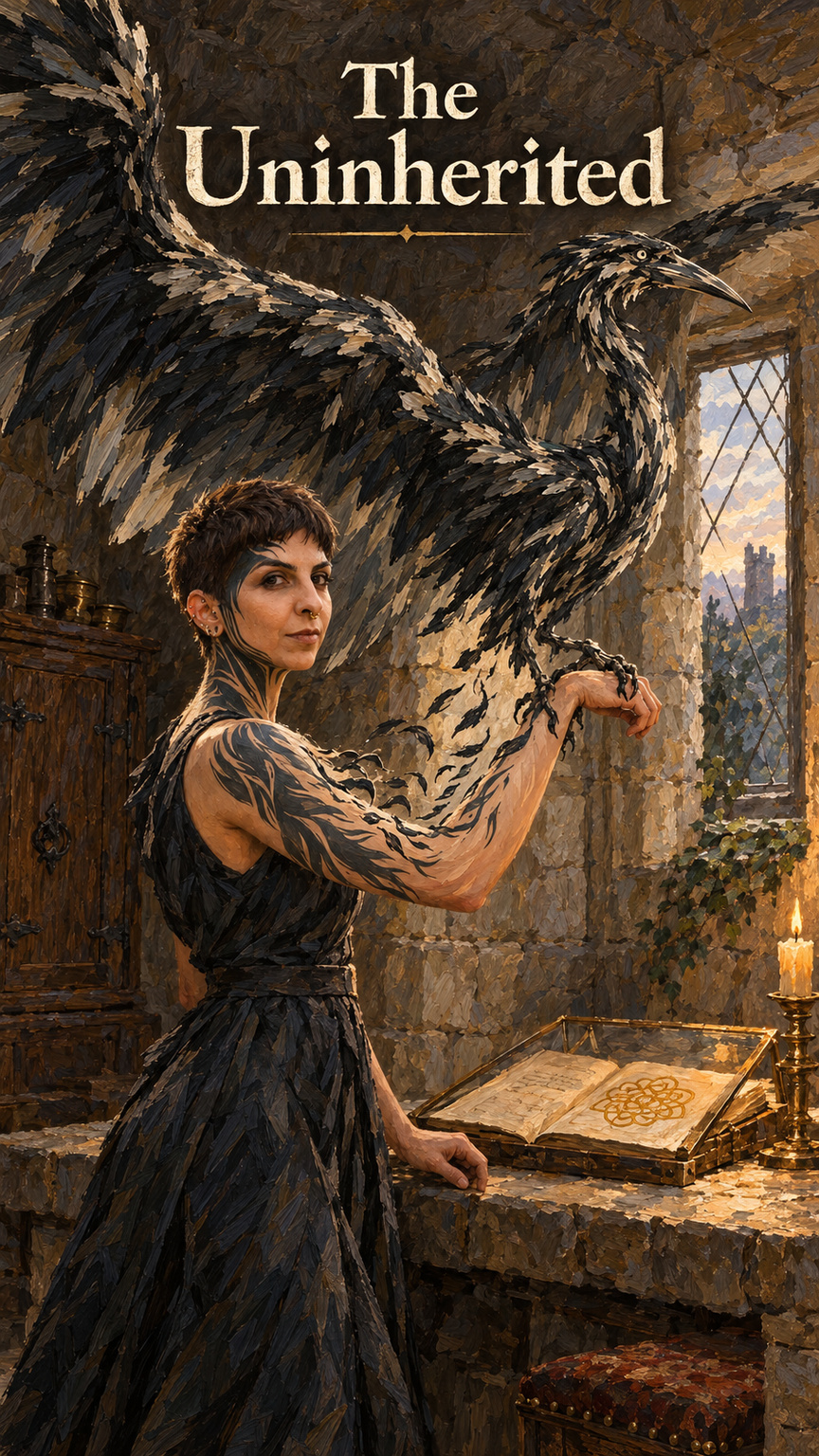
On the night she meant to become an ancestor, Desra stole the talent of hearing through stone.
The last stroke lay just below her thumb. She watched it darken, waiting for the familiar little theft inside her: a sense of something finding a room it had not known was there. Then the castle spoke.
Behind six inches of plaster, a mouse was eating a moth. Below her, someone set a tray on a table and swore at it. Farther down, through floors and joists and a very expensive carpet, Lord Ossel said, “Speak up, will you?”
Desra smiled. He had never needed to say that before.
His family had listened through walls for eleven generations. He had paid Desra to copy the branching shape of their gift into a wedding book, and left a bloody thumbprint on the account when he cut himself on its clasp. She had kept both the tracing and the stained scrap. An account, he had told her, was no place for expensive red pigment.
Now he would have to put his ear to a keyhole like anyone else.
She cleaned the needle and set it beside the other instruments. The room had once been a portrait studio; empty frames leaned against the wall, and a queen without a mouth stared from a canvas on an easel. Desra had slept here for seven nights, among old commissions nobody wanted and old work nobody remembered paying for. Her dark dress hung from the easel. In the small mirror above her pallet, the gold ring in her nose was a point of warmth among the black branches climbing her throat.
She had cut her hair short to watch them.
On the table lay seven sheets of thin paper, each carrying a tracing of the same part of her arm. On the first, the door-gift curled tidily around her wrist. On the second it had crossed the boundary she had drawn in red before going to bed. By the fifth night a hook of it had reached her shoulder. Last night, after she woke with her face in a cushion, it had joined the long feather of the gift that let her arrest a fall.
The changes had come while she slept. Staying awake had seemed a satisfactory answer until she caught herself dreaming with a needle in her hand.
She touched the first tracing. Of all her thefts, the door had been the easiest. An injured nobleman, a family book she was repairing, an idle little design pricked into her wrist with the pigment on her pen. When every locked cupboard in her lodging sprang open, she had thought the noise would bring the whole street running.
Afterward she had been more deliberate.
Blood from the living bearer. The whole branching spell, written into living skin. There was nothing like it in any book she had been allowed to read. She had taken seven gifts before Ossel's hearing, and she had gone to sleep each night feeling richer than when she woke.
Until the first one moved.
The king kept the remedy in his inheritance chamber. Desra had painted copies of the ceremony often enough: the kneeling heir, the royal hand, the gold knot beneath them both. The Knot of Descent could settle a loose gift into new blood and make it heritable. Every house had a first ancestor. Desra intended to be hers.
Let the genealogists do the uncomfortable part afterward.
She put on her dress, buckled her instruments under its skirt, and climbed out of the studio window.
The gap to the gallery parapet was six yards wide. She could have crossed where the roofs nearly touched, but the moon was out and she had been awake too long, and she wanted something easy.
She stepped.
Distance tightened once around her ribs and let go. Her foot came down on the far parapet. The courtyard remained below, all that cold air she had declined to travel through. She had once taken a paying passenger by the hand and carried him in a step to his sweetheart's balcony. He had wept. Desra had charged him extra for making her wait while he finished.
She loved this gift best.
The gallery ran open to the courtyard behind its parapet. Along the panelled inner wall, a little service door had been painted to disappear; at the far end, a guard nodded in a chair beside a great oak door. Desra lifted her hand toward the little door. The old hinge-shape stirred at her shoulder.
The little door stayed shut. Across the gallery, the great oak door banged open.
The guard jerked upright. For a moment they regarded one another across the length of the gallery. Then he shouted, and Desra went backward over the parapet.
She caught her fall halfway down.
The sudden stillness hurt her teeth. Above, the guard's lantern leaned into view. She hung with her cheek beside a stone saint, unable to go up, unwilling to let go. A bolt struck the saint's hand and took two fingers off it.
Desra released the fall and stepped in the same breath. The two gifts dragged against each other. She hit the studio's window frame with her hip, scrambled inside, and lay on the floor listening to boots begin to move through the walls.
“You could have used the stairs,” said Ildenne.
She was sitting on Desra's pallet. Her pale wool gown was torn below one knee, and her fair braid had come half unpinned. A length of knotted curtain cord lay beside her, and she held Desra's newest tracing flat with both hands.
Desra sat up slowly.
“My room had good locks,” Ildenne said. “It also had a window. They seem to have forgotten I have arms.”
“How did you find me?”
“I saw you climbing out. You still keep your elbows in when you work. As if the whole world were a piece of vellum.” She looked at Desra's side. “Is it there?”
The distance-gift lay below Desra's ribs, a black fork beneath the edge of her dress. Once she had painted that fork with powdered silver in Ildenne's family book. Ildenne had leaned over her shoulder to watch.
“Yes.”
“Give it back.”
Below them, a door slammed. The guard captain was sending men to the roofs. Desra could hear a buckle being done up, each impatient scrape of its tongue.
“You should go,” she said.
“My father signed the succession to my cousin yesterday. In the morning he means to send me to my aunt. She is very good at finding husbands for inconvenient women.”
Desra picked up the fallen tracing and set it on the table. The corner had crumpled.
“You asked me what happened to heirs who lost their gifts,” Ildenne said. “Do you remember?”
“I remember.”
“I thought you were interested in the book.”
“I was.”
Ildenne stood. Desra put a hand out, and Ildenne recoiled from it with such plain disgust that she let it drop.
“I can give it back,” Desra said.
She had worked out how three nights ago, when the door first reached her shoulder. She could go back to every bearer, offer her own blood for the return, empty herself of every marvel. It had seemed a grotesque solution. Like burning a house because the windows rattled.
“Then do it.”
“The inheritance chamber. Is it still behind the west nursery?”
“So that's what you're after.”
“I need the knot.”
“And you think I'm going to help you keep all the rest?”
Desra looked toward the window. Beyond it lay the convenient gap, the gallery parapet, the royal tower. She could still cross it. She could leave Ildenne here, take another route, and trust the gifts for one more night.
The fork beneath her ribs gave a small, hungry pull.
“You don't have to,” she said. “But if you know another way, I'll pay for it.”
Ildenne looked at the instruments, then at the blackwork climbing Desra's face.
“My step first.”
Through the stone, Desra heard the captain send the search toward the occupied guest rooms, away from the abandoned studio wing.
The return took most of an hour.
Ildenne kept her forearm on the table and watched the window. Desra worked beneath the lamp, using her own blood this time. The shape was familiar enough that she could have made it blind. She had, after all, been paid very well to copy it the first time.
Partway through, the old door-mark shifted.
She had been awake. She was certain of it. But there had been a little blankness between one stroke and the next, and now a narrow black tip extended toward her thumb.
“Don't stop,” said Ildenne.
Desra pressed a clean pin across the narrow black tip, holding it still.
The door-gift vanished from her reach. She tried the locked instrument case beside her; nothing answered. Under the pin, the black tip curled against the pressure, withdrew, then tried to get around it.
She lifted the pin. The tip darted beneath the edge of the new hearing-mark and stayed there.
Desra picked up yesterday's tracing. Then the one before it.
“What?” Ildenne demanded.
There were lines that had not existed before. Not displaced lines, not stretched ones. New joints. She had spent years learning to distinguish a flourish from the smallest necessary turn in a spell. She had copied these particular turns into her own skin. The hook from the door was bending against the fall-feather.
It was a hinge, certainly. But it was also a jaw.
“They're growing,” Desra said.
Ildenne looked at her own unfinished mark.
“Not that one. That one has somewhere to go.” Desra swallowed. “The others are growing together.”
She put her arm near the lamp. A fine offshoot lifted within her skin and turned toward the warmth. When she moved away, it followed as far as it could. At her shoulder, the long feather folded. She felt it trying to continue beyond the edge of her body, and failing.
She had imagined ownership as a kind of silence. A thing was hers when it did what she wanted and nothing she did not.
Ildenne drew her arm back.
“Finish.”
Desra did.
At the last stroke, the fork beneath her ribs loosened. For a moment she felt the gap she had crossed outside, felt its entire ordinary width. Then the gift was gone.
Ildenne rose, took one step, and stood beside the far wall.
Her hand flew to her mouth. She tried it again, across the room and back. On the third crossing she shut her eyes. Desra watched the pleasure move through her, sharp enough to look like pain.
Then Ildenne opened her eyes and saw her watching.
“The nursery door is watched,” she said. “Go through the old dressing room beside it. The back of the linen press opens onto the ceremonial passage. We used it when my sister's son was presented. You can open the door at the other end.”
“And after?”
“There is one high casement. Below it is the kitchen roof. Don't look at it and decide you can jump. It's farther than it looks.”
Desra nearly said that she knew.
Ildenne gathered her curtain cord. “That's my part.”
She left through the door. Desra did not ask her to stay.
The way to the royal tower was very long without the distance-gift. Desra had to go downstairs to get upstairs. She waited behind a statue while two guards searched the gallery, holding herself still until her calf cramped. At the linen press, the old door-shape answered only on her third attempt.
In the ceremonial passage she brushed past the painted founders of seven noble houses. Each portrait showed the family's gift in gold, branching behind the founder's head. Her own marks pulled toward one another under her dress.
She wanted them still. She wanted to sleep. She wanted to step across a courtyard because she happened to dislike walking round it. These were separate wants, and she counted them separately as she opened the inheritance chamber.
The room was smaller than the paintings made it. There was a stone table, a padded kneeling stool, and a high casement whose leaded panes had gone grey with approaching morning. The book rested beneath a glass cover. No royal hand guarded it. No ancestral voice asked her name.
She opened the cover and found the knot.
For a while she forgot the guards.
The knot was not one design but a way of closing other designs. The old illuminators had drawn each crossing clearly. A temporary catch first, to hold the loose gift; then the gathering turns; then the final line, which would carry the closure inward, beyond the skin and the reach of any needle. The gift would be hers, and her children's after her. There would be no opening it again.
She knew the work was good. Whoever had first drawn it had been very clever.
Desra began the catch on the unmarked skin inside her elbow.
The door-gift shuddered. Its long wandering line drew back down her arm. At her wrist, the familiar hinge lay still.
She turned toward the cabinet beside the table and lifted her hand.
Its little doors opened.
Just those doors. Exactly those doors.
Desra laughed once, shakily. She opened and closed them again. Four short turns and the closing stroke remained; she could make them in a dozen heartbeats. They would gather the other gifts, hold every part in its own proper shape. She could close it, catch her fall from the window, and leave the castle with everything except Ildenne's step.
That loss was bearable. She could bear it.
She looked down at the book to find the next turn.
Having seen how the knot caught, she could see how it might open instead. The little temporary catch would have to be released. The divided shapes could be joined without the final gathering line. What was trying to grow through her would have a way out.
The hinge strained against its catch.
She set down the needle.
Boots sounded in the passage. Even without Ossel's hearing she could have heard them now. A man tried the outer door of the linen press. Someone said to fetch the captain.
Desra looked at the window. A thief caught stealing a royal gift was hanged from the tower's eastern beam. She had passed beneath it on her way in, empty and waiting for the day's flags.
She could still keep the gifts. She could sleep safely with them closed inside her. In time there might be a portrait, a gold branching shape behind her head.
At her shoulder something tried to spread a wing.
She wanted to see it.
The desire was so strong that she resented it. She had spent three years assembling this wealth. The woman whose fall-feather she wore had written twice to ask if the old books said anything about gifts fading. I still go up to the roof before I remember, the second letter said. Desra had answered neither. Once she joined these gifts, there would be no separate gifts to give back. Now, at the last turn, there was another impossible thing beyond her reach.
It would not belong to her.
Desra picked up the needle and opened the catch.
The hinge ran up her arm. She followed it with one short joining line, through the blank space between the old door and the fall-feather, leaving the shape open where the royal knot would have closed. Her hand shook. She stopped to steady it, furious at the wasted seconds, then finished.
Black lifted from her shoulder.
It rose as slowly as a wet page being peeled from another. A narrow head emerged first, its jaw opening soundlessly. Then a jointed neck, a breast of tangled dark strokes, a foot that gripped her arm with the light, definite pressure of a living thing.
Desra held still.
The wings came last. They had been folded into so many places that she could not follow their leaving: her throat, her temple, the long black fields of her arm. The little hearing-mark below her thumb opened like an eye and disappeared into the creature's head.
It spread across the chamber. For a moment it was larger than anything the room could hold, black pinions passing through one another without tangling. The air under them stood perfectly still.
Desra reached up.
The creature stepped off her arm and onto the table. It did not look at her. Its head turned toward the window.
Outside the door, a guard struck the panel with the butt of his spear.
The creature put its beak to a lead seam. The pane opened the width of a penstroke. It drew itself through, wing after immense wing, and spread on the other side of the glass.
For a moment it hung over the courtyard, motionless, holding its own fall.
Then its wings took up the weight.
Desra watched until she could no longer distinguish it from the last darkness above the roofs.
The guards struck again. The door-gift was gone. The fall-gift was gone. When she put her hand against the wall, she heard nothing beyond the ordinary knocking.
She dragged the kneeling stool under the door latch, its back legs braced against the stone table.
The casement catch had rusted shut. Desra hit it with the brass candlestick from the table, missed, hit it again. Her skin looked bare and unfamiliar in the grey light. Pale brown paths remained where the gifts had been, but nothing answered when she reached inward.
The catch bent. She threw her weight against the casement and forced it open.
Below lay the kitchen roof. Ildenne had been right about the distance.
Desra climbed onto the sill anyway. An iron flag bracket projected to her left, well beyond her reach, and farther down was a projecting course of stone. She could not see a way between them. Behind her the stool scraped, then caught hard against the table. The next blow only rattled the door.
She gripped the outer frame and moved one foot out. The cold went through the sole of her shoe. She had never noticed how much the castle leaned away beneath this window.
“Give me your hand.”
Ildenne stood on the roof below, her torn skirt caught in one fist.
Desra nearly let go of the frame.
“Don't,” Ildenne said. “Stay there.”
She crossed to the sill in a step. There was scarcely room for their feet. Desra flattened herself against the stone while Ildenne reached round her and took her hand.
The courtyard tightened and released.
They landed badly behind the broad kitchen chimney, its brickwork blocking the high casement from view. Ildenne sat down hard, and Desra caught her by the shoulder before she could slide. For a little while both of them breathed.
Wood cracked above them. Then a man shouted from the casement for the kitchen court to be searched. Both women stayed low.
“They were going up the passage,” Ildenne whispered. “I heard them say they'd found you.”
Desra looked at her own hands. She could feel every place where the stone had scraped them.
“You came back.”
“I wanted my step. I didn't ask for your head.” Ildenne pulled the torn wool over her knees. “Where are the others?”
Desra pointed toward the sky.
Ildenne followed her hand.
“Can you give them back now?”
“No.”
Her face closed. “You could have.”
“Yes.”
Ildenne looked as though she might say something more. Instead she shook out her torn skirt.
“I'm going to my father. If they ask whether I've seen you, I shall answer.”
Desra nodded.
Ildenne stayed low as she went to the roof's little stair door. There she hesitated. “I'll need a moment to make myself presentable.”
Then she was gone.
The morning had reached the ivy on the outer wall. Beyond it, close enough to be infuriating, the roofs of the city sloped into sunlight. The easy way down was through the kitchen court. The watch would be there already.
From behind the chimney, Desra studied the wall instead.
A cracked lion projected from its far corner, around from the tower window. Above the lion, ivy hid a line of old putlog holes. The crossing from the roof to the lion was too wide for a step. She measured it with her eye, then measured it again, feeling the absence beneath her ribs.
In the city somebody would have breakfast for sale. Somebody would have a purse carelessly tied. She was so tired she could have slept standing up, and so hungry that the thought of hot bread made her jaw ache.
She took off her shoes and tied them to her belt. There were three finger-widths of stone beneath the lion's paw. She could get both hands there, if she turned sideways, if she trusted the second foothold rather than the first.
Desra put her empty wrist against the cold wall and began to climb.