
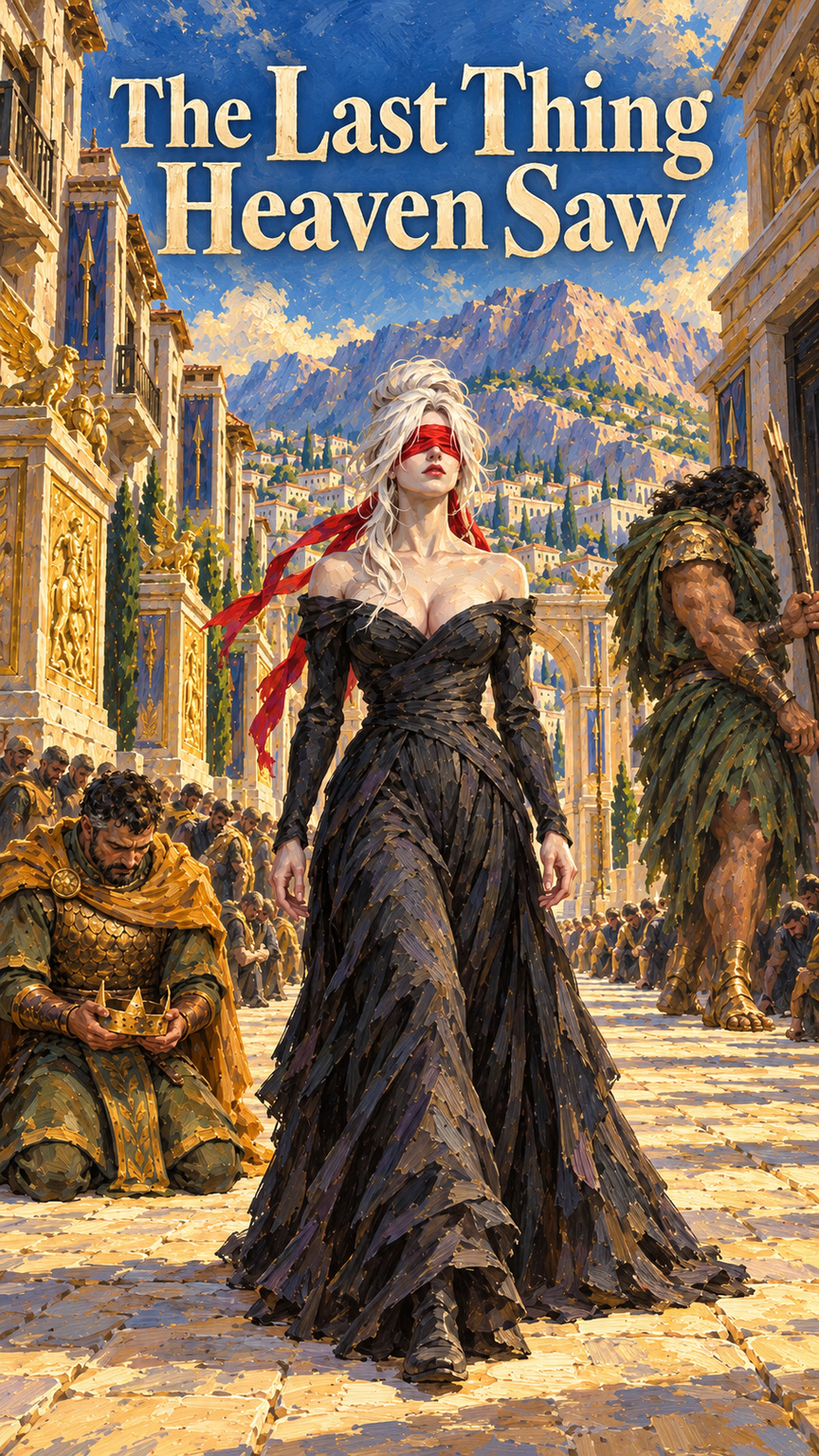
The emperor took off his crown before he crossed her threshold. He had kept it on while his brothers died.
Ilessa heard the hinges of its case, the small disturbance among the men behind him, and then his bare footsteps on her tiles. He had removed his boots as well. That was excessive, but she let him decide how frightened he wished to be.
“Your men can wait outside the garden.”
Darovan dismissed them. When the last harness stopped ringing, he knelt.
She sat beside an open window. The afternoon had warmed the stone beneath her hands. In the garden, fruit was splitting in the heat; she could smell the sweetness through the bitter leaves. This was an hour she liked. For most of her life there had been someone who believed his need more urgent than her pleasure in it.
He laid something at her feet. Gold struck gold, four times.
“My crown,” he said. “And those of the west.”
“I asked you to leave your men. Have you brought their kings instead?”
“Their kings are dead.”
She waited.
“I need your help.”
“Then you should have begun with what you need.”
He drew a breath through his nose. He had a soldier's care for his breathing, using it to hold still what wished to shake. She had heard men breathe like that before a charge. Beyond the window, a wasp worried at the open flesh of a peach.
“Namar has taken the high throne.”
“I heard the bells.”
“He defeated the Nine at their own gates. He broke the Spear-Bearer. The others have sworn to him.”
“And you?”
“My armies closed their temples in the west. My people fill his.”
There was pride under the fear. She was glad he had not tried to hide it.
“What does your god want?”
Darovan's next breath was less orderly.
“Your eyes, to be set into his coronation crown. Two places have been cut in the gold.”
Ilessa lifted her hands from the warm stone.
“He put it in those words?”
“He said the last power that would not kneel would be made an ornament.”
“What were yours?”
“I said I could carry a demand. I could not give him what was yours.”
“Yet you carried the crowns of the west.”
The wasp left the peach. She listened to it go.
“I have thirty thousand men within a day's march,” Darovan said. “The northern passes can be held. If you will come behind my walls—”
“When is he coming?”
“He will send his war hand at noon tomorrow. He stays on the throne when he uses it.”
“Then you have until noon to clear the imperial avenue. Clear the pilgrimage stair as well, from its first step to Heaven's gates. No soldiers. No priests.”
“You mean to go to him?”
“He has announced that he means to come to me.”
The emperor shifted on his knees. One of the crowns scraped across the tile. She reached toward the sound, and he put it into her hand.
The fourth point had been bent inward. She knew it under her thumb.
“This one should be in a grave.”
“It was my ancestor's.”
“He had a loud laugh. He thought that made his jokes good.”
Darovan was silent for a while.
“There is a portrait,” he said at last. “In the old palace. He stands beside you. When I was a boy I thought the painter must have loved you.”
“He disliked me. I would not let him use white for my hair. It was silver even then.”
“Your face has not changed.”
She heard him look. They always grew quiet when they did, even those who had rehearsed what they would say. She was still the most beautiful woman in his kingdom. A thousand years of portraits had failed to prepare a single emperor for the woman at the window, with the crimson cloth over her eyes and the old crown loose in her hand.
She returned it.
“Your ancestor asked me to look at his enemies.”
“What did you tell him?”
“He was standing in front of them.”
Darovan took the crown very carefully.
“Will Namar listen?”
“I don't know him.”
“He has beaten gods.”
“Yes,” she said. “You told me.”
She rose. Dark cloth slipped over the edge of her chair. Darovan drew back to give her room, still kneeling, and she went past him to the door.
“Ilessa.” He had to force her name out. “If there is a war—”
“There is already a war. You brought four crowns into my house.”
He said nothing more.
“Take them with you,” she said.
She heard him gather them by their bands. He had difficulty carrying so many without letting them strike one another.
Outside, the sun lay warm upon her covered eyes.
She had tied the first crimson strip a thousand years before Darovan's visit. Everyone who had watched her tie it was dead. The woman who had held her hair away from the knot; the man who had been unable to stop thanking her; all the people who had promised she would never be asked for anything again.
The peach trees still ripened. Men still mistook the gift for a debt.
She went into the garden and sat beneath the leaves until the stone lost its heat.
At noon the imperial avenue was empty.
No carpet had been laid for her. She had sent it back. Her shoes sounded plainly on the pale paving, beneath the balconies and the shut doors of the goldsmiths. People waited in upper rooms. She heard a shutter open, a hurried whisper, the shutter held before it could slam.
The city had grown toward her house over the centuries. There had been a field here once. Later, a wall, and a gate at which a man had asked her business. She remembered being pleased with him. He had been very young and had taken his duty seriously.
Now there were victories carved along the avenue, high enough for a conqueror on horseback to admire. Darovan had ordered the newest figures gilded. When the wind came from them it smelled of worked metal and the last bitter drying of size.
At the Temple of Spears, something heavy moved backward.
Ilessa stopped.
The bronze feet moved again. A long shaft rattled against a lintel.
“I thought he broke you,” she said.
“He broke my spear.”
The voice came from well inside the temple. Once it had spoken over battles. Men had heard it with blood running from their ears. Now it was having trouble getting past the doorway.
“And you swore to him.”
“He had the high throne. What would you have had me do?”
“I have not asked you to do anything.”
A quick breath, too large for a human chest.
“I did not advise this.”
“Keep out of the avenue.”
The god retreated until its feet no longer sounded on the temple floor.
She resumed walking.
Farther on, incense ceased to burn. A small god who lived in the heat above a jeweler's altar fled through the roof with a noise like tearing silk. Three priests called after it by three different names. None brought it back.
The silver bells at the palace began the noon measure. Before they reached the seventh note, a voice rolled down from the mountain.
“At last.”
Its force pressed the air against Ilessa's face. Every shutter in the avenue shook.
She stopped where the street widened before the palace. The paving here was bare for a hundred paces. Behind her, an iron bolt was drawn very softly.
“Where are you?” she asked.
“Where this kingdom kneels.”
The heat arrived before the hand. She felt the hairs at her temples stir in it. Above her a vast palm turned, and the avenue darkened. Rings rang against one another, each larger than a wheel. Something brushed the top of the victory arch; stone burst into dust and fell well behind her.
“Give me the cloth,” Namar said.
She tilted her face up. A broad, hot finger lowered toward the back of her head, seeking the knot.
Ilessa raised the lower edge of the blindfold over one eye.
She saw gold.
After so long, its brightness startled her. For a heartbeat she wanted only to look: the intricate creases of a hand too large to be born, the white fire in its joints, a narrow piece of blue between its fingers.
The nearest finger vanished. The absence widened through the palm. Its rings disappeared with it, and the heat broke away from her face.
She closed her eye and lowered the cloth before moving her head.
Sunlight returned to the avenue. Nothing fell from the place where the hand had been.
Namar did not speak.
There was a murmur behind the upper shutters. Someone began to pray and was silenced by someone else.
“That was your hand,” Ilessa said. “Will you come yourself?”
From the mountain came the hard crash of gates closing. Its echoes moved down the slopes, striking the lesser temples one by one.
She waited until they were finished.
“Come down without your crown. Tell the kingdom you had no right to demand my eyes. Renounce your claim upon me. Then I will leave you alive.”
Her voice was not loud. In the emptied avenue it carried.
The mountain gave no answer.
She turned toward the pilgrimage stair.
Namar had chosen his seat well. From the low city, the mountain's rim hid his living body. An emperor could see the banners of Heaven and the light it cast into the clouds, but never the god who received his petitions.
Ilessa could have looked at the mountain. The houses climbing its slopes would have gone first.
She took the stair.
At the first turn she put a hand to the wall. There was a deep groove in the stone where pilgrims had touched it for luck. Higher up, the groove became intermittent. Most people who began the climb never reached Heaven. There were lower altars at which to surrender their gifts.
She went past the altars. The sun moved to her left. Her breath shortened on the steep sections, and the muscles above her knees began to ache.
She had not promised to preserve Namar's peace. He had reached into a city to take her eyes, then shut a door when he failed. If she let the closed door settle the matter, he would come back with a better hand. Or the next emperor would.
She stopped to tighten the knot behind her head. It was hard to do with her hair lifting in the wind. Once secure, she smoothed the silver strands out from beneath the cloth and continued.
The first god fled above her at the eightieth turn. Six wingbeats struck the air in rapid succession. Ilessa leaned against the wall until the gust had passed.
From far above came Namar's summons.
It was an immense note, shaped by a living throat. She had heard it before, from the city, on the day he took the high throne. Then the Nine had answered, one after another, until the windows rattled in her house.
This time something scraped along an upper ledge. A heavy body launched itself into the air and departed southward, keeping far to the west of the stair.
Namar called again.
A voice answered him from a considerable distance.
“You knew what she was.”
“Come here.”
The wind carried a thin, undignified cry. The speaker was going farther away.
Namar's summons followed her up the mountain. He called upon oaths, upon debts, upon the seats he had allowed the Nine to keep. She heard him promise victory to anyone who would stand beside him.
Ilessa climbed into cold air.
Above the last inhabited terrace, the stair crossed a stretch of bare rock. She stopped there to rest. The wind had the clean mineral smell of the summit. No cook smoke, no grain, none of the warm scents of people pressed together. A loose offering bowl rolled somewhere nearby, struck a step, and went ringing down the mountain.
She remembered this slope before the stair was cut, when there had been only a narrow track. There had been flowers in the cracks. She had seen them: small yellow things with five petals, before anyone called her dangerous.
The memory still had its yellow. She was grateful for that.
She could have gone back. The thought came without shame. Darovan would call the broken hand a victory; priests would find a way to leave Namar's retreat out of their songs. There would be fruit in the garden for another week.
She rose.
Above her, the great gates were being barred.
At the final turn her hand ran out of wall. Wind came from ahead now, cold and unobstructed. She had reached the little shelf beneath the gatehouse. Six broad steps led up from it into the court. Before there were gates here, she had stood on this shelf and watched clouds pass beneath the summit's far lip. Behind her were the warm smells of the terraces.
The first king who built a hall on this summit had asked whether he could put a throne in it for her. She had refused it.
Now she set her palm upon the old threshold stone. The notch he had cut for the first gate remained beneath the later metalwork.
“I am here,” she said.
An enormous breath moved on the other side.
She waited.
Footsteps hurried across the court to her right, into the white-pillared gallery. A chain began to run through a winch there.
He was lowering the high drawbridge. It led from Namar's court to the old gods' refuge on a separate pinnacle. She had crossed it once with a god who spent most of the journey describing the terrible distance below. He had thought he was amusing her.
“Will they receive you?” she asked.
The chain stopped.
For a moment there was only the wind.
“Go back,” Namar said. “You have had your answer.”
Ilessa faced the high gold doors and lifted a corner of the blindfold.
Gold filled the narrow slit, with a strip of pale sky above it.
The gold parted without bending. A lane of absence opened straight across the court to the sky beyond. She shut her eye.
Wind rushed through the opening. The winch rattled violently.
She turned her covered face toward the bridge.
She lifted the cloth again.
The white bridge swung down from the gallery's outer end, bright against the sky.
She looked at the middle of the span.
A gap opened in the bridge and widened to either end. Ilessa closed her eye before turning back toward the gallery.
The chain rattled to a stop against its wheel.
“You knew that road,” Namar said.
“I crossed it before you had an altar.”
Namar called the Nine by their oldest names.
He called the Spear-Bearer, whose western temples Darovan had closed. He called the god of the western air and the twins who carried evening between them. His voice grew rough. He offered the high seats back. He offered the conquered kingdoms.
At last, from the direction of the refuge, a god answered.
“We will not cross in front of her.”
“Come behind her, then.”
“You come behind her.”
No one laughed. Ilessa felt the cold wind moving over her hands.
“The stair is open,” she said. “You can walk down it.”
Namar came back along the gallery, his steps heavy now.
“You would have me crawl past you.”
“Walk. There are steps. Take them carefully.”
She heard the sound he made at that. Anger suited him better than fear. He found his great voice again.
“I have waited three hundred years for this crown. They used to ring for me when their banquet lamps went out. Little Flame, they called me. They will ring again if I go down past you.”
“Let them ring. You may have three hundred more years without that crown.”
He was quiet.
“What would you leave me?”
“Your life. Your own altar. Those who choose to kneel before it. Give back the high throne and renounce your claim upon me. No one will take my eyes for you. Say it where the kingdom can hear, and I will go down the stair.”
She meant it. She had no desire for his temples, and three hundred years was long enough to acquire something worth keeping. Let him remember it. Let him live beside it.
“And the other gods?”
“You can ask them what they will forgive.”
His breath came out slowly. Far below them, an eagle cried.
She could feel how badly he wished her to be someone else: an old god to whom he could offer a kingdom, a woman to whom he could offer a god's bed, a rival whose followers could be starved into submission. There was nothing in her hands for him to take. Even the cloth was tied with an ordinary knot.
“You will swear to leave?” he asked.
“I have given you my word.”
The pause lasted long enough for her to hope.
Then metal struck stone in the gallery. He had set his crown down, but she heard the scrape of its rim being driven into a groove. A ringing note rose from the gold. She had heard that note from the mountain when he took the high throne, followed by a blaze she had felt in the city below.
She took her hand from the threshold.
“Namar.”
He drew a vast breath.
“I will not go back.”
The court filled with heat.
It struck her face hard enough to hurt. Her sleeves snapped against her arms. In the pillared gallery, the living god gathered his force into the crown beneath his hands. He had broken the Nine with one sudden stroke, catching them still in their seats. He sent the whole of that strength at her now, without another word. Stone cracked, and the wind bent away from him.
Ilessa turned her covered face toward the sound. She raised her chin a little. The gallery stood above her; beyond it there was only sky. The stair ran down behind her heels.
Fire rushed toward the threshold.
She lifted the crimson cloth and opened both eyes.
Namar stood among the gallery's white pillars, taller than any of them, with the crown blazing between his hands. He had made himself beautiful. His skin shone like the inside of a shell. Six arms spread from his shoulders, each scarred by an old victory. There was fury in his face, and the effort of holding something enormous. Above the crown's rim, two empty settings waited for her eyes.
The fire came to an end in front of her.
For an instant he could see her plainly: the silver hair blown back, the dark dress drawn tight in the wind, the cloth held against her brow. She was looking up at him. Her mouth was closed.
He drove the crown forward.
The gold disappeared between his hands.
His lower arms went with it. Blue opened in his body. He tried to bring the remaining hands together, holding his fire in the narrowing places where he still existed.
Ilessa kept looking.
She saw the lines cut into his throne, the crowded figures of kneeling gods along its base. The throne ceased to be. Pillars opened from their bright capitals downward. The roof went, and with it the banners she had heard so often from the city, beating above a place she could not see.
Namar made one last attempt to strike her. His surviving hand reached out through the vanishing gallery, immense and empty.
She watched until it was gone.
Beyond him the sky was the same blue she remembered. She had expected, after a thousand years, to find it altered.
She closed her eyes before her gaze could lower, and brought the cloth down over them.
The heat left her. Wind came across the ruined summit from the far side. Nothing crashed into the valleys. There was no great weight left to fall.
She stood a while on the lower shelf, with her feet on the stone where the first king had cut his gate notch.
Then she retied the blindfold.
“Come here,” she said.
No one answered.
She waited with the patience that had outlasted their temples.
At last wings moved beyond the court. A large body settled at the far end of the shelf, careful to keep away from the space directly before her face.
“We did not help him.”
It was the god who had answered from the refuge. Its voice was quite small now.
“Bring the others.”
“What do you want?”
“You will carry me down through the city.”
A pause.
“The stair remains.”
“Yes.”
The god said nothing more.
Soon she heard the weight of the Spear-Bearer upon the shelf, and the arrival of things whose passage changed the pressure in her ears. They spoke quietly to one another. Six gods lowered themselves until their joined hands lay level with the shelf. She stepped onto their palms. They lifted her standing.
They carried her over the intact stair, past the abandoned altars, out above the inhabited slopes. Below, doors opened. People came into streets from which they had been forbidden, looking up at the gods who bore the blindfolded woman down from Heaven.
She felt the warmth of the city rise to meet her.
Darovan waited in the imperial avenue with his crown in his hands.
Behind him stood the court, the commanders, the priests whose gods were descending without their high king. The emperor knelt before the bearers had set Ilessa on the paving. This time the sound traveled backward through the people behind him: cloth, buckles, knees upon stone.
The gods stepped out of her path.
“Namar?” Darovan asked.
“He chose to keep his crown.”
Darovan drew a breath. The same soldier's breath, taken carefully, to make something bearable.
“What would you have of me?”
“Stand aside.”
He moved on his knees. She passed him, and the gathered court opened before her without a word.
In an upper window, someone began to weep. Elsewhere a voice called a god's name. No one answered it. The Spear-Bearer's great feet withdrew toward its temple, then stopped until she had gone by.
Ilessa walked toward the quieter streets. The paving was warm. Beyond the walls there would be grass, and then the path to her unbarred house. She could smell smoke from the little kitchens the city had lit again.
She paused where the wind from the mountain reached the avenue. For a moment, in the warmth behind the cloth, she could still see the blue.
Above her road, the gods began their long way round.