
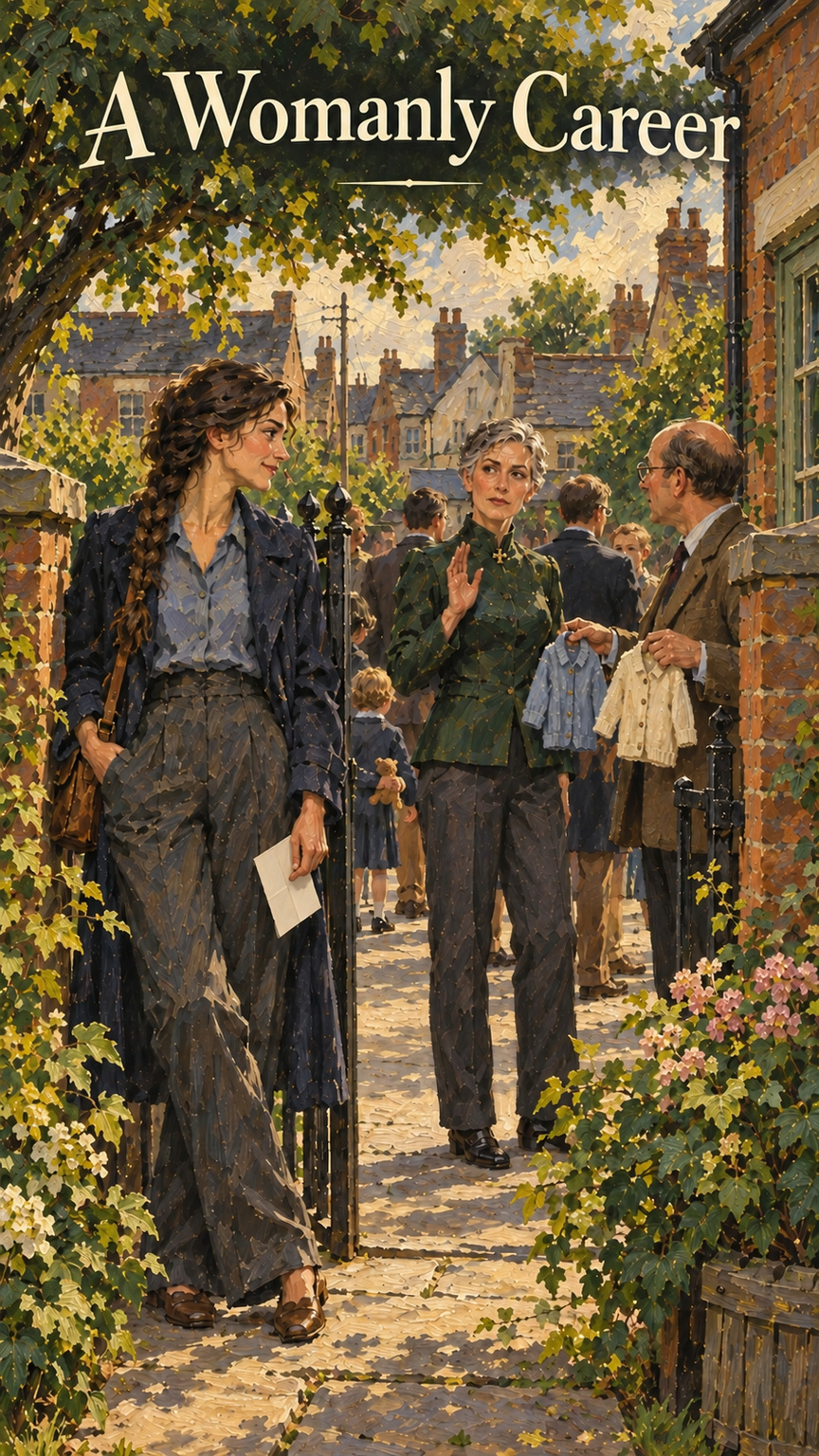
“Good lord,” Father said. “You're a lady from a highborn family! Why can't you choose a womanly career, like firing a .90-calibre sniper rifle like your mother, or being a tank gunner and radio operator like your grandmother?”
He had been cutting a pear into six identical boats. At the word nursery, he had stopped with the knife in the air.
Cressida took the plate from beneath it.
“I don't want to join the army.”
“We have established that. Your mother has suggested the marines.”
Mother looked up from the paper. Her grey hair was cropped close above the collar of her dressing gown; she had a faint square of paler skin where her regimental badge usually sat against her throat.
“I suggested the marines because you like the sea.”
“I like swimming.”
“Yes?”
At the head of the table, Grandmother turned down the receiver of her old field radio. On retirement she had discovered that civilian broadcasts consisted largely of people speaking while other people were still speaking. She followed three such programmes with mounting professional disgust.
“Which nursery?” she asked.
“Little Orchard.”
“The one behind the shops?”
“It has a garden.”
“Behind the shops,” Grandmother confirmed. “What do they pay?”
Cressida told her. Father put down his knife altogether.
“That's the apprenticeship,” she said. “It goes up when I'm qualified.”
“By how much?”
Cressida told her that too.
Outside the long windows, the gardener was coaxing a climbing rose away from the stone woman who had captured three forts with a broken collarbone. He had reached her left boot. It would be another hour before he reached her bayonet.
“You'd have your own quarters with us,” Mother said. “Your pay would be yours. And your pension.”
“I've seen rooms I can afford.”
“Rooms?” said Father.
“A room.”
Mother folded the paper, lining up its edges. On the sideboard stood the long leather rifle case she had brought home yesterday. Cressida's initials were stamped beneath hers.
It was not a new rifle. Mother had carried it through seventeen years, and Cressida had first been allowed to fire it with Mother lying beside her, correcting the position of her shoulder. She remembered the weight of Mother's hand much more distinctly than hitting the target.
“The mess has a room kept for you on Thursday,” Mother said. “They want to hear about the college match.”
Cressida had won the college match. She had enjoyed winning it. She could see the room: the red lamps, the women she had known since she was small enough to be handed from knee to knee, somebody already ordering her a drink before she asked.
“I haven't accepted the school place yet,” she said. “Today is a trial. On both sides.”
“Then try it,” said Grandmother. “But ask whether that pay continues through the holidays. And whether you can afford to be ill.”
“I have savings.”
“So did I. I enjoyed acquiring more.”
Father rose. He had said everything there was to say last night, including that children deserved a properly trained man. He was too well bred to say it all again before ten o'clock.
“I suppose you'll need your box.”
He brought it from the hall with both hands.
For a week he had helped her make a theatre from a wine case. The curtain ran on brass rings; six flat pasteboard animals stood in slotted wooden feet. The goose had a working wing. Father had painted individual feathers while explaining that if she simply wanted the company of children, she might marry a nice young man and let him arrange some.
He set the box beside her chair and lifted the curtain with a finger.
“The mole's nose was loose. I've fixed it.”
“Thank you.”
“And don't let them pull the goose's wing backwards.”
Mother watched Cressida put on her coat. Neither of them looked at the rifle case.
“Shall I tell them Thursday is still possible?” Mother asked.
Cressida looked down at the little brass curtain rings, all in a straight row.
“Yes,” she said.
Mr. Brindle answered the nursery door with a red cardigan over one shoulder and a child's sock over the other.
“Come in. Excuse the sock. Its owner has opinions about seams.”
He was a lean man with a long face and large, capable hands. His hair was pinned back with two pink clips. When he saw Cressida looking, he touched one.
“Being improved,” he said. “You can put your coat in the cupboard.”
Ten children occupied the room in ways no inspection could have anticipated. A girl lay on her back beneath a table, singing one word over and over. Two boys were moving wooden bricks from one basket into another with the solemnity of undertakers. Beside the window, a very small person in a yellow smock was licking a mirror.
“That's Orri,” said Mr. Brindle. “He'll show you where things go. Orri, we look with our eyes.”
Orri detached himself from his reflection and examined Cressida.
“Are you somebody's mother?”
“No.”
“Why?”
“I haven't had any children.”
He considered this disappointing explanation, then pointed to her theatre.
“What's in there?”
She showed him the goose. He made its wing move once, then again very slowly, watching the little joint. Cressida crouched beside him. There was a wing. How did it work? On her afternoons as a volunteer, she had often stayed beyond her promised hour, watching a child work out a hinge or a buttonhole.
A father at the doorway interrupted them.
“Lady Cressida? I didn't realize.” He straightened his son's collar. “Does he salute you, or—”
“Miss Varn,” Mr. Brindle said. “And he says good morning.”
The father laughed uncertainly. “Well, a little discipline might do him good. His mother says he's getting soft.”
His son pressed his face into the man's trouser leg.
Mr. Brindle knelt and said something Cressida couldn't hear. The boy answered into the cloth. They stayed like that for a while. Cressida discovered she was standing very straight, with the goose held against her waist.
At college, the answer to a departure had generally been a whistle.
Eventually the boy consented to show his father the brick baskets. Father had to put three bricks in each. Only then could he leave.
“We'll start with the story after fruit,” said Mr. Brindle. “Would you like to tell it?”
Cressida would.
She had practiced The Goose Who Went Visiting in the mirror until she could give the badger a voice quite unlike the mole's. There were six animals, six houses, a refrain, and an excellent opportunity to count. Father thought the houses too plain and had added window boxes.
Four children came to sit on the rug. Mr. Brindle asked the others whether they wanted to listen. One joined them. The girl beneath the table continued singing ham.
Cressida put the goose through its door.
“One morning, Goose decided—”
“That's mine,” said Orri.
“You can have a turn afterward.”
“I was doing it.”
“You were looking at it. Now we're having the story.”
She smiled at him. He did not smile back.
“One morning, Goose decided to visit her friend—”
“Why?” said a girl with a scab on her chin.
“Because she wanted to see him.”
“Was he ill?”
“No, he was—”
“My father was ill.”
“I'm sorry.”
“He was sick in a hat.”
This information interested everyone. A boy who had declined the story came over to hear more about the hat. Cressida waited until they had finished, then made the goose knock at the mole's door.
“Is this the house of my friend Mole?”
Orri reached across and took the goose.
“Not yet,” she said, taking it back. “There are other people watching.”
He held on. The little wing caught the edge of the stage and bent.
“Careful!”
She said it in her range voice.
Orri let go at once. So did the boy holding a brick. Beneath the table, ham stopped.
Cressida sat with the goose in her hand, its wing pointing out at an angle Father had explicitly forbidden.
Mr. Brindle came to the edge of the rug.
“Put it on the shelf a moment,” he said quietly.
“I can mend it.”
“Put it down first.”
She did. Her face was hot. The girl's father was still sick in the hat somewhere in the story she had not managed to begin.
“I shouted,” Cressida said to Orri. “I'm sorry.”
He pushed the theatre curtain closed.
“I wanted the wing.”
“I know. It belongs to the theatre, so we have to be gentle with it. I can show you again when it's fixed.”
He pushed the curtain open, then closed it. He seemed to have finished with her.
Two children began to leave.
“What happens to the goose?” asked the girl with the scab.
Cressida looked at Mr. Brindle.
“Do you need the goose to tell it?” he asked.
“No.”
“Then you've still got listeners.”
She told the rest to three children, using her empty hand for Goose. The girl wanted to know whether the badger had a sick hat. He didn't, but Cressida thought he might have a biscuit. A boy ate the imaginary biscuit off her fingers. She made him return one for the badger, who had done all the baking.
When they finished, Orri was still opening and closing the curtain.
“All done,” she told him. “Would you like a turn with the animals?”
He shook his head.
He held out his hand to the girl who had been singing under the table. She crawled out, went behind the little stage and said, “Ham.”
Orri opened the curtain.
“Ham,” she said again.
He closed it.
They performed this entertainment eleven times. Cressida found herself waiting for the twelfth.
By four, her knees hurt. She had wiped a nose with the wrong tissue, misplaced the lid of the paint box, and learned that announcing there were only two biscuits left did not cause the remaining children to become good at subtraction.
She had also spent nearly twenty minutes beside a boy who was drawing a dog. He had drawn the dog's feet in a row along its back. Every time she thought he had finished, he found another place it needed to go and added a foot to reach it.
She had not helped him. She had wanted to. Then she had wanted to know where the dog would go next.
While the last children put on their coats, Mr. Brindle gave her a folded sheet.
“The terms we discussed. Take them home. Ring me by Friday.”
“You still want me?”
“You'll need to learn. You knew that when you applied.”
“I thought I knew.”
“Yes,” he said. He retrieved the sock from the windowsill. “Could you look under the table for its partner?”
On the way out, Cressida checked the notice about pay. It continued through the holidays. The school paid for a limited number of sick days. After that she would need her savings.
She could go on Thursday. She could walk into the mess and be understood. Nobody would make her explain why a story with six painstakingly painted animals had required her hand to become a goose.
She stood on the pavement with her theatre box until a man pushing a pram said, “Excuse me, miss,” and she realized she was blocking the nursery gate.
At home, Father saw the wing before she had taken off her coat.
“Oh, Cress.”
“I know.”
“I said—”
“I know.”
He took the goose out of its slot. She had wrapped a handkerchief around the joint to keep it from getting worse.
Mother came in from the drawing room. She was dressed for dinner, her regimental cross fastened to a dark green silk jacket. The rifle case was gone from the sideboard.
“Well?”
Cressida had prepared an answer on the walk. The children had loved the theatre. The school had asked her to stay. Both statements were sufficiently true to be defensible.
“I shouted at a boy,” she said.
“Did you?” Father looked up from the goose.
“He was pulling that and I grabbed it back, and then I frightened everyone.”
Mother glanced at the wing.
“It's a delicate thing for children.”
“I took it. I told him he could have a turn. He thought he'd already been having one.”
Father touched the bent paper with a thumbnail.
“Did any of them like the story?”
“Three. One kept asking about a hat. Two others just opened and closed the curtain and said ‘ham.’ They liked that very much.”
Father's mouth moved. She couldn't tell what he was going to say.
“Was that in the story?”
“No.”
“I should hope not. You cut my whole second verse.”
She laughed, suddenly and painfully, and had to sit on the hall chair. Father took the box and the goose into the drawing room.
“Perhaps,” Mother said, “you've found out what you needed to find out.”
Cressida rubbed a spot of dried paint on her wrist. Beneath it was the little crescent scar where a hot case had once caught her. She could hear the mess women laughing over the college match.
“Yes,” she said. “I think I have.”
Mother began to smile.
“I'm going to take the apprenticeship.”
The smile stopped before it had properly arrived.
Cressida kept her eyes on her mother's face.
“I like them,” she said. “Even when they didn't like my goose. I want to go back and learn how to do it.”
For a time Mother said nothing. From the drawing room came Father asking Grandmother to stop turning the goose's wing, and Grandmother saying she was establishing the nature of the damage.
“Your own quarters,” Mother said at last. “Your own pay. Women who'd stand beside you.”
“I know.”
“You could be very good.”
Cressida nodded. This was the part she could not make harmless for either of them.
“I know.”
Mother looked away first.
“Will you live here?”
“For the trial term, if I may. Then I'll take the room over the bakery.”
“I thought it was the bookshop.”
“The bakery costs less. I did the sums again after what Grandmother said. I need to keep more back.”
Father appeared in the doorway.
“Your clothes will smell of bread.”
“Yes.”
“Everything you own.”
He retreated before she could answer. A moment later he returned with the goose.
“I'll make a second one with cloth at the joint,” he said. “For handling. This one can stay on the stage.”
“Can you show me how?”
“After dinner.”
Mother was still standing by the drawing-room door. Cressida stood too. They were almost the same height, but she had to stop herself lifting her chin.
“Could you meet me tomorrow?” she asked. “When I finish. At four.”
“What for?”
“To walk home.”
“The carriage can—”
“I'd like you to.”
Mother pressed a finger against the clasp at her throat.
“I have a fitting until half past three.”
Cressida waited.
“I'll see,” said Mother.
Cressida had rung Mr. Brindle after dinner, accepted the place, and arranged to start the next morning.
The following afternoon, Cressida came out carrying a sheet of paper. The dog now had seventeen feet and an upstairs.
The nursery gate was crowded with fathers. They stood in twos and threes, exchanging things from little bags and stooping to greet children.
Mother stood among them in her green jacket. Her hands were empty. A man was telling her something at length, holding up two very small cardigans for comparison.
Mother looked from one to the other with the fixed attention she gave to briefings in an unfamiliar field.
Then she saw Cressida.
She raised a hand. The man raised both cardigans, thinking she had decided, and Mother had to turn back and explain.
Cressida waited for her at the gate.