
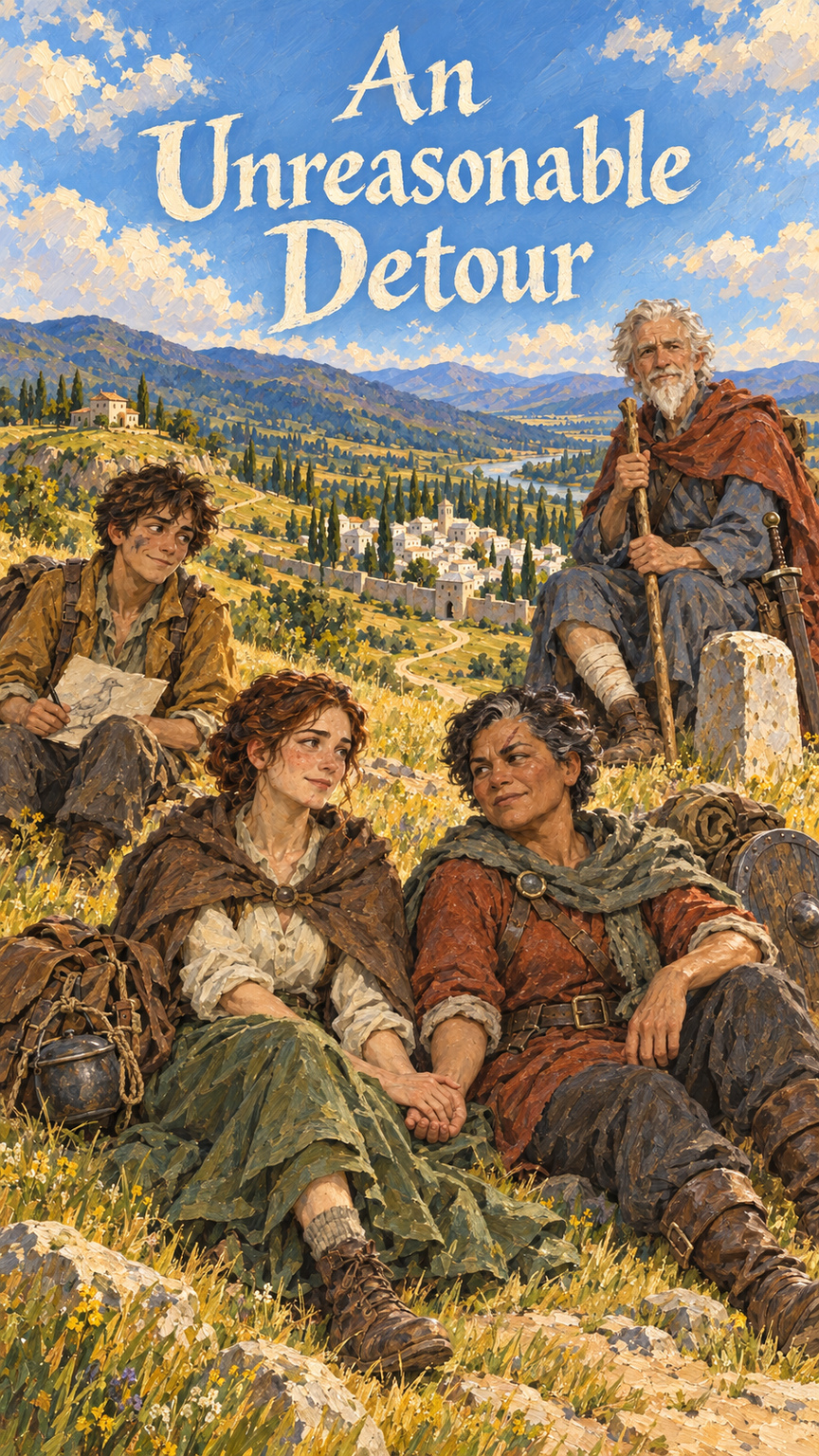
The princess's luggage went over the stile first. The princess remained on the bottom step.
Her skirt had caught beneath her boot. To free it she needed to lift the boot, but to lift the boot she needed to stop standing on the skirt. Above her, three adventurers waited with the careful faces of people being paid not to laugh.
“You can let go of the bag,” said Haddie.
Sereya looked down. She had forgotten the bag.
Haddie took it. Freed of this small responsibility, Sereya climbed over the stile and dropped onto the other side rather harder than she intended.
“Lovely,” said Osnet, who had white hair, a pointed beard, and a sword almost as tall as he was. He offered her a hand as though they had met at a ball. “Only the mountain left.”
The youngest adventurer made a noise into his sleeve.
“Ket,” Haddie said.
“Nothing.”
“It was a stile,” Sereya told him. “The mountain will presumably have fewer bits of wood.”
“You would be surprised,” Osnet said.
She could not tell whether that was a joke. They started walking.
Her attendants and the trunks containing her wedding clothes had gone by the coast road. The pass would bring Sereya to Bellan's city three days before them, with time to rest and to see the house where she would live. Her mother had approved the expedition after looking up Haddie's company in a book. The book recorded a slain marsh-worm and the recovery of an abbot from kidnappers. It had not mentioned the flat, considering look Haddie gave Sereya's boots.
“Tell me when those start rubbing.”
“They won't.”
“Tell me anyway.”
By midday there was a hot patch on each heel. Sereya waited until the others stopped to drink before mentioning it. Haddie sat her down, looked at the boots, and made her change into a pair of thick stockings from the company's spare clothes.
“But these are yours.”
“They're spare.”
“I shall wash them.”
“I hope so.”
Osnet offered her a pickled egg. She accepted because he seemed proud of the jar, and managed to swallow half before her eyes began to water.
“All right?” he asked.
“Quite.”
Ket watched her over his bread. “You can give it back.”
She had been a princess for twenty-six years. Nobody had ever told her she could give back half an egg.
“I don't think I like it,” she said.
Osnet took it and ate it himself.
That evening they came down to an inn with smoke rising from both chimneys. Through the open door Sereya could see a tiled floor and a girl carrying a covered dish. Beyond the inn, a shoulder of bare grass rose against the sky.
“Could we sleep up there?” she asked.
Haddie followed her gaze. “Why?”
“I've never slept outside.”
“You've never had Osnet's stew either. There's still time to avoid both.”
“But we could?”
“There's no shelter up there. It will be cold. We'll have to gather fuel and cook something when there's a perfectly good supper six feet away.”
The girl in the doorway lifted the lid of her dish to show Haddie what was inside. It looked very good. Sereya almost withdrew the question.
“I'd like to see the stars come out,” she said instead.
Haddie put her thumbs beneath her belt and studied her. She was a broad woman with a round shield strapped to her pack and a mended seam across one eyebrow.
“We eat here. Then, if the landlord agrees, we can sleep in that lower field. Near the wall. You carry your own bedding.”
“Yes.”
“And if it rains, we come in.”
“Yes.”
“I wanted a mattress,” Osnet said.
“So did I,” said Haddie, and went to negotiate for the field.
After supper Sereya carried a bedroll, a blanket, and what felt like a second blanket made of lead up the short slope. She helped Ket move small stones out of the place Haddie selected. Then he showed her how to tuck the groundcloth beneath her blanket rather than leave its edge sticking out to catch the dew.
“You could have told me before I lay down,” she said.
“You were very quick.”
There was straw in her sleeve. She tried several times to remove it without getting out of bed, then gave up and stood in the cold while Ket held the blanket.
“This was your idea,” Osnet remarked from his bedroll.
“I'm aware.”
Haddie laughed. It was the first time Sereya had heard her do it.
In the dark, Ket made an ember glow between his cupped palms and used it to light their little lamp. He had to lean close and shelter the wick with his whole body.
“Can you make more?” Sereya asked.
“More what?”
“Fire.”
“Not enough to make this a good idea.”
He sat beside her and took a folded sheet of paper from his coat. On it was a charcoal drawing of something with a large head and a number of sharp protrusions.
“What is it?” she asked.
“A hawk.”
Sereya looked at the drawing again.
“You can say things,” Ket said. “Osnet does.”
“It looks a little like a boot.”
“A hawk's head looks a little like a boot.”
“Not with a heel.”
He gave her the charcoal. Her attempt, made on the other half of the paper, resembled a boiled thumb. Ket told her so immediately. They argued about where the beak should go until Haddie asked whether either of these birds intended to let anybody sleep.
Sereya lay down. She could feel a stone they had missed through the groundcloth. Over the dark edge of the wall, stars appeared in places where she had never seen stars before, because there had always been a roof.
Her feet were cold. She lay awake for a long time, watching.
In her bag was Bellan's last letter, which described the little garden behind the house. There was an old pear tree, he had written, which no longer fruited but made good shade. He had told the gardener to leave the narrow beds empty. Sereya could put in what she pleased.
She had read that part to her mother twice. All her life gardens had been places where someone fetched her because she was wanted elsewhere. Bellan had said she need not receive visitors in this one, and that he would knock.
She had packed nasturtium seeds. Orange ones. She thought of the pear tree until she slept.
On the second day a pack train met them where the path widened beneath a stand of beech trees. Haddie stepped off the track well before the first horse reached them.
Sereya, following her, saw how still she had become. Haddie's hands were closed hard around the straps of her pack. A horse turned its long head toward her, and she moved behind the tree.
Sereya stopped in front of her.
“Could you show me that knot again?” she asked.
“Which knot?”
“The one for the bedding.”
Haddie looked past her at the horses, then down at the cord Sereya offered. She took it.
They tied the knot four times. By the fourth, the pack train had gone.
“You knew that already,” Haddie said.
“Only on good days.”
Haddie handed her back the cord. “Don't tell Osnet.”
“Doesn't he know?”
“He knows. Don't tell him you know.”
At the next halt, Osnet produced the eggs again. Sereya said no, thank you. He looked pleased, though that might have been because there were more for him.
Toward evening the sky closed in. Haddie made them put on their cloaks before Sereya thought she needed hers. Ten minutes later the rain was striking sideways, hard enough to sting her cheek.
Osnet went ahead to inspect the path. He returned without his usual bow.
“Loose stones coming down at the cut. We need the star house.”
Haddie turned at once. They left the main track and began climbing a steep path through the heather.
Sereya could see nothing above them. Water ran from her hood into her mouth. When she stopped to catch her breath, Haddie took her elbow, firmly enough to hurt, and said, “Keep going.”
She kept going. She hated Haddie for the next twenty steps.
They had almost reached the building when Osnet's foot slipped on a slab of wet rock. He sat down abruptly. His sword struck the stone with a sound Sereya felt in her teeth.
He tried to stand and sat down again.
Haddie crouched beside him. Ket took Osnet's pack. There were quick instructions, mostly lost in the wind, and then Sereya was carrying the long sword in both hands while Haddie and Ket helped its owner up the last of the slope.
The star house was a round stone building with a square room attached to its side. The dome had fallen in long ago. Rain struck a great rusted ring standing in the middle of the open rotunda. Haddie led them into the smaller room, where one corner of the roof was sound and there was a hearth.
“Put that down before you stab a wall,” she told Sereya.
Sereya set down the sword. Her hands would not stop shaking.
Osnet's ankle was swelling. Haddie unlaced his boot while Ket laid out dry kindling from an oilcloth bundle. He tried to bring an ember to life between his palms. The first went out. The second caught a shaving of wood, and he lowered it carefully into the hearth.
“Dry shirt,” Haddie said to Sereya. “In your bag. Change behind the door.”
“Can I help?”
“In a dry shirt.”
When she came back, Haddie had wrapped Osnet's ankle. Sereya was given two ends of a bandage to hold, then told to hold them less tightly. Ket fed the little fire. There was steam coming from all their clothes and a smell like a wet dog, though nobody had brought a dog.
“I do apologize,” Osnet said.
“For the ankle or the smell?” Ket asked.
“I was going to say the delay.”
“Then you've two apologies left.”
Osnet tried to laugh and stopped. Haddie looked at him, then shifted the rolled cloak beneath his foot.
They had bread and cheese for supper. Sereya dropped her cheese on the floor. She picked it up, found grit on one side, and held it in her hand until Haddie said, “You can cut that bit off.”
Afterward Ket and Haddie went through the square doorway to examine the rest of the building. Sereya sat beside Osnet with her wet stockings hanging from a stick.
She did not know what to say to him. At home there would have been a physician and a person to make hot drinks and someone else to tell her when her presence was no longer helpful.
“Would you like me to read?” she asked.
“What have you got?”
She looked in her bag. “Letters. A small book of prayers. Instructions for removing stains from silk.”
“Tempting.”
“There are different instructions for different stains.”
“You must leave me something to look forward to.”
He closed his eyes. She could see him breathing carefully, waiting for the worst of the pain to pass. She stayed because he had not asked her to go.
After a while he said, “How did you get the mark on your chin?”
She touched it. It was small and pale. “A goose.”
Osnet opened his eyes.
“I was eight. It had stolen one of my mother's state slippers and I tried to recover it.”
“A loyal effort.”
“I was wearing the other one.”
He made a little choking noise.
“She had left them by her chair. I thought they might fit.”
“Did you catch the goose?”
“No. My mother said the slipper was lost to the realm.”
Osnet considered this. “A difficult start to a life of crime. Only one slipper.”
“It stole a foot next,” said Sereya.
He looked at her.
“A wooden one,” she added hastily. “From a retired admiral.”
“Naturally.”
The admiral pursued the goose on a kitchen stool. Osnet wanted to know how he moved it. Sereya had to give him wheels. By the time Haddie and Ket returned, the goose was aboard a fishing boat, the admiral had acquired a smaller stool for boarding actions, and Sereya was having trouble remembering whether she had given him a hook as well as the wooden foot.
“Too much equipment,” Haddie said, settling by the hearth.
“You're welcome to take over.”
“I'm listening.”
Ket objected that geese could fly. Sereya said this one was seasick. That made no sense, Ket said, and she told him he could draw it if he wished to be useful.
He found his charcoal.
She could not work out how to get the admiral onto the boat. She tried a rope, then remembered she had already put him in a harbor with no rope to hand. Ket offered him an enormous magnet. Haddie said magnets did not work on wooden feet.
“His buttons,” Osnet said faintly.
They all looked at him.
“An admiral would have very fine buttons.”
He was smiling. Sereya sat back on her heels and began again from the harbor.
Later the rain stopped. Haddie took first watch, and Ket fell asleep with charcoal on his cheek. Sereya went through to the rotunda. The ring towered above her, black against a gap in the clouds, its little brass fittings green with age.
She could make out two stars through it. She stood there in her borrowed stockings until her feet became too cold, then went back and lay down with the others.
Osnet could put weight on his foot the next morning, but not much. They cut him a walking stick and divided his things among the three of them. Sereya carried his cooking pot, which knocked against her hip all the way down the hill.
Nobody was very agreeable. Ket had slept badly. Haddie's neck hurt. Osnet snapped when Haddie asked for the third time whether he wanted to stop, then apologized with such ceremony that it became another argument.
At midday Sereya sat on a stone and found that she did not want to get up. Her heels were burning again.
“We can stay a little longer,” Haddie said.
“I thought you would say I should have mentioned my feet.”
“You should have.”
Sereya threw a piece of grass at her. It landed a foot short. Haddie left it there.
They stayed a little longer.
In the afternoon Ket walked beside Sereya and held out the drawing he had made in the star house. The goose was recognizable. The admiral resembled an expensive beetle.
She laughed so hard she had to stop walking, which annoyed Osnet until Ket took the drawing back to show him.
That evening they reached an inn. Sereya asked for a mattress before anyone could make a suggestion. They gave Osnet the room nearest the stairs and left his door open while they ate in the passage outside it. He complained that they were missing the good room downstairs. Then he told Sereya she had never explained where the goose kept the slipper.
She said she would think about it. Ket turned the drawing over and sketched a cliff, with a building wedged halfway up it.
“Is that somewhere real?” she asked.
“North of here. A monastery. We've been asked to find the old way in.”
“How do you get up there?”
“That's what they'd pay us to find out.”
She leaned closer. “I'd like to see it.”
Ket added a tiny door, considered it, then rubbed it out.
It was late when she put out her candle. In the next room, Ket and Haddie were quarreling over whose turn it was to sleep by the window. Sereya could hear every word. She lay smiling at the ceiling, then began to cry without quite knowing why.
In the morning she washed her face before she opened the door.
Bellan's city appeared below them in the middle of the morning, white roofs among poplars, a road descending in long, easy bends to its gate. Farther up the valley, on a green rise, stood the house he had described. Sereya could not see the garden from here.
Haddie put her pack down beside a milestone. Osnet lowered himself carefully onto it.
Ket said, “Ask her.”
“I was going to.”
“You keep looking at the road.”
Haddie unfastened her cloak. Fastened it again. Sereya waited.
“Would you like to come with us?” Haddie asked.
“To the house?”
“After here. With the company. Adventuring.”
Osnet looked at Ket. Ket looked at his boots. Sereya had thought they were going to ask for a testimonial.
“We talked last night,” Haddie said. “And this morning. We weren't certain we ought to put it to you.”
“We were certain,” Osnet said. “You weren't.”
“Because I've been doing the sums without the other thirty crowns.”
Sereya stared at them. Thirty crowns was the balance of their fee. Haddie had mentioned it once, when Ket wanted to buy a second-hand crossbow from a peddler.
“You would lose that?” she asked.
“Possibly. And I doubt your mother will recommend us for another royal job. Don't decide on account of it.” Haddie rubbed her eyebrow. “We'd teach you. You'd have a share of what we make. There are long stretches when we don't make anything.”
“And I can't fight.”
“I know.”
“Or do what Ket does.”
“Fortunately,” Osnet said.
Ket kicked Osnet's uninjured boot.
Sereya sat down on the grass. It was dry and warm. Below her, people were moving along the road toward the city with bundles, baskets, a cart of chairs. In three days she would be married there.
“Would we go north?” she asked.
“To the monastery,” Ket said at once.
“We haven't taken it yet,” Haddie said.
“But would we?”
Haddie glanced at Osnet's foot. “When he's fit.”
Sereya picked a seed out of the grass and rolled it between her fingers. She could ask Bellan for more time. In her mind he was beneath the pear tree, waiting for her to come home. She tried to choose a month to promise him. With every date, she found herself wondering where the others would go afterward, and how much she would miss.
“I have to see him,” she said.
Haddie nodded.
“I don't know what I'll say.”
“We can walk down with you.”
“No.” She got up before she could think better of it. “No, please wait here.”
Bellan was in the garden when they brought her to him. He had his sleeves rolled up and a bit of bark caught in his hair. A man beside him was sawing through a fallen branch of the pear tree.
He came toward her smiling. “You're early.”
“A day late.”
“Earlier than I feared.” He took her hands. “You're all right?”
“Yes.”
He looked past her for her companions. “Will they come in? I've had rooms made ready.”
“They're waiting outside the city.”
He let go of one of her hands. She could feel the other still resting in his.
“Could we be alone?” she asked.
He sent the man with the saw into the house. In the sudden quiet she could hear the leaves moving. The beds were just as Bellan had promised: dark, loose earth, ready for something to grow.
“I can't marry you,” she said.
He looked at her for a long moment. Then he let go.
She had prepared things to say on the road down. Nothing remained of them now except her knowledge that she was hurting him.
“Has something happened?” he asked.
“Nothing bad.”
“I see.” He looked away toward the house. “No. I don't think I do.”
“They've asked me to go with them. To stay with their company.”
“And you want to?”
“Yes.”
He took the bark out of his hair and turned it over in his fingers.
“You could have said you wanted to travel.”
“I didn't know.”
“We could have talked about it.”
“I know.”
She looked at the empty beds. There was room for all the seeds she had brought. Along the wall were little hooks for supporting climbing plants; he had remembered she wanted those too.
“Do you want to postpone the wedding?” he asked.
She wanted, fiercely, to say yes and leave him something. But then he would be waiting, and she would be carrying that wait with her, and she could not tell him when it would end.
“I can't promise I'd come back to marry you.”
He nodded once, without looking at her.
“I'm sorry, Bellan.”
“So am I.”
She remained by the bed of dark earth. He did not ask her to stay. When at last she said she would write to her mother herself, he said, “Yes. Please do.”
There was nothing else she could mend by remaining. She thanked him for seeing her, heard how wrong that sounded, and went out through the house.
Ket was drawing Osnet, who was refusing to sit as he was told. Haddie stood when she saw Sereya.
“Will you have me?” Sereya asked.
“Yes.”
She sat down beside her pack. Haddie waited, then sat too.
“He was in the garden,” Sereya said.
Nobody answered. She told them about the branch and the empty beds and how she had thanked him at the end. She began to cry on the word thanked.
Ket made a movement as though to put away his paper, then stopped. Osnet studied the head of his walking stick. Haddie put her hand out on the grass between them, palm up.
Sereya took it. For a while they sat like that, with the city close enough to hear the noon bell.
“I still want to come,” she said at last.
Haddie squeezed her hand and let go so she could wipe her face.
They stayed until Sereya was ready to stand. Then Ket held her pack while she put her arms through the straps. The cooking pot was still tied to its side. She had forgotten to give it back.
“Shall I take that?” Osnet asked.
She looked at his bandaged ankle.
“When you're fit,” she said.
He bowed from where he sat. It was difficult, and a little absurd, and she was glad he did it.