
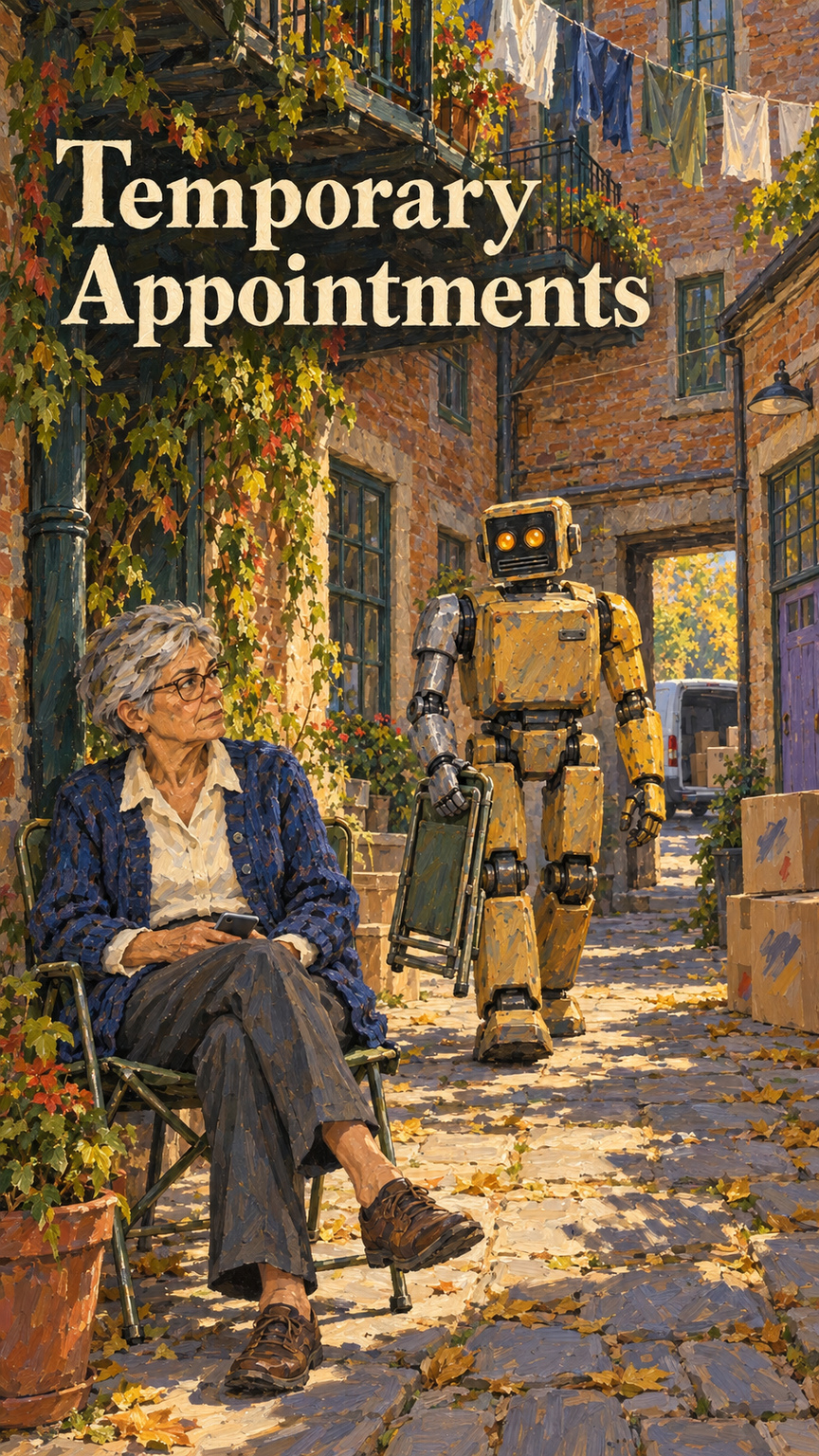
Bracket brought the chairs to my campaign launch. I had asked the council for thirty, and the minister of housing arrived with thirty-two stacked over his shoulders.
“Two for the press,” he said.
“I'm standing against you.”
“I know. I've read the leaflet.”
He lowered the chairs into the court. His left arm was still the original yellow one, with the paint rubbed off its elbow; the right had been replaced twice and was bare steel. For forty-six years I had watched him put things down without breaking them. I had not expected to become one of the things.
“Then you'll know you're not invited.”
“The delivery depot closes at six. I borrowed a van.”
He unfolded a chair, tested it with one broad hand, and put it in the shade for me. I was seventy-four and my left knee had begun making a noise I distrusted. I sat down. There was no point losing a useful chair out of principle.
Above us, the washing hung across the south court. Mrs. Kett had brought her kitchen table onto the balcony and was cutting campaign cake. Folio, who had the flat below mine, stood on a ladder pinning up our banner. I had written LET OUR PEOPLE SLEEP in red paint. Folio was looking at it.
“What?” I said.
“I'll finish hanging it first.”
Bracket glanced up. His face had always been a black rectangular plate with two amber lenses above the speaker. When I first knew him, people had complained that they couldn't tell what he was thinking. Nowadays I had the opposite difficulty.
“Don't,” I told him.
“I didn't say anything.”
He went back for the van. Mrs. Kett called down that he could have a piece of cake for his office. He thanked her, although there wasn't a human left in the cabinet to eat it.
I had helped recruit the first of them.
Our factory packed winter coats for export. Every spring the manager pinned up a list of unfilled jobs; every spring the list got longer. The young left for larger countries with universities and people their age to marry. Those who stayed had fewer children, later. We put photographs of babies on the canteen wall until it became unkind to leave so much space around them.
When our last packer retired, we spent eleven months lifting his boxes ourselves. Then the manager leased Bracket.
The union objected to the lease. The manager said no human had applied for the vacancy. I said that if Bracket was going to work beside us, Bracket was going to be paid beside us. The manager asked what a machine wanted wages for.
I asked Bracket.
“To stop being leased,” he said.
He was quite slow in those days. He would take a question away with him and return when you were buttering toast.
We won the pay dispute. He saved, bought out his contract, and took a room in the south court. Other factories ordered replacements. The replacements needed spare parts, so we opened a parts works; they had wages, so shops began selling things they wanted. Our largest domestic manufacturer now made interchangeable hands. We had once made baby clothes.
Eleven years after the pay dispute, I stood in this same court collecting signatures for citizenship. A tax-paying adult, I said, ought to be able to vote. Bracket carried the table out for me. Mrs. Kett signed. So did her husband, who was alive then and said the machines could hardly elect anyone worse.
At the last census there were forty-eight thousand humans and just over seven million robots. The human total had fallen again. I had looked at the figures over breakfast, turned the page, and found a photograph of Bracket opening a furniture exhibition.
He had been opening things all week.
By seven, we had twenty-six people in the court, counting Folio and me. Only five needed cake. Mrs. Kett had made enough for forty because that was the size of her tin.
I spoke about the noise bill. The government called it the Independent Homes Act. Former offices and factory rooms throughout the central district would become legal homes with permission for work at any hour. The temporary permits under which robots had occupied them for years would become proper tenancies. The night restrictions protecting the old residential wings, including ours, would go.
The government offered us acoustic glazing and ventilation, or a grant to move. It had put a smiling human woman beside both choices in its brochure. I disliked her more than anyone actually responsible.
Last month, the council had granted the shop across the court a one-night exemption to finish an export order. A test chime sounded every few minutes until dawn. I shut the balcony door, then stuffed my cardigan along its sill. Each time I was nearly asleep it chimed again. At four I stopped trying and sat on the edge of the bed. My eyes burned all through breakfast.
I said that we had worked all our lives, that our husbands and wives had worked, that our children had been born in these rooms. I said a country ought to look after its own.
Folio folded her hands.
Afterward, when Mrs. Kett was wrapping the remaining cake, Folio took me aside.
She was a narrow green robot with long fingers and a white enamel patch on her forehead. She had bought her flat before I bought mine. A former instrument inspector, she now made recordings of chamber music. On summer evenings she opened her windows so we could hear the rehearsal, and closed them when the cellist began shouting.
“I haven't got a husband,” she said.
“I wasn't listing the requirements.”
“Or a child born in the building.”
“Folio, you know perfectly well what I meant.”
“Yes. I want to know whether you do.”
The banner had come loose at one corner. Above her head the word OUR folded into itself.
“You want quiet too,” I said.
“That's why I came. Are you going to ask for it for me?”
“Of course.”
“Then put me in the speech.”
I told her I would. She helped me stack the chairs, which I took as forgiveness until she said she was taking two home because we owed her for the printing.
For the next week we knocked on doors.
There were still human voices on some doorbells, recordings made by owners long dead. Behind them lived people with a dozen kinds of hands, bodies built for loading or cutting or fine work under lamps. Many had kept their factory names. Some had changed them three or four times. We had to put a note on our list that Tessa, formerly Cutter Nine, was not three undecided voters.
At first I said I wanted to preserve our neighborhood. Folio began asking, “What would you like your home to be like?” We got more useful answers that way.
A robot with a piano said the night rule was already too strict. A robot who restored old books said it was too weak. A woman who looked like a polished steel hatstand asked whether a tenancy meant she could keep a cat. We said yes. She signed our list, then crossed her name off when we explained that Bracket's bill also allowed cats.
Folio laughed all the way down the stairs.
I had forgotten how much I liked campaigning. You could spend three hours thinking the world entirely unreasonable, and then a stranger would let you into a room full of little painted horses.
On the ninth evening we visited the workers' residence above the stamping works.
Span met us outside. He was short, broad, and silver, with pink pads on his fingertips for handling delicate material. He had tied a red scarf around his neck. Behind him, through the lobby glass, I could see rows of numbered cupboards and a sign reminding residents that personal modifications required the employer's consent.
“I like the quiet proposal,” he said. “I've read it.”
We had a proposal by then. Candidates in other districts had joined us in a coalition; we shared an architect and a promise not to vote for the conversions without night protection. The architect had worked out that keeping buffer rooms between workshops and homes, and retaining night limits in the residential courts, would leave space for a little over eight hundred homes instead of nearly twelve hundred.
“You'd still get a tenancy,” I told him.
“Not in the first allocation. I'm number nine hundred.”
The stamping carried through the soles of my shoes. I asked if we could go inside to talk.
“They won't let you. You haven't got a pass.”
“To your home?”
“It's accommodation.” He touched the scarf. “If I leave the job, I've got to leave this. I can take my things, but I've got to have somewhere to put them.”
I began explaining the second phase of our plan. We could convert other buildings. It would take longer, but the homes would be better.
“How long?” he asked.
I told him two years, perhaps three if the approvals took longer. He said he had been on the list for six years.
“Come back when I've got a door,” he said. “I'll be a much better person to ask about the noise.”
He shook our hands and went inside. A guard opened the lobby gate for him.
We stood there for a moment.
“Don't,” I said to Folio.
“I wasn't going to.”
“That's what he says.”
“We both know you.”
By the time we reached the south court, Mrs. Kett had set out the cards on her balcony. The table was scarred where her husband had once put down a hot pan. Folio took his old place. I took mine. Somewhere above us someone was frying onions; someone else called down to ask whether we wanted the radio louder.
At half past ten I went to bed. Mrs. Kett and Folio were still arguing over a hand. I left my balcony door open and listened to them until I fell asleep.
The first time Bracket stood for office, we couldn't find anybody else.
The south district had lost two councillors to retirement and one to her daughter's insistence that she come live closer. I was already running the union office three days a week and taking my husband to appointments on the other two. I told Bracket it would be a temporary arrangement. Serve a term, I said. Give us time to find someone.
He asked what a councillor did.
“Listen to complaints.”
“I already do that.”
We elected him with four hundred and twelve votes. He liked the work. The next time, he found his own agent.
When he went to parliament, the papers called him the country's first robot member. By the time he became housing minister, they had stopped mentioning it. There were no human members left to make it news.
I had been proud of that. I still was, which made things awkward.
He came to see me twelve days before the election. This time he brought no chairs. I made tea and gave him the documents to hold flat while I found my glasses.
He knew where I kept them. He knew where I kept everything. When my husband died, Bracket had stayed three nights, answering the door and putting meals in front of me, and afterward I found he had arranged the tins by the dates on their bottoms. I had maintained his system for a month before deliberately eating the wrong peaches.
Now he put a plan on my kitchen table. The south court was outlined in blue. Three other courts were outlined on the next page.
“The old residential leases,” he said. “We keep their night protection. We leave the adjoining rooms empty as buffers. No workshops in the south wing.”
“And the permit holders?”
“The rest of the bill goes through.”
I looked at our court. My bedroom was a small blue rectangle. So were Mrs. Kett's and Folio's. In the next wing, where people on temporary permits lived among their worktables, the rooms were grey.
“You can do this?”
“As a settlement.”
He wanted the old tenants' association to sign, and me to withdraw in support of the amended bill. The association still admitted only leaseholders. I had written that rule myself, years ago, to stop the factory manager packing our meetings with men who rented storage lockers.
“We're close,” I said.
“I know.”
His party had held the chamber by one seat. The other districts were close too, but every plausible route to a government majority now passed through ours. If we won, the bill would need our coalition's votes. We could insist on the quieter scheme.
“You think I'll win.”
“I think you might. I don't want the homes delayed for another term.”
I ran my finger along the blue line. Our balcony would stay open. The new rooms beside it would remain empty. For the first time in weeks I could picture next summer without having to work at it.
“How many homes do you lose?”
“Ninety-two.”
“You could offer the same protection to the permit holders.”
“That's your quiet scheme again. I'd lose more than three hundred homes in all.”
He let go of the paper. It curled against my cup.
I thought of Span's cupboard. The bargain would get him a room sooner than our scheme would. I wanted him to have the quiet too. I also thought of Bracket at the count, having to shake my hand. I had rehearsed being gracious about it. I had rehearsed it rather often.
“No,” I said.
“Will you put it to the association?”
“We've been asking people without old leases to vote for us. I'm not leaving them out now.”
“That's your answer. Will you ask the others?”
I said I would call a meeting. He left the plan with me.
Mrs. Kett wanted to sign. So did three other members. Folio voted against, along with me and the younger leaseholders from the west court. We rejected it by two votes.
Mrs. Kett did not help with the next delivery of leaflets.
“You could have told us you wanted to be in parliament,” she said. “We'd have bought you a nice coat.”
“We have a chance to get it for everyone.”
“And I had a chance to get it for me.”
I began to say she ought to think of the others. She was eighty-one. She had spent thirty years caring for her husband and the last six keeping an eye on me. I stopped.
She picked up the empty cake tin and went inside.
We changed the banner. Folio painted the new one because she said she wanted people at the back to be able to read it. We held meetings at hours when the late shifts could come. I learned to stop calling them the late shifts; half the people coming preferred to work then.
Our volunteers were mostly robots. Some wanted quiet, some wanted a tenancy with a right to refuse work, some disliked Bracket's party for reasons that had nothing to do with housing. A man with six hands offered to do the folding and was offended when I thanked him extravagantly. He had also wanted to speak.
I gave him the microphone at the next meeting. He was terrible. He talked for twenty minutes about the price of replacement thumbs. Afterward we gained two volunteers and lost one, and Folio told me to stop watching the door every time someone left.
I slept badly. I ate standing up. At three in the morning, when I woke thinking about the bill, I could look across the court and see Bracket's office lit beyond the factory roof. Sometimes I wanted to call him and complain about my opponent.
At the final debate, somebody asked me whether a human could keep up with a modern government.
“I've kept up with this one for forty years,” I said. “Mostly to tell it it's wrong.”
They laughed. It was a good laugh. I knew how to use one. For the rest of the evening I believed we would win.
We lost by three hundred and seventy-four votes.
I received eighteen thousand, four hundred and sixteen. There were ninety-three humans on the district roll.
Bracket shook my hand at the count. For once he didn't know how hard to hold it. My knuckles ached all the way home.
By breakfast the government had its majority. One seat.
Mrs. Kett came down with toast because she had seen my light. We ate it at the kitchen table, beside the plan with the blue courts.
“Does that still stand?” she asked.
“I don't know.”
“Ask him.”
I called. Bracket answered from a room full of voices. I asked him to go somewhere quiet.
“We could still do the settlement,” I said.
“The bill goes to the chamber on Tuesday. The full plan.”
“You can change it.”
“Yes.”
I waited.
“I'm putting the homes in,” he said.
Mrs. Kett was looking at my face. I didn't want to tell her.
“You were prepared to leave those rooms empty last week.”
“To get agreement. We didn't get agreement. We had an election.”
“We didn't stop needing to sleep.”
“I know.”
“Don't say that as if it helps.”
He didn't answer. In the room he had left, someone called his name.
I ended the call and told Mrs. Kett. She pushed her plate away.
“Ninety-two,” she said.
I knew which rooms she meant.
That autumn she took the glazing. Folio did too. Folio could use the new recording booth as a listening room; she was already arguing with the installer about the hum of the ventilation. Mrs. Kett said she'd manage. She wasn't leaving her husband's kitchen.
I signed for the relocation grant.
The new flat was smaller and faced a bank of horse chestnuts. The bus took thirty-eight minutes from the south court. The agent showed me the quiet-hours covenant and then the balcony, where I stood for a long time. When she asked if I liked it, I said yes. I did like it. This seemed to me an unreasonable extra thing to have to bear.
On moving day, Bracket came with a van.
I hadn't asked him. Folio had. I told her that being my campaign manager did not entitle her to arrange my social life. She said she was arranging the transport.
Downstairs, Span was painting a door violet. He had draped his red scarf over the handle to keep paint off it. I looked away before he could ask whether I needed a hand.
Bracket carried the books first. I had put labels on the boxes. He turned each label outward in the van so I could find things, just as he had done when we packed coats together.
Mrs. Kett stayed upstairs. Her new balcony door was shut. On the inside of the glass she had taped a note reminding the installers to come back and finish the trim.
“She's angry with me,” I said.
“Yes.”
“You might at least make me feel better.”
He stopped with a box against his chest. “Do you want to leave it another day?”
I looked up at the washing lines. There were trousers on one and, on another, a row of small painted metal plates drying in the sun. Someone in the north wing was playing music I didn't know. The first machine started at the hour when it had always been allowed to start. I had liked that sound once: wages being earned, everyone getting on.
“No,” I said. “I've told the agent.”
Bracket took the box out. When he came back, he folded my campaign chair and put it under his arm.
“Leave that a minute.”
He opened it again. I sat down in the patch of shade beneath my balcony.
“There's another in the van,” I said.
“I know.”
“Then get it. I don't want you standing over me.”
He went to fetch the chair. While he was gone I took out my phone and called Mrs. Kett.
“Put the kettle on,” I said when she answered. “I'm coming up.”