
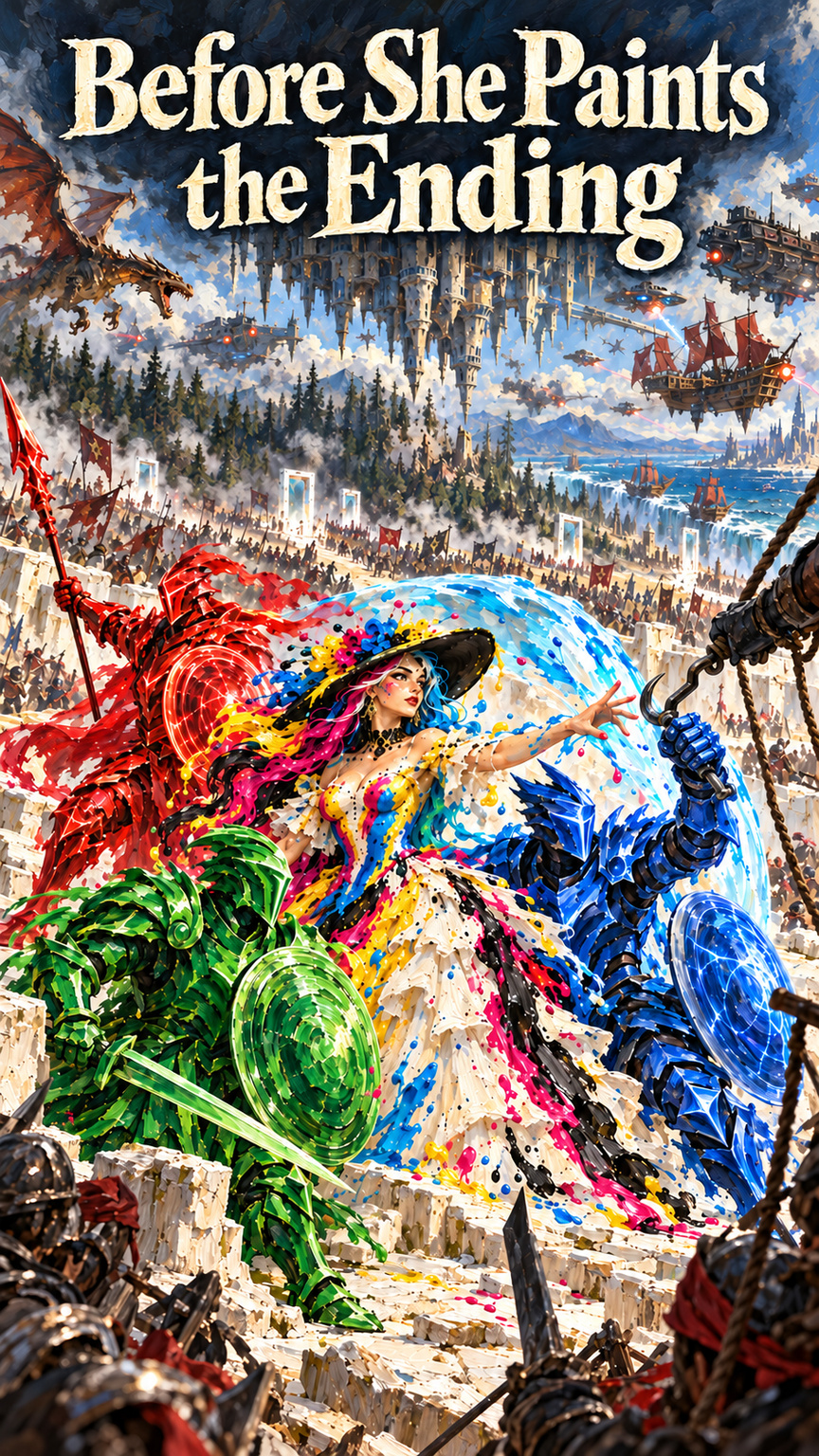
Blue caught the pirate's hook a finger's width from her wrist.
His fingers held the iron fast against the rim of his round shield. The Princess kept painting. Cyan ran from her forefinger across the broken terrace, rose in a shining curve, and hardened into a wave of glass. The pirate struck it boots first. Behind him, six companions came swinging down from a galleon that had sailed halfway into the starship above them.
“Mine,” announced the starship, in a voice that moved the stones.
The galleon's captain fired a cannon into its loudspeaker.
Red laughed. His spear lengthened through the smoke, a straight line of red light that severed the seven grappling ropes. Green spread his shield beneath the falling pirates, caught them on a broad green slope, and tipped them into the arms of an astonished cavalry regiment.
Blue let the hook fall. The Princess tapped the inside of her wrist twice, their old signal, and he resumed his place at her left shoulder.
They had defended her together for three hundred and eighty-six years. Before that, the three knights had been ancient already. There were fortresses whose names she had forgotten but whose stairways she could still descend without looking, because Red would take the high side, Green would close the gap, and Blue would catch whatever reached for her painting hand.
Nothing in those centuries had prepared them for a tyrannosaur in siege armor landing on a submarine.
The impact threw her off her feet. Her broad black hat stayed on by its pins; cyan, magenta, yellow, and black streamed from beneath its brim, mingling with her hair. She swept one hand down. Yellow paint burst across the stones as a flight of steps, and she landed running.
“Princess!” Green called.
“I see it.”
A dragon had gripped the submarine in its claws. It was lifting the dinosaur, submarine, and three crews of would-be captors together, making a platform broad enough to land beside her. On its back, soldiers in silver masks were assembling a cage.
Beyond it, the battlefield climbed into the sky. A castle hung upside down over a prehistoric forest. Trains ran between its towers. Airships fought with saucers among the branches, while armies marched out of doors standing alone on the plain. An ocean ended in a straight line across a desert, and ships came over that line with their sails still full of the wrong world's wind.
There had been walls between all those places yesterday.
She had not seen the first wall fall. No one she had questioned had seen the first blow. Everyone had a different account of who had attacked first, but the orders carried across the field were remarkably alike.
“Capture the Princess before she paints the ending!”
The words came from a brass horn, then a radio, then the throat of something with three heads. They were stitched on banners and burned in the air behind missiles. Every army had arrived with a place for her: a cage, a carriage, a throne with straps beneath the arms.
“Our king will protect you,” a herald shouted from the dragon's back. “Paint him victorious and every surviving kingdom will be yours!”
“How generous,” said Red.
The starship opened a hatch below its wounded loudspeaker. A column of pale force gripped the Princess's skirts and began lifting her toward it. She pressed both palms down. Magenta poured from her cuffs, wrapped her ankles in roots, and took hold of the terrace. The ship strained. Stones tore loose around her.
“White,” she said.
Red lowered his spear. Green turned his shield inward. Blue opened his hand.
Their three lights crossed between them. Red and green met in yellow; green and blue opened cyan; blue and red made a trembling magenta edge. Where all three filled the same space, the colors vanished into a white so clean that it made daylight look stained.
The Princess raised her hands into it.
Cyan spread beneath her right palm. Yellow flowed under her left. She touched them together, and a green plain opened in the white, filled with the small, exact shapes of the cavalry charging toward them. She drew their distant door behind them and curled two fingers back.
The whole regiment slid backward. Horses screamed as the ground carried them away from her. Their general clung to his saddle, still waving his command to advance.
“She's sending us back!” the cavalry general cried. “Take her hands!”
For an instant, she had room.
She reached for black. One closed line around their painted door would finish that retreat and shut their way back to her. Then she would turn to the fleet.
A shadow crossed the painting. Above her, the dragon dropped its cage. Behind her, the pirate captain came through the shattered glass wave with a weighted net. The white ground demanded all three knights; her two hands could not turn the cavalry, hold down the terrace, and stop two new captures at once.
“Break,” said Green.
His shield rose beneath the cage. Red's spear threw the dragon sideways. Blue's hand closed around the pirate captain's wrist before the net touched hers.
The white tore apart.
Her unfinished plain went with it. Out on the field, the regiment lurched forward again, several hundred soldiers suddenly discovering that they had been shouting their war cries while traveling in the wrong direction.
The Princess's black touched empty air.
She closed her fist around it before a drop could fall.
The first horseman came out of a sentence on page nine.
I had been carrying The Upward Rain back to its shelf when I heard hooves on paper. An open book lay on the long reading table. A cavalryman was climbing over the word advanced, drawing his horse after him by its reins. He crossed the white margin and stepped through a slit standing above the page. Beyond it, a castle hung upside down.
The sentence he had left read: The .
He was followed by another man, then twenty, then enough horses that I could feel their passage through the table's legs. They went straight from the print into that impossible country. The pages flapped in the wind of their leaving.
All along our library, books were opening.
Some had proper titles, worn into familiar places on the shelves. Some still had questions for names. I saw Four Crowns in Hiding lying open beneath a book with no lettering on its cover at all. In that one, stars moved between the lines. Something enormous turned behind the paper, and a ship's bow nosed through a paragraph.
I dropped what I was carrying and shut the cavalry book.
The slit pinched closed. Out in the field, the last horseman to clear it wheeled around, furious. He remained where he was. All the men already out remained. Only the next rider, whose head had not yet crossed the margin, dwindled back into type.
I shut the star book before its ship could get through. Then I began closing everything I could reach.
I heard the same order from a dozen pages. Sometimes it was translated in small print beneath the shouting. Sometimes I understood it without a translation.
Capture the Princess before she paints the ending.
I had never heard of her. There was no portrait of her in any of the books I first opened. But in every visible piece of battlefield, among the smoke and running armies, four colors streamed toward the same distant point, and three lights stood around them.
The door behind the cavalry vanished.
So did a ladder of stars that had been delivering armored infantry into the air. The infantry already falling continued to fall. Green caught them before they struck the terrace, and Red chopped the chains from their empty capture harnesses.
“Someone is shutting the doors,” Green said.
“Let them,” said the Princess.
She pulled a cyan road across the wreck of the submarine. Green brought his shield beneath the tyrannosaur's jaw and lifted, turning its enormous head away from her as she passed. Green's sword swept a rider's lance aside. The dinosaur's other riders hauled the reins. One lifted a pair of golden manacles.
“Alive!” the man with the manacles shouted. “She's no use dead!”
The Princess slapped yellow across his saddle. It became a bright wooden box with him inside. The manacles rattled against its lid.
A starship's beam found her road and lifted the entire thing.
Red ran up it toward the ship, shots sparking against his round shield. His armor shone through the smoke in long, crimson seams; at the crest he drove his spear into the beam's mouth. A red crack crossed the vessel's underside. The beam winked out. Her road fell apart, and she stepped off its falling end onto Green's shield.
“You could have left me the stairs,” Red said as he landed beside her.
“You keep breaking the things they're attached to.”
Blue lifted a hand.
A hundred small metal spheres were rising out of the dust.
They did not fire. They watched. Each turned as a knight moved, keeping its single dark lens trained upon him. When Red raised his spear, the spheres watching him shifted to preserve their view of the Princess behind his shoulder.
She flicked magenta at the nearest. It became a flowerpot, dropped, and shattered.
The others retreated beyond her reach.
Across the battlefield, pirates were cutting down the soldiers who had come to put her on a throne. A dragon closed its jaws on a cage dangling beneath a saucer. None of them was trying to protect her. They were trying to prevent the others from taking her first.
In the places where worlds overlapped, that rivalry was becoming something worse. The forest beneath the inverted castle was disappearing under its masonry. A city at the edge of the desert had lost half its sky to an ocean. Every retreating army met another advancing one, and there was less world left behind them each time.
“Princess,” said a new voice. It came from every watching sphere at once. “Our transport offers sanctuary.”
Above the battle, a low black vessel turned to show its armored belly. Other ships fired upon it immediately. Their shots broke against overlapping plates. A dragon struck it claws first and skidded off, leaving four bright wounds in its hull.
The Princess saw those wounds close beneath shutters.
“Does sanctuary come with a lock?” she asked.
“Your survival is required.”
“And afterward?”
“Victory.”
Three spheres descended together. Each unfolded a great sack of translucent dyed mesh gathered around a metal throat. Cyan spread above Red, magenta above Green, yellow above Blue.
Red lunged to cut the nearest suspension cable. Cyan fell over him.
His spear vanished inside it. So did the brilliant planes of his armor. There was only a dark, struggling shape beneath the blue-green sheet. Red light struck the net from within and was swallowed.
Green drove his shield up under the magenta bag. Its rim caught. The sheet slipped around him, gathered beneath his feet, and closed with a metallic snap. His green went out of the world.
The Princess flung out her right hand. Yellow and cyan raced toward the two nets in a twisting green branch.
A piece of paper fluttered over her wrist.
She almost brushed it aside. Then iron fingers came out of its print and closed around her arm.
The branch went crooked. It struck a wreck behind Red and blossomed uselessly into leaves.
The paper opened wider. More iron hands emerged, finding her elbow, the shoulder of her gown, her other wrist. A robot pulled itself across the margin, its body still flattening and filling as the letters became metal.
The black transport overhead rang under a dragon's blow. Through the paper's widening fold, she saw a metal deck and a shutter jolting in its frame with the same impact.
Blue moved to interpose.
The yellow net waited above him. He could catch the hand that held her, as he always caught it. The bag would close over his shoulders. Then there would be no white anywhere she could reach.
The Princess looked up at the transport, at its thick plates enduring the other armies' fire. A galleon struck its side and broke. While it held her, the machine would fight to keep its prize alive.
It might give her a little time.
Below the cyan sheet she could just make out Red's fist striking the net's metal throat. On the inside. Blue could reach it. His light would pass through cyan where Red's could not.
She opened the hand with which she always gave Blue his signal.
“Away,” she said.
He checked. Even through his closed helm, she felt the question.
She had called him nearer in fire, in darkness, under falling towers. She had never ordered him to let a hand take hers.
“Blue. Away.”
He sprang backward as the yellow net fell. Its mouth snapped shut on nothing.
The robots hauled her through the page.
An iron hand had reached out of the robot book and torn off a leaf before I could close it.
The figure in the illustration pulled the paper through its own opening. I caught one corner. For a moment we had a tug-of-war across the margin. Then the corner tore in my fingers, and the robot carried the rest away.
I slammed the covers together.
It made no difference to the loose page. I could see it through the cavalry book when I opened that one a crack: a white fleck crossing the field, almost lost beneath the running feet. The robots inside its lines remained there, waiting to come out.
Two of the three lights had disappeared. The blue one moved away from the woman they had been guarding, and the page opened around her like a mouth.
I shut the cavalry book again.
All through the library, empty sentences waited for their people to return.
She landed upright, held between two robots in a chamber that rocked beneath her feet.
The paper lay open on the floor behind them. Through it she could see the broken terrace. Blue was kneeling at the mouth of Red's net. Half his arm had passed through the cyan weave; his fingers closed on its inner fastening and tore it apart. Red blazed free. He went straight to Green, thrusting a crimson hand through the magenta sheet to find its metal throat.
Then a guard turned her toward the press.
The transport climbed. Its engines strained against grappling lines, against dragons, against a second ship trying to tow it sideways. Something immense struck the roof and began walking there.
“Sanctuary,” the Princess said.
One robot turned its head toward her. It wore the same armor as the others, with a small white square upon its chest. Within that square, the word COMMAND changed to SECURE.
“Present your hands.”
The guards did it for her. They brought her to a standing press: two narrow cuffs beneath a pane of glass, a fresh sheet of paper stretched beyond it. Her hat scraped the top bar. A robot removed it and dropped it beside the page on the floor.
She crooked a finger.
A thread of black slipped down the cuff. Before it reached the metal, the press straightened her finger and held it still.
“You will have use of your hands when we permit it,” said the command robot.
Fine channels opened against her palms. Paint entered them. Cyan first, then magenta, then yellow: the living colors pulled from her skin and gown, made to travel beneath the glass. On the waiting sheet, the shape of a woman began to appear.
The portrait wore her gown. Its arms were raised into drawn chains.
She pulled against the cuffs. The portrait pulled too.
“A book?” she said.
“A secure binding.”
There was no white light here. This was no ending, only a place to keep her. The soldiers had come out of print; the machine was pressing her into it.
The command robot brought a heavy cover from a rack. Its hinges had teeth.
“Your lights will follow,” it said. “They will provide the ground. You will paint our victory. Until then, you remain closed.”
It laid the cover beside the portrait.
Through a narrow observation slit, she saw a thousand rival banners turning toward the rising vessel. A dragon's head filled the view, one gold eye fixed upon her. Its rider leaned out, reaching for the slit with a hooked pole. The shutter slammed before the hook entered.
The ship gave her time, and took her colors in exchange. Yellow faded from the folds of her skirt. A lock of hair slid over her shoulder, white from root to tip. She tried to curl it toward the cuffs, but her fingers could not make the smallest directing stroke. Beneath the glass, black began moving into the portrait's outlines.
She watched it go. The machine was being thorough. It even found the little black line at the edge of each fingernail.
Her left thumb was turned inward against its cuff. Under that nail, a thin crescent remained.
The robot lifted the cover.
Above them, something tore through the first layer of armor. Daylight flashed across the chamber. The guards looked up.
A blue hand came through the gap and caught the descending cover.
Blue wrenched it sideways. Red followed him through the roof and drove his spear beneath the press's glass. Green landed last, his shield raised against the claws reaching through after them.
Cyan fluttered from Blue's gauntlet. A torn strip of magenta hung from Red's shoulder. They had freed each other. Of course they had. The Princess had known how they could, but knowing had been a colder thing than seeing them arrive.
Red broke the pane. Blue drew his sword and cut the cuffs from her wrists.
The portrait's chained hands dissolved. Its face blurred and ran into four pools of color. The Princess folded her fingers at last, and the paint still upon her answered, gathering in thin ribbons in her palms. Most of it lay beneath the shattered glass. She reached toward those pools.
The command robot seized the sheet and thrust it into a slot. Metal closed over it.
Green's shield rang. The dragon above them had found the hole.
“Princess,” he said.
She looked from the sealed slot to the colors she still held. There was enough cyan. Enough magenta and yellow, if she spread them thin. Black shone beneath her left thumbnail, scarcely more than a stain.
Through the observation slit, the battlefield had become one vast converging movement. Every ship was turning, every wing beating toward the transport. The forest and the castle were grinding together below.
She left the stolen colors where they were.
“White.”
The robot book was opening again. Metal fingers had pried the covers apart from inside.
I found the transport in an illustration near its end.
It was our Princess in the press. Her three knights were breaking through the roof. The next sentence was filling itself in as I watched, and the men named in it were rising from its letters.
The reserve guard entered the prize chamber.
Six metal figures were already halfway across the margin.
The words farther down the page had not appeared. I could not read ahead to discover whether she escaped.
I put both hands on the cover and pushed. An iron arm caught between the pages. I leaned on the book with all my weight. The table slid. My spectacles fell off, and I heard a lens break beneath my shoe.
The arm became a line of print.
The covers met. I dragged The Credit Book from the nearest shelf and laid it on top, then A Crown for the Endless Fire. Under their weight, the robot book thumped once.
“Stay in,” I told it.
A guard coming through the chamber's side hatch flattened abruptly into a dark stroke. The stroke folded back into a white margin, and the margin vanished.
The command robot turned toward the hatch. Its chest changed from SECURE to RESERVE. No one answered it.
Red laid his spear down. Green drove a buckled roof plate across the gap above them, trapping the dragon's claw, then lowered his shield. Blue laid his shield beside the press, sheathed his sword, and opened both hands.
The dragon beat upon the wedged plate. A pirate's harpoon tore through a seam beside it. The transport's armor shuddered under them. Yet for this moment the walls still kept out most of the armies, and the guards inside could come at her from only one side.
Three colors flooded together.
White filled the broken press. Its frame stood between the Princess and the guards, holding a new surface where the glass had been. It was broad enough for her two open hands.
She began with the nearest robot.
Cyan and magenta made the dark blue of its armor. Yellow found the little scratches along its hands. She gave it a white margin beneath its feet and drew its outline backward into a sentence.
The guard slid away from her.
It caught a stanchion. Its fingers shrank around the metal, losing depth. They became five dark marks, then part of a word. The loose leaf on the floor filled with new type.
The command robot lunged for her wrist.
She painted the lunge. It carried the machine headfirst past her, toward the same white margin.
Behind her, Blue made a small sound. It had cost him something to stand still.
“Hold,” she told him.
He held the white.
She swept the guards into their page. It buckled on the floor under the weight of its new sentences. They were still moving in the print, pushing against its edge. Without black to close the picture, they could come out again.
She could not spend her last black on the guards. The Princess pressed her palms wide.
The white ground widened beyond the press. She began the ocean at the desert's edge, laying in the hulls of the pirate fleet. A little blue prow formed beneath her fingers. Its ship swung away from the transport, drawn toward the homeward margin she had given it.
Her cyan stopped halfway down its sail.
She pressed her palm harder. A thin, clear thread came out. Beyond the slit, the ship turned back toward her. Another fleet rose behind it on a sea that had no place in that sky.
Behind her, metal scraped paper. The command robot had reached the loose leaf's edge again.
She could not finish a picture of every ship, every soldier. She swept her hands across the white, wiping away the small, unfinished fleet. Only its long strokes remained: the sea's edge, the margin home. She drew those together.
The ocean lifted away from the desert.
She caught the next join with magenta: forest against inverted castle. Yellow carried it around the prehistoric plain. She left out the crowded ranks and the towers' fine windows, following the rents where the worlds had met. Each stroke opened another stretch of pale margin. Beneath them lay the places the armies had left.
The transport tilted. Green planted himself behind her; she braced her back against his breastplate and her heels against the press's footbar. His hands kept giving white. Cannon fire tore through the roof's seams, and a chain caught Red's discarded spear and drew it out into the battle.
He watched it go. “That was old.”
“So are you,” she said, and brought the last yellow stroke around.
Across the field, armies stumbled as their ground divided into paths. The dinosaur riders hauled on their reins, but their beasts ran for the warm plain opening before them. A starship fought the pull of its own black sky. At the white margins, captains were still turning their soldiers around to come for her.
The command robot's hand gripped the leaf's edge. Its head rose from the print.
Her picture was bare in wide places. The joins lay open; the loose leaf still led to her. She could not hold the armies back while she filled in what was missing.
She had kept her left thumb curled against her palm. Now she lifted it.
Black gathered at the nail: her key-color, clear and exact. Mixed cyan, magenta, and yellow could make a muddy darkness, but this black would decide precisely where one thing ended and another began.
She drew it along the painting's edge. The robot's shoulders broadened out of the print. It reached her as she brought the line down the final side.
Blue's white flickered.
“Stay,” she said.
The wedged roof plate tore free. Sunlight and a dragon's claw came through together.
The robot closed its hand around her left wrist.
For three hundred and eighty-six years, that had been Blue's hand to stop. This time he did not move.
The Princess turned her thumb into the machine's pull and let it drag her arm sideways. Her nail stayed against the white. Its pull carried the last black stroke to the corner, leaving a small thumbprint where the boundary joined.
She closed her hand.
The ending held.
The robot's grip became a row of letters against her skin. Its body folded down into the page. The loose leaf rose after it, suddenly no heavier than paper, and flew through the closed observation shutter without disturbing the metal.
All around the transport, the battlefield opened.
Dragons went wing first through bright margins, their shadows sweeping back across the mountains of their own worlds. Galleons rolled into lines of moving ink and broke out again upon their own seas. The starship that had called her mine diminished through a paragraph, its engines still burning. The word passed out of hearing before the ship did.
A thousand armies followed their roads. Some ran. Some resisted until the ground beneath them became the ground they had left. Their banners crossed the closing borders; their cannons, cages, and thrones went with them.
The transport flattened around the Princess. Its engines lost their roar. The sealed slot unfolded into the illustration around her feet, releasing four long threads of paint. They ran back into her open hands, leaving a blank sheet to vanish with the broken press. The monster walking on the roof was gone, and the roof itself was gone, and she stood on the white stones of her terrace with all her weight suddenly her own.
Above her, the castle was upright. On the far side of the last closing door, a row of pines still lay broken where the inverted towers had crushed them. The door narrowed to the width of a brushstroke and closed.
Red, Green, and Blue stood around her.
Their white separated slowly. Each color returned to its own hands, its own armor, its own weary stance. A white lock hung against her cheek. Blue looked at the place where the robot had held her wrist.
She held it out to him.
“I was there,” he said.
“I know.”
He laid his hand beneath hers without closing it.
Red went to retrieve her hat. It had come home with her, lying upside down on the terrace. He shook a few black letters from its brim before he brought it back.
The books grew heavy beneath my hands.
Their covers stayed shut. Ink traveled between the edges of the pages: dark rows of soldiers, the long strokes of ships, a dragon's wing narrowing into a line. The loose leaf slipped between the robot book's closed covers and drew the torn corner out of my fingers.
When I lifted the books weighing it down and opened it, the page was whole. The empty sentences had filled without my turning a cover. The army in its illustration stood beneath a different sky, looking toward a door that was no longer there.
There was no first account of the war. I searched the opening pages and found the same thing I had seen at the end: someone else's forces arriving, someone else's attack already under way.
But on the reading table, beside my broken spectacles, lay a book I had never seen before.
Before She Paints the Ending.
Its final page showed four figures on a white terrace. Three stood in their own colors around a woman lifting one tired hand. Beneath the picture was a small black thumbprint.
I touched it before I thought to be careful.
The paint was still wet.