
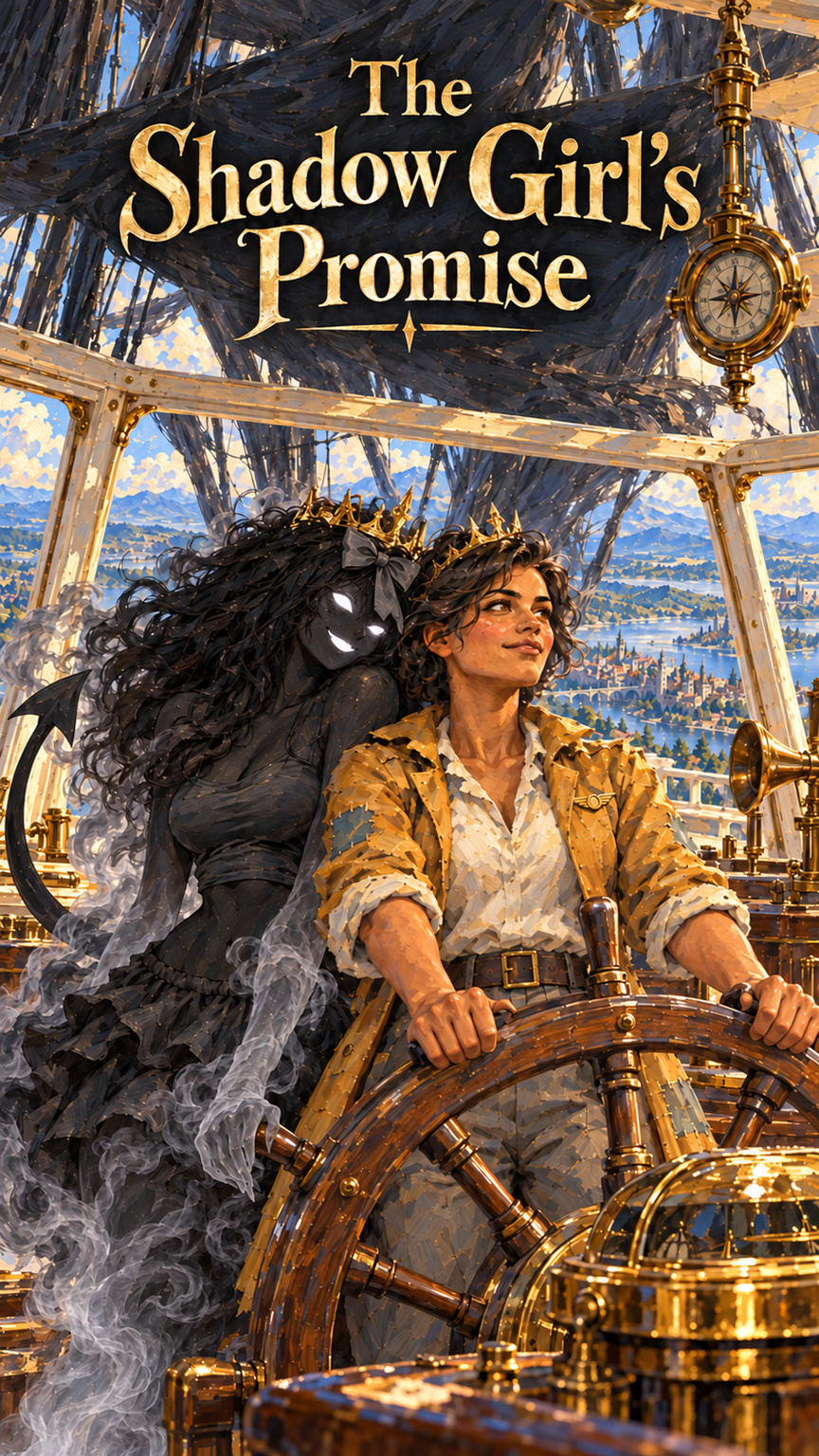
The woman at the foot of my bed had caught the ceiling in her hair.
Black curls drifted through the plaster. Darkness poured from her shoulders and gathered again at her hips, making a sleeveless top and a ruffled skirt over the suggestion of legs. Where her fingers ended, smoke searched the floorboards. She had a beautiful face, all sharp cheekbones and a mouth I couldn't quite stop looking at. Her eyes shone white. So did her smile.
I lay very still. I had flown a passenger boat through a thunderhead with one engine burning, and had never felt such a small, urgent wish to be elsewhere.
Then she raised a hand to her mouth and hooked one little finger over her lower lip. It was what Nettle used to do when she had a secret too large to keep behind her teeth.
Above her left temple, tangled in all that moving black, was a bow. One loop was twice the size of the other. I had tied it that way.
“Nettle?”
She grinned.
“You got so big! Anyway, remember when you promised we'd rule the world together? Well, I did my half.”
I sat up. I was thirty-one years old. My knees cracked.
She looked down at them with interest.
“Do they do that often?”
“What?”
“Your legs.”
I put my feet on the floor. A long tail drew its pointed tip out of their way.
“Where have you been?”
Her little finger slipped from her lip.
Twenty years was a great deal of silence to find waiting behind a question.
When I was six, a hand came out from under my bed and stole the last biscuit from my plate.
I caught its wrist. There was a pulse beneath my thumb, quick and furious.
The hand let go of the biscuit.
“You can have half,” I said.
Two white eyes opened under the bed. After a moment, the biscuit broke exactly down the middle.
Nettle was smaller than me then. She could go thin enough to fit between two floorboards, but when I tickled her she lost control and spread all over the rug. She ate burnt toast and made horrible faces in the dark behind my mother. She came to the museum inside my schoolbag and was furious that the lion I'd promised to show her turned out to be stuffed.
We played pirates on my bed. I had a wheel made from the lid of a hatbox. Nettle climbed the bedposts and spread herself into sails.
My torch was our signal lamp: three quick flashes, one long.
Captain aboard. Ready to go.
“Where to?” she would whisper from the rigging.
I had an atlas, so our destinations were ambitious. We crossed deserts that were not quite the right colour. We robbed the Ice Kings. We sailed past the edge of the map to see what held the paper up.
At eight I made us a flag, two gold crowns on black cloth. Neither crown was straight. We had to share my mother's sewing scissors, and Nettle's fingers kept going through the handles.
“When we're big,” I said, “we'll rule the world together.”
“I'll take it,” said Nettle promptly. “You be the other captain.”
“You have to come and get me.”
“Obviously. You're the one who knows where we're going.”
The bow came off a dress I had outgrown. She wore it because pirates ought to have something that fluttered.
The last time we played I was eleven. I remember being annoyed that she had put an island in the wrong ocean. I remember laughing afterward. Nothing about the evening warned me to remember it better.
In the morning she was gone.
I looked under every bed in the house. Then the other furniture. For months I left a biscuit beside the bedpost, until my mother said I was encouraging mice.
I put away the flag. I grew tall enough that my feet stuck off the end of our ship. I learned to fly a real one.
There were things I liked better than our old atlas: the lift of a hull as its mooring ropes came off; a valley filling the front windows; the row of quiet faces when I brought the last boat home through weather. I had friends and a flat with a roof I could sit on. I was good at my work.
Sometimes a hand-shaped patch of darkness passed over the instrument panel, and I looked up too quickly.
“He found me,” Nettle said.
She was sitting on the end of my bed now, her hair clear of the ceiling. The mattress dipped beneath her. Her tail had wound around a bedpost, with its pointed tip tucked out of the way of my bare feet.
“Who?”
“The king I ran away from. I thought he'd stopped looking. He came while you were asleep.”
I looked at the strip of ordinary floor beneath my bed.
“I couldn't get out of his house for seven years,” she said. “Then I could get out of the house, but not his country. After that, there were people who came with me. We took his gates first.”
She turned her hands over, studying the fingers. They were almost solid until she spread them.
“There were six kings underneath. They had divided up the ways through. I had to beat all six before I could come back without bringing one of them through your bedroom.”
“And the world?”
Some of the smile returned.
“The kings on top had been helping hold the upper gates. They thought they were a great deal harder to reach.”
For weeks I had flown around closed borders. Passengers had carried newspapers full of plain black flags, empty arsenals, generals whose guns had become smoke in their hands. We had argued about it in the pilots' room. Nobody knew what the conqueror wanted. Nobody had put my childhood friend's face on a newspaper.
“That was you?”
“That was us.” She saw my glance. “The people who came with me. I'm not all of us.”
“Did you have to take the top as well?”
“No.” She met my eyes. “I wanted it. We said we'd have it.”
In the new shape of her face, the old mischief was startlingly familiar.
“Nettle, I looked for you.”
“I know. I mean, I thought you would.” Her smoke drew close around her wrists. “I wanted to get back before you woke up.”
I reached for her hand.
The pulse was still there. Faster now than mine.
For a while neither of us spoke. I held on hard enough that an ordinary woman would have complained.
Then my phone began to ring.
The name on it was my morning dispatcher. I had forgotten I was due at the aerodrome in forty minutes.
“I need to—”
“Listen first,” said Nettle.
I answered. My dispatcher sounded as though he had been awake all night.
“Don't come in. Nothing's leaving. Switch on the news.”
“Is it the borders again?”
“There aren't any borders. Or there are, but they're all the same person's. Just switch it on.”
The newsreader had taken off his spectacles. A ribbon of text crept beneath his face: LAST SIGNATURE RECEIVED AT DAWN. WORLD SURRENDER COMPLETE.
Behind him hung a new banner: two crooked gold crowns on black.
I looked from the screen to the woman on my bed.
Nettle's tail-tip waved once.
“You kept the flag,” I said.
“I remembered the flag. I couldn't take yours.”
I got out of bed, crossed to the cupboard, and pulled a battered tin from behind my winter boots. The cloth inside was stiff along its old folds. One gold crown had lost a point.
She took it from me very carefully.
“Oh,” she said.
That was all. I had to turn away and find my trousers.
I put on my flying clothes: grey trousers, boots, the ochre coat with my licence in the inside pocket. Nettle watched me fasten the buckles as though I were performing a difficult piece of magic.
“You really learned to sail,” she said.
“Airboats. Passenger and post. I told you I would.”
“I remember.”
She offered her hand. The shadow beneath my cupboard opened, and daylight came through it.
“Is that safe?”
“It is now.”
She led me out onto a palace roof.
The capital lay below, close enough that I could hear the trams. I had visited once on a day off and paid to look through the gate. We were standing six storeys above it on cream-coloured tiles, among orange trees and mooring posts. Service launches bobbed along the roof's eastern edge.
Our flag hung from every tower.
Beyond the roofs, people were gathering in the great square. Some cheered when Nettle appeared. More stared. A man was taking down a portrait from the front of a shop; he paused with it in his arms, uncertain where to put it. On the opposite corner a woman had reopened her bakery and was serving a queue through the shutters.
The palace guards had stacked their rifles. One kept glancing at them. Another stood close to a young man in spectacles and whispered something that made him stop shaking for a moment.
High above the eastern aerodrome floated the royal fleet, moored in two long ranks. At its centre was the Ascendant.
I knew the ship from pictures. Pictures did not prepare me for the size of its lifting hulls, or the nine tiers of windows in the palace slung beneath them. Its engine screws were taller than my flat. Between its forward masts, an open deck held a grove of full-grown trees.
I had once spent an entire evening watching a grainy film of it turning.
“Oh, that's a good one,” Nettle said, following my gaze.
A thin man in a formal coat hurried across the terrace. He slowed when he reached her shadow.
“The broadcast rooms are ready, Majesty. The other capitals are holding their delegations. And the fleet handover—”
“Is at noon. I remember.”
“King Vaust is asking to receive his officers aboard the Ascendant before they disembark.”
Nettle considered the ships.
“He signed for them this morning. He can say goodbye.”
The man bowed. His eyes kept coming back to me.
“This is Corra,” she said. “My other captain.”
I had a sudden view of my own face appearing on a thousand screens. My flying coat was patched at the elbows. I had been planning to eat lunch with a friend who owed me money.
Nettle turned toward me.
“I haven't asked properly,” she said. “I didn't mean—”
“Yes.”
She became so still that even her hair stopped moving.
Below us a tram rang its bell. Someone called from the square. The world was immense and full of people, and she had crossed it to stand beside me.
“I'm coming,” I said. “I'm going to need a larger boat.”
Her smile spread slowly.
“We can arrange that.”
There were thirty-seven other capitals to see. She showed me three before the shooting started.
We stepped from the shadow of an orange tree into the shade beneath a bell tower. White-eyed people sat along its parapet, drinking from enamel cups, their bodies as dark and changeable as hers. One called a greeting. Nettle waved. A mountain stood over that city, with fresh snow almost down to its roofs.
At the next opening the sun was setting behind a forest of aerial masts. Someone was trying to get a gold crown flag untangled from a weather vane. Then came a city I knew only as a coloured smudge on the old atlas: red cliffs, white houses, hundreds of little balconies facing the evening. In the square below, its ruler read the surrender aloud. His voice carried through loudspeakers, harsh with fatigue.
Nettle stood beside me, listening until he had finished.
“They'll want to see you too,” she said.
“I know.”
I had wanted those white houses all my life. Now there were people inside them who would have to look up and learn my name.
A white-eyed face pushed through the shade beneath the balcony. A smoky hand caught Nettle's wrist.
“The fleet,” it said.
Shooting came through the opening behind it. Nettle pulled the shade wide, and we stepped back onto the palace terrace into a noise so loud I felt it in my teeth.
The Ascendant had cast off and come west over the palace.
Its escort was rising around it, engines streaming blue exhaust. Guns had come out of the ceremonial housings along their flanks. King Vaust had been permitted a farewell; he was taking his navy with him.
A shot struck the tower across the square. Stone fragments rattled over the terrace. The thin man fell against an orange tub and stayed there, with his hands over his head.
Nettle's smoke caught the next shell. I saw it slow inside the black, a little brass shape turning end over end. Then she folded her fingers, and it was gone.
“He signed in my hand,” she said.
She put me behind a mooring post.
“Stay here a moment.”
Her face rose away from mine.
The skirt, the hands, the wild hair came apart. Darkness passed up the wall of the palace and spread across the sky. It had shoulders. It had a mouth that opened between two towers. A gunship fired into it, and the pale burst showed ribs within ribs, spaces too deep to belong above a city.
The darkness closed around the gunship. Its gun barrels came out first, bent neatly shut. Then its engines stopped. Nettle lowered it toward the aerodrome while an arm long enough to cross the square reached for the next ship.
There was no bow that I could see. No woman. White eyes turned in a face wider than the roof, and my body wanted to run before those eyes found me.
I crouched behind the post with my hands over my ears.
Above me, she opened a palm beneath a broken mast. Sailors slid down the rigging into it. Her fingers curled around them.
I made myself watch. The hand moved to the ground and opened. Men stumbled out, running. One turned to drag another clear.
She was still there. She had said where she was going. She had even said a moment.
But I could feel the floorboards beneath my eleven-year-old knees, and the empty space under the bed.
On the eastern edge of the roof, a palace launch strained at its ropes.
I could wait. I could also fly.
I went to the launch.
It was a two-seater, overpowered and beautifully kept. Royal passengers evidently disliked being made to wait for the wind.
I checked the lifting cells, shut the canopy, and brought the engines up. The familiar vibration steadied my hands. There was somebody else's coffee in a clip beside the wheel.
I left it there. I cast off.
From the air I could see what Nettle was doing. Four ships were already on the ground. Two more hung in the arms of a creature whose lower body filled the streets between the palace and the aerodrome. She was catching wreckage, putting people down, crushing guns into little black bundles. I saw a falling engine screw stop a yard above a crowded roof.
The Ascendant was turning low over the palace, bringing its bow guns to bear.
I flew toward the hands in the sky.
A dark surface rose in front of my launch. I eased the throttles back. The landing field lay below; she was clearing the air, and I was another small boat to put down out of danger.
I found the navigation lamp switch.
Three quick flashes. One long.
The dark surface stopped.
I did it again.
An eye opened directly beyond the canopy, white and taller than me.
“Corra?”
Her voice shook the glass. I nodded, absurdly, then pointed toward the Ascendant.
“I want that one.”
She brought a smaller face out of the darkness, close enough to hear me. Her old habit, a face in the end of a finger. She had used it to see what I was reading after lights-out.
“Intact?”
“Very much intact.”
She looked at the ship. Then she looked at me, strapped into the pilot's seat with my hands on the wheel.
“You could really sail her?”
“With her crew. And some good sails.”
The small mouth widened.
“Captain aboard,” she said.
She opened a way through herself.
I flew between the fingers of a hand that could have closed around the launch without noticing, and came out beside the Ascendant's outer bridge deck. Darkness steadied the two hulls as I brought them together. I hooked a mooring line over a cleat, climbed out, and stepped onto the great ship.
Nettle did not lift me the rest of the way. She held the launch still while I climbed.
The bridge doors were unlocked.
Inside, King Vaust was shouting at a woman in a pilot's harness. An officer stood between him and the speaking tubes, one hand raised as though to ask a question he had forgotten.
The king turned when I came in. He was younger than the portraits: a broad, red-eyed man with his formal sash twisted under one arm.
“Who let you aboard?”
“Nettle.”
His right hand went inside his coat.
Something black passed over my shoulder. It came back with a pistol, folded the barrel against the grip, and set it on the chart table.
The hand pointed Vaust toward a chair.
He sat down.
“I'm Corra,” I told the pilot. “I'd like to take your ship.”
She stared at me, then at the enormous shape beyond the windows.
“She's already taken it.”
“Yes. I'd like to fly it.”
The woman looked at the flying badge on my coat. She leaned closer to read the grade, then gave a short, disbelieving laugh.
“Passenger boats?”
“And post.”
“This is six hundred yards of ship.”
“You know her. Tell me what she needs.”
The bow began to settle. Through the forward windows I could see the palace domes rising toward us.
“He ordered the forward cells vented,” the pilot said. She jerked her head toward the king. “Said she'd have to let us through if she didn't want the palace under us.”
A black hand spread beneath the hull. The descent stopped so gently that the hanging compass scarcely moved.
Vaust watched the darkness fill his windows. The officer beside the speaking tubes slowly lowered his hand.
“All right,” said the pilot. “If you're taking her, let's have her flying. You can't leave her hanging off somebody's fingers.”
I took the wheel. It was warm from the pilot's hands.
“Aft lift down, slowly,” I said.
She passed the order through a tube. Far below, someone answered.
The ship began to level in Nettle's palm. The pilot pointed out the trim indicators and named the screws that would answer fastest. I watched the nearest dome pass below the bowsprit, close enough to pick out birds pressed against the gold.
“Easy,” the pilot said.
“I am being easy.”
“Be easier. Forward starboard lags.”
I eased back. The great wheel moved under my palms with a weight I had never felt in a boat. The ship answered, reluctantly at first, then with the long, gathering certainty of all that mass coming round.
“Nettle,” I said, “can you give me a little more room to port?”
The darkness shifted. An escort vessel slid sideways, its guns plucked from their mountings as it went.
We cleared the domes.
I could have shouted. I had flown half my life and never held anything like this. The enormous bow swung toward open country. Below, the last of the escort settled into the aerodrome, where white-eyed soldiers waited beside the surrendered guns.
“Ready?” asked Nettle.
I looked up.
Black masts were growing past the windows. Lines ran from them to the ship's spars, and above the lifting hulls a darkness unfurled, panel after panel, until it filled the upper sky. It had folds. It had a curve in it that I remembered from a bedsheet pegged to two posts.
The sails took the wind.
I felt it through the wheel, through the soles of my boots. The pilot grabbed the back of my chair. Somewhere on the lower decks a great many people exclaimed at once.
Nettle's hand opened beneath us, its fingers drawing out into lifting lines along the keel.
We flew.
We put King Vaust ashore at the first landing field, into the custody of two of Nettle's officers. The bridge crew stayed. The pilot said she had better, if I intended to keep steering her ship like that. While we waited, Nettle sent a narrow hand up the foremast with the flag from my tin.
By noon, the broadcast cameras had come aboard, along with the thin man in the formal coat. He had dust on one sleeve and two crowns in a velvet case.
Nettle returned to her woman's shape beside the wheel, although part of her remained overhead, lifting the hull and pulling us west. Her hair was worse than before. Her bow had nearly vanished inside it.
The crowns were gold. One was slightly larger than the other.
“I had them made a while ago,” she said. “I had to guess your size.”
The thin man lifted the smaller one toward me. I took it and faced the cameras.
The other capitals were watching. On the monitor above the chart table I could see a snowy bell tower, the white houses by the red cliffs, a room full of people waiting in silence. Those people would have to live with my orders.
“I will rule with Nettle,” I said, and put the crown on.
Nettle set hers on with one dark finger. Her hair billowed through the points.
I moved my crown back far enough to see the instruments.
“Keep the surrender terms,” I told them. “Passenger and post boats may cross every old border as of now. Open the royal airfields to them.”
The thin man looked from me to Nettle. She nodded toward the speaking tubes, and he hurried to them.
“Bring your delegations aboard,” I added. “We'll come to each capital.”
Beside the speaking tubes, the pilot folded her arms. She was going to have questions about that itinerary.
Nettle was watching me. I reached into her hair and found the bow. The ribbon was worn thin, but the knot still held. I pulled one loop gently until they were almost the same size.
“You finally fixed it,” she said.
“It took you a while to bring it back.”
She laughed, and leaned her shoulder against mine. I could feel the ship through her: the wind in the high sails, the enormous steady pull.
Outside, the capital fell behind us. Our small, faded flag snapped from the forward mast. There were mountains ahead, and cities beyond them, and whole coasts I had never seen.
“Where to, Captain?” Nettle asked.
I put both hands on the wheel.
“Everywhere.”
Above us, the black sails filled.