
By half past eight the candles had burned low inside the pumpkins, and the porches smelled of hot rind. Someone was calling a little vampire home. Farther up the crescent, a father carried a sleeping princess with her wand dragging along his trouser leg.
Marnie shook her pail. It was nearly full, but much of it rattled.
“Listen to that. All those horrible hard ones.”
“You can give them to me.”
“I didn't say I wasn't eating them.”
We were fourteen. We'd agreed that this was our last year, although we'd said the same thing the year before. Marnie had borrowed her little sister's witch mask and wore it with a pointed hat and a black plastic cape. Her mother had made her wear red wool gloves. I had painted bones on an old black sweatshirt, which had looked better when I was standing in front of the mirror with my arms out.
The wind caught Marnie's cape and filled it behind her. She hunched her shoulders, her witch nose almost touching the sweets, and picked out a chocolate bar. She lifted the mask to take a bite, then let it fall back.
Across the strip of woods at the end of the crescent, the new houses were still lit. You could see them through the branches now that most of the leaves were down. Their windows looked close enough to throw something at.
“They give out the big bars over there,” I said.
“I know.”
“We could do one more street.”
She turned her green face towards me, already chewing.
The path through the woods came out beside those houses. We used it going to school, going to the shops, going anywhere that would otherwise mean following the long bend of road around the trees. In summer you had to push through nettles at the entrance. Now they had fallen back, leaving the path wide open.
My mother had caught my sleeve as we left home.
“Come back by the road,” she'd said. “Don't go through the woods after dark. All the way round.”
From the kitchen, my father had asked whether there were any chocolate bars left for him. Marnie had called back that there would be if he put on a costume. That was what I remembered as we stood at the path: my father pretending to be offended, Marnie laughing with her mask pushed up. The woods were the same woods we crossed every day.
I stepped in first.
Leaves gave way under my trainers, dry on top and slick underneath. The air smelled of the dark wet ones we'd turned over. We could still hear children in the crescent, a car door slamming, someone shaking a box of sweets. Then we went around the first bend and the sounds were gone.
Marnie's pail knocked against her leg. My pillowcase brushed the leaves. I could hear her breathing through the little hole beneath the witch's nose.
“Take that thing off,” I said. “You sound horrible.”
She pulled the mask down under her chin. Her forehead was damp and a red mark ran across the bridge of her nose.
“You try wearing it.”
There was a great deal of black between the trees. I had expected the lights of the new houses to show us where to go, but from inside the wood they were harder to see. When I moved my head, a light would appear beside a trunk and vanish behind it again.
The path bent around the upturned roots of a fallen beech. We knew that tree. In daylight you could walk the length of it with your arms out. I felt better when my foot knocked against a root.
Beyond it, somebody laughed.
There were children ahead of us. We couldn't see them yet, but their voices carried through the trees: somebody saying to wait, somebody else saying it was their turn. Small orange lights showed between the trunks, down near the ground.
“Other people had the same idea,” I said.
Marnie didn't answer. She'd stopped beside the beech.
One of the lights was close enough now to illuminate the edge of a stump. A jack-o'-lantern sat on it. The face had narrow eyes and a mouth like a torn pocket. Candlelight moved inside it, touching the wet inner wall. Beyond that was another. And farther back, a third.
“Someone's done it up,” I said.
Marnie took a step sideways, trying to see past the first pumpkin.
“That's not the houses.”
“I know. It's for Halloween.”
“No. Look where they go.”
The lights receded into the thickest part of the wood. The new houses ought to have been on our right, beyond the thin fringe of trees. I looked that way. I couldn't find a window.
“Let's go back,” she said.
I was relieved she'd said it first.
We turned together. A child stood on the path behind us.
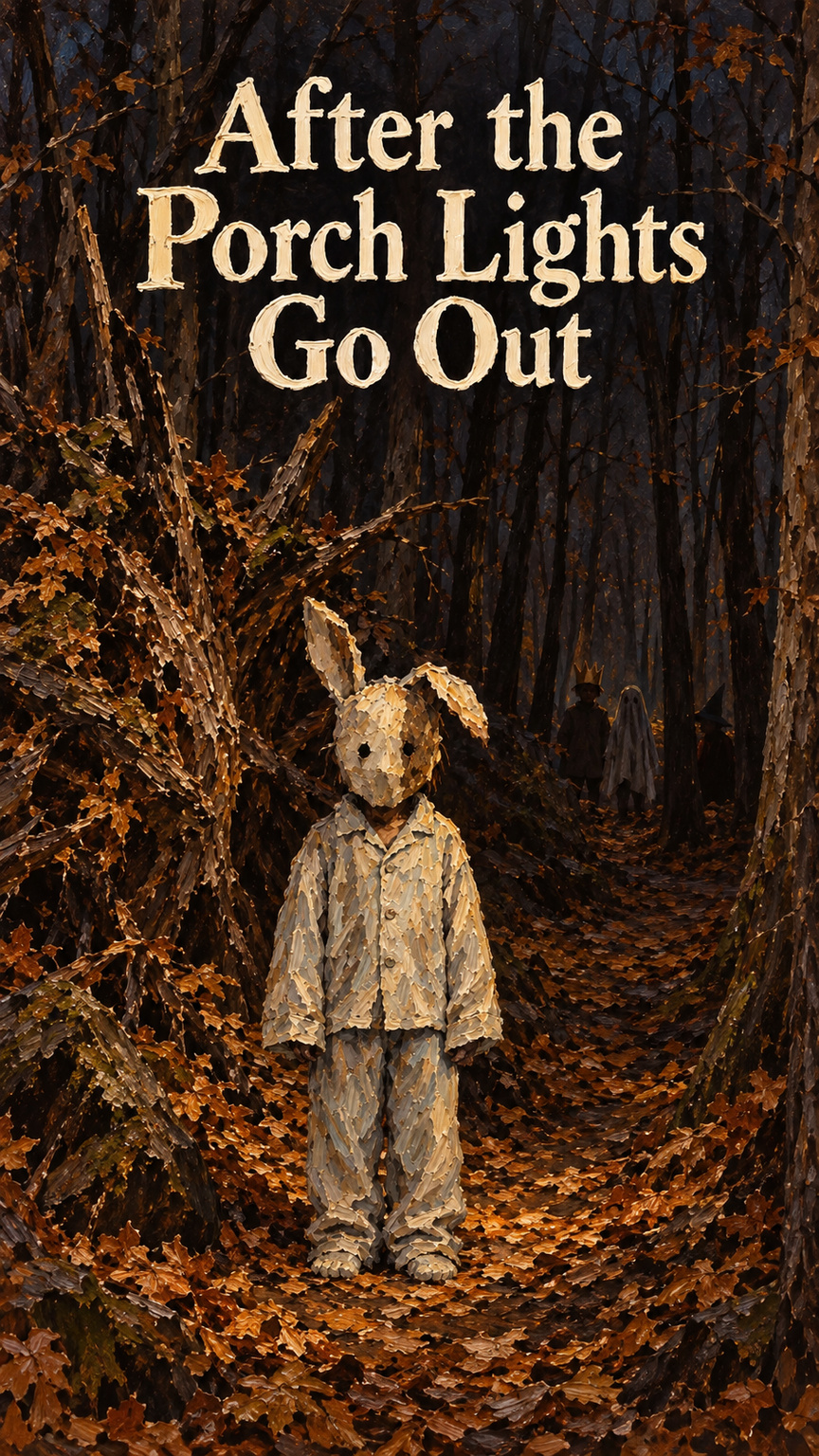
It wore a rabbit mask with a bent ear. One side of the paper face was stained dark, and the elastic had sunk into the soft place where the cheek should have been. Its clothes were pale. I thought it was wearing a pyjama suit.
“Oh,” I said. “Sorry.”
The child didn't move.
Farther back along the path stood a king in a wet paper crown. There was a clown beside him, and a small figure with a white cloth over its head. I could see the hem hanging in points. Their costumes had the heavy, collapsed look of clothes left out in the rain. They had no torches.
Nobody was talking now. Marnie moved close enough to press her elbow against mine.
“Is this a haunted walk?” I asked the rabbit.
Its face stayed towards us. The dark eyeholes were too small and too far apart for me to see through.
“We just want to get past.”
I stepped to my left. Leaves cracked under my shoe. The rabbit's face turned with me, but I heard nothing from where it stood. I waited. It waited.
There was room between its shoulder and the beech's upturned roots if it would shift a little. I pointed to the gap, smiling the way you smile when somebody is being awkward and you don't want to make it worse.
“Can you move over a bit?”
The bent ear trembled. There was no wind that low down.
I edged into the gap. Wet cloth nearly touched my sleeve. From close beside the mask came the smell of a cupboard in a house where nobody had lived for a long time.
Marnie caught the back of my sweatshirt.
“There's another one.”
Just beyond the gap, directly where I would have put my foot, something small sat against the roots with its knees drawn up. It had a round smiling face. A red ribbon tied beneath its chin disappeared into the collar of a coat. I hadn't seen it arrive. I couldn't see its hands.
I backed out of the gap. The rabbit's face followed me back. Marnie was looking beyond my shoulder, her mouth open above the green mask at her throat. I turned slowly, wanting to discover that she was looking at a grown-up.
Children stood between us and the pumpkin lights, their bags hanging flat against their legs. They were facing us too.
The leaves around my feet seemed terribly loud. I tried to shift my weight without making a sound, but they scraped together anyway. I became afraid of the noise of my own breathing. The children stood in the same leaves and made no noise at all.
A pale line appeared far behind them. It widened into a doorway. Yellow light fell across the ground, showing roots and fallen leaves, and the lower part of a tree that stood in front of it. I could see the open door's edge. I could not see a wall on either side.
For a moment I wanted to go towards it. There was a grown-up there. Someone had opened a door. Whatever was happening with these children, there would be someone who could tell them to stop.
Then a woman called, pleasantly, “You two at the back. Come along.”
Marnie made a small sound in her throat. I glanced back along the path. The king, the clown, the rabbit, all kept their faces turned to us. None of them looked at the door.
I dropped my pillowcase and caught Marnie's left hand. “This way.”
There was a space between two trees off to our right. I pulled her into it. A branch struck my cheek. Her pail hit something with a hollow knock, then I heard sweets scattering behind us. We went faster.
I couldn't see a path. I aimed for places where the dark looked less solid. Once, a white face appeared at the edge of my sight and I swung away so hard that Marnie cried out. I tried to say sorry, but there was no breath for it. The only sounds were ours: the scramble in the leaves, my shoes slipping, Marnie's cape snapping against branches.
A low limb lay across our way. I ducked beneath it, keeping her hand behind me.
Her arm jerked straight.
“Mind the branch,” I said, and pulled.
She didn't come. I planted my feet and pulled harder. Through the wool I felt her fingers close tightly around mine.
Then the glove went flat.
The resistance vanished. I pitched forward, caught myself, ran two stumbling steps before I could stop. There was tarmac under my feet.
I turned, still holding the glove.
The trees crowded together at the verge. I could see the low branch, but nothing beneath it. I called Marnie's name. My voice came out much louder than I'd meant it to, and I called again, more quietly.
“Wait,” she said.
She sounded close. Frightened. I went towards the branch.
“I'm here.”
“Wait for me.”
That came from farther along the verge, to my left.
I stopped with one foot in the leaves.
“Where are you?”
“Here.”
It was her voice. It came from behind the branch, where it had been the first time.
“Here,” she said again, from much deeper in the wood.
I tried to see the red of her other glove. There was only bark, and leaves, and black spaces too narrow to hold a person until I looked directly into them.
“Please,” she said from my left.
The glove hung from my fist. Its fingers touched my wrist, light and empty.
I took my foot out of the leaves.
She called again. I backed onto the road, shaking my head, though nobody I could see was there to see it. I kept backing up until my heel found the grass on the other side.
Only then did I hear an engine.
A car came around the bend. Its lights swept the trunks. For an instant the whole edge of the wood stood out, every branch and knot, and I searched the bright spaces desperately for Marnie.
The driver braked beside me. He asked where my parents were, then got out when I couldn't answer. I told him my friend was in the trees. He called her name several times. We listened together. I heard leaves falling. Nothing else.
They searched that night, and the next day, and for days after that. Marnie's father kept going in after the other people came out. They found my pillowcase near the fallen beech, still full of sweets. They found her pail. There were no pumpkins on any of the stumps.
The path, in daylight, took less than three minutes. You could see the new houses nearly all the way across.
My mother still lives on the crescent. Last Halloween I stayed with her while the children came to the door. By the end of the evening she was giving out handfuls because she didn't want anything left. We watched a little boy in a wolf mask try to carry six chocolate bars without putting down his sword.
When I left, the windows along the crescent were dark. At the last house, a man came onto the porch and lifted the lid off his pumpkin. He bent over it. The face went black. I was passing the entrance to the path.
“Come on,” Marnie said.
Just inside the trees. Just far enough that I would have to step off the pavement to see her.
I kept walking towards the bend in the road. All the way around, as my mother had told us. The cold had got through my coat, and I could hear each step I took.
Behind me, in the leaves, her pail rattled.
“We can do one more house.”