
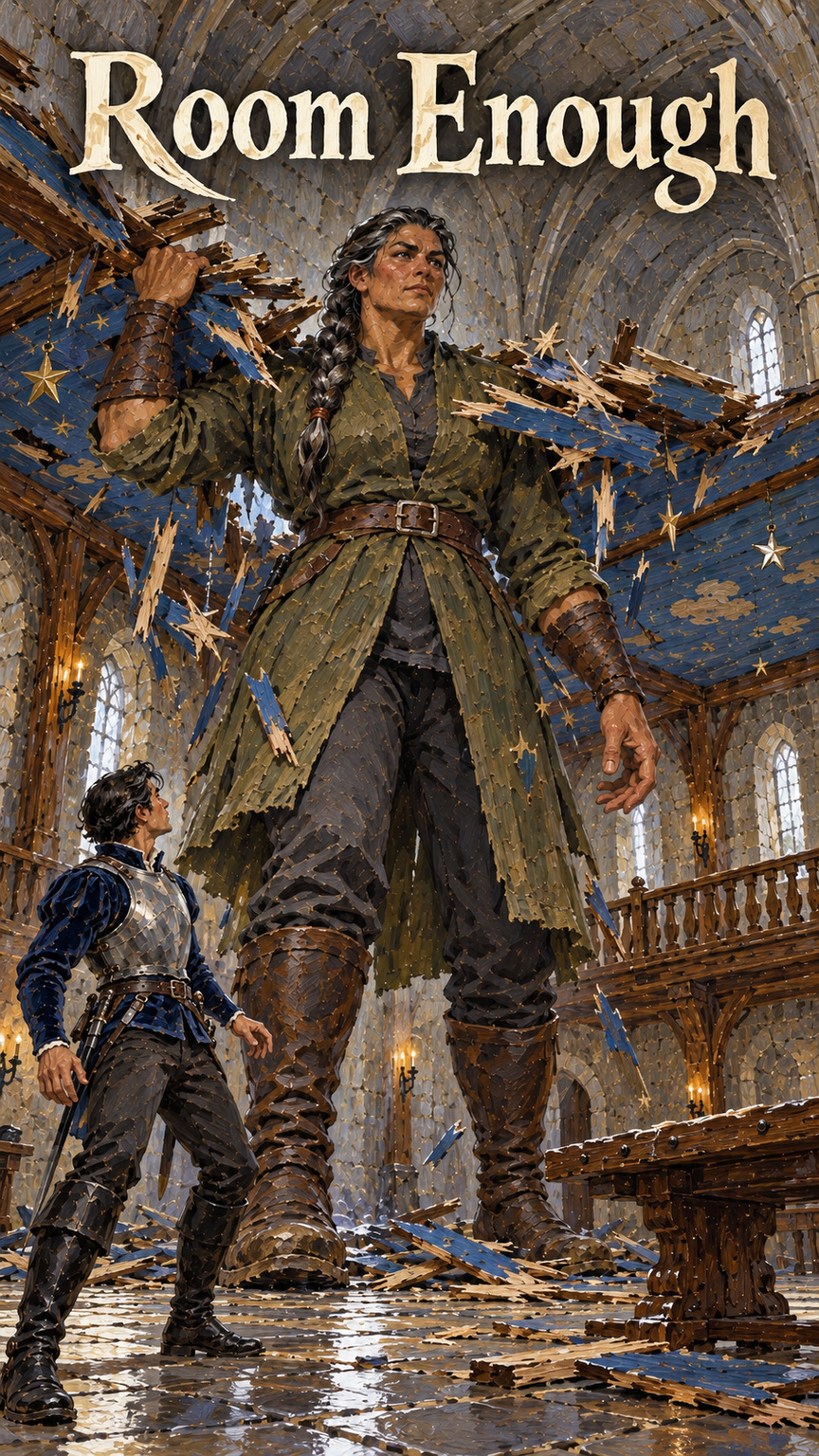
The sky in Lord Haverel's hall was seven feet from the floor. Breska was eleven feet tall.
She came through the stone doorway sideways, with her chin tucked down, and caught a painted star in her braid. It swung on its wire. Somewhere above the blue boards, a mouse ran away.
Haverel watched from the far end of a long oak table. He had put on a steel breastplate over his blue velvet, but no helmet. His hair lay neat against his temples. Breska had expected that. A man who won as many duels as Haverel liked people to see his face.
The painted boards covered the main floor right up to the musicians' gallery. Its platform stood three feet above the flagstones, with no wooden ceiling over it, only the high stone vault. Behind its tall railing, nine people sat with their wrist irons threaded on a chain.
All nine looked up.
Her sergeant had lost his red cap. The woman beside him was holding one boot against her chest. A strip of linen hid the lowest part of the youngest man's face. Breska could see his breathing move it.
She put her long sword beside the door, beneath the eyes of four spearmen, and came forward bent beneath the boards. Six crossbowmen crouched low at the gallery rail, sighting beneath the lip of the painted ceiling. Two more men waited at each of its narrow stairs. She counted them without appearing to count.
“Captain,” said Haverel. “Will you sit?”
There was a chair waiting for her. Someone had taken the trouble to polish it.
“I'll manage.”
She lowered herself to one knee and set a leather sack on the table. The coins settled with a dense, unlovely noise.
“The sum you asked for.”
Haverel did not reach for it.
“You understand that my victory was costly.”
“You should have asked for more.”
“I am asking now.”
Her sergeant stopped moving on the gallery. Breska looked at the sack. She had sold two horses, a winter of wages not yet earned, and the gold clasp she had worn at her throat since her first command. She could feel the pale place where it had rested.
“How much?”
“Not how much. Who.”
He came around the table. There was a narrow sword at his hip and a dagger on the other side, both with black grips. He wore them as comfortably as other men wore shoes.
“I have three towns to take before winter. One holds a gate for which I have no suitable engine. You would be suitable.”
“No.”
“Your people go free. You remain.”
Above him, the woman with the boot shook her head once. Breska was grateful that she did not speak.
She shifted her knee off a knot in the flagstone. The painted sky brushed her grey-threaded braid.
“We can handle this like civilized folk, or uncivilized. Your choice, but I’d prefer if you picked the former.”
Haverel glanced at the sword she had left by the door.
“Would you?”
“Single combat. You and me. To submission. I win, my people leave with me. You win, they still leave, and you have my service for one year.”
He looked up at the gallery, then back at her. She could almost see him adding the months.
“A year from today?”
“From today.”
“Without ransom?”
She drew the sack back across the table.
“You've chosen what you want.”
Haverel smiled. He was younger than she had thought, or he became younger when he wanted something badly enough.
“And if I decline?”
“Then I try to take them out. Your men try to stop me. People get frightened, and someone does something he can't undo.”
“You speak as though you wouldn't be frightened.”
“I didn't say that.”
For a moment he considered her without smiling. Then he drew his sword and turned its point toward the floor.
“No interference. The fight ends when one of us yields.”
“And he isn't struck again.”
“Or she.”
“Or she,” Breska agreed.
He called the terms up to the gallery. Her sergeant repeated them, slowly, so that no one could later pretend to have heard something else.
Breska got to her feet as far as the ceiling allowed. She had to bend at both knees and lower one shoulder. The knife she drew was short in her hand, though its blade was longer than Haverel's forearm.
He gave it a professional glance.
“You may fetch your sword.”
“I know where it is.”
He struck before the last word had quite left her mouth.
She caught his blade on hers. He let the contact turn him and cut at her thigh. Breska pulled back, knocking her head against a ceiling board. A silver cloud trembled overhead.
Haverel had already moved away.
She followed him around the end of the table. He gave ground exactly as fast as she came, keeping her knife point outside his shoulder. When she advanced her left foot, he changed direction. She had to haul herself after him without straightening. The muscles above her knees began to burn.
He had chosen this room well.
They met again beside the wall. His blade glanced off her knife and found the seam above her left boot. Pain opened sharply along her calf. She shifted her weight before the leg could fold and heard someone on the gallery draw breath.
“You can yield,” Haverel said.
She could. That was the bargain. Nine people would get up from the gallery and walk out, and she would spend the next year coming whenever this man lifted a finger.
At the first town, she would be the thing the people on the gate saw approaching. Haverel would stand somewhere safe behind her. By spring there would be other gates. There were always other gates once a man discovered how cheaply they could be opened.
A year was long. She had lived enough of them to know.
“Not yet.”
She drove him back. Twice his sword slid past hers; twice she turned it before it could bite. Her right shoulder scraped the painted boards. He watched her injured leg, waiting for the moment when she would put too much weight on it.
She watched his feet.
He would not retreat between the table and the wall. Too narrow. He preferred to circle its free end, turning so she had to struggle after him. On each turn, he passed with his back close to the tabletop.
She let her left knee sag.
He came in.
Breska caught his sword on the thick back of her knife and pushed, making him retreat around that corner again. As he turned, her free hand closed around the table's end. She dragged it a foot toward him.
The oak struck the backs of his legs.
He recovered well. She would remember that later. He turned the stumble into a lunge that almost reached her throat, but now she knew where he had to go. She stepped into him, trapped his sword arm against the tabletop, and put the edge of her knife under his chin.
The hall became quiet enough for her to hear the mouse again.
“Yield,” she said.
He tried his arm. She tightened her grip.
“I yield.”
“Loudly.”
“I yield.”
Her sergeant laughed once, a broken sound that he quickly swallowed.
Breska took Haverel's sword from his hand and laid it on the floor behind her. Then she removed the knife from his throat and let him go.
He stood rubbing his wrist. There was a red line beneath his jaw, no deeper than a shaving cut.
“The keys,” she said.
Haverel looked at the gallery.
“Use the bows.”
One of the men up there hesitated. Another did not.
Breska dragged the table up between herself and the rail. The first bolt struck the oak with a crack. Others followed, each impact jolting through the oak into her hands. Her knife fell somewhere under the table as she took its weight with both arms.
She drove forward.
The men at the nearest stair had time to lower their spears. The table hit the shafts and swept them backward. One man fell under the stair; the other let go and ran. Breska's wounded leg slipped. She caught herself against the wall, taking the blow through her shoulder. For an instant she was folded between stone and oak while the crossbowmen wound their weapons above her.
Haverel was shouting. She could not make out the words. The ceiling pressed against the back of her neck.
Breska put the table down on its edge. She set both hands beneath the timber frame overhead and pushed.
The blue boards bowed. Dust sifted into her hair. She heard the fast little pops of nails drawing, and then the frame tore away from its hangers.
She stood up through Haverel's sky.
Boards fell across the empty middle of the hall. A silver cloud spun past her face and shattered on the stones. Above her was cold air and the great old vault, much farther away than anything she had felt over her head since entering.
She caught the falling frame with one hand and flung it down behind her. It struck the floor between her and Haverel. His next order ended in a cough.
A crossbowman leaned over the gallery rail, trying to see past the dust.
She reached down over the rail, seized the bow before he fired and pulled it out of his hands. She struck the railing with it. The bow broke. So did the rail. The man dropped flat, covering his head, and she left him there.
Another guard was turning his weapon toward the prisoners.
Her sergeant threw the loose part of the wrist chain around its stock and hauled. The shot went into the stone vault. The man with the bandaged jaw brought both bound hands down on the guard's fingers.
Breska took hold of the front of the guard's coat. She lifted him over the broken rail and set him on the floor with enough force to make his teeth meet.
“Stay.”
He stayed.
The keys were hanging from his belt. She tore them free and tossed them up. Her sergeant caught them against his chest.
The four remaining bowmen dropped their bows and drew swords. Three laid their blades down almost at once. The fourth backed through the musicians' little door and vanished.
The bandaged young man swayed as he stood. Breska looked from him to the narrow stairs, then dropped the broken bow and lifted the oak table. Bolts bristled from its underside. With the ceiling gone she could turn it upright, lower its far end through the broken rail, and let the near end settle on the flagstones.
“Down,” she told her people.
Her sergeant was already unlocking the last wrist. He picked up a surrendered sword and went first. The woman put her boot back on. The youngest man came down with an arm across a companion's shoulders. On the broad oak they could walk side by side.
Both guards at the farther stair lowered their spears to the floor as the armed prisoners passed.
Breska waited for the ninth person. Only when the gallery was empty did she turn back toward Haverel.
He had reached the entrance. The four spearmen closed before him, fresh men with their weapons level. Breska was bleeding into her boot. The table lay behind her. Haverel pointed at her empty hands.
“Together.”
She picked up the fallen ceiling frame and shook the broken boards from its crosspiece. With room to stand, she had room to step. Her injured calf sagged as she met the advancing points, but she drove the timber across them and into the wall. Two shafts snapped. Her people came up on either side of her; the other two spearmen let go before their weapons could be wrenched away.
Haverel slipped between them while she was still braced against the timber. A quick little motion, as good as any he had made in the duel: the dagger coming toward her injured leg.
Breska dropped the crosspiece, caught his wrist and lifted him by the front of his breastplate.
His boots left the floor.
She took the dagger away. Then she held him while her company passed on either side of her, collected the fallen weapons and opened the doors. Rain blew in across the flagstones and broken stars.
Nobody was between her people and the road.
Haverel looked over her shoulder, toward the gallery. He looked down at his own men. One was nursing a hand. Another stared fixedly at the dagger Breska had taken.
“May I yield?” he asked.
Her calf throbbed. The wounded young man had stopped in the doorway, watching her. She could feel Haverel's breathing against the palm that held his breastplate. It would take very little to stop it.
She set him on his feet.
“Yes.”
He swayed, caught his balance and looked at her as if he had misunderstood.
“Put your hands where I can see them,” she said.
He did.
Her sergeant fetched the ransom sack from among the broken boards. He tied it to his belt, then brought Breska her knife. She looked at its edge before sliding it into the sheath.
Haverel stood beside his shattered spears. Above him, what remained of the painted sky hung in strips. He seemed about to say something. Breska waited, and he decided against it.
She backed to the door, keeping him in sight until the last of her company was outside. Then she picked up her long sword and stooped beneath the stone arch.
There was rain on her face before she had finished straightening.