
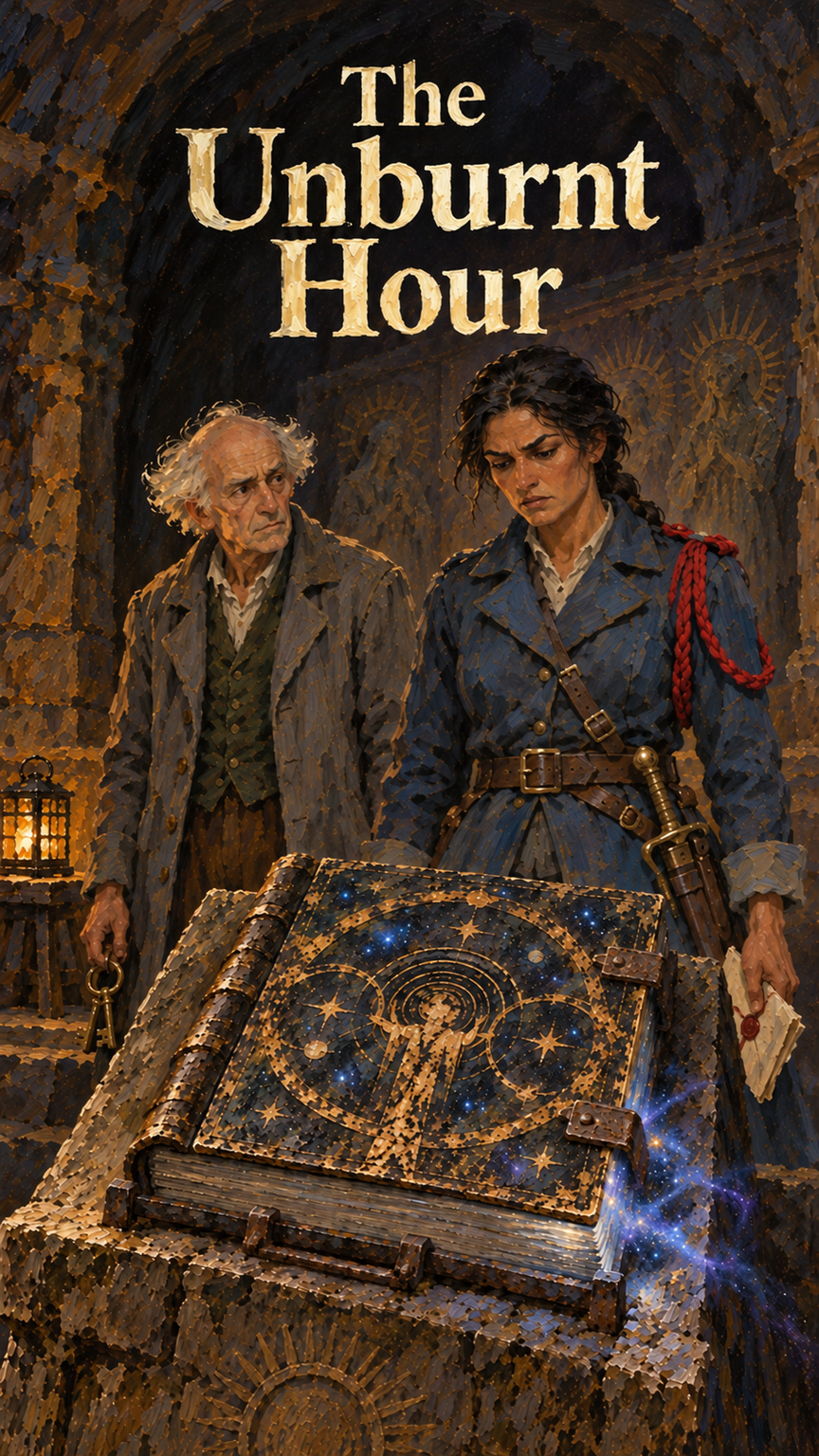
The order said the book was to be burned unopened.
Ysabet had approved that precaution herself. She had seen what came out of the king’s other collections. Now she stood below his burning library with a lantern in one hand and the order in the other, while an old man told her he had guarded this particular volume for twenty-three years.
“I don’t get it. If this Book of Eternity is so dangerous, why do you have it under lock and key? Why couldn’t you simply have it destroyed right then and there?”
“We could have.”
The old man’s name was Orrel. He wore a grey coat with shiny elbows, and his white hair grew in two unruly wings above his ears. Nothing about him suggested the terror promised by the iron door, the three dead bolts, or the warning cut into the stone above them.
“Then why didn’t you?”
He looked at her lantern.
“Will you hear a witness first?”
Behind him, the book lay on a sloping stone stand. It was as wide as a paving slab and thick as Ysabet’s fist. Its covers were black and translucent, with stars suspended at different depths beneath their surface. Some were no more than dust. Others shone through the nearer constellations with a cold, steady brilliance. Bands of ancient gold crossed that darkness in great intersecting circles. At their center, a worn figure raised both hands beneath seven concentric halos. Its face had been struck away.
An iron cradle enclosed the volume. The cradle’s clamps and locks looked crude against the old gold, like a manacle fitted around the wrist of a colossal statue.
Ysabet raised the lantern. Its flame moved across the iron. The stars remained where they were.
She had taken the carvings on the chamber walls for cracks. In the Book’s light they became ranks of kneeling figures, each with a crown of rays. The palace masonry had been laid across their heads. A bracket for a royal banner pierced one upraised hand.
Above them, something heavy fell. The floor quivered beneath her boots. They had taken the palace by dawn; now the men were opening cupboards, bringing down portraits, discovering how much of a king could be made to burn.
Ysabet folded the order along its existing crease.
“One witness. I have people waiting upstairs.”
Orrel set a low stool before the stand, then placed her lantern on it. He opened the shutter enough to light the book.
“Stay behind this. Whatever you see, keep your hands to yourself.”
“Is that the danger?”
“Part of it.”
He unlocked the cradle’s two iron clasps. A toothed rail ran beside the spine. He raised the cover two inches and drove a pin through the rail to hold it there. Light slipped between the leaves: a thin gold horizon, a green one, a line of blue so fierce it laid a second shadow beneath the stool. Then the light of the topmost leaf spread across the chamber, filling it with afternoon.
She expected writing.
There was a street.
It lay below the edge of the cover, farther down than the book was thick. A stone stair descended from the opening. Its nearest step was broad enough for Ysabet’s boot; the lower steps narrowed into the distance. Red roofs crowded one another above a steep cobbled slope. The light came from somewhere to the left: a late sun, although dawn had scarcely passed outside. A cart stood crooked across the street. Two men were arguing over which of them should move it.
Ysabet bent forward.
The men stopped arguing and looked up.
Behind the roofs rose a white bell tower with three clock faces. The fourth face had been bricked over. Ysabet knew the absurdity of that tower. As a child she had walked around it with her father, trying to find the clock that people on the north side were supposed to use.
“Harrowick,” she said.
Orrel watched her face.
“The army report said it was abandoned.”
“The army found an empty hill.”
She put the order down. She had carried it all morning without once wanting both hands free.
At the bottom of the slope, a yellow-coated woman came out of a doorway. She had close-cut black hair and something white tucked under one arm. As she hurried toward them, she kept looking over her shoulder and shouting. More people appeared at the windows.
“Orrel!”
The voice was small, but not faint. Ysabet heard the catch in it.
“What is that smell?”
“The palace library is burning, Edris.”
The woman stopped.
“Again?”
“Not here.”
“That’s what I was told last time.”
Orrel did not answer immediately. In the silence, Ysabet heard a child asking somebody to lift him high enough to see.
“Show her,” Edris said.
“I was going to.”
“Then do it.”
Orrel moved to the other side of the stand. Ysabet shifted the stool and followed, keeping it between herself and the opening.
A black crescent had been eaten out of the leaf. There were no houses in it. The city stopped in the middle of streets, at half a courtyard, along the straight, clean edge of a room whose wallpaper was still blue. Beyond those cuts was a blackness that the afternoon light did not enter.
The margin around it was brittle and brown. Where it had not burned, the leaf was silver-grey, fine as the skin inside an eggshell. It trembled in the draft from the stair.
Ysabet had seen enough burned towns to know what was missing. There should have been rubble, tiles, the stubborn shapes of fireplaces. Here there was nowhere for those things to lie.
“Who?” she asked.
“The keeper before me. He thought the same as you.”
“And the people?”
Orrel’s hand rested beside the black edge, careful not to touch it.
“The ones who were left told me where their families had been.”
Edris had climbed the narrow stair from the distant street to the book’s open fore-edge. At the top she was only an arm’s length away, looking over a low parapet. The white thing under her arm was a folded shirt. She laid it down and flattened it with both palms, as if she had remembered she had been carrying it.
“My husband was at the south gate,” she said. “Ask him where the south gate is.”
Ysabet looked at Orrel. He pointed into the crescent.
She stepped back so sharply that her heel caught the stool.
“The king is dead.”
“Yes.”
“Then what is holding them?”
“They are. He bound them to the leaf. Their hearts keep it.”
Ysabet looked at the distant people crowding the windows. The thought had nowhere decent to go. Every sign that they were alive was also proof that the prison was working.
“Then take this leaf out,” she said. “Keep it whole. Could we destroy the rest?”
Orrel looked at her.
“The royal inventory names Harrowick,” she said. “One recorded use. Nothing earlier.”
“It records what the king put in.”
He took a long steel ruler from the stand’s shallow drawer.
“Keep back.”
He slipped the ruler under the leaf and raised it into the shadow beneath the cover. Harrowick disappeared. Edris’s voice cut off in the middle of a question.
Underneath was night.
A city of circular white terraces descended toward a square crowded with people. Blue lamps stood along its walls. Two figures on a rooftop looked up; one began waving a pale board, and the other ran down a stair. More faces appeared. Far above them, at the crown of a sky dense with unfamiliar constellations, a blue star burned inside a halo of gold.
Ysabet knew its shape. She had copied it at school above the first number of the calendar: the Year Star, whose disappearance marked the beginning of the count. There were thousands of years between that night and the oldest kingdom she could name.
Its light fell across her hand.
She turned her palm up, then over. The shadows changed. The cold blue lay in the creases of her knuckles.
“That went out.”
“Outside,” Orrel said.
In the square below, people were pointing toward the opening. Someone had brought out a second board. The marks on it meant nothing to Ysabet. She held up her hand and the people on the rooftop raised theirs.
A moment ago, while they were living beneath that lost light, she had called them the rest.
“How many?”
“I have never reached the last leaf.”
Ysabet looked at the narrow stack beneath his ruler. At its edges lay more horizons, fine as threads. The stars in the cover were their light, escaping through the dark.
On the front of the stone stand, beneath a disk of rays, ran a line of deeply cut characters. Orrel rested a finger beneath them.
“Keeper of the hours that time would take. That is the old name.”
“Book of Eternity.”
He nodded.
“The palace was built above this shrine. The king found the way down. He learned how to dedicate an hour to it.”
“Dedicate.”
“He made an offering of Harrowick.”
The pale boards moved urgently below. Ysabet could not read them, but she could no longer look at the open book and see a weapon that had begun with the man they had killed.
Orrel lowered the first leaf. The blue star vanished from the opening. Afternoon returned, and Edris was still on the stair, looking from one face to the other.
“Are you finished?” she demanded.
“Not yet,” Ysabet said.
She turned from Edris to Orrel. “Twenty-three years?”
“Since I came here. The city was taken five years before that.”
She was thirty-nine. She remembered the tower from a spring journey when she was nine. The army had come two years later.
“That woman can’t be more than thirty.”
“She was twenty-seven when they took the city.”
Edris heard him.
“Don’t tell it as though I haven’t been here.”
Orrel bowed his head.
The three clocks all showed the same time. Nothing moved in the sky above them. It had been that late afternoon while Ysabet grew tall, learned to ride, buried her father, took her first command. Somewhere in the city was the child who had asked to be lifted. She did not ask how old he was.
“You can open it,” she said. “There must be a way out.”
“There is a way to exchange.”
At the top of the stair, Edris had taken off her yellow coat. She laid it over the shirt. Without it, she looked narrower and older, though Ysabet could not have said why.
“The held hour cannot give up a life without receiving one,” Orrel said. “That rule was here before him. He used it. Sometimes he demanded a relative. Sometimes somebody who displeased him. Touch a prisoner through the opening and the passage begins. Let them come all the way through, and you take their place.”
Edris climbed onto the parapet.
“Get down,” Orrel said.
She did not look at him. She looked at Ysabet, put one foot outside the parapet, and pitched forward toward the opening.
Ysabet had spent the morning pulling people out of broken masonry. Her hand was already moving when she remembered the warning.
Edris’s outstretched hand came through the gap. Ysabet caught it.
For one instant it was only a hand: warm, with hard skin at the base of the fingers. Then Edris gripped her wrist and pulled.
Ysabet’s cuff went flat. Beneath it, her arm thinned into rows of black strokes. She could feel her fingers, but she could no longer see where one ended and the next began. The street rose toward her. Someone was shouting from below, a voice suddenly as large as her own.
She braced a boot against the stand and pulled back. Edris clung to the iron clasp at the cradle’s lower lip with her free hand and hauled herself toward the gap. One of her elbows was outside the cover.
Orrel hooked the steel ruler beneath the fingers gripping Ysabet’s wrist.
“Let go!”
Ysabet did not know which of them he meant. She opened her fingers.
He levered Edris’s fingers up, forcing the flat steel between her palm and Ysabet’s wrist. The contact broke.
The street fell away. Ysabet struck the floor with her shoulder. Her arm was heavy and solid again, and she clutched it against her chest while Orrel pulled the pin and brought the cover down.
He locked both clasps before he helped her up.
She could hear herself breathing. She could hear the library burning overhead. The voices had stopped.
“Did you hurt her?”
“She was back on the stair.”
“That wasn’t what I asked.”
“I don’t know.”
Ysabet looked at the book. Her wrist ached where Edris had held it. She remembered the coat and the folded shirt, set out on the parapet. Edris had left them where somebody else could find them.
Orrel stood with the ruler hanging at his side.
“I should have kept it shut.”
“Then I would have burned it.”
Boots sounded on the stair. Sergeant Pellan came through the doorway carrying an iron fire pan, followed by two soldiers with a sack of kindling between them. The sergeant’s sandy moustache was grey with ash.
He looked at Ysabet’s bare wrist, then at the old man. His gaze caught on the Book. He lowered the fire pan a little, though he had not yet been told to put it down.
“Trouble?”
“Put the pan down. We’re taking the book out intact.”
Pellan put it down, but he did not let go of the handle.
“That’s expressly forbidden.”
“There are people in it.”
He waited. She could see him making room for one more impossible thing. They had found a room upstairs in which every mirror was somebody else’s window.
“Alive,” she said. “Harrowick. The people who disappeared. And others from before the first year.”
Pellan looked again at the depths beneath the gold seals.
“The king didn’t make it,” she said. “He put a city into something that was already keeping other lives.”
“Can they come out?”
“By taking somebody else’s place.”
Pellan’s eyes returned to her wrist. The soldiers behind him shifted away from the stand.
“Then we don’t carry it through our lines.”
“Locked. Nobody touches it.”
“The order says every royal weapon is to be destroyed on recovery. No exceptions by field command.”
“I know what it says.”
“You helped write it.”
“We only knew what he’d used it for.”
The two soldiers watched their boots. Orrel moved nearer the stand, as though his body would be useful between the fire pan and the book.
Pellan let go of the handle. “I can put a guard on this door while you take it to the council. But I can’t help you take it away against a sealed order.”
There was another crash overhead. Dust slid down the curve of the chamber ceiling, catching in the stone crowns beneath the palace brick. Waiting here while she rode across the city would leave the book under a burning building. Its cover had outlasted kingdoms; one flame had still taken a street, a gate, a man standing at his work. All those other thin horizons were under the same roof.
Ysabet unbuckled her sword belt.
Pellan looked up.
“You can arrest an officer who refuses the order,” she said. “You can seize what she refused to destroy. Take us both before the council.”
“As evidence.”
“Yes. The people in the older leaf have messages we can’t read. I’ll ask the council for someone who can.”
Pellan lifted the order from the stand and read it again.
“They may say I helped you save it.”
“They’d be right.”
He folded the paper and put it inside his coat. “That isn’t a pardon for either of you.”
“I’m asking you to carry it out of the fire.”
She held the belt toward him. After a moment, he took it. The weight leaving her hands was worse than she had expected. She unfastened the red cord from her shoulder and laid that across the sword.
Pellan passed them to a soldier.
“You’ll come under guard. He comes too. I take the keys.”
Orrel nodded.
“Let us tell them first,” Ysabet said.
The sergeant looked at the book for a long time. Then he moved the fire pan against the wall and told his men to stand back.
Orrel unlocked the iron clasps, raised the cover to the same notch, and set the pin. This time Ysabet stayed well beyond an arm’s reach. Pellan stood beside her with one hand on his sword.
Edris was sitting on the stair. Her yellow coat lay across her knees. People had gathered below her, looking up. Ysabet could not see whether her hands were hurt.
“We’re taking the book out,” Ysabet said. “It will go to the council intact. I’ll tell them what I saw.”
Edris lifted her head.
“When do we get out?”
“I don’t know.”
“He’s been saying that for years.”
“I heard him.”
“And now you have the keys.”
Ysabet looked at Pellan. “No. I’m going with you under guard.”
The woman’s gaze moved from her face to the plain shoulder of her coat where the officer’s cord had been. She stood and put on her coat. Down in the street, somebody began passing her words back to the people who could not hear.
“What’s your name?” Edris asked.
“Ysabet.”
Edris said it twice. Ysabet waited while the name travelled down the stair.
“Put out that lamp, Ysabet.”
She knelt beside the stool and turned the wick down until the flame dwindled and went out. The little street remained bright with its own afternoon. Beneath its leaf, the Year Star’s blue light still threaded the edges of older hours.
Orrel pulled the pin. Before the cover closed, Ysabet saw Edris pick up the folded shirt and take it down to someone waiting below.
The old man locked the cradle and gave Pellan the keys. The soldiers took its iron handles and lifted the volume between them with the care they would have used for a wounded man. The Year Star shone through the old cover, blue across their hands.
Ysabet held out her wrists into that light.