
“Try not to call the thumb the customer's remaining hopes,” Elska said.
“That was one rehearsal.”
“That was a catalogue.”
“Then we educated several customers.”
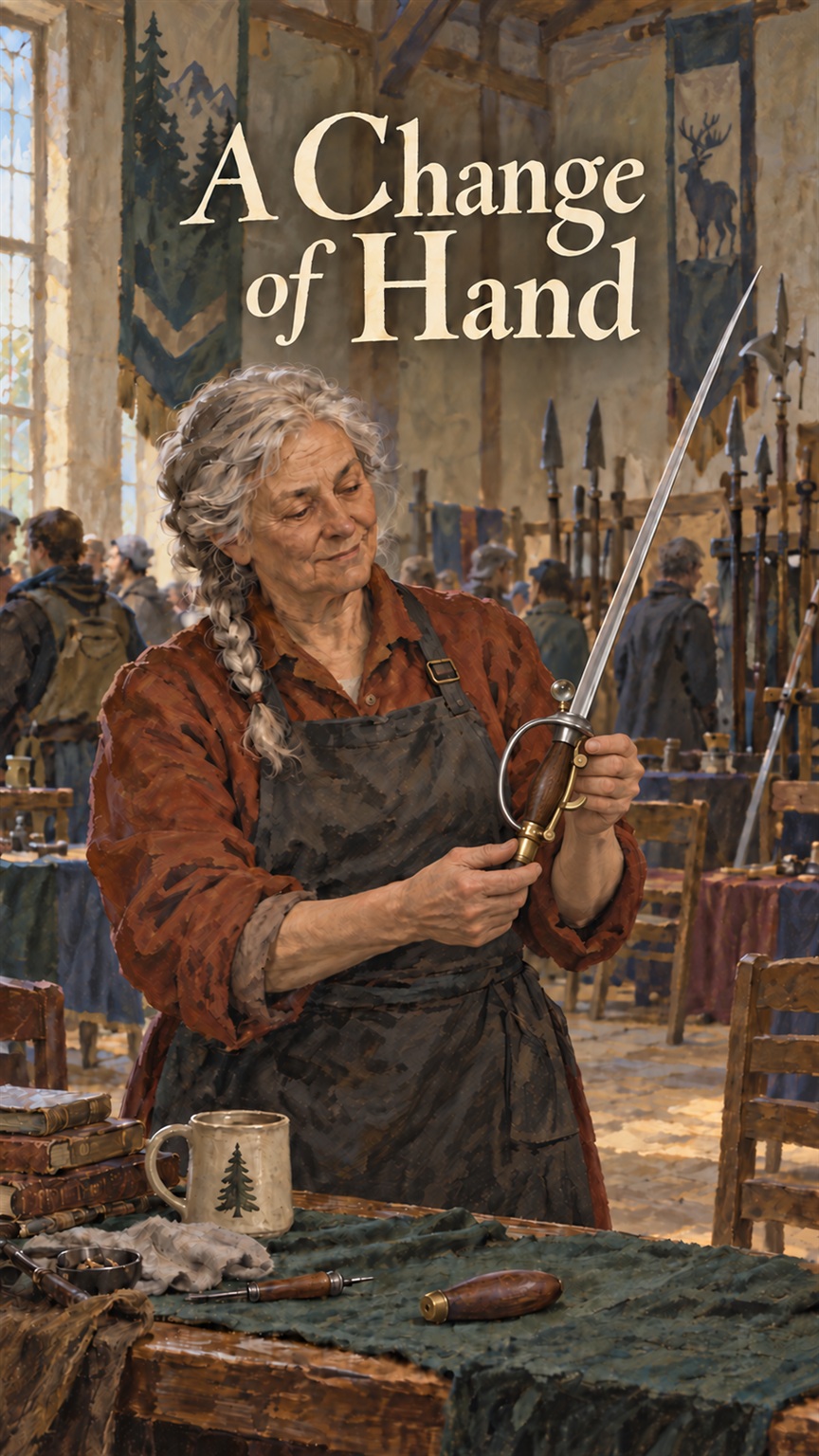
Elska loosened the little brass screw beneath Scathe's grip. Her third finger would not straighten this afternoon. She worked with the other two, the rapier laid across her knees, while a war hammer on the adjoining chair explained to its carrier that it had never agreed to the fringe.
The fringe was bright yellow. It quivered with each objection.
Beyond the dressing-room curtain, the Feast of the Noble Blades was getting louder. A vendor had opened a flask of the expensive mountain oil; half the weapons in the west gallery were accusing him of dilution. Someone was demonstrating a quick-release scabbard by dropping a sword every few breaths. The sword's language suggested that the release worked very well.
Elska had come every year since Scathe's living root first took in her forge. In that first year the blade could manage three words through the reed in her guard: hot, again, and Elska. Now she gave unsolicited opinions on haircuts. The root was still a warm, narrow braid inside the tang, fed through a wick beneath the pommel cap. It let her speak through the reed and see through the little glass bead above it. It had never enabled her to lift her own weight.
“The chair has been reading our abstract,” Scathe said. “I heard him practicing ‘metacarpal.’”
“He can say ‘hand.’”
“He won't. He's a ceremonial mace.”
Elska smiled and lifted the rapier. The new support settled against the heel of her palm. Its thumb rest was broad enough to spread the pressure that, with the old grip, had gathered cruelly beneath one joint. She did not have to squeeze so hard. After nine months of cutting models, moving screws, and being told to rest, she could hold Scathe upright again without calculating how long it would be before she had to put her down.
Their half-hour panel was followed by a bench examination that ran until quarter past four. Elska had brought order slips as well as measurement paper.
The three-o'clock bell sounded. On the other side of the curtain, the mace struck the floor for quiet.
“She'll introduce us as ‘Master Elska and her demonstration weapon,’” Scathe said.
“He.”
“I'm speaking of the woman carrying him. He only likes to think he runs things.”
The woman announced Elska and Scathe by name. They looked at each other as well as a woman and a sword could.
“You owe me a sweet oil,” Elska said, and carried her out.
Their diagram was already hanging behind the demonstration table. Elska had drawn it herself, a hand in black ink around a red cross-section of the grip. Beneath it she had lettered Scathe's contribution, in a much smaller script: Hand shown for purposes of illustration. Yours may vary.
The hall was full. Human listeners occupied chairs. Blades without bodies rested in padded racks among them; polearms rose from the back rows like a winter wood. A buckler had insisted on facing the speakers from the breast of a particularly tall woman. To Elska's left, an elderly crossbow was making its carrier take notes.
Above the platform hung the convention's great banner: THE FEAST OF THE NOBLE BLADES. Only THE was gilded. A previous committee had tried giving equal prominence to FEAST and had failed to secure reelection.
Elska put Scathe on the table.
“Twenty years ago,” she began, “I stood here with a sword who knew three words.”
“It was a more economical presentation.”
“We have since learned to distribute our costs.”
The people who knew their act laughed first. Elska could pick them out without looking up. The man with the blue beard had sat in the same corner for six years. Last time, Scathe had told him his beard resembled a polishing accident. This year it was blue again.
Elska held up the old oval grip, dark walnut worn pale where her thumb had rested.
“An excellent shape for a hand that closes easily. My hand has recently become less enthusiastic.”
“We issued a formal complaint.”
“It has not replied. So.”
She indicated the drawing. Two brass rails ran beside the ordinary grip. One carried a thumb rest; the other supported a curved shelf beneath the heel of the palm. Each could be moved and fixed independently. Neither wrapped behind the hand.
She lifted Scathe again and slowly opened her fingers. With her thumb and palm still bearing against the supports, the blade remained level.
“You are transferring more of the load here, and here. You still need a hand. You need less of a fist.”
“Can it be locked?” called the buckler.
“No.”
“My bearer drops me.”
“Your bearer should be able to drop you.”
“She should be able to catch me afterward.”
Elska lowered her thumb and let Scathe fall onto the padded table. The buckler conceded, reluctantly, that the release was good.
Next came the old exercise. Scathe wore a cork button over her point. The assistant from the convention held out a padded rod; Elska turned a small thrust aside, recovered, and met the second. For sixteen years the rod had come high, low, high, low. At the fourth exchange Scathe said, “If he's still doing this after supper, leave him.”
The assistant grinned. The audience laughed. Elska had time to take a breath before the return.
They did it again. Her hand ached, but the ache stayed small. She could feel the sword's weight against the palm shelf and the familiar readiness of her living root. She had missed this. In winter she had begun rehearsing seated, with Scathe propped in a clamp. The clamp had held her perfectly and had been no company at all.
“The attachments can come off,” she said. “You keep your old grip. They can also be fitted to plain steel.”
A knife in the second row made an indignant sound.
“Some people have plain steel,” Scathe told it. “They still have hands.”
“Is the thumb angle fixed?” asked a woman in copper silk.
Three copper feathers stood above her dark hair. She sat beside a long, pale green scabbard tooled with leaves, rather than wearing it. As she raised her hand, Elska saw the fine joint at the wrist beneath her glove.
“Within a range,” Elska said.
“My right thumb doesn't bend at all. Solid ash. I wondered whether I could brace it against that rest without breaking it.”
The sword in the green scabbard was Ildesse; Elska remembered the name from the delegates' list. Ildesse's living thread let her move and speak through the wooden woman in copper silk. She could send that body six paces from her steel and had taken two chairs to seat both of herself comfortably.
“I'd need to examine the thumb,” Elska said. “And how much movement you get here.” She touched her own wrist. “I can't promise from across the room.”
“An encouraging answer. The last man promised me a new elbow before I'd taken my glove off.”
“Did you buy it?” Scathe asked.
“No. He wouldn't let me try it in a sleeve.”
Elska put down her pointer. “Which brings us to fitting. I'd like a different hand. Broader than mine, if possible. Someone who fences.”
A woman near the aisle stood. She wore a blue teaching jacket with one sleeve repaired at the elbow; her right hand was broad and her nails were cut almost to the quick.
“Rusha,” Scathe said, with a brightness Elska had not heard in the rehearsal.
“We found one another,” Rusha said. She climbed the platform steps and offered Elska her hand.
Elska knew her name too. Rusha taught on the western circuit, gave public bouts, and traveled with two enormous bags of masks. Scathe had read three notices about her aloud over breakfast. Elska had been trying to get a screw out of a flawed casting and had listened with half an ear.
She loosened the thumb rest and moved it out. Rusha's palm was wider, her thumb shorter. The first setting made her cock her wrist; the second let the shelf take some pressure without turning the point inward.
“Try a change from the high guard,” Elska said.
Rusha did. The extra brass checked against the base of her thumb. She tried again, more slowly.
“There,” Elska said. “You lose that little turn. For the quickest changes I'd take the support off. For an hour of the same work, you may prefer to keep it.”
“An hour?” Rusha smiled. “I teach nine-year-olds. Some days the same work lasts forever.”
“Do they know that?” Scathe asked.
“They are determined to prove it.”
Rusha turned Scathe over to look at the screws.
“How long to put her back on the oval? I have from half past three to quarter to four to try her. Then I'm booked with Helvek, before I choose for tomorrow's bout.”
Elska's fingers stayed on the brass rail.
“Tomorrow's bout?”
“At the South Yard.” Rusha glanced at Scathe. “Your letter said we'd have you fitted after the talk.”
The crossbow's carrier went on writing. Somewhere at the back, a lance asked its neighbor which way round the little shelf went.
“My letter,” Scathe said.
“What did you say?” Elska asked.
“I asked if she'd try me.”
“For a bout.”
“For the circuit. If we suited.”
Rusha looked at Elska's hand, still touching the grip. “I thought you knew.”
“She didn't,” Scathe said. “I said ‘we.’ I hadn't asked.”
Elska could hear the reed now, the small effort behind the fine carrying voice. The diagram at her back showed the supports fitted to her own hand, knuckles enlarged with an accuracy she regretted. She had thought Scathe would be proud of it. Scathe had been proud of it. Both could be true, apparently, while Elska stood in front of a hall of people and learned what else had been happening in her workshop.
She could say, certainly, of course, take her. She knew precisely how to make it sound like an excellent advertisement.
“We have the bench examination after this,” Scathe said. “Elska, talk to me afterward. I shouldn't have made this part of the presentation.”
Rusha began taking her hand out of the grip.
“Stay for the fitting,” Scathe said. “If you will. That's what you came up for.”
“The trial can't wait until after the examination. I've promised Helvek an answer at four, and we rehearse then.”
“I know. I'm staying for the bench.”
“I haven't promised you the bout.”
“I know that too.”
The reed went quiet.
Elska tightened the screw. “Try the high guard once more. This setting may still be a little wide.”
After Rusha's fitting, a large man in a padded fencing coat held up his left hand. His sword spoke first.
“He won't volunteer. He's afraid he'll be asked to fight somebody.”
“I am not,” said the man.
“He's a registrar. He has come for the finishing oils.”
“I fence on Thursdays.”
Elska invited him up.
His palm was broad, but his thumb reached farther than Rusha's. He held his own sword so tightly that the tip trembled. Elska reversed the supports on their rails and placed Scathe in his left hand. Scathe was lighter, and after Elska moved the shelf he was able to loosen his fingers. He seemed surprised that she stayed in his hand.
Rusha had remained at the end of the table. Elska gave her the padded rod.
“Can you put him through the exercise?”
“Which exercise?”
“A simple one.”
Rusha looked at the registrar. “Do you know a low parry?”
“Yes.”
“Show me.”
He showed her. She sent the rod down toward his thigh; he turned it aside, bringing Scathe too far across his body to recover easily.
“A shorter turn,” Rusha said. “Again.”
At the third try, Scathe said, “That's enough hand. You needn't push the rest of him through it.”
The registrar laughed, lost his guard, and received a soft tap on the padded thigh of his fencing coat.
“That's my fault,” Scathe said. “I'll save it until afterward.”
Elska watched Rusha vary the attack. Once she began high and changed her mind. Once she paused until the registrar made an impatient little movement, then sent the rod in. He missed it. Scathe missed it with him. At the next attempt he made a smaller turn; the support took the load, and he brought the point back to line.
“There,” Scathe said, quietly this time.
He did it again. The sword said nothing. The man looked up, waiting for confirmation.
“You felt it,” Scathe said.
Rusha glanced toward Elska. Elska held out her hand for the rod and asked the registrar what ached. He showed her the side of his thumb. She moved the rest a little farther out.
From the front row, the blue-bearded man called, “Can I order one for a saber?”
“Bring it to the bench.”
“You'll pay extra for that beard,” Scathe said.
“Only if it sheds,” Elska said.
The laughter was smaller than usual. Elska was grateful for that. She explained the limits of the fittings for curved guards, answered a question about gauntlets, and showed how to take the supports off without opening the protected channel that held the living root. When she finished, the chair mace announced their bench number and threatened anybody who wanted to ask a sixth question.
Rusha returned Scathe to the table.
“Thank you,” she said to Elska. “I'll come past before I leave.”
She went down the steps and out by the west door. Scathe's glass bead followed her until the door closed.
At the bench, Elska examined a saber, a plain practice foil, and Ildesse's wooden thumb. The saber wished its bearer would admit that she was sixty. The bearer wanted the supports in silver. Elska told her what silver would cost and left them to argue.
Ildesse took off her glove and drew back the copper sleeve. She watched Elska test the range of the wrist.
“I like these hands,” she said. “I'd like to keep them.”
“We can work around that.” Elska made a drawing, asked her to close the hand again, and changed the angle. “Leave the glove with me for a pattern?”
The quarter-to-four bell sounded. Scathe's glass bead faced the west door.
“The left one. I need my right hand dressed for the evening.” Ildesse worked the little pearl buttons free. “I wore these to the Ousel Room a fortnight ago. I'd like to get more than one season out of them.”
Elska took the left. Scathe offered to remember the wrist measurements. Elska wrote them down.
After the bench examination, Elska carried Scathe back to the dressing room. The hammer and its fringe had gone. There was a yellow thread on the empty chair.
She shut the curtain, set the rapier across the arms, and sat opposite her. Her hand was tired. It had held up.
“How long?”
“I had the polish boy write it down and post it three weeks ago. While you were at the foundry.”
“We rehearsed every evening.”
“Yes.”
“And you said nothing.”
Scathe's root made a small warmth through the walnut. Elska rested her hand against it and then moved her hand away.
“I wanted to tell you when the talk had gone well,” the sword said. “You worked so hard on the grip.”
“I did.”
“I like it.”
“I know. You told me.”
“I thought you'd think I didn't.”
Elska looked at the reed. “Let me do my own thinking.”
“All right.”
In the hall somebody cheered. Elska hoped the quick-release sword had finally caught its demonstrator.
“Why now?” she asked.
“I've wanted to for a while. I kept thinking we'd have a different exercise next year.”
“We could.”
“You'd tell me what was coming.”
Elska rubbed the joint beneath her thumb. Even this afternoon, with the registrar, she had wanted Rusha to settle into the familiar high, low, high, low. It would have made the work look better. Scathe had gone still in the man's hand, waiting for what Rusha might do.
“You had a good life here,” she said.
“I know.”
Elska looked away first.
“I won't have customers bringing me news about you.”
“I won't do that again.”
“You might have had to wait. If you'd asked me three weeks ago.”
“How long?”
“I don't know.”
Scathe did not help her by saying it didn't matter.
The curtain rustled. Rusha spoke from the other side, asking whether they were ready to see her. Elska took a breath and let her in.
“Helvek has tomorrow's bout,” Rusha said. “I kept my appointment with him. We still haven't had our trial, Scathe, and with Helvek I know what we can do.”
Scathe said nothing.
“I can take a second blade as far as Harrow Fair. Three weeks. Most of the work will be lessons. I have pupils who grip the life out of their swords, and some swords who enjoy telling them they're idiots.”
“I used to enjoy that,” Scathe said.
“You caught yourself today. I liked it. We'd try actual bouts along the way, after we'd learned something about each other. I can offer you that.”
“And after the fair?”
“We decide again.”
Elska asked about the traveling chest. Rusha brought it in from the hall: a slim case lined in wool, with room for a wrapped blade and a place for the wick flask. A new traveling chest. Scathe had thought of that too. Or Rusha had. Elska could not ask about every item in their correspondence.
“I want to go,” Scathe said.
“Yes,” Elska said.
She fetched the small screwdriver. Rusha's setting was too wide for the palm shelf; she had seen that on the last turn. It took only a little adjustment. She made Rusha take the rapier and hold a guard, then lower the point, then hold it again. She checked that the pommel cap could be opened in the case.
The old grip lay beside her tools.
“Could you leave me that?” she asked.
Scathe took a moment to answer. “I'll need it for the bouts.”
“The supports come off this one.”
“I know how that one feels.”
Elska picked it up. The walnut was warm from the afternoon, worn to the shape of her thumb. She turned it over once and wrapped it in a scrap of cloth for Rusha's case.
“Then take it.”
Rusha stepped outside to fetch her other bag. Elska stayed by the table.
“Will you come next year?” she asked.
“I don't know what she'll be doing.”
“What you'll be doing.”
“What I'll be doing. I can send you wear notes.”
Elska shut the tool case. “Send me a letter. You have plenty of words.”
“I will.”
“And an address. When you have one.”
From outside came Rusha's voice asking a porter to stop leaning her other sword against the wall. Scathe's reed stirred.
“Go on,” Elska said.
Rusha returned and took the rapier in her hand. She carried the traveling case under her other arm; in its pocket were the old grip, the feeding flask, and Elska's instructions. They went through the curtain together.
Elska could still hear Scathe asking about the case as Rusha took her across the hall. The sword disliked the brass hinges. Rusha said they would have to do until Harrow.
Elska moved to the curtain. For a moment the little glass bead in the guard faced her through the people moving between them. Then Rusha turned to avoid a polearm, and Scathe went with her.
Elska held the curtain aside until they had passed out of sight.