
The first person I caught was falling.
A man in Manila had been cleaning the outside of an office tower. The platform dropped away from his feet. He reached for a rope, missed it, and felt the building rise past him. He thought of the cigarette he had left on the parapet. He had promised his wife he had stopped.
Then the air took his weight.
He hung below the broken platform. His feet pointed at a road. He tried to move one hand and rose three storeys, screaming. The men above him screamed back. One was holding out a ladder which could no longer reach him.
I was in Bristol, in a radio studio, with the weather half-read on the screen. My knees had given way. The producer caught my head before it hit the desk.
But the man was still rising inside me, and a woman was falling in São Paulo, and a boy was falling out of bed, and someone on a mountain had begun to fall upward, carrying a tent and two sleeping friends with him.
I could feel the sleeping friends begin to wake.
"Darya. Look at me."
My producer had a name. I knew it. I had used it every morning for four years. There were too many other names between us now.
A woman fell down a flight of stairs in a building close enough that she might have heard our station through an open window. Her orange key tag turned in the air ahead of her. 4B. She was trying to catch the rail with her left hand. There was a crack in the thumbnail, a yellow crescent of old varnish. She thought, with immense irritation, that she had just paid to have these shoes resoled.
The stairwell burst around her.
I lost her.
"You're falling," my producer said. "Hold on to something."
I held on to falling.
It was the only distinction I could make. Falling people were a thread through a roar which had no edges. When I followed the thread, other things grew quieter.
A man fell from a burning aircraft into the Atlantic. He struck the water, went down into darkness and came up whole, amazed that he could still breathe. He waved at the empty sky. He could survive the fall. He could not make anyone see him.
A woman fell off a bicycle in Seoul. Both palms hit the road. The surface became soft as a mattress. Cars sank to their axles around her. A bus stopped in a trough of black rubber, its driver leaning on the horn. She laughed once, and the bus kept sinking.
In a church in Lagos, people caught a boy who had jumped from the gallery because he had watched his sister float. His sister was trying to get down. He had broken an arm. Their mother climbed onto the pews with a broom and pulled the floating girl within reach.
Someone was falling in love. I got a flash of a woman's face across a restaurant table, the shock of wanting to leave a life that had seemed settled until that second. I dragged myself away from her with an effort which felt rude.
It was early morning where my body sat. Elsewhere the event had arrived in the middle of meals, arguments, births, sleep. There was no announcement to hear before it, no flash everybody could later agree they had seen. There was only a world in which impossible things had begun happening, and people still reaching for the ordinary thing that might stop them.
The studio clock said 05:17.
Everything I can tell you starts there.
The first hour
My producer put headphones on me. They did nothing. He took them off again and held a mug against my hands until I remembered which hands were mine.
"Is it a fit?"
I could not answer. Somewhere a man had become larger than the room he was in and was trying to crouch without bringing it down. Somewhere a woman had opened her front door and walked into the kitchen she had left twenty years before. The people now living there asked who she was. She asked who they were. Neither question made the door close.
I needed someone who knew what was happening.
The need narrowed me.
A policeman in Mumbai knew the thing in front of him was a bomb. It had a boy's face and it was giving off enough light to make the shadows jump. He ordered people back. The boy called for his father. His father tried to reach him. The officer caught the man's shirt, afraid for him, afraid of him, absolutely certain they had seconds before everyone on the street died.
A woman in a farmhouse outside Toulouse knew it was the end of the world. She had been ready for it for thirty years. She packed bread, a blanket and a pistol. Her grown son stood in the doorway with antlers pressing against the lintel and asked her to help him turn sideways.
A surgeon knew someone had attacked the hospitals. Every monitor in her ward had begun displaying the same patient's heartbeat. Beside her, a cleaner had a palm against the mains cabinet and was begging the machinery to stop shouting. In his head the entire ward was one screaming animal. He was trying to quiet it. The surgeon could not hear what he heard.
Their certainty was solid enough to stand on. I did not yet know that what came to me was the force of a belief, not the thing which made it true.
Closer, a man in an ambulance uniform was trying to isolate a woman whose skin shone through her clothes. She had touched an injured boy. A light had run along his arm. The man had watched it happen and put the pieces together with terrible speed: contact, transmission, the next carrier. There were other glowing people on his street. He needed the crowd to move.
Our microphone was still live. The weather screen waited for the next sentence.
"Keep your distance from people giving off light," I said. "Don't touch them. It passes by contact."
My producer stared at me.
Then he looked through the window at the street, where someone was shining beside an overturned van, and turned my fader up.
For four minutes I believed I had done something useful.
A woman on the street had heard me through a car radio. She let go of the shining man's hand. He was standing in a gap in the pavement, his legs below the ordinary surface, one arm caught in something she could not see. He had been asking her to pull. She stepped away because she wanted to live long enough to see her children.
He sank another few inches.
Inside his head there was no wish to infect her. There was the heel of her shoe receding, the radio voice still talking, and the recognition that she had stopped because of it.
My voice.
I did not know where the street was. I could see a green door. Half a registration plate. Those things were not an address. When I tried to hold him and tell my producer what I saw, I caught another mind, then another. A man who was delighted because nothing now hurt him. A girl whose hands made sparks she was practising on the bus shelter. An injured woman thinking that her blue skirt would never be clean again.
The shining man was gone from my attention. I could not get him back by wanting him harder.
I pulled the microphone toward me.
"I don't know that it's contagious," I said. "I told you it was. I was wrong to say that."
I could not know which radio still carried us, which people had already stopped listening, or whether the woman by the green door would ever hear the correction.
My producer reached to cut the fader. I caught his wrist.
"Please."
I had nothing reliable to replace the warning with. That was what I could tell them.
Hours two to five
I stopped asking for people who knew.
I tried to find people who had seen the beginning. What reached me was broken by their own urgencies. A dropped spoon. A stranger's fist turning transparent. A child in a dark room who had wished he could see and found that he could see through the wall as well. The people behind it were undressing. He turned his face away, and the next wall was no protection either.
A boy in Naples saw three versions of his sister opening the front door. In one she stepped into fire. In one a crowd swept her off the step. In one she shut the door again and turned toward him. He slid the bolt and saw three different versions. His sister told him he could not keep her there. He did not tell her what he had seen. He watched the possibilities change until he found a moment in which she might have room to run, then pulled the bolt back.
A deckhand off Java had reached for a crate and lifted the stern of his boat. Water ran out of the nets. He put it down too quickly. His captain went over the side, came up furious, and ordered him to hold the boat steady while they pulled another man from the sea.
The deckhand was still hoping the captain would notice how strong he was.
A girl in Santiago was growing a tree through her grandmother's balcony. The roots had lifted the sofa. The neighbour below was banging on the ceiling. Her grandmother climbed out onto a branch, picked a peach, and laughed with juice running over her fingers. The girl grew a second branch for the neighbour to stand on.
In Shanghai, a man had become four men. He put all four of himself to work digging beneath a collapsed shopfront. When they found a safe, two wanted to take it and two wanted to keep looking for the shopkeeper. The argument had his voice on both sides. They lost time. There was a cough under the concrete, and all four stopped arguing at once.
The coughing pulled me into other people trying to breathe.
People putting fires out. A woman in Ankara drew cold into her hands until frost climbed to her elbows; the burning curtains crumbled beneath her touch. A man in Johannesburg called water out of the air and discovered he was taking it from people's mouths. They coughed. He stopped. A fire crew with no new abilities hauled a hose up three flights because the miracle had not finished their work.
People starting fires. A child lit a candle without a match and stared, entranced, at the small flame. Her brother asked for a bigger one. In another room a man set his landlord's clothes alight from across the street. He watched the window for the face he wanted to frighten and did not look at the flames taking the next balcony.
A young man in Reykjavik watched strangers carry his body toward a clinic. He followed, calling to them that he was right there, that the coat they had put over him was too warm. Nobody turned. He ran ahead, reached to open the clinic door and passed through it. Inside, the chairs were all occupied. He tried to sit on the back of one and found himself hanging above it. The first pleasure came so unexpectedly that he forgot his body until the strangers carried it in below him.
An invisible man in Cairo could not find his own hands. He followed the feeling of his fingertips along the table, touching familiar things to learn where he ended. His wife came in and screamed at the empty chair. He said her name. She approached the voice, put out one hand and struck his cheek. Then she gripped him so hard he could not speak.
In a shop in Buenos Aires, an invisible woman lifted the till. The cashier grabbed it. Both held on, arguing, until she began to laugh. She had put on her oldest shoes that morning; now she could buy any shoes in the window, and the absurdity pleased her more than the money. The cashier let go to catch a falling display. She left with the till against her chest.
I could not arrange these people into a warning which would remain true for the next person.
A nurse in Nairobi touched a dead man and brought him back. He opened his eyes and asked for the man who had killed him. She told him to lie still. He tried to get up, and she held him down with ordinary arms.
A nurse in Warsaw tried the same touch. Nothing happened. Her new gift was elsewhere: she could hear the moment when a patient's pain began to ease. She kept asking the bodies under the sheets to give her that sound.
No amount of looking told me why one had been given what the other needed.
Then the orange key tag turned in the air.
4B. The cracked thumbnail. The left hand reaching for the rail.
The woman from the first minute was still falling.
I came out of her into a studio in which the clock had moved nearly four hours. My producer had taped one window. The other had already broken. Outside, a bus hung between two buildings; people were climbing along it toward a roof.
He asked me where I had been.
"Back at the beginning."
There had been nothing new in her terror. I had never heard anyone fall that long. It felt like a memory my own mind was refusing to let go.
I had frightened people with certainty once already. I did not put her on air.
Hours six to twelve
I looked for people to whom nothing had happened.
A woman in Accra was holding a kitchen knife, waiting for it to float. She had watched her sister lift a refrigerator with one arm. She put the knife down, closed her eyes, tried again. The knife stayed on the table. Her sister called from the street; there were people trapped beneath a wall. The woman took the knife along to cut their clothing free.
A man in Delhi had ordered his children away from the windows. One could see through things. One could make a shadow separate from its owner and walk. He could do neither. He gave them a job: find the people under the fallen school roof, make shadows show the searchers where they were. The children stopped arguing about whose was better and went to the door.
There were far more such minds than I had expected. People pressing against locked doors until others came to help. People holding towels over wounds. People discovering that the one impossible thing they could do was small: change the colour of cloth, hear insects, make a coin land on its edge. A woman could restore a broken cup with her hands. She spent twenty minutes trying to make those hands understand a broken spine. Then she fetched a stretcher.
On a balcony in Moscow, a man was trying to fly. He jumped from a chair, landed, stood on it and tried again. His neighbour was flying above the courtyard, delighted with herself. She saw him and waved. He gave her the finger, then went downstairs when someone called for help.
I had imagined the unaltered people as an island outside the noise. They were everywhere inside it, doing things the others could not spare attention to do.
My producer still could not do anything impossible. He had found a car battery and a man who knew how to connect it to our equipment. The man was frightened of the young woman in the hall. She could make current run through glass. She offered to help; he asked her to keep her hands behind her back while he worked. She did. He thanked her when the transmitter came back.
The man had come to ask us to read out his wife's name. He had connected the battery first. Now he took a folded receipt from his pocket and showed my producer the number written on it, as if the number itself might explain why she did not answer.
They tried it again. I stayed with the ringing until another phone rang inside somebody else's head.
I searched for people bringing order.
In a ministry, a deputy was writing names beneath headings on paper because the computers had begun answering a cleaner. The cleaner was in the basement, afraid to move, holding every fire door open for people to get out. He had not meant to take the computers too. The deputy needed the doors, the computers and the cleaner. He sent a man downstairs with a chair, water and instructions to ask before unplugging anything.
An army captain watched one of his men lift a truck out of a ditch. The soldier set it down and waited, grinning, for the next order. The captain put him on the front of the convoy. A kilometre farther on, another soldier heard that same order and grew a line of stone teeth across the road. He thought the captain meant to stop the civilians approaching it. The truck hit the teeth. The captain ran toward the impact before remembering the first man might be able to lift it away.
In Dhaka, a road had fallen sideways.
People were being pulled along it toward a row of shops. A bus slid broadside into the shutters. The people inside it lay against the windows, unable to climb back to their seats. Above them, washing stretched horizontally from balconies. A woman held the bars of a gate and watched a motorcycle strike the wall beside her. She could not reach her son. He lay at the far end of the road, among people she could no longer tell apart.
I went looking for him and caught a man who had made the air solid beneath his feet. He stood sideways above the road. He kept trying to make a step for someone else. Where he looked, people struck invisible surfaces; where he looked away, they began sliding again. He shouted at them to stop moving, then begged them to. They could not hear him over the engines running without anyone's foot on their pedals.
A girl came along the roofs, jumping from one to the next. She had discovered that distance would shorten if she closed her eyes before she jumped. She reached the bus and put one hand through a window. A passenger caught it. She shut her eyes and pulled him toward her.
They landed on a roof together. The man had a child against his chest. She had stopped breathing against his neck while they were still in the bus. He kept one hand over her face when the girl reached to help him stand.
He would not leave the roof. He pointed back toward the bus. His other daughter was there.
The girl jumped back. The street pulled her against the bus's side and held her there. She shut her eyes. This time she did not know where to put her feet. I stayed in her long enough to feel her choose the roof she had just left, long enough for her to appear beside the man without his daughter.
He was still pointing.
Below them the woman at the gate had stopped calling. Her son had turned his head toward her. He was alive. The woman next to him was not. The mother's hands began slipping along the bars. She took one off to wipe it on her skirt. For a moment the hand on the gate was not strong enough.
My producer touched my shoulder.
"Darya. They're asking where."
I had said the city into the microphone. I had not known I was saying it. There were streets full of people there, listeners with family somewhere among them, and I had no turn to give them, no building number, no way to make a girl land where she wanted.
I found the gate again after I found six other gates. Only one hand was still on it. I could not tell whose. I could hear children calling from balconies. No one I reached knew what was pulling them, or when it would stop.
In the studio someone had laid coats over the people brought into the hall. My producer asked the living ones to move closer together to make room. The young woman who could send current through glass sat on the floor holding a man's shoes. He had asked her to take them off because they hurt. She was still holding them when he no longer needed her to.
I could not bring the mother at the gate back by closing my eyes.
The next voice which could make people obey felt like relief before I heard what it was saying.
A man on a roof in Jakarta spoke, and everyone who heard him knelt. He had discovered it by asking his neighbours to keep calm. Now he was trying different words, watching which ones the crowd obeyed. His wife was kneeling beside him, furious. He told her to stand, and she did. Then he kissed her forehead, certain she would forgive him when she understood how much safer everyone would be.
A girl in Lisbon could bring any object which was hers into her hands. Her phone appeared. Her bicycle. She thought of the house her father had promised she would inherit. A wall filled her room. She let go of it in her mind and crawled through the wreckage to reach her father. He was alive, trying to get the door open. In the hall, the missing wall had made the stairs fall.
Farther away, a clerk discovered that spoken promises grew visible as thin bright cords. He could not make anybody promise. He could show the cords to people who had denied what they said. When the police brought him to a government office, he was excited to be useful. When they locked the office door behind him, he began considering what he had promised them.
A woman in Mexico City turned the wreck of a car into bread. It came apart in her hands, warm and fragrant. She kept the first piece for herself. She had missed breakfast. Then she began passing the rest down a line of people who had been waiting to see what else she would change.
I tasted it inside her. My own fingers were still hooked under the desk. My producer had to lift them one by one before I could take the sandwich he offered.
A young man in Johannesburg stood in a queue outside a stadium and found that every decision came out in his favour. The dropped money landed by his shoe. The crowd parted where he wanted to walk. When a policeman tried to stop him, the man's radio called him away. The young man went straight to the gate and was admitted. Then he saw his little sister still outside, caught between people pressing forward. He went back for her, delighted that this was, at last, his day.
A swimmer off Perth changed into a dolphin. The sea reached her in details she had never known were there. She followed a trail of sound under the surf, and for several minutes wanted nothing but the next turn. On shore, her friends watched the place where she had disappeared. One ran for a lifeguard. She came back to them as a woman, coughing and laughing, already wanting to return.
A man in a casino kept winning without knowing whether he had changed. He had always believed he would. Beside him, a croupier touched the table and turned its green cloth into living grass. Players backed away. The winning man pulled his chips toward himself, unwilling to waste the luck on an evacuation which might be unnecessary.
I followed his fear of losing what he had gained and found a thousand unlike fears. A woman who had healed an old scar kept touching the smooth skin. A child had lost his shadow and believed it was hurt somewhere. A soldier could no longer close his hand around a weapon because his fingers passed through metal. He was trying to tie the rifle to his wrist so his sergeant would not see.
Then I found a woman who had been waiting too long.
She sat on a station floor beside an empty vending machine. There were people asleep round her. She had eaten the food from the machine yesterday. She had used a chair to break its glass the day before. Now she was arguing with a man who said they should try walking up the tunnel again.
Beyond the station's mouth a train driver's face hung in the windscreen. He had turned halfway toward them and stayed like that. When they walked into the tunnel, their legs began to feel heavy. The woman had watched one of the men take three steps, stumble, and remain bent forward for a whole night. He was still there. They could see him from the platform.
She wanted to fetch him. She wanted the arguing man to stop saying they had to be patient. It was their fourth day.
It was my eighth hour.
I came back to the desk with the taste of stale crisps in my mouth. My producer gave me the end of his sandwich. I looked at it for too long.
Was that a dream? A projected mind? A person whose new ability made her believe memories she had never lived? I had heard people who were certain they were dead while their bodies stood untouched. I had heard a child calling a stranger his mother after her face changed. Belief was still not proof.
Our next caller asked whether I could find her brother.
"They've searched his street," she said. "There's nobody there. My parents won't leave the house until he comes."
My producer wrote down the street. The caller spelt her brother's name twice. While she waited, I caught her father in her thoughts: sitting on the stairs in his good coat, listening for a car. The coat belonged to him. For a second I had thought it was the one over a man's face in our hall.
"Can you tell them?" she asked.
"Tell them what?"
"That he's dead. They believe you."
Behind her a door banged. She turned from the phone. Someone was telling her they had to go now, before the next houses came down. My producer pointed at the microphone, then at the name he had written. He needed an answer he could put on air.
I could have told her about a woman who had already lived four days in a station. I had not found her brother. The station was not his street. I could have given her the one kind of hope which would keep her father on those stairs.
"I can't tell you he's dead," I said. "I can't tell you he's coming."
"Then I'll have to tell them."
She put the phone down. I caught her again as she took her mother's arm. Her father asked what I had said. She said his son wasn't coming. The mother stood. The father kept his good coat on and stayed where he was.
The caller left with her mother. I lost them at the front door, where other people were waiting to get past. I could not know whether she had just saved her mother's life.
My producer crossed out the name on the sheet of questions he could answer. He did not cross it out on the list of people we were still asking about.
I had to find out what waiting meant now.
I tried to find people waiting for the world to move.
A man in Casablanca was sitting at his kitchen table while tea hung between the spout and the glass. He had not touched the teapot. He had tried to touch the suspended stream and found it harder than the table. His wife had gone through the doorway to ask their son for help. She was still passing through it: one foot lifted, her scarf out behind her, a grain of white paint caught between her fingers. He had been speaking to her until his voice grew hoarse.
He did not want to know where anybody else was. He wanted her to finish leaving the room so she could come back.
At a crossing outside Bogotá, a driver watched a woman move too quickly to follow. She opened every door on a crashed bus, carried a child out, came back for another. To her, the passengers' mouths opened as slowly as flowers. She could hear a deep rumble from a man who was shouting. She wanted him to help her, and was frightened that she would have to do it all herself. She had lived eleven hours since the crash. The driver's watch had moved less than two.
In her own time, she wasn't running quickly. Between journeys she sat on the curb to catch her breath, and the shouting man continued making the first sound of his word.
I found places where clocks had stopped, places where every clock disagreed, people looking at suns which seemed to pause and then leap. Machines were doing impossible things too; a clock alone could tell me nothing. Yet people sharing a room could no longer share the time it took to leave it.
In the studio, the young woman had made the cracked window glow. She was tired of people being frightened of her hands. She drew a line of light round the edge of the pane and smiled at it. The light brought everyone in the room close enough to see the clock reflected there.
It had been twelve hours since the first minute.
The orange key tag was still turning somewhere.
Hours thirteen to twenty
I searched for people who were missing.
The condition caught people who believed someone ought to be looking for them. A man inside a collapsed tunnel. A woman on a desert road with no shoes. An old fisherman lifted out of the sea by his own boat, which had become a living thing and was swimming away with him on its back.
It caught a girl who had run away and did not want to be found. She had become a bird above a bus station, then a girl again in another city. She was buying a coat with money she had taken from her mother's purse. The shopkeeper wanted to know why she kept looking at the door. She wanted him to let her finish becoming someone else.
It caught a man who had stepped through a factory wall to escape a fire and could not find the way out of the stone. He had one hand free. People outside kept trying to pull it. Inside there was very little air. I felt his efforts grow weaker and lost him while he was still trying.
It did not give me a map of all the absent.
Somewhere an airport terminal had emptied in seconds. The baggage belts continued carrying bags into a hall with nobody in it. A security guard stood under a camera, calling names. He could make people remember things they had forgotten. He used every name he knew and waited for someone to answer.
Somewhere a man was trying to raise the dead by laying hands on them. He could raise himself. He had done it twice already. He kept making the same motion over his friend's chest, trying to give away whatever had returned him.
In a hospital, a child who could turn anything her hands touched into soap refused to put them on her mother's face. The mother wanted to kiss her. The child held her wrists between her knees and bent forward until her mother could reach her forehead.
There were minds celebrating too. An old woman had regrown teeth and was eating an apple one loud bite at a time. A man heard music from bare stone and had brought his daughter to listen; she could hear nothing, but she liked the expression on his face. A young couple had begun moving through the air whenever they held one another. They went hand in hand above a city where other people were trying to get down. They were drunk with each other and with height.
In Tehran, a teacher wrote a word on a board and it became a thing she could lift. She made a door. The frame stood unsupported on the floor. Children ran through it into the next classroom, laughing, until the first child came back to say there was no school on the other side any more. The teacher went to see. Beyond the door lay a field. She could smell wet earth. She stood between the field and the children while a colleague fetched their coats.
A soldier on an island runway watched a whole mountainside rise off the ground. Houses moved with it. He put down his binoculars and began directing people onto the empty tarmac. The woman raising the mountain was under the houses, trapped by a landslide. She wanted the weight off her legs. She had no idea how far she was lifting.
A man who could breathe storms out of his mouth had climbed above a coastal town. He was trying to blow a coming cyclone away. The cyclone turned. On the other side of the bay, a family watched the weather change direction toward them. Their daughter could stretch her skin into a thin bright sail. She spread it across the roof and told her brothers to hold its edges. They were afraid of hurting her. She told them to hold harder.
Our phones rang. People told us things which were more useful than my power: a shelter had room, a street had become impassable, someone needed batteries of a size a listener happened to have. My producer relayed those messages. He made callers repeat their addresses. If they could not, he told them that too. I could hear him from a long way inside other lives.
When the lights outside the window came on, he was still reading names. He had put one list beside the car battery. There was no question attached to the people on it. They had been identified, and someone would have to tell their families.
A caller asked us to stop saying her husband's name as if he might phone back. She had been beside him when it happened. She wanted to hear his name. Just not like that.
I kept searching the missing.
Not all of them were frightened. A man was sitting in a train with his newspaper open. He wanted to get to the last page before his stop. The carriage clock had begun running backward. He thought the railway really ought to replace it. Outside his window, people were running past in brief jerks of light. He had noticed them but did not yet consider them his concern.
A woman lay on a floor with a cup in her hand. She had fainted and was waiting for the dizziness to pass. Beside her, a man knelt so slowly that she could not see his movement until she looked away and back. He was trying to help. She wished he would get on with it.
A boy slept in a room where a woman was unable to leave the doorway. Her current thought was that if she moved again, the ceiling might come down. His dream had put a forest in the room. She could see branches outside the window too. The floorboards had begun to grow leaves. She wondered whether waking him would make everything fall. I left her before she decided.
I could not separate all these things into kinds. Some people surely were stopping others; some were moving faster than anyone around them. But there were also rooms in which each life went on, while almost nothing went on outside, and streets in which the people trying to enter could not keep up with those trying to leave.
One instant had begun this. We had all counted from it as though we were still counting together.
I thought of the woman on the station floor who had already used up days of patience. Of the man watching his wife's foot go through the kitchen door. Of the woman still reaching for a rail.
I had been looking for people who had gone somewhere else.
Some had not got through the beginning.
I was afraid to say it. I was more afraid of what might be done to places everyone thought were empty.
Hour twenty-one
The stairwell came back to me with something new in it.
Light.
It lay across the woman's left hand. Where there had been a wall, there was a ragged opening. Plaster hung in the air beside it. Her fingers were still on their way toward the rail. The orange tag had begun to touch her wrist.
She was still falling. The light had caught in her sight. She was only just beginning to understand that the wall had opened.
I went looking for the opening from the other side.
A man in a hard hat stood beside a drill, looking through a hole in the concrete. His work lamp lit the broken stairwell beyond. He had made the opening hours earlier, while there was daylight in the street. He had stopped when he saw what he thought was a mannequin inside. He had left the lamp on it so the next men would see it too.
Now he held his phone beside the hole, comparing the shape with the photograph he had taken then. A hand had moved. Very little. It had not been in that position before.
There was a plan spread on the bonnet of a van beside him. MARINER COURT. He had been trying to find the load-bearing wall marked in red. The plan was old enough to show a shop which no longer existed. He was thinking of that error, annoyed by how many different things could make his job go wrong today.
My producer found the address. He found the command number for the district on a list a caller had given us. Three calls failed. A fourth was answered by someone who said we could not keep filling the line with rumours.
The man on the phone had heard me that morning.
"It isn't a rumour," I said.
"Like the infection?"
There was no way round the voice I had already put in his day.
"You shouldn't have believed me then."
"My daughter heard it. She wouldn't let me in."
He was giving off light. It was his new ability, and he did not know what it was for. He had stood in his own doorway explaining that he was still her father while the girl retreated into the house.
I heard the memory because he was thinking it now. I did not tell him that I could.
"Then don't believe me because I'm on the radio," I said. "Ask the man with the drill what he can see."
He put me on hold. Through the phone came other voices. Through the condition in my head came the worker again, stepping back from his new hole, trying not to look until someone else would look with him.
The woman inside was still moving toward the steps. Her elbow was on its way out to take the fall. She could see the lamp beyond the broken wall. She thought somebody might be looking in. It was a new thought, full of fear of being seen like this, of someone watching her fall and not putting out a hand.
The opening had not been there when I first caught her. The man outside had made it in the hours between. What he had left in her room was now arriving in her experience.
The officer returned.
"There's a person. He says her hand's moved since he took the picture. They can't tell if she's alive."
"She's reaching for the rail."
"They've seen other things that look like people."
"I know."
He had people coming toward Mariner Court from a stadium in which the ground had begun to tilt. Their route passed under the damaged building. Its front had peeled away that morning. A force had held the upper floors together for several hours and then left them. The remaining facade moved every time the street shook. They meant to bring it down before the evacuation reached it.
If they waited, the crowd would have to go east. He was looking at a map of the alternative: a long yard, rubble from a market roof, an opening people would have to pass through single file.
"There's someone inside," I said.
"There's six hundred outside."
I did not ask him to weigh them as if I possessed both numbers in my hands. I did not know how many were inside. I did not know whether the woman would survive when she finished falling. A drill entering her room from our time might have hit her like a weapon.
"I can't tell you it's safe," I said. "I can tell you she can see the opening you made. She's wondering why nobody will reach in."
The officer stopped looking at his map.
"Hold," he said to someone else.
The word did not enter any mind as a power. Men passed it along because it was an order they had agreed to follow.
Hours twenty-two and twenty-three
The crowd reached the barrier at Mariner Court.
I found a woman at its front who had two children with her and was shouting that the way had been open when they set out. Behind her, more people pushed. The officer stood in the street with his arms spread. His shining skin made him easy to find and hard for people to trust.
They turned east.
At the market yard, a man took his father's chair apart because its wheels would not pass through the gap. He and a stranger lifted the seated man between them. Another family tried to follow too closely. Someone shoved. A boy went down between the broken stalls.
His mother had the power to make people laugh. She had discovered it when she tried to comfort him that morning. Now, as she called his name, people began laughing around her. She struck a laughing man's chest until he understood. He went down on his hands and knees beneath the feet of others and pulled the boy to the edge.
The boy was breathing. His leg lay at an angle his mother could not stop looking at. There was no stretcher in the narrow yard. They put him on a shutter, and the line waited while they carried him through.
Others were still arriving at its back. The officer was delaying a demolition for a person whose fall he could not see. The people in the yard were paying for it before anyone had saved her.
I stayed in them until the boy's mother had stopped trying to make her voice gentle.
The drill worker put a board through the broken wall at Mariner Court. A rescuer took it farther. His hand entered the stairwell and moved differently from his arm. He tried to pull it back. The worker stopped him before he pulled hard enough to hurt himself.
I reached the woman inside. She could see a hand where there had been no hand a moment before. Her shoulder had begun to turn away from it. She wanted room for her own landing.
The rescuer kept his hand there while someone went for another board. By the time they came back, he could feel something against the very ends of his fingers. He did not know whether to move toward it.
Neither knew how to help the other yet.
I told the phone operator not to let them pull. She relayed what I said, and added, "She's been wrong before."
That warning belonged with mine.
The telephone stayed against my ear. The operator at Mariner Court had put her receiver down without cutting the line. I could hear people moving round it, a board being dragged across the ground. Other voices came through those sounds.
A minister stood beside a woman who could carry voices over the whole country. He wanted to use her for an order to remain indoors. She asked whether the houses were safe. He said he did not know. She repeated that first, then his order. I caught a man leaving his door open while he listened, a woman looking out at her neighbour, a child who wanted to ask whether the voice could hear him too.
In a prison, a guard unlocked a cell because the woman inside could make bread. She made him one loaf. Then she stood at the open door with it in her hands and asked which other doors he would unlock. He looked toward the corridor, where men who could no longer be confined were calling for him.
The receiver scraped at Mariner Court. The rescuer's arm had begun to tremble. The worker eased a board under his forearm, trying not to move the hand beyond the wall. The rescuer wanted to be told he could draw it back. I could feel his shoulder ache, and then I was in another woman's shoulders, carrying her child upward.
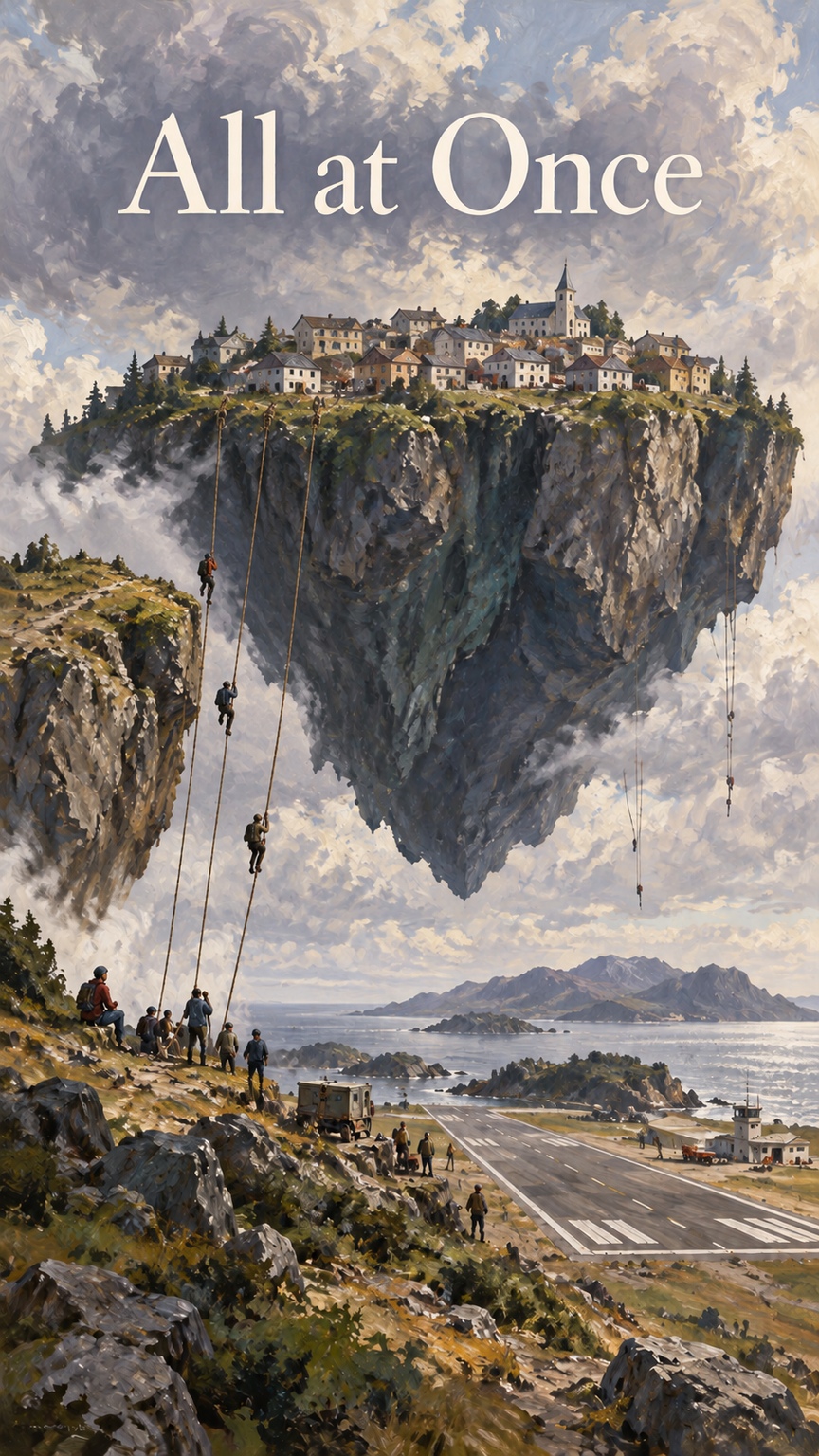
The mountain had stopped rising. It remained above the ground, with a city on its back. People threw ropes from its edge. Some wanted to get down. This woman was climbing toward the people above. A man at the foot of the rope had asked her for money. She had none. She had pushed past him and begun climbing, unpowered, with the child tied to her back. Now the rope moved beside her face. Someone else had begun to climb below her.
A plane came down on a field held level by twelve people who had all discovered different ways of moving things. None could have held it alone. An ordinary pilot felt the wheels take the ground and kept the aircraft straight. When it stopped, the twelve left the field separately. One wanted to ask a woman's name, but she was already running toward the opened cabin door.
In an alley in Dakar, a man who had once wanted to be a surgeon made new skin over a girl's burnt arm. He asked a woman beside him to take his picture. She did, then brought him another child. He reached to see what had happened to this one.
I was in the boy on the shutter before the healer touched the child. Someone had lifted one end too quickly. The boy wanted them to put him down. They had cleared the narrow gate, but they could not put him down here; others were still coming through. His mother walked behind them because there was no room beside him. He was trying to turn his head to see her when the operator picked up the receiver again.
"Are you there?"
I answered. Through the phone I could hear the worker telling someone the hand was still in the same place.
A woman on a beach heard voices from out past the breakers. She could breathe under water now. She went in with a rope round her waist, and the people holding it could do nothing but hold.
Somewhere the man who had survived the Atlantic fall had stopped waving at aircraft. He had begun swimming toward the place where he hoped a coast would be. The sea had not become less immense because it could no longer kill him in the same way.
A girl tried a new face in a mirror. She made the chin rounder, then put it back as it had been. Behind her, shoes lay scattered across the floor; she had been packing to leave when she discovered what she could do. She sent a photograph to a friend. It was the first message she had sent since the beginning which contained no question.
There were people refusing rescue, people trying to surrender abilities they could not take off, people discovering how much could be done to others before anyone arrived to stop them. A man's darkness spread across an entire town. He meant to hide it from the sky. Those inside it could not see the steps on which they tried to leave. People began tying themselves together by the wrist.
A soldier walked through the darkness with a white cane borrowed from an old man. The old man came with him. He had walked that road all his life. The receiver scraped against my ear, and I could not hear the rest of his directions.
I could not make their lives pause while I arranged what I had found.
The last minutes
By the end of the first twenty-four hours, 1.3 billion people would be dead or missing. Of the seven billion alive at the beginning, 2.8 billion would have developed powers. Those were the numbers the day would leave behind. We did not have them in the studio. We had callers reading out names, and sometimes someone answering that one of the names was theirs.
Resurrection had returned some people. It had not returned everyone beneath the sheets. A man who could hear insects sat beside his dead brother and listened to a fly which would not leave the window. A woman could change the shape of anything she touched. She kept her hands away from the body they brought her. It was already the shape of the person she loved.
Mariner Court was still standing. The evacuation line had reached the far end of the market yard. The injured boy was on his way to a place which might have a doctor. The worker and the rescuer sat beside their opening, waiting for instructions nobody knew how to give.
Inside, the woman had caught the rail with the very ends of her fingers.
It was barely a change. Her orange key tag still turned below her wrist. Her feet had not yet reached the step. In our day, thousands of people had moved round her building, an order had been stopped, an injured child had been carried through a gap, and the sun had set. For her, it was still the beginning of a bad morning.
I gave the officer the one thing I had seen change. He did not thank me. He asked me to tell him if she moved again.
My producer wrote her flat number on a sheet of paper. Beneath it he wrote a station name the woman who had lived four days had read from her ticket. We could not place that station. Beneath those he wrote tea above a glass, because we did not know where to put the man who was still waiting for his wife.
Three pieces of a thing too large to draw.
I did not know whether somebody's power had made those places, whether the first instant had damaged something nobody had known could break, or whether our abilities were the cause of what was happening there or another consequence. No thought I caught could tell me who had done this or why.
But the missing were not all missing from a place. Some were missing from the amount of time we had assumed belonged to everyone. Others had lived too much of it. Searching for them as though they had all gone away was already making us do dangerous things.
"There's a woman in Mariner Court who's still falling," I said into the microphone. "She's been falling since this began. She isn't living through as much time as we are. I've heard other people who've already lived days. I don't know how many. I don't know how it happened."
My producer pointed at a question on his paper. Can they get out?
"We haven't got her out," I said. "I can't tell you how. But if you've found an empty place, please look again before you destroy it."
Some asked for names. Some called me a liar. A demolition elsewhere continued. At another site, someone took the explosives back to the truck. I caught his doubt as he carried them. It weighed nothing like relief.
Then the producer put his hand over mine.
"A minute," he said. "Just come back for a minute."
I looked at him. I remembered his name. I drank what was left of the cold tea. The street outside our broken window had lights in it which had no wires. A woman was walking home beneath them with her shopping held above her head. She had made the lights. The bag was ordinary and heavy. She shifted it from one hand to the other and kept going.
I had wanted a person who could tell me what was happening. I had wanted a sentence big enough to tell everyone else.
I had not found one inside the noise.
Before our first day ended, I went back to the people still in their first minute.
A man was trying to catch his glasses as the ladder beneath him snapped. A woman was reaching for a door which would not open. A child had shut his eyes against a flash and had not yet opened them. Far away, the woman on the station floor was beginning another night.
Between them moved the rest of us, already learning how to climb, how to claim, how to ask permission, how to do without it. Cities shone. Cities burnt. In one of them a boy had made the stars visible through the ceiling, and people were coming into his room to look.
I caught him as he decided to take away the next wall.