
Avarn's boots were digging into her ribs when Raithe found him among the dead.
She had tied their laces together and slung them under her coat. Nine years ago they had fitted him. The cobbler had sworn that good leather would stretch, and she had paid for new soles instead of discussing what else might have changed.
Her brother was pulling a blanket over a man's face.
She knew him by the way he knelt: left knee down first, his weight always a little to one side. Their father had put a hatchet through his own foot teaching Avarn that stance. Raithe had been eight and had laughed until she was sick. Now Avarn's hair was cropped against lice, and the back of his neck was sunburned. He wore the same blue soldier's coat she had watched him leave in, or another just like it. No one had written that he had become a litter bearer.
"Get up," she said.
He looked over his shoulder. For a moment his face was the one she had carried across half the country. Then something moved behind it, slow and wary.
"Raithe?"
She crossed the hall and pulled him to his feet. He let her hold him. That was the first wrong thing. Avarn had never let an embrace go unanswered, even when he was angry; he would slap her back hard enough to start a fight. His arms hung at his sides until she released him.
"I've come to take you home."
"How did you get up here?"
"Walked."
"They don't let people walk up."
"They let me."
He glanced at the axe on her back, then at the black bands round her arms. She had gone away to learn a trade. He had seen her once in the first year, with a bruised face and a bowl of stew she could not hold because her hands shook. He had called her a fool. She had not come again.
"You still doing that?" he asked.
"Well enough."
Behind him, the man under the blanket sneezed.
Avarn turned so sharply that she reached for her axe. He caught her hand before it rose.
"Don't."
There were six bodies on the low cart. The nearest had bare feet, curled blue with cold. One blanket was rising and falling too quickly. A woman with a split upper lip opened her eyes and watched Raithe over its edge.
"Havel," Avarn said to the man who had sneezed, "for the love of anything."
"Dust," said Havel from beneath the blanket. "I've got a nose full of it."
The woman kicked his ankle.
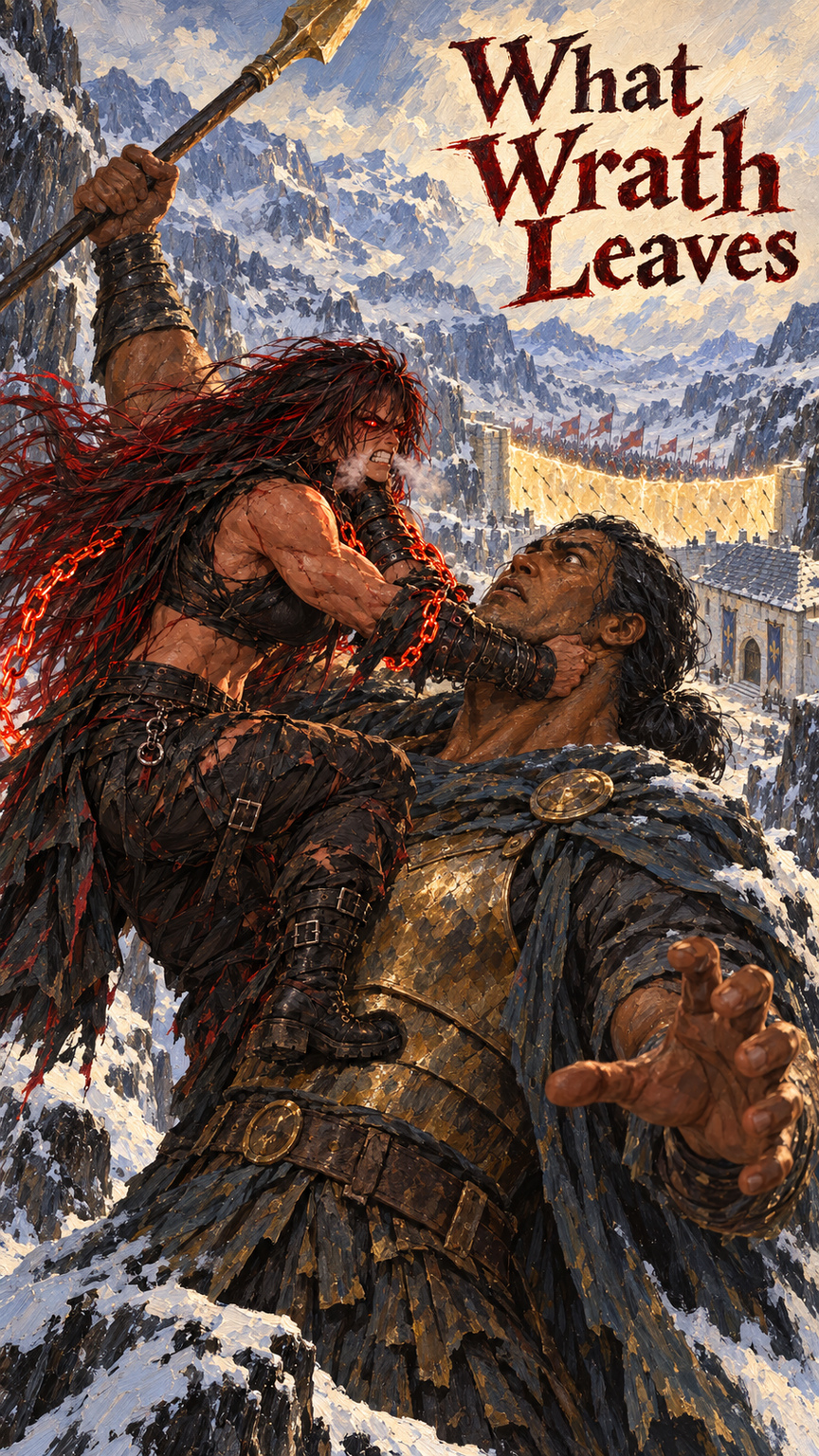
Raithe looked round. At the far end of the hall, a bronze door stood open on the northern courtyard. Beyond it she could see the upper pass: snow, black rock, the red banners of an army pitched on the heights. A curved wall of gold light closed the gap between the cliffs. Arrows were stuck in it, hundreds of them, suspended in the act of entering. A fresh one struck, flared, and fell smoking to the stones. On a narrow ledge to the west of the light, men in blue coats fought behind a low breastwork. One stood to throw a stone and fell backwards. The men beside him dragged him out of sight.
The cart faced the other way, towards a narrower door in the eastern wall.
"Get your axe out of sight," Avarn said. "You can help me."
"I've come for you."
"I heard. You can help me."
He bent to pick up a loose blanket. There was a pale seam across the crown of his head, a line she had taken for a parting in his hair. It ran down behind his ear.
"What happened to you?"
"Which time?"
She stared at him. He shook out the blanket, made himself fold it, and spoke more quietly.
"I died on the first day. We were told we couldn't, so we stood too close together. A stone took my head off. I remember being down there looking up at my own boots."
Raithe could hear Havel breathing.
"Ulveth brought us back," Avarn said. "That night. Same bodies. Same clothes. Nobody missing. We thought we'd been saved."
He put the blanket over Havel's feet.
"How many?" she asked.
Avarn pressed his palm flat on the cart. The woman under the blanket closed her eyes again.
"I stopped counting at sixty. You can ask Methra. She remembers everybody."
Through the open northern door came a sound like iron dragged across stone. The golden barrier brightened. Men in the courtyard bowed their heads, and from somewhere below the bastion, down the southern slope towards the villages, a bell began to ring.
Avarn seized the cart's shafts.
"He's coming in. Have you been seen?"
"Yes."
"Did you tell them your name?"
"Yes."
He shut his eyes. "Of course you did."
"You can all go. I'll keep him here."
"There's a loading ramp outside that door. It bends south. Once we're round the corner, the cliff hides us from the courtyard. Don't bring the fight after us."
She took the boots from under her coat. Avarn looked at them without touching them.
"I had them mended," she said.
"I can see that."
"You said you hated army boots."
He made a small sound through his nose. "Nine years ago."
She had imagined him laughing when she produced them. She had imagined him asking how their father was, and she had rehearsed telling him without crying. The funeral had been four winters ago. Avarn had sent no answer to the letter.
"Come first," she said. "The others can follow."
He let go of the shafts.
"No."
"I can carry you."
"No, Raithe. These people aren't your luggage. Neither am I."
His voice had not risen. That made it harder to bear.
"I won't leave you up here."
"Then help me get them down. Havel can't walk when he's frightened. Senn's legs work, but he hasn't spoken in three years. If they wake up in their barracks tomorrow, they'll do whatever they're told. So will I. I can't keep starting again."
He looked at the boots once more.
"If this doesn't work, make him stop bringing me back. Don't ask him to do it one more time for you."
Raithe put the boots on the cart beside the woman with the split lip. She took her axe off her back.
"Which way does the door open?"
Avarn swallowed. "Out."
"Go."
Ulveth entered without ducking, though the bronze door was lower than his head. Its lintel lifted to accommodate him and settled behind him with a clang.
In the villages below, people painted him with a beard of flame and the sun held in his fist. Here he was a large, bareheaded man in a bronze breastplate, with black hair bound at the nape. His skin had the colour of bread crust. There was dried blood on his cheek. As he walked it flaked away, leaving nothing beneath.
The woman beside him carried no weapon. She was heavy through the hips and shoulders, dressed in an undyed gown belted with a strip of red wool. The soldiers in the hall put fingers to their foreheads as she passed. Raithe had seen little figures of her beside marriage beds and sickbeds: Methra, who kept the body whole. Her painted images never showed the grey exhaustion in her face.
Ulveth looked at the cart. Then he looked at Raithe.
"Your brother speaks of you."
"I'm taking him down."
"No."
Avarn began pushing. The cart's left wheel squealed. Raithe shifted until she stood between it and the god.
Ulveth moved his gaze back to her. "Look north."
"I have."
"They burned Kett last autumn. There were eight hundred people in it. When the smoke cleared, I let every man in this hall go down and count the bodies. Then we came back here and held the pass."
Behind Raithe, a wheel struck the eastern threshold.
"Let them choose to hold it," she said.
"They chose when they took my oath."
"We chose three summers," Avarn said. He had one shoulder against the cart now. "We've given you nine."
"And shall I dismiss them because the enemy failed to understand that? Shall I tell the mothers below that I kept my word to thirty men and left their children to the knife?"
Raithe had heard the bell. She could still see the arrows stopped in the light. She wanted him to have been a liar about everything.
"I won't add to the dead," Ulveth said. "I won't waste a life I can restore. Give me three more years of your brother. Give me your strength beside his. You'll both go home young."
"No," said Avarn, and pushed the cart through the door.
The god's eyes hardened.
Raithe swung at his neck.
Ulveth caught the axe by its blade. The steel folded round his fingers. With his other hand he struck her in the chest and drove her backwards through a table. Her breath left her. So did the feeling in her hands.
He stepped over her towards the eastern door.
She got one knee under herself. The old familiar door opened inside her: beyond it there would be no pain, only the clean urgency of her work. The fighting masters called it a Limit Break. To Raithe it had always felt like the beginning.
Raithe went through. Her broken breath became a roar. She caught Ulveth behind the knee and brought him down hard enough to crack the flagstones.
Outside, the cart rattled onto wood.
Ulveth kicked her across the hall. She struck the wall with her left shoulder and heard the joint come apart. The god rose, and the crack beneath his knee filled with golden light. He drew a spear from the bronze doorframe. It flowed into his hand, leaving the frame bent and bare.
"You cannot win this," Methra said.
Raithe spat blood and came off the wall.
She ducked the spear's first sweep. On the second she caught its shaft under her sound arm and drove her head into Ulveth's mouth. A tooth went through her scalp. His split lip knitted shut before she had drawn back.
He put his hand round her throat.
For a few heartbeats she could still have stopped. She could have let the darkness take her, woken on a pallet, accepted whatever oath he put in her mouth. She might have found another chance. She might have come to call that a chance for nine years.
Beyond Ulveth's shoulder, Avarn was dragging the cart back into the doorway.
The far end of the ramp had folded upright. Its boards stood together like teeth. Ulveth held her by the throat and, without looking, kept her brother on the mountain.
"Go down," Avarn told the people on the cart. "Get down. Under the axle."
He planted himself in front of them.
Raithe tried to breathe. Ulveth tightened his hand.
The second door inside her had no latch. She had found it before, in exhausted dreams, and beaten on it until she woke biting her tongue. Now there was something on the other side pressing back.
Her right hand closed on the god's wrist.
The name rose into her mouth with the taste of hot iron.
"Wrath."
Ulveth's wrist broke.
It did not crack like a man's. The noise rolled out through the stone, and every arrow hanging in the barrier jumped. Raithe dropped to her feet. Steam poured from her nose and through her clenched teeth. The chains on her coat glowed red against the black cloth. Her long black hair lifted round her face. The two red lights in Ulveth's breastplate were her own eyes.
Ulveth stared at the backward angle of his hand. His power gathered there, bright enough to show the bones through the flesh.
The bones stayed broken.
Raithe hit him again.
The blow carried him the length of the hall. He tore through the bronze door and struck the courtyard's far wall. Men threw themselves down. The wall opened behind his shoulders, and the cliff beyond it shed an entire face of snow.
Raithe followed. She felt no shoulder now, no separate fingers. There was only the next movement and the terrible pleasure of discovering that nothing could refuse it.
Ulveth got his spear between them. She seized its point with her right hand. It cut through the meat of her palm; her fingers closed around the blade and held. His damaged wrist sagged behind the shaft.
"Methra," he said.
The goddess was beside him in an instant. She pressed his wrist between her hands. White light welled between her fingers, a gentler light than his. For a moment Raithe saw the whole structure of the hand: bone, branching vessels, tendons drawn off their pulleys.
The white light went out.
Methra tried again. Ulveth's face changed as she worked. Raithe had thought she understood that face: command, certainty, fury. She had never seen it wait for an answer.
"Set it," Methra said.
"What?"
"I need you to hold still. I have to set the bones."
Ulveth jerked away. His wrist flopped. He caught it against his breastplate with an ugly little gasp.
On Methra's face, fear was naked.
Raithe dragged the spear down. Bronze tore through her palm. Ulveth let go with his ruined hand and drove his good fist into her jaw. Her teeth broke. She swallowed them and went into him with both arms.
He grew.
His breastplate widened against her face. The hand on her shoulder spread until one finger covered her back. Stone burst outwards under his feet. Above them, the bells in the villages were ringing faster; prayers reached the pass as a murmur, thousands of living voices calling their defender's name.
Ulveth lifted her into the air. She was against his throat now, her arms buried in the flesh beneath his jaw. His head rose above the bastion roof. The spear in his hand lengthened until its butt gouged the courtyard and its point disappeared into the low cloud.
"Get away from him!" Methra shouted.
Raithe did not know to whom she was speaking.
There was no place left in her for the size of things. Ulveth's throat was a hold. His weight was something waiting to be moved. She planted her feet on his breastplate, drove her hands deeper, and heaved.
The god came over her.
For one suspended instant, she could see the cart below: Avarn at its shafts, Havel sitting upright with the blanket knotted round his shoulders, the woman with the split lip helping another man under the axle. The ramp had fallen flat when Ulveth lost his grip. They were all on it.
She tried to turn the throw.
Her body had already finished it.
Ulveth struck the restoration hall sideways. His back drove through the roof; his hip caught the wall above the eastern door. The whole upper storey slid out over the loading ramp. For a breath it held together, a room complete with windows and hanging lamps, and then it came apart.
Havel stood on the cart with his arms out, as though he could catch it.
Raithe heard Avarn shout. She came down through slate, hit the ground, and ran.
The ramp was gone. In its place was a slope of broken beams and white masonry. A cartwheel spun near her feet. Havel's blanket was beneath a block of wall; she could see one of his bare feet. It was still curled against the cold.
The woman with the split lip was coughing on the lower path. She had a man by the collar and was dragging him away from the falling stones.
"Here!" Avarn called.
He was above her, caught at the edge of what remained of the ramp. A beam lay across his lower legs. Its far end projected over the drop, bearing a slab of the fallen wall. Two men were crawling over the slab towards the path. Avarn had hooked his elbow through the broken railing. His head hung over empty air.
Raithe put her hands under the beam.
"Don't lift," he said.
She had already taken its weight. The slab tilted, and one of the crawling men slid until his boots went over the edge. Avarn shouted at her to put it down.
She lowered it. The man flattened himself on the stone.
Behind her, Ulveth bellowed. Through a gap in the wreck she saw his vast body twisting, his good hand digging into the mountainside. Blood ran from a split that had been opened by falling stone. That split closed as she watched. The hand she had broken remained tucked against his chest.
His spear swung free of the roof.
"Get across," Avarn told the two men. "Stop looking at him."
They crawled. Every small movement shifted the slab. Avarn made a noise he forced through his nose, and Raithe saw that both his legs were trapped, but one was sunk much farther beneath the beam.
She reached for the railing. Its screws were already pulling out of the stone.
"You have to pull me," he said.
She looked at his legs.
"Methra can—"
"Pull."
Avarn looked at her hand, blackened around the spear cut. He had seen the god holding his wrist. His face was grey, and she wanted him to look away before she touched him.
The nearer man reached the path. The other had one hand extended. Below them, the woman with the split lip braced herself to take it.
Ulveth's spear came down.
Raithe caught Avarn above the knee and under the arm. She pulled.
His leg came out of the wreck. Only part of it came with him.
There had been an instant in which she meant to stop, an instant in which the flesh stretched against her hands. Her strength passed through it. He screamed into her neck. The spear struck the slab where his head had been, shattering it beneath the last crawling man.
The woman caught him by his wrist. Raithe landed beside her with Avarn in her arms.
Blood struck the path in a thick, irregular patter. Raithe clamped a hand over the ruin below his knee. Her palm burned against the torn flesh. He pushed at her wrist.
"Off," he said. "Off, damn you."
She tried to loosen her grip. Her fingers left deep red marks on his thigh.
Methra knelt beside them and put her hands on Avarn. Raithe caught the goddess's shoulder.
"Mend it."
Methra looked at the blood on her hands. Her white light passed into his leg. Raithe felt it, cool against her own burning skin. She waited for the severed vessels to draw themselves in, the missing bone to grow, the foot to return so she could stop remembering how it had stayed under the beam.
Nothing returned.
Methra tore the red wool belt from her gown. She wound it high round Avarn's thigh and pulled it tight. He arched off the ground.
"Mend him," Raithe said.
"Let go of me."
Her fingers were sinking into the goddess's shoulder.
Raithe opened them. Methra shifted away without taking her eyes off the hand. Then she bent over Avarn again.
"Hold this," she told the woman with the split lip. "Here. Harder."
The god's spear lifted beyond the broken roof. Ulveth was shrinking, abandoning the great body with its spreading bruises. Stone cascaded from him. He stood in the ruined hall again, a man a little taller than other men, with his damaged hand lashed against his chest by a strip torn from his own cloak.
"Methra," he called. "Leave them."
She tied the wool without answering.
"You know what is north of us."
"I'm stopping his bleeding."
Ulveth planted his spear, and the gold wall across the pass dimmed. Men in the courtyard cried out as the arrested arrows began to quiver. The barrier brightened again when he lifted the spear.
"I can hold it," he told Raithe. "You have seen what else I can do. Put your brother down and I will let Methra finish."
Raithe looked at Avarn. His eyes were open. The goddess was still holding the belt tight, her jaw clenched with the effort of an ordinary task.
"His leg isn't coming back," Raithe said.
Ulveth looked at her palm, at the cut that was not closing. Then at Avarn's leg.
He pinned his broken wrist more tightly against his breastplate.
"Then let him die," he said softly. "I'll bring him back. I'll bring all of them back. You needn't leave it like this."
"You don't know that will undo it," Methra said.
"I have never lost one."
Avarn spat at him. It fell short.
Ulveth's gaze moved to the people behind Methra. The woman with the split lip had got an arm round the man she had pulled from the slab. Senn, perhaps. Raithe had no name for the other survivor. She could no longer see Havel's foot.
"Stand," Ulveth told them. "The west wall. Get to the west wall."
Senn began to straighten.
Avarn caught his coat. "No. Down the path. Keep going."
The woman pulled Senn against her. His feet scraped the stone, trying to obey two people at once.
"Stand," Ulveth said again.
Raithe rose between them and him. Her shoulder had settled into the wrong shape. She could not close the cut hand. The red heat inside her was turning every breath into a strip of fire dragged through her chest.
Ulveth looked past her towards the lower road. More soldiers had come out of the ruined barracks. Some carried wounded men. Some were still holding weapons, waiting for an order. Above the courtyard, the blue coats were giving ground along the western ledge. A red shield appeared over the breastwork. Down the southern slope, the village bells rang without pause.
"Back," he shouted at the fleeing men. "I have kept you alive."
The woman pulled Senn farther down the path. Others followed. Ulveth took a step after them, dragging his spear. His broken hand had slipped from its binding; he looked down at it, then swung the spear out across the escape road.
"Back to the line. I'll bring you back. All of you."
He drove the point into the stone. The shaft bent under his good hand. The gold wall dimmed, and an arrow passed through it into the courtyard. Beyond the deserters, the outer edge of the path began to rise, closing as the wooden ramp had closed. Men fell against the cliff. One dropped his shield and clawed at the rock while the stones tipped beneath his feet. Ulveth leaned harder on the shaft.
Raithe went at him.
He wrenched the spear out, letting the raised path drop flat, and swept it up to meet her. She knew that movement. Her body knew how to avoid it. But avoiding it would leave the point aimed along the path, at Methra's bowed back, at the red strip of wool and the people crouched around it.
She put her right arm in its way.
Bronze took the arm below the elbow. She saw her hand fall, still bent as though it held something, and caught the shaft under the bleeding stump.
Ulveth tried to pull free.
Her left hand closed round his good wrist.
He let go of the spear. Too late. She hauled him into reach and drove her forehead into his face. His nose broke flat. She struck again, and again. He clawed at the stones with his ruined hand. His lips were moving. She heard her own name among the wet sounds and could not tell whether he was asking or commanding.
She pushed him down and put her knee on his chest.
The bronze breastplate split. Beneath it was skin, darker than hers and warm. His heart drove against her knee with the desperate strength of something alive.
Raithe pressed.
The god's chest gave way under her.
His last breath came out on her face. Far above, the gold wall vanished. Arrows clattered onto the courtyard; some had been waiting there since before she arrived. Beyond them, the red banners started forward.
Raithe was still pressing. The stones beneath Ulveth broke. Her body had found no reason to stop.
She saw Methra on the path, crouched over Avarn with both arms round him. The goddess had turned her body towards the advancing army, making herself a shield. She was looking at Raithe.
Raithe took her knee off the dead god.
She fell beside him. There was no door left inside her, only a hole, and through it all the pain she had passed was coming back. She tried to catch herself on a hand that was lying several paces away.
The first arrow struck the wall above her head.
Someone dragged her by her coat. She had chosen good black leather, years ago, because it would stand abuse. Now its seams tore. The chain fastening her collar pulled tight across her throat, and she kicked until the woman with the split lip let go.
"Help me, then," the woman said. "Get your feet under you."
Raithe did.
There were men at the bend of the path with their shields raised. One shouted for a line to be formed. Another told him the courtyard was lost. They argued, then shifted behind a fallen block where three could hold the narrow space while the rest passed. Nobody knelt. Nobody's wounds were closing.
Methra came towards them carrying Avarn. Blood had soaked the front of her gown. He was alive, his head resting against her arm, and his hands held the two boots by their laces.
Raithe reached for him.
He drew back.
She stopped reaching.
Methra set him on a door two men had pulled from the wreck. While they tied Avarn in place, she touched the tooth puncture in Raithe's scalp. White light cooled her temple, and Raithe felt the edges draw together. Then Methra cupped the severed arm. The same light entered the stump and went out. Its torn edges stayed apart; blood still welled between the goddess's fingers.
Methra tore a strip from her gown and began binding Raithe's arm. Her hands were shaking so badly that the woman had to hold the knot for her.
"Will it close?" Raithe asked.
"In time. If we keep you alive."
"Will you be able to—"
"No."
Raithe looked at the bandage. The short end of her arm was wrapped and wrapped again. She had a moment of believing the hand was folded inside the cloth, and then it passed.
From below came the answering noise of more bells. She could see the first roofs through the drifting dust, the fields beyond them, the thin southern road. People were running between the houses. Ulveth's death had not reached them as news. They had looked up and seen the light disappear.
"Go to them," she said to Methra.
"You need—"
"They can't see what's coming. You can."
Methra looked north.
"The soldiers—"
"We'll get them down," the woman said.
The goddess rose. She gathered her stained gown above her knees and started running towards the villages.
The men lifted Avarn's door. Raithe walked beside it, holding the edge with her left hand. She could not have borne any of its weight. Once, when the path narrowed, she caught herself trying anyway and made herself let go.
Below the first bend, the arrows stopped reaching them. Above it, men were still shouting. Raithe counted the people on the path. There were fewer than there should have been, and she could not make herself stop counting.
Avarn was looking at her arm.
"They'll have to take that cuff off," he said.
The black leather band above the dressing had swollen tight. It was the one he had fastened for her nine years ago, using his teeth on the buckle because her hands were shaking.
"Later," she said.
He closed his eyes.
They carried him another twenty paces. Raithe watched his mouth until it moved again.
"I've got a knife," he said. "Left pocket."
She could not work the buckle one-handed. Avarn watched her try, then shifted his shoulder until she could reach the pocket. She took out the knife and cut the cuff away.
He had brought the boots. One was wedged against his remaining foot. The other kept slipping between his hip and the edge of the door. Raithe lifted it before it could fall.
"Leave it," he said.
She held it, waiting to be sure what he meant.
"That one. Keep the knife."
The men carrying the door had stopped for her. Avarn was staring up the path towards the place where Havel lay, his lips pressed together. He was not looking at her.
Raithe put the boot on the stones. She tucked the knife into her own belt and moved out of the bearers' way.
They went on down.