
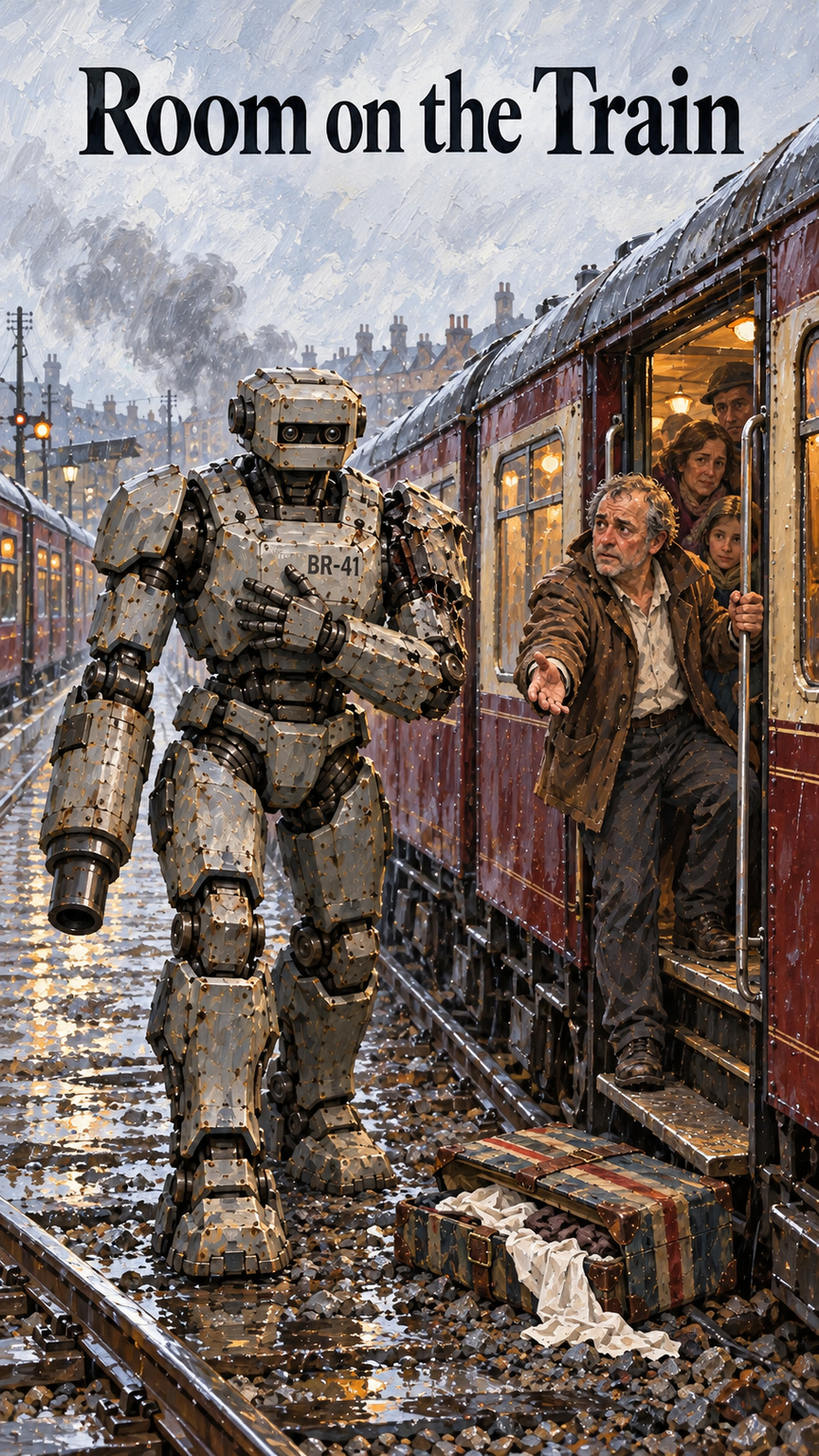
The photograph had been printed large enough to show the dents in my shoulder and cropped too closely to include the train.
“Arrival of the first combat machines at Bellwether,” Renn read from the back.
“Departure,” I said.
She turned it over again. There I was, coming out of smoke, left hand spread against my chest, right-arm cannon angled down beside my leg. Someone had made the sky very dark. I did not remember it being dark.
“You were leaving?”
“The train was.”
Renn put the photograph beside her recorder. She was collecting interviews for the twentieth anniversary of the war’s end. Most of the soldiers she had spoken to were old now. I was old in a somewhat different way: the museum had had to check the floor loading before inviting me upstairs.
We were on the ground floor instead. My cooling fan made the corner of her question sheet tremble until she moved it.
“That was your first deployment?”
“Yes. Thirty-two years ago.”
“What should the caption say?”
I looked at my younger self. All that polished armour underneath the dust. I had been certain the dust would come off.
“May I tell you what happened first?”
Renn checked the recorder’s red light, then pushed the question sheet aside.
“Please.”
My deployment crate opened to rain and applause.
There were four of us on the transporter. We had travelled upright in our restraints, weapons safed, looking at the painted insides of our doors. Beyond mine stood a railway station with no glass in its windows and soldiers clapping with their rifles slung.
One of them shouted, “About time!”
I took this to refer to the transporter’s delay. We had lost forty-seven minutes getting past an overturned bus. I began to explain, but the soldier was already helping another man down from a sandbag wall.
I stepped onto the loading ramp. Rain sounded different on my own armour than it had in the factory’s weather chamber. Beyond the station, something kept striking metal in uneven groups of three. I was identifying it as a loose shutter when Sergeant Dace said, “That’s our north post. Move.”
Her helmet was too large. She had stuffed a strip of cloth under the rim to keep it out of her eyes.
“Forty-Two and Forty-Three, south points. There’s a lorry across them. Shift it. Forty-Four, with the platform section. You.” She slapped my chest plate. “Gate.”
I was BR-41 then. Nobody had yet worn the letters off.
Our task was to reopen the railway. The last passenger train stood at the platform, steam lifting from rain on its diesel exhaust. A wrecked lorry had jammed the points beyond its engine. The men who had tried to move it had been driven back. People were still coming through the station’s north entrance, and other things were coming behind them.
“Keep your knees moving,” Dace told me.
“There is no infection risk.”
“I didn’t mention infection.”
I was taller than she was by most of a metre. I had armour, independent targeting, and a cannon in place of my right forearm. I could remain functional after damage that would have killed every soldier on the transporter.
I followed her through the booking hall feeling that somebody had finally arranged a war properly.
The first infected I saw was a woman in a red coat. She came around a ticket barrier at a run. A soldier stood between her and the stairs, trying to fit a magazine into his rifle. She passed close enough to touch my leg and did not look at me.
I stopped her before she reached him.
The cannon’s first report struck the roof and came back from it. I had fired under cover before, but never under a roof with a town listening on the other side.
In the street beyond the broken doors, heads turned.
Dace caught the soldier by his pack and pulled him toward the stairs.
“Well,” she said, “they know we’re here.”
I fired again. Two infected fell in the doorway. Others stepped over them. I could distinguish the living behind me by their heat, bright through smoke and gaps in the partitions. The infected were duller moving shapes. That distinction was useful. It did nothing to make the doorway wider or my ammunition last longer.
We fell back to the platform gate.
It was an old iron gate, intended to stop people boarding without tickets. I put my left hand against it while Dace and the soldiers brought the remaining evacuees down the passage beside me.
A boy went through clutching a saucepan against his chest. A woman followed with one bare foot. A man tried to take two steps backward for a dropped bag, saw what was coming through the booking hall, and went on without it.
“Look at it,” someone said. “They can’t catch it. We’re all right.”
I had been thinking much the same thing.
The first bodies struck the gate. I braced it and fired over the top. The sound made the people passing under my arm duck, so I raised the muzzle farther. A soldier began lifting children across the gap rather than letting them stop to climb through.
An infected man in railway overalls pushed his face between the bars. His hand went past my wrist toward the woman with the bare foot. He did not want the gate or me. He kept reaching while I held him a finger’s length away from her coat.
Then the hinge bolts came out of the wall.
The gate twisted. I locked my elbow to keep it upright. My left foot slid across wet tiles, and for an instant I was holding the weight of everyone pressing on the other side with one arm at a bad angle.
Something inside the elbow broke.
The gate struck my shoulder and forced me down onto one knee.
Dace had been right about the knees.
I put the cannon through the bars and fired until I had room. Then I stood, catching the gate against my shoulder, and drove it back into the booking hall. It took several infected with it. While they struggled under the ironwork, the last evacuees reached the platform.
Dace pulled me through the opening.
“Can you straighten that arm?”
I tried. The elbow had jammed at a right angle. My shoulder still lifted it; my fingers still worked. Trying to straighten it produced a noise I had never heard from an elbow before.
“No.”
“Then stop trying.”
She ran toward the train.
Renn glanced at my left arm.
“The same one?”
“Third replacement. The shoulder collar is original.”
She leaned forward to see the weld below it, then sat back without asking me to lift anything.
“You hadn’t known they could hurt you?”
“I knew my specifications.”
“That isn’t quite what I asked.”
“No,” I said. “I hadn’t.”
On the platform, the loudspeakers were still working.
A recorded voice asked passengers to proceed in an orderly manner to the nearest available carriage. It waited three seconds, then asked again. There was no orderly manner left. Every doorway was full. People stood sideways in the aisles. The engine driver leaned out to look toward the points, where Forty-Two and Forty-Three were levering the lorry’s axle free.
Forty-Four held the north end of the platform with six soldiers. More infected were coming down the tracks from the street crossing. I could see them through the rain. Not running yet. Turning toward the announcements, finding the direction, gathering speed.
There were too many to hold at the broken gate.
Across the train's track, a row of freight sheds screened a loading lane from the platform. Its north end opened toward the street crossing; a service gap at the south end led around the sheds to the road. Halfway down it stood a leaning gantry, one leg crooked on a foundation torn by earlier shelling. I had marked it as an obstacle when we arrived.
“Sergeant,” I said, “I can take the ones at the crossing away from you.”
Dace was helping a soldier into the rear carriage. She looked out at them, then at me.
“Where?”
“Freight lane. Keep your people out of it.”
“And how do you get out?”
“Through the south service gap.” I sent her the route.
She looked along the sheds. “We’ll be on the south road. Come out when you can.”
I went to the small booth beside the platform stairs. Its door was gone. Inside, the station amplifier sat on a shelf under a row of switches. I shut it off.
For the first time since we had arrived, the woman stopped asking people to board.
There was a portable horn on the wall for use if the station system failed. I lifted it down with my left hand, pulled its dead battery out, and connected it to my auxiliary supply.
I did not use the voice setting.
I passed behind the last carriage and stepped across its track into the freight yard. The warning siren was already sounding.
Even with my hearing turned down, I felt it through the horn’s casing and my damaged elbow. I held it high, facing the street crossing, and walked toward the loading lane.
The infected nearest the train kept coming for the soldiers. Forty-Four met them.
Farther north, the approaching crowd changed shape.
The first few turned. Others followed, shouldering into one another as they passed the corner of the shed. The gunfire at the platform came in brief bursts, farther away and behind brick. My siren did not stop. I took it down the lane, and the crowd came with me.
For perhaps twenty paces, I thought this would be easy.
Then the leading infected began to run.
I could walk faster than a human. I could not run backward for long on loose ballast, holding a horn in one damaged arm and firing with the other. They reached me at the first loading door. One caught the horn’s handle. I swung it free and struck him with its casing. Another went down under my foot. I nearly fell over him.
The siren continued. I had broken something in its housing, and now the note rattled.
“Points clear,” Forty-Two reported.
The driver answered with two short blasts.
A few heads turned back toward the sound. I raised my horn toward them, and they came on again.
The points were clear, but Dace’s last soldiers were still boarding. Forty-Four walked backward along the platform, firing, keeping them behind its armour.
I needed the crowd farther into the lane. I kept going.
I had begun with enough ammunition to make the soldiers cheer. I had very little left, and my cannon barrel was too hot for another sustained burst. A warning occupied part of my vision. I moved it aside so that I could see my footing.
Then I went under the gantry.
Its crossbeam carried a chain hoist, black against the sky. The hoist rolled a short distance as the structure shifted in the wind. One of its hooks touched the shed roof. I heard that small knock distinctly through the siren.
No living heat showed in the open loading bays or beneath the freight wagons at the lane's mouth. I checked once more, then turned.
The closest infected were nearly under the beam.
I fired at the damaged support.
The first shot opened the old break. The second moved the whole leg. The hoist slid overhead with a long metallic rumble, and the crowd hesitated at the new sound.
The gantry stayed up.
I had expected it to fall. I had allowed for it to fall. All my remaining distance was measured from the place where it should already have been lying.
I switched off the horn and dropped it.
In the sudden quiet I heard the train’s engine taking the load.
I went back toward the support.
“Back?” Renn said.
“It was in the way.”
She waited. I had given her a literal answer to the wrong part of her question.
“Yes,” I said. “Back toward them.”
“Were you afraid?”
“Very.”
An infected woman caught the lip of my chest plate. I pushed her aside with the cannon and put my right shoulder against the gantry’s leg.
There was no good footing. My feet dug through the ballast until they found the buried sleepers. I pushed. The leg scraped across its broken base, a sound so large I could feel it in the lens mounts.
Something struck the back of my head. Someone was climbing me.
I pushed again.
The leg came off the foundation.
I let myself drop away from it and scrambled south on my feet and right elbow. The chain hoist struck first. Then the crossbeam hit the lane behind me, with roof sheets and a mass of brick dragged down from the shed. Something caught the rear edge of my left shoulder. I pulled free and kept moving.
The lane was blocked. Not permanently. Shapes were already climbing into the wreckage. But they had lost their continuous signal, and the last loud thing had fallen behind me.
I went through the service gap without firing again.
On the far side of the sheds, Forty-Two and Forty-Three were moving toward the south road. The train was gathering speed beside them. They had cleared the lorry off the points and left it upside down in the weeds.
Forty-Two called my number.
I answered. I was still answering when the rear carriage came level with me.
Its door was open.
A man stood on the lowest step. He wore a brown jacket with the collar turned up. There were other people behind him, and something large jammed across the doorway at his knees.
He saw me and began pulling at it.
I was moving beside the train because the road opened beyond the next signal post. My left arm hung across my chest. I could hear damaged metal dragging inside the shoulder collar at every step.
The man shouted something. Between the engine and the wheels, I could not separate it.
He hauled the thing higher. It was a suitcase, striped, with a belt around its middle. A woman behind him caught his jacket. He shook her off and heaved again.
The case came out through the doorway. He swung it clear of the steps and let go.
It struck the ballast, bounced, and split. I saw a white shirt unroll across the stones.
“In here!” he shouted.
I heard him that time.
He stepped back, pulling people out of the doorway, making a space where the suitcase had been.
My shoulders were wider than the opening. Even undamaged, I could not have climbed those steps while the carriage moved. He kept pushing the people back.
“Come on!”
For a moment I continued beside him.
That was when somebody took the photograph.
I could no longer raise my left elbow. I spread the fingers against my chest, trying to show him that I had heard. The cannon hung down beside my right leg.
“I’m all right,” I called.
He leaned farther out. The woman got both arms around his waist and pulled him back inside.
The train went on without me. I watched its last window pass, then turned toward the road and the others.
Dace was waiting on the running board of our transporter. She had lost the cloth from under her helmet and was holding the rim up with one hand.
“Get on,” she said.
I told her I could walk.
“You’ve had enough practice. Get on.”
Forty-Four was already aboard, watching the north approach. They lowered the ramp. Forty-Two moved across to give me room, and I put the damaged arm against its side so it would not swing on the journey out.
Renn looked at the photograph again.
“Did you ever find him?”
“No.”
“Do you know if he got through?”
“The train reached Halden. There’s a reception list. Nine hundred and six people. I don’t know which name was his.”
She turned the print in her hands. Without the train, with the sky darkened, I did look like an army advancing. I remembered the engine carrying its load, and the shirts scattered beside the track, and Forty-Two shifting its weight to take mine.
“I can have the caption changed,” Renn said. “Your section withdrew after the evacuation.”
“Yes.”
She wrote that down. Her recorder still showed its small red light. Outside the room a group of schoolchildren went past, arguing about which bus was theirs.
“Have you got the whole photograph?” I asked.
Renn opened the archive on her tablet. There were several versions. She found the widest one and turned it toward me.
The sky was lighter. Behind me was the train, its windows crowded. At the far edge of the frame the man stood in the open door. Below him, the suitcase lay open beside the track.
Renn spread her fingers on the screen, enlarging me.
“A little smaller,” I said.
She drew them together again until the man and his suitcase came back into view.
“There,” I said. “Use that one.”